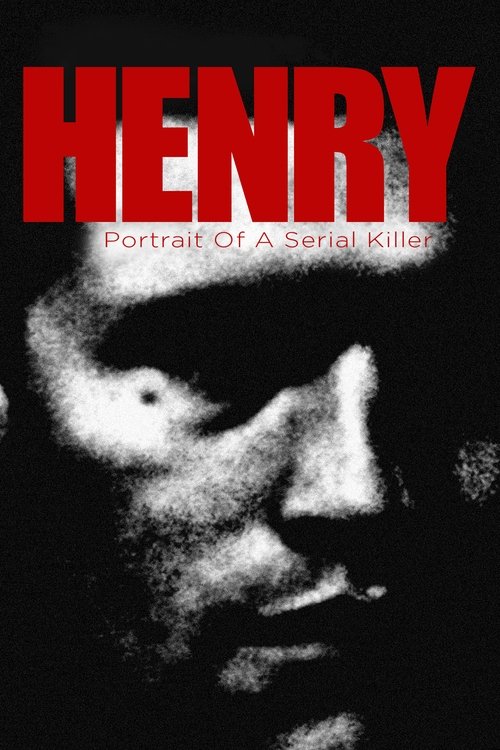
Henry: Portrait of a Serial Killer
1986 · John McNaughton
Only for when you want to be truly unsettled and can handle it — this is challenge viewing, not comfort viewing, the kind of horror you respect more than enjoy. Not a film for a casual night in.
What it's about
Henry drifts into Chicago and moves in with Otis, a coarse ex-con he knows from prison, and Otis's sister Becky, who's fleeing a bad marriage. Henry kills people. The film simply follows him — through dingy apartments, night streets, and casual encounters — as Otis is drawn into his orbit and Becky, not seeing what he is, gets closer.
The experience
Cold, flat, and genuinely disturbing — there's no detective, no chase, no score telling you how to feel, just observation. It refuses every comfort the genre usually offers, and that refusal is what makes it linger; this is a film that implicates you for watching.
Performances
Michael Rooker, in his first film role, is terrifying precisely because he underplays everything — polite, quiet, blank — and Tom Towles makes Otis repellent in a completely different, needier way.
The craft
Shot on a tiny budget in Chicago by first-timer John McNaughton, and the grubby 16mm plainness is the point: it looks like surveillance, like something you weren't supposed to see. The most notorious sequence involves a home video camera, decades before found footage became a genre fixture.
Why it matters
It sat unreleased for years, fought the ratings board, and emerged as a landmark of American independent horror — the film that stripped the serial-killer story of glamour and mystery and showed how frightening pure banality could be.
Snapshot
Henry: Portrait of a Serial Killer is a microbudget American film, shot in Chicago in 1985–86 by first-time feature director John McNaughton, that reframed the serial-killer subject as documentary-flat observation rather than suspense or spectacle. Loosely drawn from the case of Henry Lee Lucas — the drifter whose extravagant, largely uncorroborated confessions to hundreds of murders had saturated true-crime media in the early 1980s — the film follows Henry (Michael Rooker), who shares a Chicago apartment with the coarser, more impulsive ex-con Otis (Tom Towles) and grows entangled with Otis's sister Becky (Tracy Arnold). What distinguishes the film is its refusal of the genre's usual machinery: there is no detective, no investigation, almost no consequence, and a killer presented without psychological "explanation" beyond a few contradictory scraps of biography. The result is one of the most influential and disturbing American independent films of its era — though its influence was felt years after it was made, because a censorship battle kept it from wide release until 1989–90.
Industry & production
The film originated not as a passion project but as a commission. The Chicago-based Maljack Productions / MPI Home Video, run by brothers Waleed and Malik Ali, had built a business in video distribution and asked McNaughton — who had made a documentary for them — to deliver a low-budget horror feature they could sell to the home-video market. The widely cited budget is in the low six figures (commonly reported at around $100,000–$110,000), making the film a genuine microbudget production even by mid-1980s standards. McNaughton and co-writer Richard Fire, a veteran of Chicago's Organic Theater Company, wrote the script after McNaughton encountered television coverage of the Henry Lee Lucas case; rather than the gothic or stalk-and-slash horror the producers likely envisioned, they delivered a bleak, naturalistic character study.
Shooting took place in 1985–86 on Chicago locations, using a largely local, theater-trained cast. The film was essentially completed by 1986 — hence its date — but then entered a years-long limbo. Its content provoked an X rating from the MPAA, not for sex but for what the board characterized as its disturbing tone and "moral" affect rather than any single act of explicit gore. Because the X carried commercial stigma and many venues and outlets refused X-rated product, the film sat largely unseen, surfacing at festivals (including the 1989 Telluride Film Festival and the Chicago International Film Festival) where it began accruing a critical reputation. It finally received theatrical distribution, unrated, in 1990 via Greycat Films. This gap between production (1986) and public emergence (1989–90) is central to the film's history: it shaped the censorship debates of the period and means its measurable cultural impact post-dates its making by several years.
Technology
The film was shot on 16mm — a format choice driven by budget but inseparable from its aesthetic. The 16mm grain, with its coarse texture and muted, slightly degraded color, lends the image a quality between low-end narrative film and surveillance or news footage, reinforcing the documentary register the filmmakers sought. This is conventional production technology for its budget tier; the film made no technical innovations in capture or post. Its significance lies in how unglamorously the available tools were deployed: available light and practical interiors, no optical spectacle, post-production sound and a synthesizer-leaning score assembled within Maljack's resources. The decisive "technology" of the film is closer to an aesthetic decision — to make a film that looks cheap and observed rather than designed — than to any apparatus.
Technique
Cinematography
Charlie Lieberman's photography is the film's defining formal achievement. The camera frequently adopts a detached, observational stance, holding on aftermath and tableau rather than choreographing violence for thrills. The film's most discussed device is a recurring structure of crime scenes — static or near-static shots of Henry's victims, often presented as still tableaux on the soundtrack of which we hear the murder's audio, the act itself withheld and displaced in time. This dislocation of image and sound forces the viewer to assemble the violence imaginatively, an approach far more unsettling than depiction. Elsewhere Lieberman favors flat, unflattering interior light and a grimy palette of browns and grays that matches the characters' worn surroundings. The cumulative effect is an aesthetic of banality: violence rendered not as gothic event but as something that happens in ordinary rooms under ordinary light.
Editing
Elena Maganini's editing reinforces the film's affectlessness. Cuts tend to be unhurried and unsensational; the film does not build conventional suspense sequences with accelerating rhythm but lets scenes play in a register of dread and dead air. The crime-scene tableaux are edited so that the temporal relationship between image and sound is deliberately destabilized — we may see the still result while hearing the live struggle, collapsing before and after. The structure as a whole is episodic and accretive rather than goal-driven, refusing the rising-action arc of a thriller.
Mise-en-scène / staging
The staging is relentlessly mundane: cramped apartments, diners, parking lots, a gas station, the anonymous edges of Chicago. Production design (working within the budget) emphasizes lived-in squalor over stylization. The film's most notorious set piece — the home-invasion murder of a suburban family, which Henry and Otis record on a stolen video camera and later replay — is staged around the diegetic camcorder image, so that the audience watches the killers watching their own footage. This staging implicates the act of looking itself and anticipates a media-saturated culture of recorded atrocity.
Sound
Sound is arguably as important as image. The score — credited to Maljack-affiliated musicians including Robert McNaughton (the director's brother), Ken Hale, and Steven A. Jones — leans on droning, synthesizer-inflected textures that establish unease without the stinger conventions of horror. More striking is the use of source and effects sound: the displaced audio of murders laid over still tableaux, ambient room tone, and the harsh diegetic sound of the camcorder footage. The soundscape does much of the work of dread that the images deliberately withhold.
Performance
Michael Rooker, in his feature debut, gives a performance of remarkable, frightening restraint. His Henry is watchful, soft-spoken, occasionally almost courtly, his violence arriving without affect or warning — a portrait that denies the audience the reassurance of a visibly "monstrous" killer. Tom Towles plays Otis as Henry's opposite: loud, leering, undisciplined, his appetites cruder and more clearly pathological. Tracy Arnold's Becky brings a wary tenderness that the film uses to draw the viewer toward a hope of redemption it has no intention of granting. The trio's theatrical training (rooted in Chicago's stage scene) shows in the naturalism and commitment of the playing; the performances are the chief reason the film reads as observed reality rather than exploitation.
Narrative & dramatic mode
The film's dramatic mode is anti-suspense and anti-explanation. It withholds the structuring elements audiences expect from crime cinema: there is no pursuing investigator, no procedural unraveling, no catharsis of capture or punishment. Henry kills, moves on, and the film simply continues. In place of psychological resolution, the script offers Henry's shifting, self-contradicting accounts of his mother and childhood — accounts that refuse to cohere into a tidy causal story, pointedly frustrating the genre's habit of locating an "origin" for evil. The narrative is episodic and observational, closer to a character portrait (as the title insists) than a plot. Its ending denies even the minimal comfort of escape or moral arithmetic. This refusal of explanation and consequence is the film's central dramatic argument: that the desire to understand the killer is itself a kind of false consolation.
Genre & cycle
Henry belongs to the serial-killer film, but it functions as a critique of the cycle as much as an entry in it. Where the slasher boom of the late 1970s and 1980s (post-Halloween, the Friday the 13th sequence) coded the killer as a quasi-supernatural force and organized films around suspense and the survival of a final girl, Henry strips out the supernatural, the suspense scaffolding, and the moral payoff. It sits closer to a lineage of grim, naturalistic crime portraiture and to the true-crime sensibility then ascendant in American media. It also belongs to the late-1980s American independent / regional film movement and to the underground horror demimonde, even as its ambitions are far more austere than most of that field. Its self-conscious treatment of recorded violence connects it to a parallel cycle of films anxious about media and spectatorship.
Authorship & method
John McNaughton's authorship here is defined by restraint and an almost ethnographic detachment, the more remarkable for being a debut. His method — building a film with theater-trained actors, available locations, and a documentary's flat gaze — privileges observation over commentary and refuses to editorialize through style. McNaughton would go on to a varied career (notably the 1998 neo-noir Wild Things), but nothing else in his filmography matches Henry's singular severity, which makes attributing its qualities solely to an "auteur signature" difficult; the film reads as the product of a specific collaboration and a specific set of constraints.
Co-writer Richard Fire, from Chicago's Organic Theater, shaped the screenplay's naturalistic dialogue and structural refusals. Cinematographer Charlie Lieberman authored the crucial observational image and the crime-scene tableaux. Editor Elena Maganini built the film's unhurried, dread-laden rhythm and the image/sound dislocations. The score by Robert McNaughton, Ken Hale, and Steven A. Jones supplied the droning unease. And the casting of Michael Rooker is itself an authorial act, since the film's effect depends almost entirely on his refusal to perform monstrousness. The film is best understood as a tightly collaborative work made under producer-driven constraints that the filmmakers turned to expressive advantage.
Movement / national cinema
The film is a product of American regional independent cinema — specifically Chicago's filmmaking and theater ecosystem of the 1980s, drawing personnel and sensibility from the city's stage world rather than from Hollywood or the New York independent scene. It is not affiliated with any organized aesthetic movement; if it has a kinship, it is with the broader strain of bleak American naturalism and with the true-crime cultural moment. Its emergence at festivals at the end of the decade aligns it, circumstantially, with the late-1980s American independent surge that would crest in the early 1990s, but Henry predates and stands somewhat apart from that wave.
Era / period
Made in the mid-1980s and released at the decade's turn, Henry is a film of the Reagan-era American underside — the drifters, ex-cons, and anonymous urban spaces that the period's mainstream cinema largely excluded. It arrives at a specific media juncture: the early-1980s explosion of the Henry Lee Lucas story and the broader true-crime and tabloid-TV culture, and the rise of home video, which both financed the film and supplied its most disquieting motif of recorded, replayable atrocity. Its censorship saga (the X rating, the years on the shelf) places it squarely within the late-1980s ratings controversies that culminated in the MPAA's 1990 introduction of the NC-17 — debates Henry helped to inflame.
Themes
The film's governing theme is the refusal of explanation: it denies that serial murder can be safely accounted for by trauma or pathology, and it implicates the audience's hunger for such accounts. A second major theme is the banality of violence — evil rendered as ordinary, undramatic, ambient. A third is spectatorship and the recorded image: the camcorder sequence turns the audience into watchers of watchers, foregrounding our complicity in consuming violence as entertainment. Related concerns run throughout: the contagiousness of cruelty (Henry "schooling" Otis), the failure of intimacy and the foreclosure of redemption (the Becky relationship), and the anonymity and disposability of life at the social margins. The film advances these themes not through dialogue or message but through form — through what it withholds.
Reception, canon & influence
Because of its delayed release, Henry's reception unfolded years after its making. When it finally screened publicly at the end of the 1980s and opened theatrically in 1990, it provoked sharply divided but largely serious critical engagement, with prominent American critics defending it as a rigorous, morally intelligent work rather than exploitation; its X rating and the resulting battle became a touchstone in the contemporaneous debate over the inadequacy of the MPAA's rating categories for serious adult films. The precise commercial figures are not something I can responsibly state; the film's footprint was always more critical and cultural than commercial, and it became a durable cult and critical object rather than a box-office event.
Influences on the film (backward): the true-crime reportage around Henry Lee Lucas and Ottis Toole supplied the raw material (the film fictionalizes rather than documents the case); the naturalism of Chicago theater shaped its performance style; and the broader tradition of bleak American crime and the period's anxiety about media violence form its context. The film positions itself in deliberate opposition to the prevailing slasher conventions of its moment.
Legacy (forward): Henry became a foundational reference point for subsequent serious treatments of serial murder, prized for demonstrating that the subject could be approached with detachment and ethical seriousness rather than suspense mechanics or gore. It is frequently cited in discussions of the early-1990s wave of serial-killer cinema and of films concerned with recorded and mediated violence, and it helped establish Michael Rooker's career. It also functions as a recurring case study in debates about screen violence, censorship, and the ethics of representation. Its standing as a landmark of American independent horror/crime cinema is now secure, even as the specifics of its quantitative reach remain modest and hard to pin down — a film whose importance has always exceeded its commercial scale.
A Deleuzian reading
A woman lies face down in a field, a few feet from her shoes.
The full Deleuzian reading of Henry: Portrait of a Serial Killer →
Reception
Shot in Chicago in 1986 for around $110,000, it sat on the shelf for years after the MPAA effectively made it unreleasable, finally reaching theaters unrated in 1990 — where critics like Roger Ebert hailed it, and it's since been canonized as a landmark of American independent horror.
How Henry: Portrait of a Serial Killer was received, from release to now →
Influences: the films it descends from and the films it influenced
- M (1931) — Renders a compulsive child-murderer as a pathetic functionary rather than a monster and stages the killings off-screen through displaced objects and sound (the rolling ball, the snagged balloon), prefiguring Henry's anti-monster performance and displaced-murder-audio.
- Peeping Tom (1960) — Welds the recording apparatus to the act of killing so the viewer's gaze becomes the murderer's, the founding gesture behind Henry's camcorder-diegesis and spectatorship-complicity.
- The Honeymoon Killers (1969) — Dramatizes real murderers in austere black-and-white with available locations, deglamorized flat framing, and no suspense scoring — the template for Henry's mundane-squalor observational tableau.
- In Cold Blood (1967) — Treats real killers via location-shot docudrama and reportorial restraint that refuses to explain or moralize, the true-crime-naturalism lineage Henry inherits from the Lucas material.
- Badlands (1973) — Delivers spree-killer violence with flat affect and no dramatic emphasis, an anti-suspense banality-of-violence rhythm Henry adopts wholesale.
- The Texas Chain Saw Massacre (1974) — Establishes regional-independent 16mm grit and documentary-grain texture around a degraded family-of-killers squalor, the visual idiom Lieberman extends in Henry.
- Targets (1968) — Locates horror in an affectless, ordinary American sniper whose suburban normalcy is the point — a direct banality-of-violence precedent for Henry's refusal of monstrousness.
- Faces (1968) — Builds drama from theater-trained actors in available rooms under a documentary's flat gaze, the naturalist-collaboration method McNaughton draws on with his Chicago theater cast.
- Frenzy (1972) — McNaughton radicalizes Frenzy's static-unflinching-take approach, stripping away Hitchcock's ironic score and classical editing architecture to produce a raw documentary register—but the foundational formal decision to hold the camera on the act without cutaway escape is the technique Hitchcock established with Brenda's murder.
- The Butcher (1970) — Deglamorizes the serial killer through flat, observational realism and everyday banality — the art-house route of tenderness-and-tragedy over spectacle that Le Boucher opened.
- Man Bites Dog (1992) — Pushes Henry's camcorder-diegesis and spectatorship-complicity into full mockumentary, making the filming crew literally complicit in the murders.
- Benny's Video (1992) — Turns the camcorder into a moral instrument, using recorded and replayed violence to implicate the viewer in mediated killing exactly as Henry's tape sequence does.
- Funny Games (1997) — Strips out suspense mechanics and catharsis and indicts the audience for watching, the explicit endpoint of Henry's anti-suspense, complicity-implicating ethics.
- Zodiac (2007) — Sustains procedural detachment and denies resolution or catharsis, extending Henry's no-investigation, anti-explanation refusal into the serial-killer procedural.
- Monster (2003) — Stakes everything on a naturalist, deglamorized embodiment of a real killer (Wuornos) that withholds performed monstrousness, the same authorial bet Henry makes on Rooker's restraint.
- Elephant (2003) — Uses observational long-take tableaux and aggressive refusal to explain mass violence, foregrounding banality in the lineage of Henry's ethnographic flat gaze.
- Snowtown (2011) — Casts nonprofessionals in mundane working-class squalor and presents unbearable violence matter-of-factly, a direct heir to Henry's regional naturalism and detached observation.
- Funny Games (2008) — McNaughton's flat, affectless video aesthetic — violence filmed without expressive lighting, slow-motion, or atmospheric scoring as a deliberate moral refusal — established the neutral-camera mode as an ethical position against Hollywood's aestheticization of killing; Haneke and Khondji's decision to light the vacation house in unremarkable white daylight and hold the camera still regardless of what occurs is the 35 mm art-film formalization of McNaughton's stance.
- Woman of the Hour (2024) — Renders the killer as banally ordinary rather than charismatic — the affectless everyman quality Daniel Zovatto channels to dramatize predation's social camouflage.
- Thesis (1996) — Stages the watched-watching structure — killers replaying their own camcorder home-invasion footage as spectators — the recursive snuff-tape viewing Amenábar builds a mystery around.
- Obsession (2026) — Sustains flat, non-judgmental intimacy with a killer's daily routine, denying the audience a moral vantage — the source of Obsession's refusal to break from its perpetrator.
- Sinister (2012) — The infamous camcorder replay of a family's murder forces the viewer to re-watch recorded killing on a diegetic screen, the diegetic-mismatch home-video dread Sinister systematizes.
- Maniac (1980) — Grounds grimy first-person serial-killer subjectivity in real low-budget city locations, a deglamorized contemporary against which Henry's even colder detachment defines itself.
- Angst (1983) — Offers a near-real-time clinical study of a released killer's compulsion with observational detachment and anti-explanation, arriving at Henry's severity from a parallel direction.
- The Vanishing (1988) — McNaughton's contemporaneous American counter to Hollywood serial-killer aesthetics: a killer observed in quotidian domestic detail with naturalistic, non-signifying lighting that refuses visual distinction between Henry's world and any other — an identical formal strategy to Sluizer's, arrived at independently in the same cultural moment.
- The Silence of the Lambs (1991) — Contemporaneous countercurrent of unromantic, vérité serial-killer realism that defined the genre territory Lambs entered from the prestige side.
Similar films
- The Texas Chain Saw Massacre (1974) — influence & lineage
- Peeping Tom (1960) — influence & lineage
- Man Bites Dog (1992) — influence & lineage
- In Cold Blood (1967) — influence & lineage
- Halloween (1978) — shared sensibility
- Manhunter (1986) — shared sensibility
- The Stranger (1946) — shared sensibility
- Sinister (2012) — shared sensibility
All the films related to Henry: Portrait of a Serial Killer →