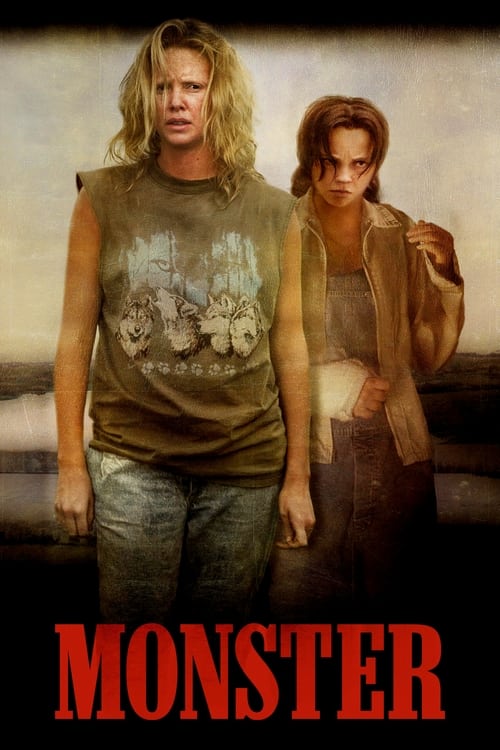
Monster
2003 · Patty Jenkins
For when you want to be shaken, not entertained — a film to chew on for days about how much of a life is choice and how much is circumstance. Firmly on the challenge end of the dial.
What it's about
Florida, 1989. A homeless highway prostitute at the end of her rope meets a sheltered younger woman in a bar, and against all odds they fall into a desperate, all-consuming love. Trying to go straight and provide for them both — with no education, no options, and a lifetime of abuse behind her — she's pulled back to the roadside, where a violent encounter with a client starts her down a path that made Aileen Wuornos infamous as America's first female serial killer. Drawn from the documented true case.
The experience
Harrowing and heartbreaking in equal measure — a doomed love story wrapped inside a true-crime tragedy. It refuses to let you keep a comfortable distance from someone the headlines wrote off as a monster, and it stays with you.
Performances
Charlize Theron's transformation into Wuornos — the weight, the teeth, the walk, the flinching bravado — is one of the most complete performances ever put on film, and it won her the Best Actress Oscar. Christina Ricci's soft, needy counterpoint makes the love story sting.
The craft
Patty Jenkins's debut works from Wuornos's own letters and interviews, framing the case as a love story rather than a police procedural — a choice that gives every scene of roadside squalor and motel-room tenderness its charge. The grimy Florida locations feel documentary-real.
Why it matters
It announced Patty Jenkins as a major director, redefined what Charlize Theron could do, and became the benchmark for actor transformations in true-crime cinema.
Snapshot
Monster is Patty Jenkins's feature debut: a true-crime biographical drama that reconstructs the final years of Aileen Wuornos, the Florida sex worker executed in 2002 for killing seven men. Working from the documented record of Wuornos's case and her own correspondence and interviews, Jenkins frames a doomed love story between Aileen (Charlize Theron) and a younger, sheltered woman, Selby Wall (Christina Ricci) — a lightly fictionalized stand-in for Wuornos's real-life partner Tyria Moore. The film's center of gravity is Theron's near-unrecognizable performance, achieved through weight gain, prosthetic dental work, bleached and thinned brows, and a wholesale reorganization of posture and gait; it won her the Academy Award for Best Actress. What distinguishes Monster from the serial-killer cycle it nominally belongs to is its refusal of spectacle and dread. Jenkins treats Wuornos not as a figure of horror but as a person produced by abuse, poverty, and a near-total absence of options — a reading that drew both passionate critical endorsement and charges of sympathetic distortion. Made on a modest independent budget, it became one of the most acclaimed American films of its year.
Industry & production
Monster was an independent production financed largely through Media 8 Entertainment and released in the United States by Newmarket Films, the boutique distributor then riding the success of Memento and about to release The Passion of the Christ. The picture was made cheaply — reported budgets cluster around the high single-digit millions — and on a compressed schedule, with Florida locations and the Daytona Beach milieu lending the project a worn, regional authenticity. The most consequential industrial fact is Theron's dual role: she was not only the star but a producer, and her commitment was instrumental in getting the film financed at all. A star of her standing attaching herself to a deglamorizing, commercially risky portrait of a convicted killer was the kind of leverage that an unproven director could not supply alone.
The release strategy was the standard prestige-indie path: a late-December qualifying run timed to the awards calendar, followed by expansion as critical momentum and Theron's Oscar campaign built. That campaign succeeded beyond expectation. Theron swept the major precursors and won the Academy Award, and the film's profile — and returns — climbed well past what its origins suggested. Precise grosses should be treated cautiously here, but the broad shape is well established: a small film that returned a multiple of its cost largely on the strength of one performance and the reviews it generated.
Technology
Monster is a conventionally photographed early-2000s independent drama; the record on its precise camera and lab specifics is thin, and I will not invent it. It belongs to the late film-origination era — shot on 35mm and finished for theatrical projection — rather than to the digital-acquisition wave that was just beginning to reshape low-budget production. The film's most "technological" dimension is prosthetic and cosmetic rather than photographic: the transformation of Theron's face and body was a makeup and physical-preparation achievement, combining real weight gain with dental appliances and altered skin and brows, executed so that the camera could hold Wuornos's face in unflattering close-up without the artifice reading as costume. The score, by the electronic musician BT (Brian Transeau), brings a contemporary sound-design sensibility — ambient, processed textures rather than orchestral underscore — that is itself a marker of the period's appetite for electronica in dramatic film.
Technique
Cinematography
Steven Bernstein's photography is keyed to the film's sociology rather than to genre tension. The Florida of Monster is a landscape of highway shoulders, motel rooms, bars, and parking lots rendered in flat, available-feeling light — sun-bleached exteriors and dim, jaundiced interiors that refuse glamour. The camera stays close to Aileen, often in unsparing close-up, letting the prosthetic-and-makeup transformation do its work under hard light that would betray any artifice. There is little of the stylized menace the serial-killer film usually trades in; the visual grammar is observational, even drab, which is the point — the violence erupts inside a deliberately unremarkable, economically marginal world.
Editing
Cut by Arthur Coburn and Jane Kurson, the film moves through Wuornos's last years with a roughly chronological drive, anchored by Aileen's first-person narration. The editing's key decision is restraint around the killings: the murders are staged and cut for moral and psychological weight rather than for suspense or gore, with the first — the rapist she kills in self-defense — given room to register as rupture, and the later ones increasingly compressed and bleak as her trajectory hardens. The cutting between the developing romance with Selby and the escalating violence builds the film's central, uncomfortable rhythm, in which tenderness and atrocity are braided into the same life.
Mise-en-scène / staging
The film's production design is an argument. Cheap motel furnishings, gas-station fluorescents, the iconography of low-wage Florida — these establish a world of constrained choices that the script and performances take as the precondition for everything that follows. The most celebrated staging is the roller-rink scene, in which Aileen and Selby skate to Journey's "Don't Stop Believin'": a moment of genuine, unguarded happiness lit and choreographed against the surrounding squalor, and one of the film's emotional load-bearing walls. Staging consistently subordinates Aileen's body and face to the frame, so that her physical transformation reads not as makeup but as biography written on a person.
Sound
BT's electronic score works in textures and drones rather than melodic cueing, keeping emotional temperature without tipping into sentiment or thriller mechanics. The needle-drops — period and emotionally pointed, the Journey track foremost — carry as much weight as the original music, locating the film precisely in time and class and granting its characters the pop-cultural interior life that their circumstances otherwise deny them. Theron's vocal performance is itself a sound-design element: a flattened, defensive Florida cadence, by turns wheedling and explosive, that the mix keeps forward and intimate.
Performance
The film is, by near-universal account, a performance vehicle in the most exalted sense. Theron's Aileen is built from the outside in — physical transformation — and the inside out: a person whose grandiosity, neediness, rage, and flickers of hope are all legible at once. The achievement is that the transformation never becomes the subject; it dissolves into character. Ricci's Selby is the necessary counterweight, a passive, dependent figure whose neediness draws Aileen deeper into providing-by-any-means; the imbalance of agency between the two women is the engine of the tragedy. Strong supporting turns — including Bruce Dern as a sympathetic Vietnam veteran — populate the margins without competing for attention. Roger Ebert's endorsement of Theron's work as among the greatest screen performances was the high-water mark of a critical consensus that was, by the standards of such things, remarkably broad.
Narrative & dramatic mode
Monster operates in a tragic, biographical-realist mode, structured as a descent. Aileen's voiceover frames the film as a retrospective account, lending it the fatalism of a life already concluded — we know, historically, where this ends. The dramatic arc is built on a cruel irony the script foregrounds: Aileen's violence is motivated, increasingly, by love — by the desire to provide for Selby and to "go straight" — and it is precisely that motivation that destroys her. The first killing is framed as survival; each subsequent one is harder to justify and the film does not pretend otherwise, allowing Aileen's self-narrated rationalizations to curdle against what we see. This is the film's riskiest move and the source of the "sympathy" controversy: it asks the viewer to understand without fully absolving, to hold causation and culpability in the same frame.
Genre & cycle
The film sits at the intersection of several cycles and subverts each. As a serial-killer film, it inverts the genre's conventions: no procedural cat-and-mouse, no aestheticized killer-genius, no investigator protagonist — instead, total identification with the killer as a damaged human being. As a lovers-on-the-margins story, it joins the lineage of Badlands, Bonnie and Clyde, and other doomed-couple-on-the-run films, while stripping away their romantic mythology. As a true-crime biopic, it belongs to an early-2000s wave of prestige films built around transformative portrayals of real figures. Its most pointed generic intervention is gendered: the serial killer in popular cinema is almost always male and almost always an object of fascinated dread, and Monster reframes the female killer as a product of male violence rather than an aberrant predator.
Authorship & method
Monster is Patty Jenkins's calling card — she wrote and directed it, an AFI-trained filmmaker making the leap from short work to a feature of unusual confidence and moral seriousness. Her method was research-driven: she immersed herself in the documentary record of the Wuornos case, including the available interviews and Wuornos's own words, and the screenplay's commitment to causation over condemnation is the clearest expression of her authorial stance. Jenkins would not direct another feature for years, eventually returning to large-scale filmmaking with Wonder Woman (2017) — a trajectory that makes Monster look, in retrospect, like the work of a director whose chief gift is steering a star performance and a clear thematic argument through commercial constraints.
Her key collaborators served that vision. Cinematographer Steven Bernstein supplied the de-glamorized, observational look. Editors Arthur Coburn and Jane Kurson shaped the descent and managed the film's difficult tonal braid of romance and violence. Composer BT contributed an electronic score that modernized the emotional register without overstating it. And Theron, as both lead and producer, was less a hired star than a co-author of the project's existence — her physical and financial commitment is inseparable from the film that resulted.
Movement / national cinema
Monster is a product of American independent cinema in its early-2000s prestige incarnation — the Newmarket/Sundance-adjacent ecosystem in which modestly budgeted, star-driven dramas competed for awards-season oxygen against studio product. It is not allied to any formal movement; its aesthetic is realist and unshowy. Its national specificity is acute, however: this is a deeply American film about the underside of the Sunbelt, about highways and sex work and economic abandonment in a Florida far from the postcard. The film's vision of poverty, violence, and the thin promise of self-betterment is rooted in a particular American social landscape.
Era / period
The film is set principally around 1989–1990, the period of Wuornos's killings, and it reconstructs that moment with care — the music, the clothing, the texture of low-wage Florida life. But it was made and received in 2003, in the immediate aftermath of Wuornos's October 2002 execution, which gives it the charge of a still-warm historical reckoning rather than a distant period piece. Its production coincides with a broader early-2000s cultural appetite for true crime and for transformative biographical performance, and it should be read against that contemporaneous moment as much as the late-1980s world it depicts.
Themes
At its core Monster is about the manufacture of a killer — the proposition that Wuornos's violence is inseparable from a lifetime of abuse, sexual exploitation, and poverty. Love is its central engine and its central cruelty: Aileen kills, in part, to sustain a relationship and a fantasy of normal life, and the relationship's dependency and imbalance accelerate her ruin. The title gestures at the gap between the person and the label society affixed to her — Aileen recalls a childhood "Monster" ride, and the film interrogates who gets named a monster and why. Other threads run throughout: the brutal economics of survival sex work; the longing for respectability and its foreclosure to those without education or capital; and the gendered dynamics of violence, in which a woman's lethal acts are read by the culture through a lens it never applies to men. The film insists on causation without claiming innocence — its most demanding theme is the coexistence of victimhood and guilt in a single life.
Reception, canon & influence
Critically, Monster was among the most lauded American films of 2003, with the response concentrated — almost overwhelmingly — on Theron's performance. Roger Ebert was its most prominent champion, ranking it at the top of his year and placing Theron's work among the finest he had seen; that enthusiasm was broadly, if not universally, shared. Theron's awards sweep, culminating in the Academy Award for Best Actress, ratified the consensus. The principal dissenting line of criticism was ethical rather than aesthetic: that the film's empathetic framing softened or sentimentalized a multiple murderer, and that its reorganization of the facts into a love tragedy risked distorting the record. That debate is, in a sense, the film's afterlife — Monster is one of the standard cases in discussions of how cinema should represent real perpetrators.
Looking backward, the film draws on a documented prehistory: the journalistic and legal record of the Wuornos case and, importantly, Nick Broomfield's documentaries — Aileen Wuornos: The Selling of a Serial Killer (1992) and Aileen: Life and Death of a Serial Killer (2003) — which had already made Wuornos a contested public figure. Its dramatic DNA reaches back to the American lovers-on-the-run tragedy, with Badlands the clearest forebear in its yoking of violence to a flat, fatalistic narration.
Looking forward, Monster shaped the discourse around the "transformation performance" — the deglamorized, physically radical portrayal of a real person — and stands as a touchstone whenever a performer's bodily metamorphosis becomes the story. It cemented Theron as a serious dramatic actor and an effective producer, reshaping her career. It launched Patty Jenkins, however slowly, toward major filmmaking. And it remains a defining reference point for empathetic, causation-focused portraits of female killers and for the ethical questions such portraits provoke — a film studied less for stylistic innovation than for the moral problem it poses and the performance through which it poses it.
A Deleuzian reading
Two women skate in slow circles under the bad fluorescent light of a Florida roller rink while Journey plays.
The full Deleuzian reading of Monster →
Reception
In 2003 it was talked about almost entirely as 'the Charlize Theron transformation' — a performance-delivery vehicle. Now it's increasingly reappraised as a strong film in its own right, with Patty Jenkins' debut direction getting the credit that was swallowed by the Oscar narrative at the time.
How Monster was received, from release to now →
Influences: the films it descends from and the films it influenced
- Badlands (1973) — Supplies the template of a flat, affectless female voiceover narrating lovers-on-the-run killings, so that fatalistic narration runs counter to the violence rather than commenting on it — the device Jenkins borrows for Wuornos's resigned narration.
- Bonnie and Clyde (1967) — Establishes the doomed-outlaw-couple structure in which an audience is maneuvered into rooting for killers, the romance-as-engine framing Monster reorganizes the Wuornos facts into.
- Thelma & Louise (1991) — Models the sympathetic staging of women who kill men in self-defense within roadside Americana, framing gendered violence as causation rather than pathology.
- Boys Don't Cry (1999) — The direct precedent for an American indie prestige biopic built on a deglamorized transformation performance (Swank) of a marginalized real person in a heartland true-crime tragedy — the exact form Monster repeats.
- Raging Bull (1980) — De Niro's bodily metamorphosis as the film's literal subject founds the 'transformation performance' discourse in which the actor's physical change becomes the story — the lineage Theron's weight gain, prosthetics and ruined skin extend.
- Henry: Portrait of a Serial Killer (1986) — Pioneers the affectless, observational treatment of a serial killer that withholds genre thrill and refuses sensational framing, the de-glamorized realism Bernstein's camera adopts.
- In Cold Blood (1967) — The foundational causation-over-condemnation true-crime portrait of real murderers, building empathy through the killers' formation rather than their acts — Jenkins's stated authorial stance.
- Aileen: Life and Death of a Serial Killer (2003) — The documentary record and Wuornos's own filmed voice and mannerisms that Theron and Jenkins studied directly, supplying the raw material for the vocal cadence and physical bearing of the performance.
- Drugstore Cowboy (1989) — Demonstrates American indie observational realism applied sympathetically to criminal lovers inside a precisely textured period milieu — production design as argument for a marginal world.
- Dead Man Walking (1995) — Carries forward the unsympathetic-protagonist gambit — a transformative Best Actress performance that humanizes a real killer without excusing the crimes, refusing the audience an easy verdict.
- A Special Day (1977) — Deploys the deglamorizing against-type casting of a glamorous star (Theron) as an interpretive act exposing human reality beneath persona — the same casting logic Scola built the film upon with Loren.
- Dallas Buyers Club (2013) — A direct heir to Monster's transformation-performance economy, where McConaughey's radical physical change becomes the marketing and moral center and the awards narrative.
- Foxcatcher (2014) — Pairs a prosthetic, deglamorized lead transformation with a causation-driven true-crime tragedy that builds toward an inevitable killing — Monster's structure of tragic descent applied to a male case.
- My Friend Dahmer (2017) — An origin study that dramatizes the 'manufacture of a killer' thesis explicitly, extending Monster's empathetic, formation-focused portrait of a real murderer before the crimes.
- Wonder Woman (2017) — Jenkins's own return reveals Monster's authorial signature — her gift for steering a single star performance and one clear thematic argument through heavy commercial constraints.
- Woman of the Hour (2024) — Female-directed reorientation of sympathy within the serial-killer form, foregrounding a woman's interiority and the male violence surrounding her rather than the kills.
- I, Tonya (2017) — Extends the same empathetic working-class true-crime portrait of a vilified woman, using period needle-drops and a deglamorizing transformative lead to argue for the social manufacture of her fate.
- The Machinist (2004) — Foregrounds extreme bodily metamorphosis (Bale's emaciation) as the film's defining gesture, a near-contemporary instance of the transformation-as-subject performance Monster crystallized.
Similar films
- Henry: Portrait of a Serial Killer (1986) — influence & lineage
- Dancer in the Dark (2000) — same viewing thread
- Tess (1979) — same viewing thread
- Raging Bull (1980) — influence & lineage · often watched together
- Caged (1950) — shared sensibility
- Basic Instinct (1992) — shared sensibility
- Memories of Murder (2003) — shared sensibility
- American Psycho (2000) — shared sensibility
All the films related to Monster →
Watch it with: curated runs of related films
- The World Against Her — A run of women worn down or driven to extremity by a merciless community, marriage, or economy — watch them near each other and the sacrifice, the drift, and the violence start to rhyme.