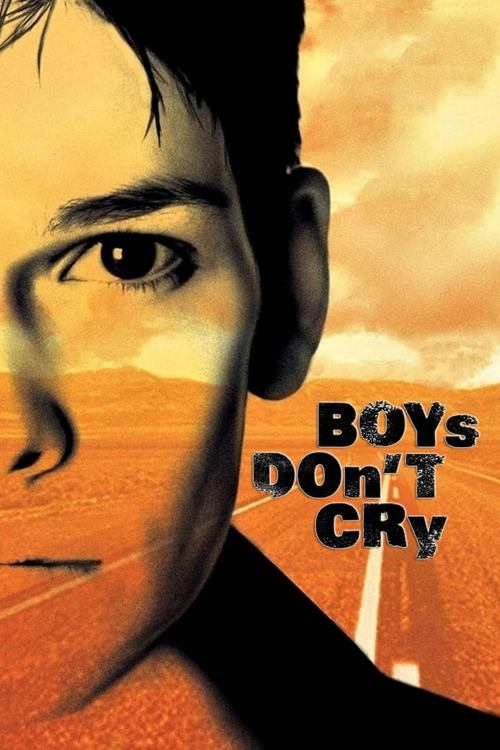
Boys Don't Cry
1999 · Kimberly Peirce
For when you're ready to have your heart broken by something true. This is the need-a-good-cry, need-to-feel-something pick — a demanding watch that repays the courage.
What it's about
Drawn from a real 1993 case, it follows Brandon Teena, a young trans man who leaves Lincoln for a small Nebraska town, falls in with a rowdy crowd of new friends, and falls hard in love — all while living as himself in a place where being discovered carries real danger. That danger hangs over every beer, every night drive, every kiss.
The experience
Tender and genuinely romantic before it tightens into dread you can feel in your chest. It's devastating in the way only true stories are, and it stays with you long after.
Performances
Hilary Swank's Oscar-winning Brandon is one of the great inhabited performances — swagger, hope, and fear in the same glance — and Chloë Sevigny matches her with a raw, wide-open turn as the girl who loves him.
The craft
Kimberly Peirce's debut, built on years of research into the case, welds hard small-town realism to unexpectedly dreamy passages — headlights on empty highways, huge night skies — so the love story glows against the poverty around it. The intimacy of the camerawork is what makes it hit.
Why it matters
A landmark that brought a trans life to mainstream American screens, capped the 1990s wave of queer independent filmmaking, and launched both Swank and Peirce.
Snapshot
Boys Don't Cry is Kimberly Peirce's feature debut, a dramatization of the short life and 1993 murder of Brandon Teena, a young trans man killed in Falls City, Nebraska. Built from years of Peirce's own research into the case, the film fuses the social realism of small-town American poverty with a swooning, romantic lyricism, and it is anchored by Hilary Swank's performance as Brandon — a piece of screen acting widely regarded as among the most fully realized of its decade. The film arrived at the close of the 1990s as both a culmination of the New Queer Cinema's movement from the margins toward the mainstream and as a singular work in its own right: an act of empathy and reconstruction that turned a tabloid crime into a tragedy of self-invention. It won Swank the Academy Award for Best Actress and earned Chloë Sevigny a nomination for Best Supporting Actress, and it remains a touchstone — and, increasingly, a point of contention — in debates about trans representation on screen.
Industry & production
The film was produced by Christine Vachon's Killer Films, the New York independent shingle that had been central to the New Queer Cinema since Poison (1991) and Swoon (1992). Producing credits include Vachon, Eva Kolodner, Jeffrey Sharp, and John Hart, and the picture was made for a modest budget characteristic of late-1990s American independents — commonly reported in the low single-digit millions, though I would treat any precise figure with caution. It was released in the United States by Fox Searchlight Pictures, the specialty arm whose backing helped carry a small, difficult film into awards contention and wider theatrical exposure.
The project's long gestation is essential to understanding it. Peirce encountered the Brandon Teena case while a graduate film student at Columbia University and spent roughly half a decade — the record consistently describes a multi-year process — researching the killing, the people involved, and the Nebraska landscape, reportedly drawing on trial materials and travel to the region. An earlier short-film treatment of the material grew into the feature. The case had already entered the documentary record through Susan Muska and Gréta Olafsdóttir's The Brandon Teena Story (1998), so Peirce's dramatization arrived in dialogue with an existing nonfiction account rather than as the first telling.
The casting of Hilary Swank — then known primarily for television work — was the production's decisive gamble, and Swank's immersion in the role (living as Brandon in preparation) became part of the film's lore. The supporting ensemble drew on the New York independent and theatrical worlds: Chloë Sevigny as Lana Tisdel, Peter Sarsgaard as John Lotter, Brendan Sexton III as Tom Nissen, and Alicia Goranson as Candace.
Technology
Boys Don't Cry is, technologically, a film of restrained means deployed for expressive ends rather than a showcase of innovation. Shot on celluloid in the late-1990s independent manner, its most conspicuous technical signature is its use of time-lapse and accelerated-motion photography of the Nebraska sky — clouds racing over flat horizons — a relatively simple in-camera and post technique used to lyrical, almost cosmic effect against the social grit of the story. I would not overstate the picture's relationship to the digital tools then emerging at the decade's edge; its power comes from classical photographic and editorial craft. (I am not certain of the exact capture format and will not guess it.)
Technique
Cinematography
Jim Denault's cinematography is the film's primary stylistic instrument, and it works by holding two registers in tension. On one hand, the interiors and small-town exteriors are observed with a hand-inflected, naturalistic intimacy — convenience stores, trailers, bars, and cars rendered in available-feeling light that grounds Brandon's world in material poverty. On the other, Denault and Peirce repeatedly lift the film into reverie: the streaking, time-lapse skies and wide Nebraska horizons function as emotional punctuation, expanding the frame at moments of longing or dread. The result is a visual rhetoric in which the vast, indifferent landscape becomes both an image of freedom (the open road, the possibility of being someone new) and of exposure and entrapment. Color and light tend toward the warm and saturated in the romantic passages with Lana, cooling and hardening as the narrative turns toward violence.
Editing
The editing is credited to Lee Percy and Tracy Granger. Its central achievement is the management of tone — the modulation between the giddy, propulsive early passages of Brandon's courtship and bravado and the slowing, tightening grip of the final movement. The film's romantic interludes are cut with a lyrical, sometimes elliptical freedom that mirrors infatuation, while the assault and murder sequences are handled with a control that refuses both exploitation and evasion. The pacing is patient by genre standards, allowing scenes of ordinary hanging-out to establish the texture of the milieu before the dramatic machinery closes.
Mise-en-scène / staging
Peirce's staging is rooted in a precise, unglamorous regional naturalism: the production design renders the trailers, kitchens, bars, and roller rinks of working-class rural Nebraska without condescension or picturesque distress. Within these spaces, the film stages Brandon's performance of masculinity as a matter of bodily detail — the sock-stuffed jeans, the swagger, the cowboy-hat-and-truck iconography of heartland manhood — so that gender itself is presented as something assembled, rehearsed, and inhabited. The blocking of the group scenes establishes the volatile social ecology (drinking, dares, casual violence) into which Brandon inserts himself, making the eventual catastrophe feel less like an aberration than like a pressure latent in the environment.
Sound
Nathan Larson, formerly of the band Shudder to Think, composed the score, which leans on a spare, melancholic, guitar-and-texture-based palette rather than orchestral underlining. Around it, the film deploys period and regional needle-drops — the country, rock, and pop of the world Brandon moves through — to locate the story in time and class and to color its emotional turns. The soundscape of the rural night, of bars and engines and open spaces, contributes to the film's atmosphere of suspended, charged ordinariness.
Performance
The film is, by common consensus, a monument of performance. Hilary Swank's Brandon is built from observed externals — voice, gait, the calibration of bravado against vulnerability — that resolve into an interior portrait of someone improvising a self under constant threat of discovery. Crucially, Swank plays Brandon not as a problem to be decoded but as a person in love and in flight, which is what gives the role its tragic completeness. Chloë Sevigny's Lana is its essential counterweight: watchful, ambivalent, and tender, she embodies a love that half-knows and chooses not to fully ask. Peter Sarsgaard's John Lotter and Brendan Sexton III's Tom Nissen render the killers as frighteningly legible products of their world rather than as cartoon monsters — a choice that makes the violence more, not less, disturbing.
Narrative & dramatic mode
The film operates in the mode of dramatized true crime crossed with the doomed-romance tragedy. Its structure follows a clear and devastating arc: arrival and reinvention; courtship and belonging; discovery; and retribution. Peirce front-loads the film with the buoyancy of escape — Brandon's flight from his past, his charm, the intoxication of new love — precisely so that the second half's mechanism of exposure and punishment registers as the collapse of a fragile, hard-won happiness. The dramatic engine is dramatic irony shading into dread: the audience's awareness of the historical outcome (and of Brandon's secret) saturates the early scenes with foreboding. The film largely confines us to Brandon's experience, aligning our sympathies with his self-understanding rather than with the suspicious gaze of those around him.
Genre & cycle
Boys Don't Cry sits at the intersection of several cycles. It belongs to the late-1990s wave of American independent dramas drawn from real crime and rural hardship, and to the longer tradition of the heartland tragedy. More specifically, it is often read as a late, mainstream-facing entry in the New Queer Cinema — the early-1990s independent movement (a term associated with critic B. Ruby Rich) characterized by formal daring and a refusal of positive-image respectability, and closely linked to Killer Films and Christine Vachon. Where earlier New Queer Cinema works were often confrontational and stylized, Boys Don't Cry channeled that movement's concerns into a more classically emotional, awards-legible form, marking a transitional moment between subcultural and broad audiences.
Authorship & method
The film is fundamentally an auteur's debut, the product of Kimberly Peirce's sustained personal investment in the material over years of research; she co-wrote the screenplay with Andy Bienen. Peirce's method — immersion in the factual record, attention to regional and class specificity, and a determination to render Brandon's subjectivity from the inside — shapes every level of the film. Her key collaborators each amplify that vision: cinematographer Jim Denault supplies the dialectic of grit and lyricism; editors Lee Percy and Tracy Granger sculpt the tonal arc; composer Nathan Larson provides the spare emotional underscore; and producer Christine Vachon's Killer Films supplied the institutional knowledge and protection that allowed a first-time director to realize a commercially risky subject. The authorship is thus best understood as Peirce's vision executed through the New York independent apparatus that had been incubating queer filmmaking for a decade.
Movement / national cinema
As American independent cinema, the film is a product of the 1990s Sundance-and-specialty-distributor ecosystem, in which small films on difficult subjects could reach theatrical audiences and awards bodies through arms like Fox Searchlight. Within that national context, its most meaningful affiliation is to the New Queer Cinema lineage and to the Killer Films house style — socially engaged, formally serious, and committed to subject matter the mainstream avoided. It also participates in a strain of American regional realism preoccupied with the economically marginal interior of the country.
Era / period
The film both depicts and emerges from specific moments. Diegetically, it reconstructs the rural Nebraska of late 1993, a milieu of economic precarity and constrained horizons. As a 1999 release, it belongs to the end-of-decade culmination of independent film's commercial and critical ascendancy, and it landed in a cultural moment newly attentive to anti-LGBTQ violence — its reception was inseparable from the surrounding public conversation about hate crimes in late-1990s America. Viewed from the present, it is also a period artifact in another sense: a marker of where trans representation stood at the turn of the millennium, before later shifts in both casting practice and critical expectation.
Themes
At its center the film is about the construction and authorship of the self — the labor, exhilaration, and peril of becoming who one knows oneself to be. Gender is presented as performed and embodied rather than given, and Brandon's reinvention is framed as both a triumph of will and a transgression that his world will not forgive. Surrounding this are themes of class and rural confinement (the way poverty and lack of escape routes shape the characters' violence and their dreams), of love as recognition (Lana's willingness to see Brandon as he wishes to be seen), and of the lethal policing of bodies and identities by communities under pressure. The film insists on Brandon's humanity and desire against a narrative the wider culture had reduced to scandal.
Reception, canon & influence
Critically, Boys Don't Cry was among the most acclaimed American films of 1999, with the consensus centering on Swank's performance and on Peirce's refusal to sensationalize. The accolades were substantial: Swank won the Academy Award for Best Actress, and Sevigny was nominated for Best Supporting Actress, results that brought a small independent film and its subject into the center of mainstream recognition.
Looking backward, the film draws on several lineages: the documentary groundwork of The Brandon Teena Story (1998); the New Queer Cinema and Killer Films traditions that made its subject filmable; and the broader heritage of American social realism and the rural true-crime drama. Peirce's archival, research-driven method roots the film in the factual record even as it shapes that record into tragedy.
Looking forward, the film became a canonical reference point in the study of cinematic gender and queer representation, widely taught and written about, and a defining credit for Swank, Sevigny, Sarsgaard, and Peirce alike. Its legacy is genuinely double-edged, and an honest account must say so. Over time the film has drawn significant criticism on two fronts that are now central to its reputation: the casting of a cisgender actress as a trans man, which later debates over trans performers playing trans roles have made newly fraught; and, more pointedly, the film's omission of Philip DeVine — a Black disabled man who was also murdered alongside Brandon Teena that night — an exclusion that critics have read as a troubling erasure. These critiques have not displaced the film from the canon so much as repositioned it: it is now studied as much for what its choices reveal about the limits and assumptions of 1990s representation as for its considerable achievements. That contested afterlife — admired, taught, and argued over — is itself a measure of the film's enduring importance.
A Deleuzian reading
The first thing Brandon does is make himself.
The full Deleuzian reading of Boys Don't Cry →
Reception
A critical sensation in 1999 — indie breakout, Oscar glory, instant landmark. Today it's viewed with far more ambivalence: still credited with bringing a trans story to the mainstream, but re-examined hard in the era of debates over who gets to tell trans stories, with Kimberly Peirce herself facing campus protests over the film in 2016.
How Boys Don't Cry was received, from release to now →
Influences: the films it descends from and the films it influenced
- The Brandon Teena Story (1998) — Supplied the documentary interview record and witness testimony Peirce mined, then converted its talking-head reportage into restricted-to-Brandon dramatic subjectivity.
- In Cold Blood (1967) — Established the dramatized-true-crime template of rendering a heartland murder with documentary fidelity while withholding nothing about the lethal outcome, building dread from the known ending.
- Badlands (1973) — Model for the Great Plains fugitive-romance lyricism — magic-hour skies, accelerated-cloud inserts, and regional flatness photographed as both grit and reverie, the dialectic Denault reprises.
- Days of Heaven (1978) — Source of the time-lapse-sky and accelerated-motion landscape interludes that punctuate the film's tonal modulation, lyricism set against rural labor and class specificity.
- River's Edge (1986) — Precedent for working-class regional-naturalist true-crime among disaffected youth, flat affect and period needle-drops standing in for psychological commentary.
- Paris Is Burning (1990) — Documented gender as an assembled, rehearsed performance — the 'realness' construction that underwrites Brandon's staged masculinity as deliberate self-authorship.
- Poison (1991) — Founding New Queer Cinema text produced through Christine Vachon's Killer Films, the institutional apparatus and aesthetic license that made Brandon's story filmable.
- My Own Private Idaho (1991) — Married regional naturalism to lyrical time-lapse-sky interludes around a queer hustler's interior life, the grit-and-reverie register Peirce inherits.
- Swoon (1992) — Killer Films New Queer Cinema treatment of a real queer murder case, proving archival true-crime could be reclaimed as queer authorship rather than pathology.
- The Crying Game (1992) — Directly rewrites the reveal it descends from: the forced exposure of a trans body still happens, but the camera holds Brandon's point of view and breaks into a dissociation shot, refusing the cisgender man's revulsion that Jordan's coverage had centered.
- Monster (2003) — Charlize Theron's immersive physical-transformation-to-Best-Actress, in a female-centered true-crime indie, directly extends the Swank-performance model BDC made an awards template.
- Mysterious Skin (2004) — Carries New Queer Cinema into Midwestern small-town trauma with restricted dual-protagonist subjectivity and a spare, dread-laced atmospheric score.
- Stop-Loss (2008) — Peirce's own follow-up reapplies her research-driven, regionally specific immersion method — Texas vernacular, class detail — to soldiers, continuing the authorial program.
- Winter's Bone (2010) — Extends rural-poverty regional naturalism around a young protagonist, non-professional textures and location authenticity producing a female lead's awards-recognized embodiment.
- The Danish Girl (2015) — Inherits and reignites the cisgender-actor-as-trans casting question BDC first crystallized, staging the same transformation-for-prestige logic critics now read against it.
- Tangerine (2015) — Answers BDC's casting critique with trans performers, while keeping the regional-naturalist street texture and propulsive needle-drop scoring of authored marginal lives.
- A Fantastic Woman (2017) — Trans-played-by-trans restricted subjectivity that revises BDC's inside-out empathy toward its subject while preserving the protagonist-locked point of view.
- Predestination (2014) — Built its performance on sustained close holds of a face negotiating gender presentation and on practical, in-camera physical alteration — binding, hair, prosthesis — rather than any optical trick, the precedent for the makeup-over-CGI continuity that keeps Snook legible as one person before and after.
- Brokeback Mountain (2005) — Rural queer tragedy structured by restricted-to-protagonist dread and a spare, lyrical underscore over wide regional landscape — the same grief-coded naturalism on a studio scale.
Similar films
- My Own Private Idaho (1991) — influence & lineage
- In Cold Blood (1967) — influence & lineage
- Tomboy (2011) — shared sensibility
- The Crying Game (1992) — shared sensibility
- Kids (1995) — shared sensibility
- Stand by Me (1986) — shared sensibility
- Capote (2005) — shared sensibility
- Chasing Amy (1997) — shared sensibility
All the films related to Boys Don't Cry →