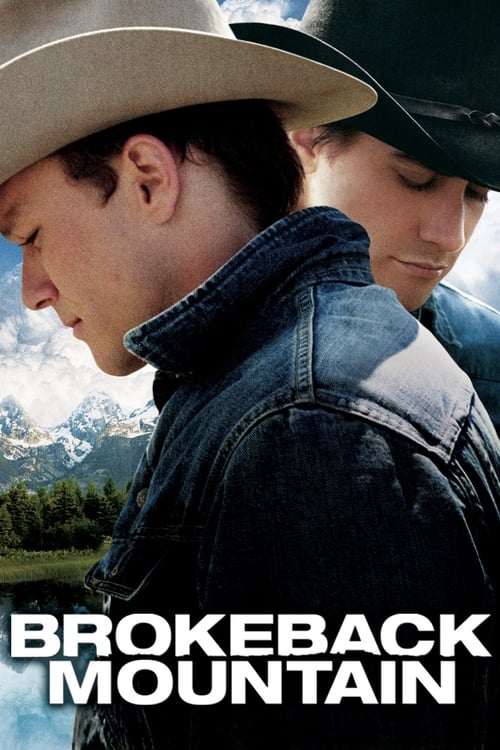
Brokeback Mountain
2005 · Ang Lee
For when you want a serious, beautiful heartbreaker — a love story to sit with, not escape into. This is a good-cry film, and it earns every tear honestly.
What it's about
Wyoming, 1963: two young ranch hands take a summer job herding sheep on a remote mountain and fall into a love neither has words for. Over the next twenty years they marry, raise children, and keep returning to each other in stolen weeks — a lifelong bond conducted in a time and place where it cannot be spoken aloud.
The experience
Quiet, patient, and devastating by accumulation — the big feelings live in silences, weathered faces, and things almost said. It builds a slow ache that stays with you long after the credits; keep tissues within reach.
Performances
Heath Ledger's clenched, mumbling Ennis is one of the great screen performances — a man at war with his own tenderness — and Jake Gyllenhaal matches him with open-hearted restlessness. Michelle Williams, as the wife caught in the middle, is quietly shattering.
The craft
Ang Lee directs with enormous restraint, letting Rodrigo Prieto's big-sky mountain photography carry the freedom the men can only feel up there, while Gustavo Santaolalla's spare guitar score does more with two notes than most soundtracks manage with an orchestra. The screenplay compresses two decades into small, precise scenes where what's withheld hits hardest.
Why it matters
A cultural landmark that brought a gay love story to the mainstream American screen on its own terms, it dominated the 2005 awards season, won Ang Lee the Best Director Oscar, and remains the reference point for tragic screen romance of its era.
Snapshot
Brokeback Mountain is a sustained act of restraint applied to material that the surrounding culture had treated as inherently sensational. Adapted from Annie Proulx's 1997 New Yorker short story, Ang Lee's film follows two ranch hands, Ennis Del Mar and Jack Twist, across two decades, from a single summer herding sheep on a Wyoming mountain in 1963 to the slow attrition of a love neither man can name or escape. Its achievement is tonal: the film locates an epic of repression inside the conventions of the American Western and the marriage melodrama, refusing both the politics of liberation and the melodrama of victimhood. What endures is its terseness — its conviction that the most violent feeling can register through what is withheld. The film entered history twice over: as a critical landmark in mainstream cinema's treatment of same-sex love, and as the subject of one of the most contested Academy Award outcomes of the decade. Both facts have tended to obscure the formal precision that makes it durable.
Industry & production
The project's long gestation is itself a story about the industry's relationship to the material. Proulx's story was optioned not long after publication, and screenwriters Larry McMurtry and Diana Ossana completed an adaptation in the late 1990s. For years it circulated as a film that could not find financing or a committed director willing to follow through; Gus Van Sant was among the filmmakers attached at various points before the project stalled. The screenplay's survival through this period — intact, faithful, unsoftened — was unusual, and McMurtry and Ossana's persistence is part of the record.
Ang Lee came to the material after Hulk (2003), a large studio production whose scale and reception made the intimacy of Brokeback a deliberate counter-move. The film was produced and distributed by Focus Features, the specialty arm run by James Schamus, Lee's longtime writing and producing partner. Focus was, by the mid-2000s, a central engine of the prestige-independent model — modestly budgeted, awards-oriented, adult-themed films released through platform distribution. Brokeback was made economically by studio standards, and its commercial performance substantially exceeded its budget, making it one of the more profitable specialty releases of its moment; precise figures vary across sources, so the safest claim is that it was both a critical and a commercial success well out of proportion to its cost. That success mattered industrially: it demonstrated that a film centered on gay protagonists could draw a broad audience and operate as a genuine awards contender, not a niche release.
Technology
Brokeback Mountain was shot photochemically on 35mm, consistent with the prestige-film practice of its period, and its technological profile is conspicuously modest. There are no significant visual-effects set pieces; the most demanding technical problems were logistical and environmental rather than digital — capturing high-altitude landscape, variable mountain weather, and animals (sheep, horses) across the seasons the story spans. The Canadian Rockies of Alberta stood in for Wyoming, a substitution driven by production economics and the availability of unspoiled high country. In this sense the film's "technology" is largely the older technology of location production: weather windows, wranglers, and the discipline of shooting in places without infrastructure. Its restraint here is of a piece with its aesthetic — the film trusts photographed reality over construction.
Technique
Cinematography
Rodrigo Prieto's photography is the film's most important formal instrument. The mountain sequences establish an idiom of grandeur held at a slight remove: wide compositions that place the two men as small figures within an indifferent landscape, the scale of the country dwarfing the intimacy that grows within it. Crucially, Prieto resists prettifying the romance. The natural light is often hard, the palette cool, and the beauty of the setting carries an undertow of exposure and isolation rather than pastoral comfort. As the narrative descends from the mountain into the men's married lives, the visual register contracts — interiors grow cramped, the framing tighter and more domestic, the color more drained. The contrast between the expansive mountain and the boxed-in towns becomes a structural argument: freedom exists only in a place they cannot stay. Prieto's work was recognized with an Academy Award nomination for cinematography.
Editing
The editing, credited to Geraldine Peroni and Dylan Tichenor, governs the film's most difficult task: compressing roughly twenty years into a coherent emotional arc without the connective tissue of conventional exposition. Peroni, a frequent collaborator of Robert Altman, died during the film's completion, and Tichenor — known for his work with Paul Thomas Anderson — finished the cut. The film proceeds in ellipses, leaping years between the men's brief reunions, trusting the audience to register the accumulating cost in the gaps. The rhythm is patient and deliberately unhurried; scenes are allowed to end on silence or on a held look rather than a line. This elliptical structure is the film's chief storytelling decision, and it places enormous weight on the actors and on the audience's inference.
Mise-en-scène / staging
Lee's staging is built on physical reticence. The relationship is conveyed less through dialogue than through blocking, gesture, and proximity — the careful distances the men keep in public, the few moments they are permitted to close them. Period detail (clothing, trucks, domestic interiors of working-class Wyoming and Texas) is rendered without nostalgia; the worn, functional textures of the milieu reinforce the sense of lives lived under constraint. A recurring object — a pair of shirts, one nested inside the other — becomes the film's central material symbol, and Lee's restraint in handling it is characteristic: the object is allowed to carry meaning without being underlined.
Sound
The film's sound design favors ambient quiet — wind, water, livestock, the hum of trucks — over score-driven emphasis. Long passages play with minimal music, which makes the eventual entrances of the score land with greater force. The relative sparseness of dialogue, much of it terse and regionally inflected, shifts the burden of meaning onto tone and silence; the men frequently fail to say what matters most, and the soundscape honors that failure rather than papering over it.
Performance
Heath Ledger's Ennis is the film's gravitational center and one of the defining performances of its decade — a study in compression, the voice clenched and the body held as if braced against itself. The performance dramatizes repression not as absence of feeling but as feeling under unbearable pressure, and it earned Ledger an Academy Award nomination for Best Actor. Jake Gyllenhaal's Jack is its necessary counterweight: more open, more willing to imagine a shared life, and therefore more exposed to disappointment; Gyllenhaal was nominated for Best Supporting Actor. The film is equally attentive to the women whose lives are deformed by the men's secret: Michelle Williams's Alma, whose silent knowledge curdles into grief, earned a Supporting Actress nomination, and Anne Hathaway's Lureen marks a sharp departure from her earlier roles. The performances share a common discipline — they communicate through what is suppressed.
Narrative & dramatic mode
The film operates in the mode of tragic realism, structured as a chronicle rather than a plot. There is no antagonist in the conventional sense; the obstacle is diffuse — social prohibition, internalized fear, the simple grind of time — and therefore inescapable. The dramatic engine is the recurring reunion: each meeting raises the possibility of a different life and each parting forecloses it, the pattern repeating until repetition itself becomes the tragedy. The story's mode is elegiac and retrospective, oriented toward loss from early on; its final movement reframes everything preceding it as something already mourned. This is melodrama in the precise sense — a drama of feeling thwarted by circumstance — purged of melodrama's usual excess.
Genre & cycle
Brokeback Mountain is most productively read as a revisionist Western, and its power derives partly from how directly it inhabits and inverts that genre's iconography. The Western's central images — the cowboy, the open range, male partnership in the wilderness, the homosocial bond — have always carried a charge the genre worked hard to disavow. The film makes that latent content manifest, locating desire in the very figures American myth had used to embody a stoic, self-denying masculinity. It also draws on the marriage melodrama and the "impossible love" tradition, in which lovers are kept apart by social order. Within the mid-2000s, it stands as the most prominent of a small cycle of mainstream films engaging gay experience seriously, but its Western framework is what distinguishes it — it does not argue from the margins but seizes one of the culture's most central myths.
Authorship & method
Ang Lee's authorship is defined by his movement across genres and national traditions — the Taiwanese family dramas, the Austen adaptation Sense and Sensibility, the wuxia epic Crouching Tiger, Hidden Dragon, the suburban anatomy of The Ice Storm — unified by a consistent preoccupation with repression, social constraint, and feeling that cannot be openly expressed. Brokeback is in this sense a quintessential Lee film, transposing his recurring theme of duty at war with desire onto American terrain. His method is one of self-effacement: the directorial hand is felt in restraint, in what is held back, rather than in visible stylization.
The collaborators are integral. Screenwriters Larry McMurtry and Diana Ossana — McMurtry himself a chronicler of the American West — preserved Proulx's terse, regional voice and her elliptical structure, winning the Academy Award for Adapted Screenplay. Composer Gustavo Santaolalla, the Argentine musician and producer, supplied a spare, guitar-led score whose simple recurring figures became inseparable from the film's emotional identity; he won the Academy Award for Original Score. Cinematographer Rodrigo Prieto and editors Geraldine Peroni and Dylan Tichenor complete a creative team whose shared instinct for understatement defines the work. James Schamus's role as producer and head of Focus Features bridges the creative and the industrial.
Movement / national cinema
The film resists easy placement within a single national cinema, which is itself characteristic of its director. It is an American film by setting, subject, and genre, made within the American specialty-distribution system, yet authored by a Taiwanese-born director and scored by an Argentine composer, and physically produced in Canada. It belongs to the early-2000s American independent-prestige movement — the Focus Features / Miramax-era model of adult, awards-driven filmmaking positioned between Hollywood and the art house. Lee's transnational sensibility lets the film view American myth from a slight outsider's distance, neither wholly inside the Western tradition nor critiquing it from without.
Era / period
The film is doubly periodized: it is a 2005 work depicting the years from 1963 into the early 1980s. Its diegetic period is essential, not decorative — the impossibility at its heart is historically specific, rooted in an era and a rural milieu in which the relationship could mean social ruin or worse. The film treats this history soberly, dramatizing the lived consequences of prohibition without anachronistic optimism. As a 2005 release, it arrived at a moment of intense public debate over same-sex relationships and their recognition, which sharpened its reception and made a period story feel pointedly contemporary. The gap between the era depicted and the era of release became part of the film's meaning.
Themes
The governing theme is repression — desire deformed by fear and social prohibition into something that wounds those who carry it and those around them. From this flows the film's anatomy of masculinity: the cost of a code that equates manhood with silence and self-denial. Ennis's inability to speak or claim his life is presented not as personal failing but as the internalization of a violence the surrounding world makes explicit. The film is equally concerned with collateral damage — the wives and children whose lives are quietly distorted by a secret they did not choose — refusing to make the central love a closed circle. Landscape functions thematically as well: the mountain is freedom and the towns are confinement, geography externalizing the men's psychology. Beneath all of it runs time and loss, the sense of a life measured by what was not allowed to happen.
Reception, canon & influence
Critical reception was broadly and emphatically positive, with particular praise for Ledger's performance, Lee's direction, and the screenplay's fidelity to Proulx. The film won the Golden Lion at the Venice Film Festival and went on to lead the awards season, winning Academy Awards for Best Director, Best Adapted Screenplay, and Best Original Score. Its loss of Best Picture to Crash became one of the most debated outcomes in the Academy's history, widely read at the time and since as a telling instance of institutional discomfort; that controversy has itself become part of the film's legend, and any account of its reception must register it.
Its influences run backward into the revisionist Western, the social-realist melodrama, and Lee's own body of work on thwarted desire, all filtered through Proulx's story, whose compression and ellipsis the film preserves. Forward, its legacy is substantial. It is routinely cited as a watershed in the mainstream presentation of same-sex love — a film that demonstrated such material could be both broadly popular and critically canonized — and it helped widen the path for later work treating queer experience within prestige cinema. For its principal actors it was a career-defining film, and Ledger's Ennis in particular acquired added resonance after his death in 2008. The "two shirts" image entered the broader culture as shorthand for the film's particular grief. More than a generation on, Brokeback Mountain is firmly established in the canon, valued less as a message film than as a formally exact tragedy that found the universal inside the specific.
A Deleuzian reading
Ennis stands in a narrow closet in Jack's parents' house, up where Jack grew up and was not loved.
The full Deleuzian reading of Brokeback Mountain →
Reception
A critical darling and awards juggernaut from day one — but its story is forever defined by Oscar night 2006, when it lost Best Picture to Crash in what's now widely regarded as one of the Academy's most infamous decisions. Two decades on, it's the loss that aged into a coronation.
How Brokeback Mountain was received, from release to now →
Influences: the films it descends from and the films it influenced
- Hud (1963) — Adapted from Larry McMurtry's 'Horseman, Pass By,' it pioneered the anti-mythic revisionist Western of arid, repressed masculinity that McMurtry himself carried into Brokeback's screenplay.
- The Last Picture Show (1971) — McMurtry's other defining adaptation, it models the elliptical, compressed-chronicle structure of a hard rural community where longing is starved by terrain and time — the same regional terseness McMurtry and Ossana preserved from Proulx.
- McCabe & Mrs. Miller (1971) — Its demythologized, cool naturalist light and ambient, unscored hush established the de-romanticized West that Prieto's cinematography and Santaolalla's spare guitar inherit.
- Days of Heaven (1978) — The template for landscape-as-isolation: figures dwarfed in wide magic-hour vistas with ambient natural sound, framing emotion as something the land withholds rather than declares.
- Brief Encounter (1945) — The foundational repression melodrama built on recurring reunions and performance-as-compression, where catastrophic feeling is conveyed entirely through what reticent faces refuse to say.
- All That Heaven Allows (1955) — Established the prestige marriage-melodrama of socially forbidden desire crushed by conformity, the genre grammar Brokeback transposes onto two men.
- Sense and Sensibility (1995) — Lee's own foundational study of duty at war with desire, directed with the same self-effacing restraint that locates feeling in held-back gesture rather than visible stylization.
- The Ice Storm (1997) — Lee's anatomy of emotionally frozen people rendered in cool, hard light and contracting domestic framings — the chilled palette and repressive mise-en-scène he reuses for Ennis's married life.
- Crouching Tiger, Hidden Dragon (2000) — Lee redeploys CTHD's structural repression architecture—anamorphic widescreen landscape as chromatic emotional register, desire expressed through what cannot be enacted rather than spoken—transposing the formal system intact into an American Western genre frame.
- 25th Hour (2002) — Marks Prieto's ascent into the front rank, his controlled, muted, emotionally restrained palette — pioneered on 25th Hour — refined into a signature for prestige American drama.
- My Own Private Idaho (1991) — Stages the campfire-side, firelit confession of unrequited love between men without consolation, inheriting Idaho's signature scene of longing rendered as restraint.
- Tea and Sympathy (1956) — Inherits the melodrama of repressed same-sex longing crushed by codes of masculinity, using landscape and withheld gesture (rather than dialogue) to carry the forbidden feeling.
- A Single Man (2009) — Extends Brokeback's model of queer grief carried in clenched physical reticence, where bereavement is expressed through controlled surfaces and withheld emotion rather than catharsis.
- Carol (2015) — Inherits the cool-light prestige melodrama of forbidden love conveyed through glances and restraint, post-Brokeback proof that queer romance could anchor awards-tier cinema.
- Moonlight (2016) — Builds directly on the elliptical, compressed-chronicle structure of a life told in widely spaced chapters, with male desire rendered as near-mute repression-as-compression.
- Call Me by Your Name (2017) — Carries forward the landscape-soaked queer romance whose tragic charge lives in physical hesitation and the elliptical jump to a later, devastating reunion/aftermath.
- God's Own Country (2017) — An explicit formal heir: two near-silent men on an isolating sheep farm, emotion compressed into terse landscape framing and physical reticence rather than dialogue.
- The Power of the Dog (2021) — Fuses the revisionist Western with repressed queer masculinity, using landscape-as-isolation, an austere recurring score, and a charged garment/object as the symbol of buried desire — Brokeback's two-shirts grammar extended.
- Cactus Pears (2025) — Pioneers landscape-as-apparatus for queer feeling — wide vistas carrying the inexpressible, with desire perpetually pressured by social duty and emotion conveyed through what goes unsaid.
- Wind River (2017) — Rodrigo Prieto's anamorphic wide-establishing shots encode masculine grief as landscape condition — men structurally incapable of expressing emotion against vast Western terrain — the visual and emotional grammar Wind River inherits directly for its own masculine-grief theme.
- The Eight Mountains (2022) — Decades-spanning intimacy between two men staged against high-country vistas, using aging performances and returns to the same peaks to register the passage of a life.
- Close (2022) — Renders repressed male tenderness and its aftermath of grief through landscape and physical reticence, the masculinity-and-withdrawal grammar Close transposes to boyhood.
- Red, White & Royal Blue (2023) — Proves the private-love/public-duty closet can be rendered with A-list prestige craft; RWRB retains the closeted-by-role premise and the ache of a love the institution forbids, but inverts Lee's tragedy into utopian resolution.
- Lust, Caution (2007) — The immediately preceding Lee/Rodrigo Prieto/Schamus collaboration, where protracted, exposed physical intimacy is used not for titillation but as the load-bearing dramatization of otherwise unspeakable repression.
- The Bridges of Madison County (1995) — A restrained adult melodrama of a brief, life-defining love recalled in fragments, structured around the ache of reunion and renunciation rather than consummation.
- In the Mood for Love (2000) — Repression-as-compression at its purest: physical reticence and unconsummated, recurring near-meetings sustained over years, longing intensified precisely by its formal containment.
- Far from Heaven (2002) — A contemporaneous prestige revival of the Sirkian melodrama centered on closeted same-sex desire, proving repressed forbidden love could be staged as formally exact period tragedy.
- The Piano (1993) — Rodrigo Prieto's desaturated Western landscape photography — where Wyoming sky and mountain encode states of interior desire and prohibition that the characters cannot voice — applies the landscape-to-subjectivity oscillation grammar and the elliptical time-gap editing structure to a parallel story of desire constrained by social law.
- 3:10 to Yuma (2007) — Rodrigo Prieto's anamorphic widescreen uses the Western landscape's spatial geometry to externalize psychological interior states, establishing in the industrial moment immediately preceding Mangold's production that the genre could support prestige psychological drama with naturalistic lighting and Academy-grade performance.
- Boys Don't Cry (1999) — Rural queer tragedy structured by restricted-to-protagonist dread and a spare, lyrical underscore over wide regional landscape — the same grief-coded naturalism on a studio scale.
- Your Name Engraved Herein (2020) — Ang Lee's forbidden-love masterwork perfects the elegiac 'too-late' reunion structure and the keepsake-as-relic motif (the shirts), the same belated-mourning frame the film builds around its adult bookend.
- The Motorcycle Diaries (2004) — Deploys Santaolalla's minimal folk-modal guitar over wide natural-light landscape in the same restrained, non-illustrative scoring method.
- Milk (2008) — The explicitly cited New Queer Cinema-to-Oscar breakthrough proving queer stories could win the industry's top honors, a precedent Milk consolidates a season later.
- Maurice (1987) — Tells rural, cross-class same-sex love through inexpressive restrained performance and landscape — a sibling that retains the tragic ending Maurice pointedly refuses.
Similar films
- Carol (2015) — influence & lineage · same viewing thread
- Cactus Pears (2025) — influence & lineage
- The Power of the Dog (2021) — influence & lineage
- The Bridges of Madison County (1995) — influence & lineage
- Moonlight (2016) — influence & lineage
- In the Mood for Love (2000) — influence & lineage · often watched together
- Happy Together (1997) — often watched together
- Braveheart (1995) — often watched together
All the films related to Brokeback Mountain →
Watch it with: curated runs of related films
- The Weight of the Unspoken — A run of quietly shattering films where the largest feelings never get said aloud — love that outlasts reason, grief that gathers over a single family dinner, a long marriage cracked open by one old letter.