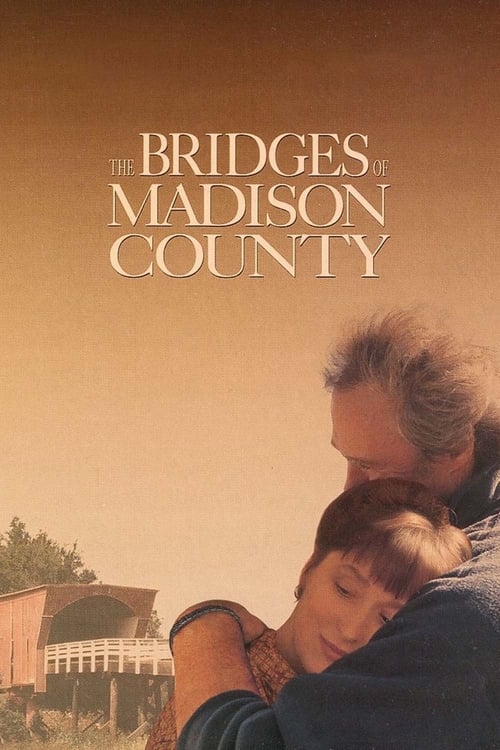
The Bridges of Madison County
1995 · Clint Eastwood
For a grown-up love story on a quiet night — when you want to feel deeply and don't mind aching afterward. Bring tissues; this is the good kind of cry.
What it's about
Iowa, the mid-1960s. Francesca Johnson, an Italian-born farm wife, has her family away at the state fair when Robert Kincaid, a roving National Geographic photographer, stops to ask directions to a covered bridge. Over four days, a courteous encounter deepens into the love of both their lives — and Francesca has to weigh everything she has built against everything she has quietly given up.
The experience
Patient, adult, and quietly devastating — a slow-burn romance that treats longing as a moral weight, not a swoon. It earns its tears honestly; the restraint is what breaks you.
Performances
Meryl Streep is astonishing as Francesca — accent, body language, whole interior life visible in how she pours iced tea — and Eastwood, playing against his own myth, gives one of his gentlest performances. Their scenes together are a masterclass in what two actors can do in a kitchen.
The craft
Eastwood directs with radical restraint: long unhurried scenes, warm natural light, and the confidence to let silence and small courtesies carry the story. It turned a sentimental bestseller into a serious chamber drama largely by what it refused to underline.
Why it matters
The film reframed one of the decade's biggest publishing phenomena into a work critics took seriously, and it stands as a key proof of Eastwood's late-career range as a director of intimate drama, not just westerns and thrillers.
Snapshot
The Bridges of Madison County is Clint Eastwood's chamber romance about a four-day affair between a roving National Geographic photographer, Robert Kincaid, and Francesca Johnson, an Italian-born farm wife stranded by choice in mid-century Iowa. Adapted from Robert James Waller's 1992 novel — one of the defining publishing phenomena of its decade — the film is remarkable chiefly for what it declined to be. Where the source was a slim, unabashedly sentimental bestseller, the film is a restrained, adult, largely two-hander drama that treats longing as a moral problem rather than a swoon. Eastwood, directing and starring, subordinated his own star persona to Meryl Streep's Francesca, and the result reframed a book widely dismissed as middlebrow kitsch into a work critics took seriously. It stands as a pivotal entry in Eastwood's evolution as a director of interior, character-driven pictures in the wake of Unforgiven (1992), and as one of the great late showcases for Streep's technique.
Industry & production
The film was a Warner Bros. release produced in partnership with Steven Spielberg's Amblin Entertainment, with Kathleen Kennedy and Eastwood among the producers through his Malpaso Productions. The property had a protracted development history before Eastwood took it on: Waller's novel was a runaway commercial success, and the screen rights attracted major studio interest and, reportedly, a rotation of writers and prospective directors — Spielberg himself was linked to the material at points in its development. The published screenplay is credited to Richard LaGravenese, whose principal contribution was to build a narrative and dramatic scaffolding the novel largely lacked, most importantly the present-day framing device in which Francesca's grown children discover, after her death, the diaries recording the affair.
Eastwood's involvement brought Malpaso's celebrated production discipline. He was known throughout the 1990s for shooting efficiently — frequently on or ahead of schedule and at controlled cost, favoring few takes and a calm set — and Bridges was made in that mode. Principal photography took place in and around Winterset and Madison County, Iowa, including the covered bridges (such as Roseman Bridge) that give the film its title and iconography, using the real regional locations rather than sets. The precise budget and grosses are best left to the studio record, but the film was a clear commercial success on release in the summer of 1995, an outcome that validated the counterintuitive bet of making a slow, dialogue-driven romance for adults inside a blockbuster season.
Technology
Technologically the film is conservative by design; it was made with conventional 1990s 35mm photochemical filmmaking and carries no ambition toward spectacle or effects. Its "technology" is essentially the classical apparatus of studio drama — anamorphic-era lensing sensibilities, naturalistic location lighting, and analog sound recording — deployed to serve performance and atmosphere. The one domain where the era's craft matters is the soundtrack's reliance on archival recordings: the film leans on period jazz and vocal records, and its emotional texture depends on the fidelity and specificity of that recorded music rather than on any original sonic invention. There is no meaningful digital-effects dimension to discuss, and to claim otherwise would misrepresent the picture.
Technique
Cinematography
Jack N. Green, Eastwood's regular director of photography of the period, shot the film. His work here is defined by restraint and warmth: soft, motivated light, an autumnal-summer palette of ambers and greens keyed to the Iowa farmland, and a general preference for stillness over movement. Interiors — particularly the Johnson farmhouse kitchen, where much of the courtship unfolds — are lit to feel lived-in and slightly dim, the camera holding on faces as conversation does the work. Green and Eastwood repeatedly favor the two-shot and the patient hold, letting the physical space between the actors carry meaning. The film's most famous image, Francesca's hand on the truck door handle in the rain as she decides whether to leave her marriage, is built entirely on this restraint: it withholds camera flourish so that a small gesture becomes the dramatic climax.
Editing
Joel Cox, Eastwood's longtime editor and an Oscar winner for Unforgiven, cut the film. The editing is unhurried, allowing scenes to run to their natural length and trusting the audience's patience — a hallmark of Eastwood's directorial temperament. The most consequential structural choice is the framing: the film opens and periodically returns to the present-day sequence of the adult children reading the diaries, so that the central romance is understood from the outset as recollected, already lost, and morally weighed by its survivors. Cox's cutting between the past affair and the present reckoning gives the film its elegiac frame without over-cutting the romance itself, which is allowed to breathe in long, conversational takes.
Mise-en-scène / staging
The staging is intimate and domestic. The farmhouse is treated as a nearly theatrical space, with the kitchen table, the porch, and the truck functioning as recurring stations of the drama. Production designer Jeannine Oppewall grounded the film in a credible, unglamorous 1960s rural Midwest — worn surfaces, modest furnishings, the specific dowdiness of a working farm — against which Kincaid registers as an exotic intrusion. Eastwood stages the growing attraction through everyday activity (cooking, driving, photographing the bridges) rather than through overt romantic set pieces, so that desire accumulates in ordinary gestures. The physical smallness of Francesca's world is itself the drama: the mise-en-scène continually reminds us what she would be renouncing.
Sound
Sound is one of the film's genuine strengths. The score by Lennie Niehaus — Eastwood's frequent composer and a jazz musician himself — is spare and unobtrusive. More distinctive is the curated use of recorded jazz and vocal standards, including recordings associated with Dinah Washington and Johnny Hartman, whose smoky intimacy becomes a shared private language between the lovers. Music is diegetically anchored to the radio and record player in the farmhouse, so the songs feel discovered by the characters rather than imposed by the film. Ambient sound — cicadas, screen doors, the farm at dusk — reinforces the sense of a hushed, enclosed world briefly opened.
Performance
The film is, above all, a performance piece. Meryl Streep's Francesca is a study in contained interiority: she constructs a specific, unshowy Italian accent and a physical vocabulary of restraint and suppressed appetite, so that the affair reads as the eruption of a self long kept dormant. The performance earned her an Academy Award nomination for Best Actress. Eastwood's Kincaid is deliberately underplayed — weathered, courtly, self-aware — a role that leans on his laconic star image while softening it into gentleness. Crucially, Eastwood the director gives the film to Streep, framing and pacing scenes around her decision rather than his character's charisma. The supporting present-day performances by the actors playing Francesca's children provide the moral counterweight, their initial resistance to the diaries modeling the audience's own passage from judgment to understanding.
Narrative & dramatic mode
The film operates in a classical realist-melodramatic register, but its structure is more sophisticated than the novel's. The framing device converts a straightforward affair into a retrospective act of reading and reckoning: the story is literally being interpreted by its inheritors as we watch, which foregrounds themes of memory, secrecy, and the unknowability of a parent's inner life. Within the central romance, the dramatic mode is compressed and unity-of-time — four days — which lends it a stagelike intensity. The decisive dramatic engine is not whether the lovers will unite but whether Francesca will leave; the film's power comes from making renunciation, not consummation, the climax.
Genre & cycle
Bridges belongs to the tradition of the "woman's picture" and the mature romantic melodrama — a lineage running through the studio-era films of Douglas Sirk and the tearjerker as a form that takes female desire and sacrifice seriously. It arrived amid a mid-1990s cycle of prestige adult romances and literary adaptations aimed at grown audiences underserved by the effects blockbuster. Against the more overtly weepy examples of that cycle, Eastwood's film is notably austere, closer in temperament to the restrained brief-encounter tradition than to lush spectacle. It is also, within Eastwood's own filmography, part of his run of intimate character dramas that interrupted his identity as an action and Western star.
Authorship & method
The film is a Malpaso production in the fullest sense, bearing Eastwood's signature working method: efficient shooting, minimal takes, trust in actors, and a preference for understatement over emphasis. As director-star, Eastwood made the significant authorial decision to recede — to serve Streep's performance and LaGravenese's structure rather than his own persona. His key collaborators were the stable of craftspeople he worked with repeatedly: cinematographer Jack N. Green, editor Joel Cox, and composer Lennie Niehaus, whose continuity across Eastwood's 1990s films gives them a consistent, unhurried house style. Screenwriter Richard LaGravenese supplied the dramatic architecture — above all the framing device — that critics widely credit with elevating the material. Production designer Jeannine Oppewall grounded the film's period realism. The collaboration exemplifies Eastwood's authorship as a matter of temperament and restraint as much as of individual shots.
Movement / national cinema
The film is a mainstream American studio production and does not belong to a formal movement. It is best situated within classical Hollywood's continuing tradition of the character-driven melodrama, and within the particular American strand of the actor-director's chamber film. Its regional specificity — the Iowa farmland — connects it to a recurring American cinematic interest in the Midwest as a landscape of repression and endurance, though this is a thematic affinity rather than a school.
Era / period
The film has a doubled temporal identity. Its central story is set in the mid-1960s, and its production design, music, and costuming carefully evoke that moment of pre-liberation domestic constraint — a specificity essential to the drama, since Francesca's options are bounded by the norms of that time and place. The framing narrative is set in the film's near-present of the 1990s, from which the past is recovered and judged. Made in 1994–95, the film also reflects its own moment of production: a studio willing to bankroll a slow, adult romance at a time when such films still had a reliable theatrical audience.
Themes
The film's central themes are desire and duty, and the cost of the road not taken. It treats Francesca's choice to remain with her family as neither simple virtue nor simple tragedy but as a genuine, weighed sacrifice — the film's moral seriousness lies in refusing to trivialize either the affair or the marriage. Related themes include the buried interior life of women in mid-century domesticity; the tension between rootedness and wandering, embodied in the settled farm wife and the itinerant photographer; and memory and inheritance, since the framing device makes the story about how children come to know, and forgive, the private selves of their parents. The photography motif — Kincaid's vocation — quietly reinforces the theme of capturing and preserving fleeting moments.
Reception, canon & influence
Critically, the film was received far more warmly than the novel that spawned it; a substantial body of reviewers regarded it as a case of a film redeeming its source, praising Eastwood's restraint, LaGravenese's structural intervention, and above all Streep's performance, which drew her Best Actress nomination. It confirmed and extended the critical reappraisal of Eastwood as a serious director that Unforgiven had crystallized, demonstrating his range beyond the Western and the thriller.
Its influences run backward to the classical woman's picture and the restrained romance of renunciation — the brief-encounter tradition of the illicit affair ended by conscience — as well as to Waller's novel as immediate source. Its forward legacy is more diffuse than seismic: it stands as a durable exemplar of the adult prestige romance and of the actor-director chamber drama, and it remains a touchstone for discussions of Streep's technical range and of Eastwood's understated late style. The covered bridges of Madison County became a lasting piece of cultural iconography, and the material later supported a stage musical adaptation, evidence of the story's continued resonance. Beyond that, the film's most cited influence is exemplary rather than stylistic: it is repeatedly invoked as proof that unfashionable, sentimental source material can yield a rigorous, emotionally serious film in the right directorial hands.
A Deleuzian reading
A hand on a door handle.
The full Deleuzian reading of The Bridges of Madison County →
Reception
In 1995 the shock was that anyone — least of all Clint Eastwood — could make a good movie out of Robert James Waller's much-mocked bestseller; critics called it the rare film that improves on its source. Three decades on it's been fully canonized as one of Eastwood's finest and one of the great grown-up American romances.
How The Bridges of Madison County was received, from release to now →
How to watch The Bridges of Madison County: what to notice on a first viewing
- Notice how long a scene of cooking or talking runs. Joel Cox lets conversations play to their natural length. Most of the four days is ordinary business: a meal, a drive, talk at a kitchen table while the light goes. Nothing in these scenes advances a plot. Desire accumulates in ordinary gestures because there is nothing else on screen to look at. The film is built out of held time.
- Watch the space between the two actors in the two-shots. Jack Green and Eastwood favor the patient hold and the two-shot over cutting between faces. The physical distance across a kitchen does the work another film would give to a reaction shot. Because the camera stays put, you measure the attraction in inches of floor rather than in dialogue.
- Watch Meryl Streep move around her own kitchen. Streep builds Francesca out of posture, a specific unshowy Italian accent and appetite kept under control. A woman dormant for twenty years occupies the room she has cooked in every day. The film trains you to read her at the scale of very small physical facts.
- Listen for where the jazz records are actually coming from. Lennie Niehaus keeps the score spare. The vocal standards associated with Dinah Washington and Johnny Hartman play from the radio and the record player inside the house, discovered by the characters rather than laid over them. The music becomes a private language between two people instead of an instruction to the audience about how to feel.
- Look at the covered bridges Kincaid comes to photograph. The bridges are the reason he is in Iowa and the reason they keep driving out together. Eastwood returns to them, and the film takes its name from them. A covered bridge is a crossing with a roof on it, a passage you can stand inside and stay in.
The whole guide to watching The Bridges of Madison County, with the keys for a rewatch →
Influences: the films it descends from and the films it influenced
- Brief Encounter (1945) — Establishes the template Eastwood inherits: a middle-class illicit affair recounted in retrospective female voice-over and ended by conscience, the renunciation staged as moral restraint rather than tragic spectacle.
- All That Heaven Allows (1955) — The named Sirkian source for the film's woman's-picture engine — private desire pressed against domestic duty and the judgment of family/community, dramatized through the mise-en-scène of the ordinary house.
- Letter from an Unknown Woman (1948) — Supplies the posthumously-discovered written testimony as framing device — a woman's hidden love unlocked by her own document after her death — the exact structural move LaGravenese grafts onto Waller.
- Now, Voyager (1942) — The classical woman's-picture star vehicle built on contained yearning and a renunciation ethic ('don't ask for the moon'), the actressly restraint Streep updates.
- Casablanca (1942) — The canonical renunciation climax in which lovers part for duty over passion — the moral architecture of Francesca's choice to stay in the truck.
- Summertime (1955) — A mature woman's brief, place-bound romance abroad, longing held under a surface of decorum — the emotional register of restrained middle-aged desire Eastwood adopts.
- Marty (1955) — Mid-1960s-adjacent American domestic realism and chamber intimacy among ordinary, unglamorous people, prizing the naturalistic small scale over stars-as-icons.
- The Fisher King (1991) — LaGravenese's screenwriting breakthrough on Fisher King launched the career that produced this, carrying forward his intimate dual-protagonist architecture of two damaged souls in brief redemptive contact.
- Million Dollar Baby (2004) — Extends the late Eastwood grammar — contained interiority, naturalistic low-key lighting, and a stripped renunciation/sacrifice climax delivered in near-silence.
- In the Mood for Love (2000) — Extends the renunciation-through-decorum craft: two-shots of near-touching, an affair sustained and finally refused, longing expressed entirely by withholding.
- The Notebook (2004) — Directly inherits the discovered-record framing device and the project of redeeming sentimental best-seller source material through performance and a story-within-retrospect structure.
- Titanic (1997) — Uses the same framing device of an elderly woman narrating a lost great love to her descendants, the affair surviving as memory-and-inheritance passed down.
- Carol (2015) — A consciously Sirkian woman's picture of forbidden desire under social constraint, restrained domestic melodrama built from naturalistic period mise-en-scène.
- Lost in Translation (2003) — A brief, unity-of-time encounter of mutual middle-aged longing renounced rather than consummated, its feeling carried by two-shots and quiet withholding.
- 96 (2018) — Framed a brief mature encounter as a suspended, retrospectively narrated memory that ends in renunciation over union — the emotional grammar of restraint 96 adopts for adults.
- Unforgiven (1992) — The Malpaso house style crystallized: cinematographer Jack N. Green, editor Joel Cox and composer Lennie Niehaus working the same unhurried, minimal-take restraint carried directly into Bridges.
- A Perfect World (1993) — Eastwood's understated two-hander chamber drama where he recedes as director-star to serve the performances and long-take patience — the same authorial self-effacement he practices for Streep.
- Bird (1988) — Eastwood and Niehaus's method of building texture from real jazz standards, the diegetic-record aesthetic that fills Francesca's kitchen with period blues and jazz.
- The Age of Innocence (1993) — A period romance organized around a renunciation climax and desire-versus-duty, framed as memory-and-inheritance narrated retrospectively across decades.
- The Remains of the Day (1993) — Emotion withheld beneath composed surfaces — contained interiority as the whole subject, love foreclosed by an ethic of duty rather than spoken.
- Brokeback Mountain (2005) — A restrained adult melodrama of a brief, life-defining love recalled in fragments, structured around the ache of reunion and renunciation rather than consummation.
- Midnight in the Garden of Good and Evil (1997) — The immediately prior Eastwood bestseller adaptation where patience, location fidelity, and trust in actors turn pulp source into an unhurried mood piece — the direct methodological predecessor.
Similar films
- Unforgiven (1992) — influence & lineage
- The Notebook (2004) — influence & lineage
- In the Mood for Love (2000) — influence & lineage
- Million Dollar Baby (2004) — influence & lineage
- Brief Encounter (1945) — influence & lineage
- The Age of Innocence (1993) — influence & lineage
- Mystic River (2003) — shared sensibility
- Brokeback Mountain (2005) — shared sensibility