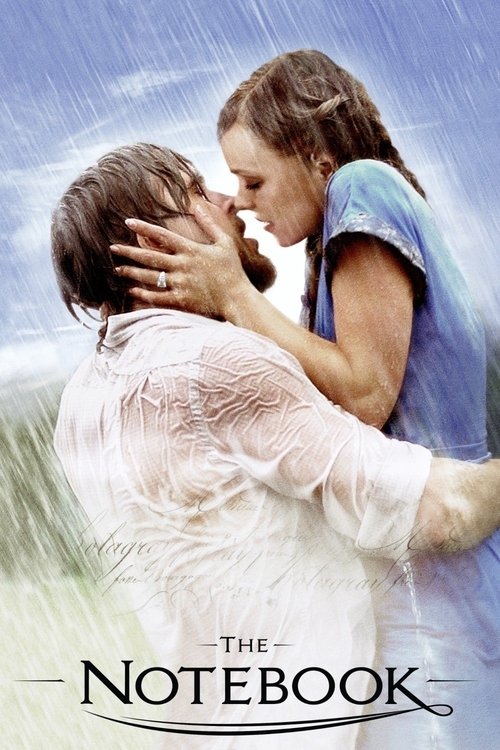
The Notebook
2004 · Nick Cassavetes
For a cozy night in when you want to fall in love and have a good cry — ideally with someone next to you and tissues within reach. Pure comfort, zero irony.
What it's about
In a nursing home, an old man reads aloud from a worn notebook to a woman whose memory is failing — the story of a Depression-era summer romance between a small-town mill worker and a wealthy debutante, torn apart by class, family, and then a world war, and the question of whether love like that survives seven years apart.
The experience
Unabashedly swooning and sincere — golden summers, big declarations, rain-soaked passion — with a frame story that quietly wrecks you. It goes all in on feeling and never apologizes for it.
Performances
Ryan Gosling and Rachel McAdams, both pre-stardom, generate the kind of unguarded, full-bodied chemistry studios spend fortunes failing to manufacture. And Gena Rowlands plays memory loss with a fearless transparency that gives the whole romance its weight.
The craft
Nick Cassavetes shoots the Southern summer in warm, burnished light and lets the love story breathe, while the notebook framing turns a simple romance into a meditation on memory. The rain-drenched reunion became one of the most quoted romantic images of its era.
Why it matters
The defining American screen romance of the 2000s — the film that outgrew its bestseller source, launched two stars, and became shorthand for the grand movie love story.
The Nicholas Sparks adaptation that outgrew its source and became the defining American screen romance of its decade: a Depression-era summer love between a lumber-mill worker and a debutante, recounted years later by an old man reading to a woman whose memory is failing. The director is Nick Cassavetes, son of the great independent filmmaker John Cassavetes — and the casting of his mother, Gena Rowlands, as the older woman gives the framing story an emotional authority the genre rarely earns; she plays memory loss with the same fearless transparency she brought to her husband's films. Ryan Gosling and Rachel McAdams, both pre-stardom and famously combustible on set, generate the kind of full-bodied, unguarded chemistry studios spend fortunes failing to manufacture — the rain-soaked reunion kiss became an instant piece of pop iconography. Shot in honeyed Carolina light by Robert Fraisse, the film flopped with critics and grew steadily into a phenomenon anyway, passed hand to hand like a love letter. Sincerity, it turns out, was the special effect.
Reception
Critics shrugged in 2004 — it got middling reviews as standard Nicholas Sparks weepie — but word of mouth and endless rewatches turned it into THE defining romance movie of its generation, now openly embraced rather than guiltily.
How The Notebook was received, from release to now →
Influences: the films it descends from and the films it influenced
- A Woman Under the Influence (1974) — Nick directs his mother Gena Rowlands in the same trembling, unguarded close-up realism his father pioneered — the raw performance grammar the nursing-home scenes inherit wholesale.
- Opening Night (1977) — Rowlands playing an aging woman confronting mortality and slipping identity supplies the exact register the film reuses for Allie's dementia — the actor-centered, mortality-facing close-up carried from father to son.
- Titanic (1997) — The blueprint for the elderly-survivor framing device: an old woman in the present narrates a doomed, class-crossing youthful romance in flashback, the past bookended and finally released by the frame.
- The Bridges of Madison County (1995) — The framing conceit of grown children reading a parent's private record and unlocking a hidden passionate romance, staged in restrained golden rural-Americana light.
- Splendor in the Grass (1961) — The template of class-divided young lovers pried apart by parents, then reunited years later having each been rerouted into different lives — the structural spine of Allie and Noah.
- Wuthering Heights (1939) — The poor-boy/rich-girl doomed-love archetype delivered as a remembered, narrated story — the class-transgression romance recounted from a later vantage.
- Doctor Zhivago (1965) — The sweeping golden natural-light romantic epic framed by later-life recollection — the lush, remembered-love lighting grammar Robert Fraissé echoes.
- The Way We Were (1973) — Star-chemistry-driven romance split by a social/class divide and structured as a look back — the two-leads-you-root-for-despite-incompatibility engine the Gosling/McAdams pairing revives.
- Summer of '42 (1971) — The nostalgic first-love memory piece shot as a golden, sun-hazed remembered summer — the wistful-recollection cinematography mode the flashbacks adopt.
- Breakfast at Tiffany's (1961) — The cathartic rain-drenched reunion kiss as romantic climax — the storm-soaked embrace that the Notebook's rain-reunion kiss directly quotes.
- Message in a Bottle (1999) — The first prestige Nicholas Sparks adaptation, establishing the letters/loss weepie house style and the sun-lit coastal grief-romance tone the source material demands.
- Dear John (2010) — Post-Notebook Sparks adaptation built on letter/voiceover narration framing a separated-lovers arc, extending the read-aloud-correspondence device.
- The Best of Me (2014) — Sparks adaptation that copies the Notebook's dual-timeline structure outright — class-divided teen lovers cross-cut with their reunited older selves.
- The Vow (2012) — Extends the memory-loss romance premise: a spouse who no longer recognizes her partner must be courted anew, mirroring Noah re-wooing an Allie who forgets him.
- Me Before You (2016) — Inherits the Notebook's class-divide-plus-mortality weepie formula, foregrounding luminous lead chemistry and an engineered tearful catharsis.
- Remarkably Bright Creatures (2026) — Codified the recollection/framing device that slowly unspools a buried familial secret as the emotional engine of a sincere literary tearjerker.
- Where the Crawdads Sing (2022) — Codifies the Nicholas Sparks book-club-romance machine Crawdads runs on: a retrospective framing device that braids a present-day reckoning with a soft-lit Southern love story, tuned for maximum audience-vs-critic exit warmth.
- A Walk to Remember (2002) — Companion Sparks adaptation of the same era working the identical class-divide, mortality-shadowed teen romance with confessional voiceover framing.
- A Moment to Remember (2004) — Western same-year counterpart: a dementia framing device wrapping a two-timeline, class-crossed romance, with a recurring musical theme — an almost point-for-point structural rhyme with AMTR.
- Touch (2024) — Deploys the same dual-casting device — separate young and old actors for one pair of lovers — with a present-day framing narrator that meters out a late reveal, mirroring Touch's construction.
Similar films
- Titanic (1997) — influence & lineage
- Even If This Love Disappears Tonight (2025) — shared sensibility
- Eternal Sunshine of the Spotless Mind (2004) — shared sensibility
- The Hours (2002) — shared sensibility
- Hamnet (2025) — shared sensibility
- Carol (2015) — shared sensibility
- A Moment to Remember (2004) — shared sensibility
- Forrest Gump (1994) — shared sensibility