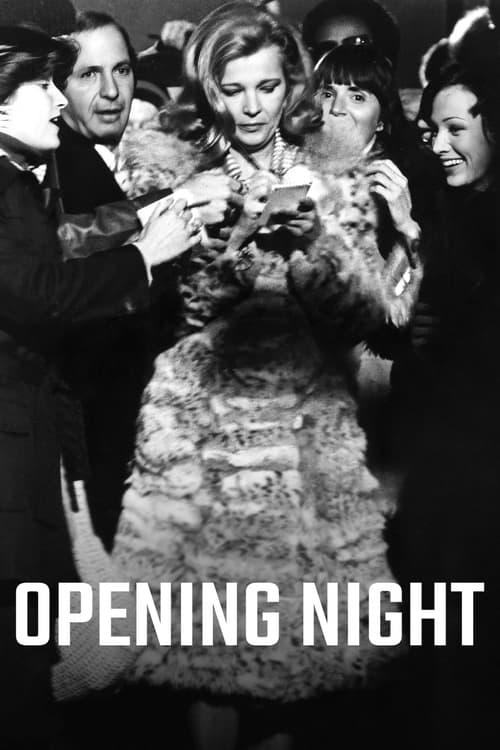
Opening Night
1977 · John Cassavetes
For when you want to be shaken rather than soothed — a film to reach for when you're ready to watch a great actress walk a tightrope with no net. Challenge, not comfort, and it will rattle around your head for days.
What it's about
Myrtle Gordon, a famous stage actress and functioning alcoholic, is days away from opening a Broadway play about a woman confronting aging — a role she can't bring herself to accept. Then a young fan chasing her limousine is killed in an accident outside the theater, and Myrtle can't shake her. As previews unravel, the line between the actress, the role, and the woman she used to be starts to dissolve, with the whole production hostage to whether she can walk onstage.
The experience
Raw, unnerving, and electric — scenes run long and loose, teetering between breakdown and breakthrough, and you're never sure whether what you're watching is collapse or performance. It's demanding, but the final stretch delivers a payoff of almost unbearable suspense.
Performances
Gena Rowlands gives one of the towering performances in American film — Myrtle drunk, terrified, defiant, and dazzling, often within a single unbroken scene. Watching her act a woman who is herself acting for her life is the whole event.
The craft
John Cassavetes shoots in his signature style — long handheld takes, scenes that breathe and lurch like live theater — and stages actual onstage performances before audiences, so the boundary between rehearsal, play, and life keeps slipping. The film's shape mirrors Myrtle's state: unstable, alive, capable of turning on a dime.
Why it matters
Barely seen on release, it has grown into one of the most revered films about acting ever made, a touchstone for performers and a peak of American independent filmmaking's founding era.
Snapshot
A stage actress named Myrtle Gordon is days from the Broadway opening of The Second Woman, a new play about a middle-aged woman's reckoning with mortality and diminished desire. On the road in New Haven, a young fan named Nancy is struck and killed by a car while chasing Myrtle's limousine. The death refuses to dissolve: Nancy returns as a haunting — literal or psychological, the film declines to adjudicate — and Myrtle's rehearsals collapse inward as she substitutes her own anguish for the playwright's written intentions. Opening Night is simultaneously a backstage melodrama, a film about alcoholism and spiritual crisis, and a sustained philosophical inquiry into whether performance is ever separable from the self performing it. It is among the most demanding and formally radical works of John Cassavetes' career, and arguably the richest treatment of female artistic identity in American cinema.
Industry & Production
By 1977, Cassavetes had established the template for American independent filmmaking that would sustain his work from Shadows (1959) onward: self-financing, distribution through his own Faces International Films, and a repertory of trusted collaborators assembled outside the studio infrastructure. Opening Night was produced with funds Cassavetes raised himself, in part from his earnings as an actor in studio pictures. This was not an unusual arrangement for him — A Woman Under the Influence (1974) had been financed similarly — but Opening Night represented an escalation in scale and ambition: a large cast, a functioning theatrical set built inside a legitimate theater, and a shooting schedule that stretched across several months in the Los Angeles area, including sequences staged to represent New Haven and New York.
The film's original US release was extremely limited, and it circulated only narrowly in North America for years after its completion. Its substantive premiere occurred at the Venice Film Festival in 1978, where Gena Rowlands received the Silver Lion for Best Actress — a critical vindication that arrived largely outside the American industrial context. This pattern of European recognition preceding domestic appreciation was consistent with Cassavetes' reception generally. Opening Night remained difficult to see in the United States for much of the following decade, which shaped its reputation as both essential and semi-legendary.
Technology
The film was photographed on 35mm, consistent with Cassavetes' practice in his later-period features (several earlier works, including Faces and A Woman Under the Influence, were shot on 16mm and blown up or distributed in that gauge). The move to 35mm allowed for a somewhat richer tonal range but did not fundamentally alter the visual grammar Cassavetes had been developing since the early 1960s. Artificial lighting is present but applied sparingly and without the high-gloss finish of mainstream productions of the period. The theatrical interiors — rehearsal halls, backstage corridors, the stage itself — are lit with the kind of pragmatic, slightly harsh illumination that makes the actor's face the primary light source of meaning rather than the frame's decorative ambience. No unusual or experimental photographic processes are documented in the production record.
Technique
Cinematography
Al Ruban, Cassavetes' longtime producer and cinematographer, handled the camera on Opening Night as he had on several preceding Cassavetes films. Ruban's approach was defined by proximity and responsiveness: the camera does not wait for actors to complete movements before following, nor does it anticipate blocking through pre-planned setups in the conventional sense. In scenes of emotional crisis — and the film contains many — the handheld frame tightens toward faces until peripheral information dissolves, producing a sense of perceptual emergency that mirrors Myrtle's inner state. The effect is formally distinct from observational documentary, however: Cassavetes and Ruban are not passive. The camera actively pursues emotional disclosure, and the slight instability of the image registers as a form of attention rather than chaos.
Wide shots of the stage itself carry a different charge. When Myrtle performs her scenes within The Second Woman, the camera sometimes retreats to a position approximating an audience member's viewpoint, and in those moments the film's claustrophobia briefly lifts before closing in again. The contrast is pointed: the stage offers a kind of distance the actors are not actually allowed.
Editing
Cassavetes was famously involved in his own editing processes, which were lengthy and often experimental. The editing of Opening Night refuses conventional dramatic economy. Scenes run past what a mainstream sensibility would regard as their concluding moment, and the film holds on faces, silences, and ambiguous reactions with a patience that can feel like endurance. This is not sloppiness but a principled decision: Cassavetes was committed to the idea that emotional truth emerges in duration, in the moment after the prepared performance, not during it. The result is a film whose rhythms are organized around accumulation rather than incident, and whose set pieces — the ghost sequences, the final on-stage breakdown and reconstitution — arrive with the force of things that have been long withheld.
Mise-en-scène / Staging
The film operates across three spatial registers: backstage and rehearsal space (provisional, cluttered, professional); the exterior world (hotels, streets, the accident scene); and the stage itself (formalized, lit, nominally controlled). Cassavetes stages the tension between these registers as a structural argument. Myrtle's crisis is essentially about the permeability between them — about whether a woman can be expected to contain her actual suffering long enough to represent someone else's. The rehearsal scenes are among the most electrically staged in the film: actors are frequently talking past each other, over each other, and the text of The Second Woman is interrupted, subverted, and collapsed by Myrtle's substitutions. The set designs ground the theatrical world in unglamorous specificity rather than theatrical idealization.
Sound
The sound design is direct and unornamented. Dialogue is primary; ambient sound is present but not elaborated into texture or mood support of the kind common in more conventionally produced films of the period. The consequence is that silence, when it occurs, has unusual weight. The film's most disturbing sequences — those in which Myrtle confronts Nancy's ghost — are not aurally embellished with horror-register effects. The ghost arrives as a visual and emotional disruption in an otherwise undifferentiated sound world, which amplifies rather than diminishes its uncanniness.
Performance
The performances in Opening Night are among the most extraordinary in American film, beginning with Gena Rowlands' Myrtle Gordon — a role of staggering breadth and physical commitment. Rowlands is required to play an actress playing a character, while simultaneously falling apart and reconstituting, often within a single unbroken take. She moves through states of drunkenness, grief, spiritual confusion, professional vanity, and raw terror without settling into any of them as a stable characterization. The performance is famous for its extremity, and that reputation is earned: there are sequences in the final act — the opening night itself — in which Rowlands appears genuinely unmoored, and the film holds on that reality without softening it.
Ben Gazzara plays Manny Victor, the play's director and Myrtle's closest colleague, with the controlled intelligence and suppressed warmth characteristic of his collaborations with Cassavetes. Gazzara is the film's stabilizing register: his Manny watches Myrtle's disintegration with something between love and professional terror, and Gazzara makes that composite legible without underlining it. Cassavetes himself plays Maurice Aarons, the playwright-protagonist's ex-husband within The Second Woman, in a role that is both dramatically functional and meta-textually charged. Joan Blondell, appearing in one of her final substantial film roles, plays the playwright Sarah Goode with a mixture of tired authority and complicated maternal solicitude. Blondell's performance is among the film's quieter treasures — a veteran actress, herself visibly aged, playing a woman whose creation is being contested by its lead performer.
Narrative & Dramatic Mode
Opening Night is structured as a film-within-a-play, though the nesting is not hermetic. The play The Second Woman is not simply a frame or a contrast: it interpenetrates with Myrtle's actual experience to the point where the distinctions between her life and her character's lines become genuinely unstable. The film is skeptical of catharsis in the Aristotelian sense; Myrtle's resolution on opening night is eccentric, improvisatory, and arguably not a resolution at all but a transformation of the crisis into something performable. This makes Opening Night a narratively open film, closer to the anti-dramatic traditions of European modernism than to the problem-solved structure of American genre cinema.
The ghost of Nancy functions as the narrative's most overtly symbolic element, but Cassavetes refuses to resolve its ontology. Is it alcoholic hallucination, psychological projection, or something the film seriously entertains as supernatural? The question remains live until the end, and the film's refusal to close it is deliberate: whether Myrtle is visited by a spirit or haunted by her own repressed terror of aging, the affective and dramatic result is identical.
Genre & Cycle
Opening Night belongs to the backstage drama tradition but systematically refuses the genre's conventional consolations. Classical backstage films — from 42nd Street (1933) through the golden-age musical — typically organize their narrative around the successful replacement of the imperiled star, or the imperiled star's miraculous recovery; the show going on functions as an affirmation of collective artistic will. Cassavetes inherits this structure and corrupts it. The show does go on, but what goes on is not what was written, not what was rehearsed, and not what any of the film's characters planned for. This situates Opening Night in the revisionary current running through 1970s American cinema, which regularly subjected inherited genre forms to pressure testing.
It is also, alongside films like The Killing of a Chinese Bookie (1976), a sustained meditation on the nature and cost of artistic self-determination — a preoccupation that links Cassavetes' mature work across genres and subjects.
Authorship & Method
Cassavetes wrote the screenplay for Opening Night, as he did for most of his major features. His scripts were more detailed than the "improvised" reputation of his films suggests — actors were not simply given subjects and told to talk — but the written text functioned as a foundation rather than a ceiling. Rehearsal processes were extended and collaborative, and what appeared on screen frequently incorporated discoveries made during that process. The line between the screenplay's language and the performers' contributions is, by design, difficult to locate.
Al Ruban's role was not limited to cinematography. As Cassavetes' longtime producing partner, he was central to the practical management of productions that operated outside normal industry support structures. Bo Harwood, who provided music for several Cassavetes films, contributed the score. The editing credit and precise details of the post-production process on Opening Night are less fully documented in the scholarly record than would be ideal; what is clear is that Cassavetes was deeply involved and that the cut went through extensive revision before its Venice presentation.
Movement / National Cinema
Opening Night is a landmark of American independent cinema in the specific lineage that Cassavetes established and that would influence virtually every subsequent wave of American independent filmmaking — from the indie explosion of the late 1980s and 1990s through the mumblecore generation of the 2000s. It is not aligned with the major Hollywood studios of its period, not with the New Hollywood movement centered on directors like Coppola, Altman, or Scorsese (though Cassavetes is contemporaneous with all of them), and not with the European art cinema with which it is sometimes grouped by critics noting its formal affinities. It is categorically its own tendency — what might be called the American existentialist underground.
Cassavetes' influence on international filmmakers — Mike Leigh in Britain, to a degree Lars von Trier in Denmark — testifies to the fact that his method registered globally as a distinct and imitable practice, even as it remained difficult to categorize within national cinema frameworks.
Era / Period
The film belongs to the high period of post-Classical American filmmaking (broadly, 1967–1980) and specifically to the second half of that decade, when the New Hollywood experiment was beginning to contract under commercial pressure. Opening Night was made in the same years as Annie Hall (1977) and Star Wars (1977) — films that defined very different possibilities for what American cinema in that moment could be. Cassavetes' choice to work entirely outside the industrial and generic assumptions of both those films was not accidental: by 1977, he was the most experienced and methodologically consistent practitioner of American independent cinema, and Opening Night represents a full synthesis of everything his practice had developed.
Themes
The film's central theme is the relationship between aging and identity in a culture structured around the performance of desirability. Myrtle resists the play's written representation of her character's decline not from vanity alone but from a principled objection: she does not believe that aging produces the specific kind of defeat the play insists on. Her contest with the playwright Sarah Goode is, at its core, a philosophical argument about what it means to be a woman of a certain age, conducted through the medium of theatrical performance.
The ghost of Nancy complicates this theme by introducing the question of youth's relationship to death. Nancy, young and yearning, is killed in her pursuit of Myrtle; Myrtle, older and frightened, is haunted by that death and by what it means that she is still alive. The film is interested in the way mortality distributes itself unequally and arbitrarily — in the strange guilt of survival, and in the inadequacy of spiritual consolation to address that guilt.
Alcoholism is present throughout but is not treated diagnostically. Cassavetes depicts Myrtle's drinking as one element in a larger crisis rather than its cause or its symbol: she is not an alcoholic who cannot perform because she drinks, but an actress in extremity for whom drinking is one of several responses to an unbearable situation.
Reception, Canon & Influence
Opening Night's belated critical recognition followed a pattern common to Cassavetes' work: initial American neglect, European validation, and slow retrospective canonization. Gena Rowlands' Silver Lion at Venice in 1978 established the film's prestige outside the United States, and European critics — particularly in France, where Cassavetes had long been taken more seriously than at home — engaged with the film substantively in the years following its release.
American critical reassessment accelerated in the 1980s and 1990s, as Cassavetes' full body of work became more accessible and as the independent cinema he had pioneered produced new generations of filmmakers willing to acknowledge his foundational importance. Opening Night was increasingly named alongside A Woman Under the Influence as the pinnacle of his achievement, and Rowlands' performance came to be regarded as among the finest in the American cinema of the period.
Looking backward, the film draws on traditions that Cassavetes absorbed throughout his career: Italian neorealism's commitment to location and non-ideal bodies; the Method acting tradition's emphasis on psychological truth over technical display; theatrical antecedents including Luigi Pirandello's interrogation of the boundaries between character and performer (the echo of Six Characters in Search of an Author is audible); and the American improvisational theater culture of the 1950s and early 1960s in which Cassavetes had his own formation.
Looking forward, Opening Night's influence is both broad and specific. The filmmakers of the American independent movement that consolidated in the late 1980s — Jarmusch, Hartley, early Linklater — inherited Cassavetes' conviction that psychological duration was a legitimate organizing principle for narrative cinema, and that faces observed at length constituted a viable cinematic subject. More specifically, the film's engagement with the performance of femininity and its costs anticipates a significant strand of later cinema: films by Nicole Holofcener, Sarah Polley, and others in which women's inner lives are treated as philosophically serious rather than generically functional. The late-period work of Lars von Trier, particularly Dancer in the Dark (2000) and Melancholia (2011), is inconceivable without the precedent of what Cassavetes did with Rowlands in this film and in A Woman Under the Influence. Rowlands' Myrtle Gordon stands with Giulietta Masina's Gelsomina, Monica Vitti's Claudia, and Liv Ullmann's Alma as one of the exemplary figures through which European and American art cinema constructed, in the postwar decades, its most serious account of what a woman's experience might look like when given full imaginative attention.
A Deleuzian reading
Start with the window.
The full Deleuzian reading of Opening Night →
Reception
A commercial disaster in 1977 — Cassavetes couldn't even secure proper US distribution, though Europe embraced it and Berlin gave Gena Rowlands the Silver Bear. It's since climbed to the top tier of the Cassavetes canon, now routinely mentioned in the same breath as A Woman Under the Influence.
How Opening Night was received, from release to now →
Influences: the films it descends from and the films it influenced
- Shadows (1959) — Cassavetes' debut established the handheld 16mm documentary proximity and rehearsal-extended performance method that Opening Night inherits and scales to 35mm theatrical production.
- Faces (1968) — Cassavetes' practice of sustained takes without conventional coverage cuts — forcing the performer's real-time physical and vocal choices into the record rather than editing toward best-take selections — is the direct formal ancestor of Opening Night's extended-duration performance sequences.
- A Woman Under the Influence (1974) — Cassavetes and Rowlands refined the method of sustained unbroken takes observing a woman's psychological disintegration; Opening Night inherits this method and adds the explicit meta-theatrical layer of the character fragmenting offstage while performing onstage.
- Persona (1966) — Sven Nykvist's radical close-up intimacy with Ullmann's actress-turned-mute disintegrating on camera — sustained without protective editing — provided the formal precedent for Al Ruban's handheld proximity to Rowlands' Myrtle Gordon at the boundary of breakdown.
- All About Eve (1950) — The film codified the backstage-theater grammar of the aging actress threatened by a younger replacement; Opening Night inherits this structural armature but strips away Mankiewicz's ironic theatrical wit, exposing only the existential crisis underneath.
- 8½ (1963) — Fellini's formal innovation of the blocked artist's creative paralysis as the film's own organizing structure — where the subject's inability to create becomes narrative form — is the direct precedent for Opening Night's meta-theatrical collapse of Myrtle's personal and professional disintegration.
- La Strada (1954) — Giulietta Masina's Gelsomina — a woman's suffering rendered without psychological retreat or emotional decoration — established the register of non-cathartic female endurance that Rowlands, placed alongside Masina by European critics, inhabits in Opening Night.
- L'Amour fou (1969) — Extends the rehearsal film's core device by dissolving the boundary between run-through, performance and private life, staging an actress's collapse inside the actual working conditions of a production rather than in dramatized privacy.
- My Dinner with Andre (1981) — Malle proves the formal viability of sustained unornamented dialogue as a feature film's entire dramatic event, inheriting Cassavetes' demonstration that psychological duration and face-observation constitute sufficient cinematic material without action-based plotting.
- Vanya on 42nd Street (1994) — Malle films a Chekhov rehearsal with no demarcation between rehearsal and performance, collapsing the film/theater/life boundary through the same three-spatial-register logic Opening Night uses — stage, backstage, and the performer's psychological interior — but makes the collapse the film's explicit formal subject.
- Dancer in the Dark (2000) — Von Trier's use of Björk as a non-actress playing a character who performs musicals deploys the actor-playing-actor doubled consciousness Opening Night established, and the film's structural refusal of emotional relief at its climax is formally identical to Cassavetes' narrative anti-catharsis.
- The Piano Teacher (2001) — Haneke's sustained clinical observation of Huppert's Erika Kohut — a performer whose professional authority and personal disintegration coexist in plain sight — extends Opening Night's formal practice of watching a woman hold two incompatible psychological states simultaneously without resolving either.
- Synecdoche, New York (2008) — Kaufman's nested theater-within-theater structure — actors playing actors playing their own lives — extends Opening Night's film-within-play grammar to its logical extreme, and the staging of mortality as production context directly inherits what Cassavetes demonstrated about cinema's capacity to hold death and performance in the same shot.
- Birdman or (The Unexpected Virtue of Ignorance) (2014) — The film's backstage staging of an aging actor's collapse between performed identity and actual self — rendered through continuous movement between stage and wings — directly inherits Opening Night's spatial architecture of theatrical performance as psychological crucible, though Lubezki's virtuoso single-take choreography replaces Cassavetes' handheld proximity.
- Drive My Car (2021) — The rehearsal process as a site where the boundary between actor and role dissolves; Gena Rowlands working through personal trauma via her stage character models the core mechanism of Hamaguchi's affectless-rehearsal method and its consequences for both Kafuku and Yusuke.
- Rendez-vous (1985) — An actress literally haunted by a dead admirer during rehearsals models theater-as-method: filming rehearsal, breakdown, and performance as one unbroken emotional continuum rather than discrete scenes.
- Steve Jobs (2015) — The pre-curtain backstage rendered as a psychological pressure-chamber, the performer cornered by intimates in the minutes before going on.
- The Notebook (2004) — Rowlands playing an aging woman confronting mortality and slipping identity supplies the exact register the film reuses for Allie's dementia — the actor-centered, mortality-facing close-up carried from father to son.
- Ghostlight (2024) — A stage production haunted by an actual death, where rehearsal and raw private feeling bleed into each other until performance becomes the only way to metabolize loss — the exact play-as-grief-work device Ghostlight inherits.
- Love Streams (1984) — Introduces frank dream/ghost interludes rupturing behavioral realism, giving Rowlands' interior life a hallucinatory register — the exact fusion Love Streams extends with Sarah's fantasy sequences.
- Husbands (1970) — The film deploys Ben Gazzara in the same extended-improvisation-within-script method, and Gazzara's specific mode of affectless male suppression observed through handheld proximity is the precise instrument Opening Night transplants and redirects against Rowlands.
- All That Jazz (1979) — Both films construct their backstage drama around a protagonist whose creative identity and mortality are structurally inseparable, and both use theatrical rehearsal sequences as spaces where the performer's psychological collapse becomes visible — though Fosse's showbiz maximalism inverts Cassavetes' unornamented restraint.
- Gloria (1980) — Models the idea of Rowlands's performance AS the film's authorship — a woman improvising survival in real time — which Gloria inherits as its structuring principle.
- The Killing of a Chinese Bookie (1976) — Reunites Gazzara and the repertory company on the immediate next film to dramatize performance-as-survival literally, theater as the arena where identity is defended.
- Face to Face (1976) — Extends the actress-in-crisis study, staging a psychological unraveling where hallucinated figures intrude on a realist performer — kindred externalization of the unconscious through acting.
Similar films
- A Woman Under the Influence (1974) — influence & lineage · same viewing thread
- Faces (1968) — influence & lineage · same viewing thread
- Husbands (1970) — influence & lineage · same viewing thread
- All That Jazz (1979) — influence & lineage
- Synecdoche, New York (2008) — influence & lineage
- Gloria (1980) — shared sensibility
- Love Streams (1984) — shared sensibility
- Rosemary's Baby (1968) — shared sensibility
All the films related to Opening Night →
Watch it with: curated runs of related films
- New Hollywood Unravelings — Watch these together for the rawest strain of New Hollywood — loose, lived-in character studies of Americans who can't hold the shape their lives demand.