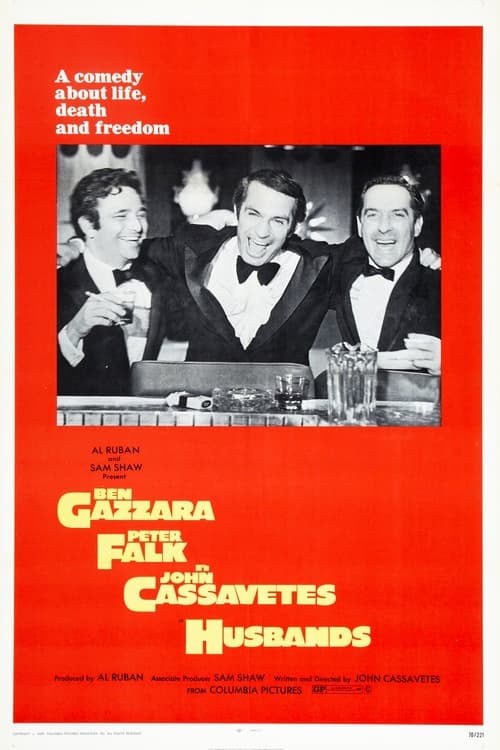
Husbands
1970 · John Cassavetes
For when you want cinema with the safety rails off — messy, alive, emotionally naked. A demanding watch that pays off if you surrender to its rhythm; not the pick for a light evening.
What it's about
Three suburban New York husbands bury a fourth friend, dead suddenly at their own age, and find they can't just go back to work and family as if nothing happened. A bender of basketball, bars, and singing turns into an impulsive flight to London — gambling, drinking, chasing women — as they improvise one last taste of freedom before home pulls them back.
The experience
Raw, rowdy, and deliberately shapeless the way grief is shapeless — scenes run long past comfort, veering between hilarious, embarrassing, and quietly devastating, sometimes within a single take. You don't watch it so much as get stuck in the car with these men.
Performances
John Cassavetes, Ben Gazzara, and Peter Falk have a loose, combustible chemistry that feels less like acting than like three real friends caught on film — bullying, needling, and loving each other in the same breath. A marathon barroom singing scene is the kind of thing no conventional film would dare hold on.
The craft
Cassavetes shoots in a rough, handheld, close-up-heavy style that chases behavior rather than plot, letting scenes breathe until the performances crack open into something true. The looseness is deceptive — it's built to make you feel the panic under the horseplay.
Why it matters
One of the foundational works of American independent film, it proved a personal, actor-driven cinema could exist outside the studio system and influenced generations of filmmakers drawn to emotional realism over plot.
Snapshot
Husbands follows three suburban New York husbands — Gus (John Cassavetes), Harry (Ben Gazzara), and Archie (Peter Falk) — through the disorienting days after the sudden death of a fourth friend. Standing at the graveside of a man their own age, the survivors are seized by a grief they cannot name and a panic they cannot suppress. What begins as a bender (basketball, beer, an all-night bar) escalates into a spontaneous flight to London, where they gamble, drink, and pursue women in a frantic improvisation of freedom before the pull of home reasserts itself. Cassavetes subtitled the film "A Comedy About Life, Death and Freedom," and the phrasing is exact: the picture is at once funny, brutal, and shapeless in the way grief is shapeless. It is one of the foundational documents of American independent cinema and among the most uncompromising studies of middle-aged masculinity ever filmed — a movie that asks the viewer to sit inside men's discomfort for hours without the relief of plot.
Industry & production
Husbands occupies an unusual position in Cassavetes' career as his most studio-backed feature. The commercial and critical success of Faces (1968) — a self-financed, independently shot film that earned Academy Award nominations — gave Cassavetes the leverage to secure backing and distribution from Columbia Pictures, a major Hollywood studio, for Husbands. This was a meaningful departure: where Shadows (1959) and Faces were made outside the system on borrowed money and deferred wages, Husbands carried a studio's resources and, with them, a studio's anxieties about a film that defied conventional length and shape.
That tension defined the production's afterlife. Cassavetes shot enormous quantities of footage and assembled a cut that ran well beyond commercial norms, and the released version — roughly two hours and twenty minutes — emerged from a contested editing process in which Columbia pressed for cuts. The precise sequence of trims, restorations, and alternate cuts is part of the film's lore, and the documentary record on exactly which scenes were lost and when is genuinely uneven; later home-video restorations have attempted to recover material, but a single authoritative "director's cut" remains a complicated claim rather than a settled fact. The promotion was as unconventional as the film: the three principals famously appeared together on The Dick Cavett Show, where their loose, semi-drunken, in-character behavior blurred the line between performers and the men they played — an episode that has become a touchstone for the film's confrontational relationship to audience comfort.
Technology
Husbands was made on 35mm in an era when lightweight cameras, faster film stocks, and portable sync sound had loosened the apparatus of studio shooting. Cassavetes exploited these tools not for documentary verisimilitude as such but for proximity — the ability to keep a camera close to actors over very long takes, in real and cramped locations, without the rigid lighting setups of classical Hollywood. The technology of the period enabled his method rather than dictating its look: telephoto lenses, available or minimal light, and a willingness to let grain and softness register meant the image itself carries the texture of improvisation. The film moves between New York and London locations, and the technological premise throughout is that the equipment should serve the actors' presence rather than constrain it.
Technique
Cinematography
The cinematography is credited to Victor J. Kemper, early in a career that would later run through mainstream Hollywood, and the visual signature of Husbands is one of deliberate roughness. Handheld camerawork, restless reframing, and long focal lengths produce an image that hunts for faces and often catches them off-balance — out of focus, half-cut by the frame, or held in punishing close-up long past the point a conventional film would cut away. The grain and the unmanicured lighting are not accidents of low budget but the grammar of the film's realism: beauty is withheld, and the camera's instability mirrors the men's. The famous extended sequences — the bar where the men coax and bully a woman to sing "with feeling," the casino, the hotel-room encounters — depend on a camera that stays present and uncomfortable rather than composing the action into legibility.
Editing
Editing is the film's most contested craft dimension, and the honest position is that the cutting history is partly obscured by the studio negotiations described above. What is clear is the aesthetic principle: Cassavetes edits for duration and emotional truth rather than economy. Scenes run long past their narrative function, and the rhythm is built on holding moments — drunkenness, nausea, repetition, the slow exhaustion of an argument — until they accumulate a weight no condensed version could carry. The notorious bar sequence and the men's morning-after sickness are governed by this logic: the discomfort is the content, and the editing refuses to spare the viewer. Where the record on specific editorial credits and reel-by-reel changes is thin, it is better to say so than to assert a clean account.
Mise-en-scène / staging
Cassavetes stages Husbands in real, unglamorous interiors — bars, bathrooms, hotel rooms, kitchens — that press the actors physically against one another and against the frame. The staging is built around bodies in proximity: men slung over urinals, sprawled across beds, looming into the lens. There is little of the choreographed blocking of classical cinema; instead the actors seem to find their positions in the moment, and the camera adapts. This produces the film's claustrophobic intimacy and its sense that domestic and social space is something the men are forever crowding into and recoiling from.
Sound
In keeping with Cassavetes' broader aesthetic, Husbands largely forgoes the cushioning of a conventional non-diegetic score; music tends to arise from within the world (the bar, the singing) rather than being laid over it to direct feeling. Sync dialogue is recorded close and often overlapping, with the messiness of real speech — mumbling, interruption, repetition — preserved rather than cleaned away. The soundtrack's roughness is continuous with the image's: it refuses to smooth the experience into something easily consumed.
Performance
Performance is the reason Husbands exists and the axis on which every other choice turns. Cassavetes, Gazzara, and Falk — close friends in life — built the film around their own rapport, and the result is among the most fully inhabited ensemble acting in American film. The popular description of Cassavetes' work as "improvised" is partly a myth: he typically wrote detailed scripts and dialogue, then directed toward a quality of spontaneity, so that the performances feel discovered rather than recited. What the actors achieve here is a portrait of men who can express tenderness only through aggression, fear only through bravado, grief only through clowning. The long takes give them room to overreach, to fail, to repeat themselves — and Cassavetes keeps the camera on them through it, trusting that truth lives in the excess.
Narrative & dramatic mode
Husbands is anti-plot by design. Its dramatic mode is behavioral and durational rather than causal: the death of a friend supplies a precipitating event, but what follows is not a story with rising action and resolution so much as a sustained study of men trying to outrun mortality. The film proceeds in long set-pieces — the bar, the gym, the flight, the casino, the hotel rooms — each one an arena for the men to perform their freedom and reveal its hollowness. The "comedy" of the subtitle is real, but it is the comedy of embarrassment and excess; the drama emerges from the gap between the men's stated liberation and their evident terror. There is no catharsis offered and no moral delivered. The structure enacts its theme: freedom turns out to be exhausting, and home exerts a gravity the men cannot finally escape.
Genre & cycle
Nominally a comedy-drama, Husbands sits athwart genre. It belongs to no studio cycle and resists the male-buddy template it superficially resembles; where the buddy film typically celebrates camaraderie and adventure, Husbands exposes the desperation beneath male bonding. It is better understood as part of the cycle of late-1960s and early-1970s American cinema that turned inward toward alienation, malaise, and the unraveling of mid-century certainties — the broader "New Hollywood" moment of personal, director-driven filmmaking. Yet even within that company Cassavetes is an outlier, pursuing a realism of behavior more radical than most of his contemporaries, with little interest in the stylistic flourishes or genre revisions that marked the era's more celebrated films.
Authorship & method
Husbands is a quintessential Cassavetes work: director, co-star, and author of its method. Cassavetes' approach inverts conventional film authorship — rather than imposing a vision through control of the image, he authors through the conditions he creates for his actors, building films around trust, long takes, and the willingness to let performances run to extremes. Cinematographer Victor J. Kemper executed the rough, handheld visual style that serves this method. The film's reliance on its three central performances — Cassavetes, Gazzara, and Falk, friends bringing their own dynamic to the screen — makes the ensemble itself a kind of co-authoring force. On the question of specific below-the-line collaborators, particularly the editorial credits, the documentary record is uneven, and the film's making is best described as a collaborative, somewhat chaotic process shaped by Cassavetes' insistence on emotional authenticity over polish. He did not compose with a traditional score, and the absence is itself an authorial signature: feeling is to be earned from the actors, not supplied by music.
Movement / national cinema
Husbands is a cornerstone of American independent cinema, and Cassavetes is routinely named its godfather. Though the film was studio-distributed, its sensibility is independent to the core: actor-centered, location-shot, indifferent to commercial pacing. Its lineage runs to the postwar realisms — Italian neorealism's commitment to ordinary life and non-glamorous space — and to the American Method tradition of psychological truth in performance, while it shares the period's broader interest in handheld immediacy associated with cinéma vérité. Cassavetes himself resisted the vérité label; his realism is constructed and directed, not observed. Within American national cinema, Husbands stands as proof that a fully personal, performance-driven film could be made adjacent to, and partly with, the studio system without surrendering to it.
Era / period
The film is deeply of its moment: 1970, at the hinge of the American counterculture's exhaustion and the New Hollywood's ascent. Its subject — middle-class, middle-aged men confronting mortality and the suffocations of suburban marriage — speaks directly to a culture interrogating the postwar bargain of family, work, and respectability. The men's flight to London and their grasping at sexual and social freedom register the era's loosened mores even as the film refuses to romanticize them. Husbands belongs to a cinema newly permitted to be uncomfortable, ambiguous, and adult, made possible by the collapse of the Production Code and the rise of director-driven filmmaking.
Themes
The film's central preoccupation is mortality and the male inability to face it. Death enters in the first minutes and shadows everything after; the men's frenzy is a flight from the grave they have just visited. Bound up with this is masculinity itself — its performances, its aggressions, its near-total incapacity for vulnerability except when routed through drink, violence, or clowning. Husbands anatomizes male friendship as both lifeline and prison: the men need each other and torment each other in the same breath. Marriage and domesticity hover at the edges as the thing the men flee and cannot finally leave, a gravity that quietly governs the film's return. Underneath runs a theme of freedom as illusion — the discovery that liberation, pursued without object, becomes its own exhaustion and despair.
Reception, canon & influence
Husbands was divisive on release, and it has remained so in a way that is part of its identity. Contemporary critics split between those who found it self-indulgent, shapeless, and punishing in its length, and those who recognized an emotional honesty unavailable in more conventional films; Cassavetes' work in general drew notably hostile responses from some major critics of the period even as it gathered passionate defenders. Over the decades the film's stature has risen substantially, and it now sits securely in the canon of American independent cinema and of 1970s filmmaking, studied as much for its method as for its content.
Looking backward, the film draws on Italian neorealism's ethic of ordinary life, on the Method tradition of psychological performance, on the period's handheld immediacy, and most directly on Cassavetes' own earlier experiments in Shadows and Faces, which established the actor-centered, long-take realism that Husbands pushes further. Looking forward, its influence is large and durable. Cassavetes' model — the director who builds films around trust in actors, long takes, and emotional rawness over plot — became a foundational reference for American independent filmmaking. Its DNA is visible in the performance-driven, talk-heavy realism of later independent cinema, in actor-turned-director projects, and in the loose, behavioral aesthetics that resurfaced decades later in low-budget American film. Filmmakers across generations have cited Cassavetes as a liberating example, and Husbands in particular endures as the definitive demonstration that a film can find its drama entirely in how people behave when they have nowhere left to hide.
A Deleuzian reading
Three men bully a woman into singing again.
The full Deleuzian reading of Husbands →
Reception
Critics were sharply divided in 1970 — many found it self-indulgent and punishingly long, and the studio trimmed it after release — but decades of reappraisal (capped by a restored Criterion edition in 2020) have secured it as essential Cassavetes.
How Husbands was received, from release to now →
Influences: the films it descends from and the films it influenced
- The Killing of a Chinese Bookie (1976) — Descendant applying the same telephoto, available-light handheld immediacy and digressive anti-plot to genre material, dissolving plot into the protagonist's moment-to-moment behavior.
- Short Cuts (1993) — Cassavetes' study of male emotional compartmentalization through overlapping improvised conversation that refuses psychological catharsis is the direct precursor for Short Cuts' male complicity storylines — Modine/Mathis, Ward/Waits/Penn — structured as recursive avoidance rather than confession.
- Love Streams (1984) — Pioneers the plotless ensemble of grown people avoiding grief, letting scenes run far past narrative usefulness — the 'states of feeling' structure Love Streams inherits.
- Martin (Hache) (1997) — Verbally dense, overlapping male-argument naturalism given rehearsal-quality looseness where behavioral performance drives the scene — the naturalistic talk texture behind Aristarain's actor-first method.
- Gary (2026) — Long-take naturalism in which the camera holds a scene past the point of comfort and the actors' negotiation of the dead air becomes the content, rather than coverage looking for the line that ends the scene.
- Shadows (1959) — Cassavetes' own origin point — the same workshop-bred improvisation and 16mm handheld pursuit of unscripted behavior that Husbands inherits and hardens into the long-take, actor-trusting method.
- Faces (1968) — Direct predecessor: establishes the punishing telephoto close-up held past comfort and the marital-collapse behavioral realism that Husbands extends to a male trio.
- Bicycle Thieves (1948) — Neorealist source — the ethic of staging drama in the unremarkable textures of ordinary life and real locations, the location-based 'ordinary people' commitment Cassavetes Americanizes.
- On the Waterfront (1954) — Carries the Actors Studio Method into film — the psychologically interiorized, mumble-and-grope performance grammar that Cassavetes, himself Method-trained, builds his entire directorial system around.
- Breathless (1960) — Handheld immediacy and a tossed-off, anti-composed spontaneity that legitimized rough camerawork as expressive rather than amateur — the visual permission Husbands' Kemper takes to extremes.
- The Connection (1961) — Parallel American-indie ancestor: scripted-to-feel-improvised, real-time durational realism among men killing time, sharing Husbands' faith in behavior-over-plot and overlapping naturalistic talk.
- Wanda (1970) — Sibling — actor-turned-director working in grainy handheld with telephoto observation and anti-plot drift, finding drama purely in how a person behaves with nowhere to hide.
- Five Easy Pieces (1970) — Sibling New Hollywood character study of male evasion and class unease, privileging behavioral nuance and aimless episodic structure over narrative machinery.
- Mean Streets (1973) — Sibling that explicitly cites Cassavetes — improvised, overlapping-dialogue scenes of male friendship and drunken bravado shot loose and close, drama emerging from horsing-around that curdles.
- A Woman Under the Influence (1974) — Descendant that perfects the method — performance run to extremes over long takes, the camera trusting Rowlands' unbroken behavioral arcs the way Husbands trusts its trio.
- Stranger Than Paradise (1984) — Descendant reviving the loose, low-budget behavioral aesthetic — deadpan real-time scenes of men loafing, drama located in dead air and gesture rather than incident.
- Husbands and Wives (1992) — Descendant adopting agitated handheld camerawork, jagged jump-cut editing, and overlapping, interrupting dialogue to anatomize marriage with documentary-style emotional rawness.
Similar films
- Faces (1968) — influence & lineage · same viewing thread
- A Woman Under the Influence (1974) — influence & lineage · same viewing thread
- The Killing of a Chinese Bookie (1976) — influence & lineage
- Stranger Than Paradise (1984) — influence & lineage
- Five Easy Pieces (1970) — influence & lineage · same viewing thread
- Opening Night (1977) — same viewing thread
- Love Streams (1984) — shared sensibility
- Mikey and Nicky (1976) — shared sensibility
All the films related to Husbands →
Watch it with: curated runs of related films
- New Hollywood Unravelings — Watch these together for the rawest strain of New Hollywood — loose, lived-in character studies of Americans who can't hold the shape their lives demand.