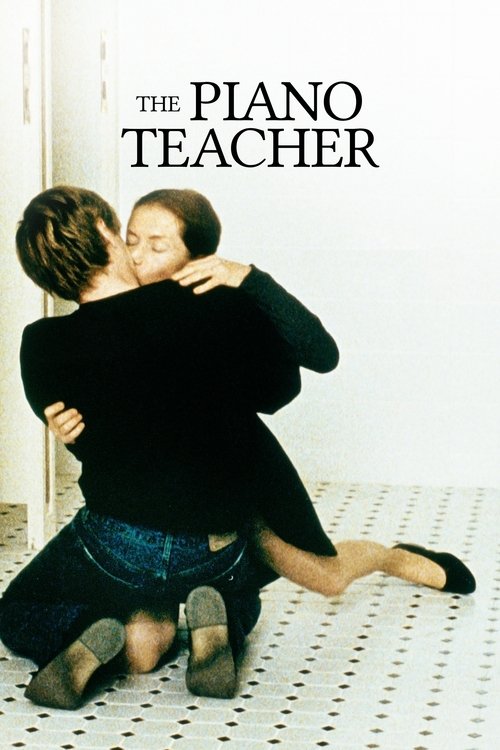
The Piano Teacher
2001 · Michael Haneke
For when you want to be challenged, not comforted — a film to reach for when you're ready to sit with something genuinely disturbing and argue about it afterward. Absolutely not a casual weeknight watch.
What it's about
Erika Kohut teaches piano at the Vienna Conservatory with ferocious exactitude, then goes home to share a bed with the mother who still controls her life. Her private world is a locked room of secret compulsions and desires she has never been able to live out. When Walter, a confident and gifted young student, decides to pursue her, the collision between his easy wanting and her buried one sets the whole arrangement on a knife's edge.
The experience
Cold, precise, and almost unbearably tense — not from plot mechanics but from watching a person's armor crack in real time. It's confrontational filmmaking that refuses to look away, and it leaves a bruise that lasts for days.
Performances
Isabelle Huppert gives one of the most fearless performances ever put on film: a face of glacial control behind which you can read shame, hunger, and panic all at once. She and Benoît Magimel both won the top acting prizes at Cannes for this.
The craft
Haneke directs like a surgeon — long, unblinking takes, no score to tell you how to feel, classical music used as both beauty and weapon. The framing is so controlled that a static shot of a face can feel more violent than anything explicit. The Schubert on the soundtrack is doing real dramatic work, so listen closely.
Why it matters
Its near-sweep of the 2001 Cannes prizes cemented Haneke as a major force in European cinema and made the film a benchmark for how far a psychological drama can go. It remains a touchstone for actors and directors interested in repression and cruelty rendered without melodrama.
Snapshot
A piano professor at the Vienna Conservatory inhabits a sealed psychic world: she lives in the same bed as her controlling mother, frequents peep shows, practices self-mutilation, and has never integrated desire into a liveable life. When a gifted young student, Walter Klemmer, pursues her with the confidence of someone who has never doubted his own wanting, the encounter does not liberate Erika Kohut — it destroys her. The Piano Teacher is Michael Haneke's most intimate and most devastating film, a clinical autopsy of a consciousness shaped by discipline, humiliation, and the violence latent in high culture. It won the Grand Prix, Best Actress, and Best Actor at the 2001 Cannes Film Festival — an almost unprecedented sweep of the major prizes — and stands as one of the defining works of European art cinema in the twenty-first century.
Industry & production
The Piano Teacher (La Pianiste) was a French-Austrian co-production, financed primarily through Les Films Alain Sarde and MK2 Productions on the French side, with the Austrian company Wega Film as a key structural partner — the same Viennese outfit that had produced Haneke's earlier features. The involvement of MK2, the company founded by producer Marin Karmitz, was significant: Karmitz had long championed rigorous European auteur cinema and gave Haneke access to a distribution network that could position the film as a prestige art-house release across Europe and North America. The casting of Isabelle Huppert, one of French cinema's most bankable and critically prestigious stars, was both an artistic choice and a commercial anchor that made the project fundable.
The source material was Elfriede Jelinek's 1983 novel Die Klavierspielerin, a scorched, formally experimental work of Austrian literature. Jelinek — who would receive the Nobel Prize in Literature in 2004 — wrote the novel in an interior mode saturated with free indirect discourse and bitter irony; it is not obviously adaptable. Haneke wrote the screenplay himself, translating Jelinek's linguistic violence into visual and dramatic terms while compressing the novel's more sprawling social critique. He has spoken of the project as a confrontation with material that resisted cinema's tendency to sentimentalize or explain psychological extremity. The production shot entirely in Vienna, using real institutional spaces — including rooms within the Universität für Musik und darstellende Kunst Wien (the mdw), which stands in for the Conservatory — alongside the cramped domestic interiors that define Erika's suffocated private life.
Technology
The Piano Teacher was shot on 35mm film, the standard medium for European art cinema of its era, and projected in the 1.85:1 theatrical aspect ratio common to continental productions of this period. Haneke and his cinematographer Christian Berger made no conspicuous use of emerging digital tools; the film's look is entirely photochemical, with a palette tending toward cool, desaturated interior light — Viennese winters, fluorescent corridors, the gray-blue of a shared apartment at night. The choice of 35mm is itself ideologically consistent with Haneke's refusal of the hand-held, spontaneous, Dogme-adjacent aesthetic then fashionable: the camera is almost always mounted and still, a technological fact that reinforces the film's rhetorical position as observer rather than participant.
Technique
Cinematography
Christian Berger, Haneke's regular collaborator and one of the most distinguished cinematographers working in European cinema, shoots The Piano Teacher in a mode of austere, frontal attentiveness. Frames are composed with the precision of still photography: figures placed in relation to walls, keyboards, doorways, mirrors. Berger resists the close-up as emotional amplification — when the camera does move in on Huppert's face, it does so with the detachment of a scientist studying a specimen, not with the warmth of a filmmaker inviting identification. Interior spaces are lit to reveal rather than flatter: the apartment's harsh overhead light, the sickly glow of the peep-show booths, the cool institutional white of the Conservatory's practice rooms. This is not beauty cinema; it is diagnostic cinema, and every lighting choice refuses the consolation of aestheticization.
Editing
The editing, by Monika Willi and Nadine Muse, follows Haneke's characteristically severe economy. Cuts are functional and withheld; sequences run longer than comfort allows. There are no conventional shot-reverse-shot passages designed to smooth dialogue or manage viewer attention; instead, scenes often remain in a wide or medium frame across their entire duration, forcing the viewer to sit with behavior rather than be guided through it. The most extreme of the film's narrative events — the self-harm, the violence of the climax — are handled without the rhetorical escalation that conventional editing would impose. The film simply cuts to or from them as it would to anything else. This flatness is its own form of brutality.
Mise-en-scène / staging
Haneke stages the film's action with a theatrical directness that recalls the work of Carl Theodor Dreyer and Robert Bresson: actors are often positioned parallel to the camera plane, and spatial depth is used not for dynamism but for entrapment. The shared bedroom that Erika occupies with her mother — two adults in one bed, the image made mundane by repetition — is the film's central architectural fact. The Conservatory's practice rooms are another key space: long, narrow, acoustically isolating, they literalize the idea of culture as a discipline that shapes and deforms the bodies subjected to it. The staging of the film's most confrontational scene — Erika presenting Walter with her written instructions for a sexual encounter — is deliberately anti-dramatic: two people at a table, ordinary furniture, daylight. Haneke refuses to stylize what is already unbearable.
Sound
Sound design in The Piano Teacher is inseparable from its thematic argument. Classical music — above all Schubert, whose late piano works and song cycle Winterreise recur across the film — is not used as conventional film score. It arrives diegetically: performed, rehearsed, critiqued, used as a weapon in pedagogical battles. The music Erika teaches and embodies is simultaneously the source of her authority and the instrument of her suppression; Schubert's late-period intensity, with its unresolved longing and proximity to breakdown, is not incidental but deliberate. Haneke strips the film of any composed score in the traditional sense, refusing the emotional cuing that background music provides. This means that silence and ambient noise — the scrape of a piano bench, the sound of breathing in a small room, the faint audio of a pornographic film playing in a peep-show booth — carry the weight that music would conventionally bear. The effect is exposure: there is nowhere to hide.
Performance
Isabelle Huppert's performance as Erika Kohut is one of the great screen performances of the twenty-first century, widely recognized as such since the film's Cannes premiere. Huppert works almost entirely in subtraction: she does not indicate, does not signal, does not use the conventional tools of sympathetic characterization. Her Erika is still and watchful, capable of ferocity in pedagogical moments and of a terrifying, helpless need in private ones. What Huppert achieves, across a performance of enormous physical and psychological exposure, is the simultaneous presence of total control and total dissolution — a person who has never been able to reconcile these two states. Benoît Magimel as Walter Klemmer is given a more extroverted part and plays it as a species of affable, self-assured masculine obliviousness that curdles as the film proceeds. Annie Girardot's mother is a masterclass in the performance of ordinary domestic menace — her love for Erika is real and predatory in exactly the same gesture. Haneke has said he spent considerable time in rehearsal, an unusual practice for him, specifically because the material required a psychological precision that could not be improvised.
Narrative & dramatic mode
The film operates in a mode of clinical case study, though it refuses the voyeurism that framing usually implies by denying the viewer any secure position of superiority or diagnosis. We are not given tools to explain Erika; we are given tools to observe her. The narrative follows no conventional arc of revelation or redemption: the ending — Erika stabbing herself in the shoulder after Walter has fulfilled her written instructions in the most violent and literalistic way possible — refuses catharsis. Nothing is resolved. No one learns anything. The film's dramatic mode is closer to tragedy in the Greek sense than to psychological thriller: what happens was always going to happen, given who these people are and what structures have formed them.
Genre & cycle
The Piano Teacher belongs loosely to the tradition of the European literary adaptation, but its genre affiliations are more usefully understood as psychological drama inflected by art-horror. It shares formal affinities with the films of Bresson — especially Mouchette (1967) and Une femme douce (1969) — in their attention to female suffering and their refusal of conventional narrative sympathy. Within Haneke's own filmography, it sits alongside Benny's Video (1992), Funny Games (1997), and Caché (2005) as an examination of violence: not the spectacular violence of genre cinema but the structural violence embedded in bourgeois domesticity, high culture, and the performance of normalcy. The film is also part of a broader cycle, discernible in European cinema of the late 1990s and early 2000s, of films willing to explore female sexuality and its pathologization without either prurience or ideological resolution — a cycle that includes works by Catherine Breillat, Bruno Dumont, and Lars von Trier, though Haneke's formal austerity distinguishes his approach from all of them.
Authorship & method
Michael Haneke was born in Munich in 1942, raised partly in Austria, and began his career in German-language television before moving to feature filmmaking. By 2001 he had made six features, several of which — The Seventh Continent (1989), Benny's Video, Funny Games — had established him as one of European cinema's most demanding and divisive figures. His method is characterized by extended pre-production and rehearsal, meticulous framing, and a refusal to accommodate spectatorial comfort. He has spoken consistently of cinema's responsibility not to aestheticize violence or suffering, and of the manipulation inherent in conventional film grammar — positions that make him not simply a stylist but a polemicist working through form. The Piano Teacher is his first adaptation of a literary source, and Jelinek's novel, with its own formal hostility and its refusal to grant Erika psychological coherence, is in this sense a natural fit.
Christian Berger, the film's cinematographer, is one of the longest-running and most artistically significant of Haneke's collaborators; he had worked with Haneke since the Austrian television period and went on to shoot Caché and The White Ribbon (for which he received Academy Award attention). His visual intelligence is central to the films' success: Berger's lighting gives Haneke's severe staging a tactile coldness that is not simply absence of warmth but a precisely calculated alternative expressivity.
Monika Willi, who has edited numerous Haneke films, brings to the cutting an understanding of the director's temporal demands: she knows when not to cut, which is the essential skill for Haneke's cinema.
The film contains no original composed score. The classical repertoire — Schubert principally, with Schumann, Bach, and Bartók as supporting presences — functions as the film's musical grammar, chosen and performed as part of the drama rather than added above it.
Movement / national cinema
The Piano Teacher emerges from a specific moment in Austrian cinema, a wave of confrontational, socially forensic filmmaking that emerged in the 1990s and that challenged both the folk-kitsch image of Austrian culture and the country's self-exculpatory relationship to its twentieth-century history. Haneke's films share this critical space with the work of Ulrich Seidl — Models (1999), Dog Days (2001) — though Seidl's approach is documentary-adjacent and more sociologically ranged, while Haneke's is formal and philosophical. Both directors take Austrian middle-class life as a site not of comfort but of suppressed pathology. The literary milieu is relevant: Jelinek's novel is a product of the same critical Austrian culture, a literature — including Peter Handke, Thomas Bernhard, Haneke's other touchstone — that treated the country's language, manners, and cultural institutions as indices of something rotten. The Piano Teacher is, in this context, not simply a film about a disturbed woman but an examination of what Vienna's culture of musical high seriousness does to the people it forms.
Era / period
The film was made and released in the early years of a new century, a moment when European art cinema was asserting its distance from both Hollywood spectacle and the ironic playfulness of 1990s independent film. The prestige international co-production model — France and Austria, festival premiere, major award recognition — was still a viable structure for formally ambitious work. Cannes under Gilles Jacob remained the central legitimating institution for this cinema, and the film's triple triumph there in 2001 confirmed its status. The era is also the last decade of 35mm as the unquestioned medium for serious filmmaking; within a few years digital capture would begin to transform both production economics and aesthetics.
Themes
The film's central preoccupation is the relationship between discipline and desire — specifically, what happens to desire when it is subject from earliest childhood to the rigid discipline of artistic training, parental control, and cultural aspiration. Erika's sexuality is not simply repressed; it has been deformed, forced into patterns of self-punishment and fantasized submission that are the eroticized residue of a life lived under constant evaluation. The film traces the architecture of this formation: the mother who sleeps in her daughter's bed, the teacher who grades and dismisses students with sadistic precision, the woman who wounds her own body in the bathroom while her mother calls from the next room.
High culture — specifically, the classical musical tradition — is implicated as a system that both enables and damages. The Conservatory is not a space of liberation but of hierarchy, judgment, and the subordination of the body to a demanding discipline. That Schubert is the film's presiding spirit is meaningful: his late work circles themes of death, displacement, and unassuageable longing. Erika reveres this music and uses her knowledge of it to dominate others; it is also, the film suggests, the aesthetic vocabulary through which she understands and fails to understand her own suffering.
Power and its reversals are the film's dramatic engine: Erika holds authority over her students and is helpless before her mother; she writes instructions for her own humiliation to a man she is otherwise intellectually and professionally superior to; Walter believes himself the pursuer and ends the film having committed an act of rape. The film refuses to identify any stable position of power or powerlessness — every character is both tyrant and victim in different registers.
Reception, canon & influence
Critical reception was intense and polarized at Cannes in 2001, though the jury's decision — the Grand Prix went to the film, and both principal performers won in their categories, a circumstance that almost never occurs — indicated that the film had achieved something beyond the ordinarily confrontational. French critics were generally enthusiastic; some objected to what they saw as the film's coldness as a form of intellectual cowardice, a refusal of the empathy that the material might have invited. Anglophone criticism, particularly in the United States, where the film received limited but well-reviewed theatrical distribution, tended to frame it through the lens of its most shocking content rather than its formal rigor, though serious critics recognized in Huppert's performance something genuinely unprecedented.
Over the subsequent decades, the film has consolidated a canonical position that is now largely beyond dispute. It appears consistently on critics' lists of the greatest films of the 2000s and of the twenty-first century to date. Huppert's performance is the standard against which subsequent portrayals of female psychological extremity in art cinema are measured.
Influences on the film are multiple and openly traceable. Bresson's formal austerity and his interest in grace under suffering (however differently inflected) are structural predecessors; Haneke has acknowledged Bresson's importance without claiming direct debt. Ingmar Bergman's psychological precision — especially in films like Persona (1966) and Autumn Sonata (1978), the latter itself about a mother-daughter conflict mediated through musical performance — is a clear antecedent. Rainer Werner Fassbinder's examination of bourgeois German-speaking society, and his interest in how power circulates through desire, provides another context. Elfriede Jelinek's own novel, and through it the tradition of Austrian literature as social critique, is the most direct source.
Legacy and influence forward are harder to trace with precision, since Haneke's cinema generates admiration more readily than imitation — his method is too distinctive to be simply borrowed. What the film did, above all, was establish Huppert as the defining actress of European art cinema for a generation, a reputation she consolidated through subsequent work with other major directors. Within Haneke's own filmography, The Piano Teacher marks the moment at which his international profile became unassailable, enabling the career that produced Caché (2005), The White Ribbon (2009, Palme d'Or), and Amour (2012, Palme d'Or). More broadly, the film contributed to establishing the viability of extreme psychological material — material involving sexual pathology, self-harm, and the systematic undoing of a consciousness — as serious art-cinema subject matter, without sentimentality and without the distancing mechanisms of genre. Films exploring female desire, suffering, and societal formation in subsequent years — from various European directors — operate in a space that The Piano Teacher helped to open and legitimize.
A Deleuzian reading
Two grown women share a bed.
The full Deleuzian reading of The Piano Teacher →
Reception
It polarized Cannes in 2001 — walkouts and gasps alongside a near-sweep of the top prizes — and has since settled into consensus as one of Haneke's masterpieces and the definitive Isabelle Huppert performance.
How The Piano Teacher was received, from release to now →
Influences: the films it descends from and the films it influenced
- Jeanne Dielman, 23 quai du Commerce, 1080 Bruxelles (1975) — Akerman's locked-off frontal camera held through unbroken domestic durations establishes the formal grammar — static frame as clinical instrument, duration as pressure — that Haneke directly inherits for staging Erika's apartment rituals and the Conservatory's practice rooms.
- Diary of a Country Priest (1951) — Bresson's case-study structure — a deteriorating consciousness rendered through notational, non-redemptive scene succession — is the narrative template Haneke adapts, including the structural refusal to convert the protagonist's suffering into cathartic resolution.
- Mouchette (1967) — Bresson's 'model' performance method — stripping the actor of expressive gesture until behavior becomes revelation rather than communication — is the precise subtractive mode Haneke demands of Huppert throughout, most visibly in the peep-show and self-harm sequences.
- Gertrud (1964) — Dreyer's filmed dialogue scenes held without shot-reverse-shot cuts — figures placed parallel to the camera plane in sustained wide or medium frame across entire exchanges — is the specific staging architecture Haneke imports for Erika's confrontational two-person scenes, including the instruction-letter scene.
- The Seventh Continent (1989) — Haneke and cinematographer Christian Berger first develop their diagnostic framing system here — frontal static camera, harsh interior lighting that reveals rather than flatters, long takes without emotional punctuation — establishing the visual grammar The Piano Teacher inherits and extends.
- Funny Games (1997) — Haneke's anti-catharsis formal apparatus — the refusal of genre payoff, the flat editorial treatment of violence without escalating rhetorical cutting, the structural denial of viewer satisfaction — is codified here and imported directly into The Piano Teacher's climactic sequences.
- The Bitter Tears of Petra von Kant (1972) — Fassbinder's theatrical micro-staging of female psychological entrapment in a single domestic interior — power dynamics performed through physical proximity, positioning, and furniture choreography rather than dramatic confrontation — anticipates Haneke's use of the shared bedroom and Conservatory practice rooms as spaces of managed domination.
- Marnie (1964) — Haneke extends Marnie's psychoanalytic case study structure and surface-opacity performance register (Isabelle Huppert's compulsion rendered as unreadable self-punishment) through clinical staging of sexual humiliation, but refuses the backward-revelation catharsis Hitchcock ultimately provides, leaving the case permanently open.
- Cries and Whispers (1972) — Haneke sustains the extreme close-up on a suffering female face as his primary instrument, and Isabelle Huppert's physical self-harm mirrors Harriet Andersson's bodily disintegration — both films using physical extremity to render psychic conditions that resist verbal or conventional dramatic articulation.
- The Silence (1963) — Haneke's extreme close-ups of Huppert's face in states the character cannot speak, the chamber confinement of apartment and conservatory, and sexuality erupting through a body whose desires exceed language all transpose The Silence's formal register into a contemporary Viennese key.
- Autumn Sonata (1978) — Haneke deploys diegetic classical music — Schubert and Schumann performed on screen, not scored — as a dramatic pivot rather than accompaniment, and builds the film's architecture around Isabelle Huppert's controlled-implosion performance within a suffocating mother-daughter relationship of damage inheritance; the specific combination of concert-hall music, female repression, and domestic confrontation is Autumn Sonata transposed to Vienna.
- Opening Night (1977) — Haneke's sustained clinical observation of Huppert's Erika Kohut — a performer whose professional authority and personal disintegration coexist in plain sight — extends Opening Night's formal practice of watching a woman hold two incompatible psychological states simultaneously without resolving either.
- Caché (2005) — Haneke and Berger carry the diagnostic frontal-framing system directly from The Piano Teacher into a new subject; the unidentified surveillance shots apply the same locked-off camera rhetoric to the politics of the bourgeois gaze and the question of who controls the clinical look.
- The White Ribbon (2009) — Berger extends his diagnostic lighting grammar from The Piano Teacher into black-and-white 35mm photography, sustaining the same frontal staging and clinical interior illumination — now rendering institutional violence in early 20th-century Germany — while the editing's withheld cuts remain unchanged.
- 4 Months, 3 Weeks and 2 Days (2007) — Mungiu's long unbroken takes that hold characters in extremity without cutting away for emotional management, and his zero-score sound discipline leaving only diegetic ambient sound, descend directly from Haneke's clinical duration and diegetic-only sound practice.
- Amour (2012) — Haneke imports The Piano Teacher's no-catharsis clinical duration — the structural refusal to resolve or aestheticize deterioration — into the treatment of terminal illness, with the same static framing of a sealed domestic interior as a space of supervised suffering without external witness.
- Elle (2016) — Huppert extends the exact subtractive performance architecture built with Haneke — the withheld interior, the refusal of the expected psychological response to sexual trauma, the affect-flat surface over an unknowable depth — into a character who likewise refuses the narrative of victimhood that conventional cinema would impose.
- Dogtooth (2009) — Huppert's affectively suppressed, rule-governed performance under Haneke's rigorous formal control provides the closest template for Dogtooth's evacuated delivery: characters executing behavior without legible interiority, the acting system functioning as psychological horror rather than psychological explanation.
- Force Majeure (2014) — Behavioral performance observed with sustained fixed-camera distance — Huppert inhabiting rather than demonstrating interiority — models the approach Östlund takes with his actors: Kongsli's Ebba does not explain her emotional state through reaction shots but enacts it in real time, and the camera simply watches.
- The Menu (2022) — Haneke's portrait of the perfectionist artist (Erika Kohut) whose aesthetic severity has consumed her capacity for human connection, culminating in self-directed violence, is the precise template for Slowik's dissolution arc — the figure of the artist who has aestheticized himself out of pleasure and into destruction.
- Babygirl (2024) — Clinical study of a controlled woman scripting her own submission via an explicit written contract — the European psychosexual candor and D/s-as-self-authorship Babygirl secularizes into corporate life.
- Dog Days (2001) — Seidl's static wide-shot observation of Austrian subjects in psychic extremity — non-judgmental frontal framing without expressive lighting or editorial mediation — operates as a contemporaneous parallel within the same Austrian confrontational cinema movement, sharing Haneke's diagnostic gaze while working independently of his Bressonian sources.
- Trouble Every Day (2001) — Denis uses observational static framings, withheld catharsis, and near-total absence of expository dialogue to render sexual violence as clinical fact rather than dramatic event, occupying the same art-horror formal register as The Piano Teacher and releasing in the same year.
- In My Skin (2002) — De Van treats her female protagonist's self-harm with the same clinical dispassion Haneke applies to Erika's mutilation — close framing without amplification, cuts away without cathartic emphasis, refusal of psychological explanation — placing it in direct formal dialogue with The Piano Teacher one year on.
- Die My Love (2025) — Renders female psychosexual extremity and self-harm through austere domestic framing and a performance-forward refusal of psychological explanation.
- The Piano (1993) — Isabelle Huppert's Erika Kohut uses the piano and its associated social performance as the medium of erotic control and self-punishment, replicating The Piano's equation of instrument with female sexuality and constraint — the same economy in which musicianship becomes the only permitted register of desire.
- Crash (1996) — Haneke deploys the same anti-cathartic editing rhythm and clinical staging of sexual transgression through affectively flattened performance — scenes that elongate past narrative utility, denying cathartic release — as a parallel essay-film treatment of transgressive desire without moralization.
- Black Swan (2010) — A female conservatory performer whose sexual repression and perfectionism erupt through physical self-destruction — self-mutilation as the body's protest against its own mastery — with the instrument-trained hand as the site where craft and pathology converge; the closest European sibling to Black Swan's central subject.
- The Handmaiden (2016) — Sibling in clinical staging of patriarchal sexual repression and a woman's transgressive desire, treating perversion with rigorous formal control rather than titillation.
- Tie Me Up! Tie Me Down! (1990) — Pursues eros as masochistic control and the disturbing fusion of love with domination through classical framing and refusal of comfort, the same uneasy spectatorial bind ¡Átame! engineers.
- Antichrist (2009) — Haneke stages female masochism and self-inflicted genital harm with rigorous art-cinema austerity and withheld judgment — the controlled, unflinching register von Trier adopts for the same material.
- The Beat That My Heart Skipped (2005) — The contemporaneous European model for classical pedagogy filmed as bodily coercion — lesson scenes staged as physical corrections at close range — and for the withheld recital: the concert the whole film is engineered toward never gets performed.
- Fat Girl (2001) — Same-year twin in method: scoreless diegetic sound, fixed camera held on the negotiation of sexual terms until the viewer's discomfort becomes the subject, and violence rendered by cutting away from the face that would tell us how to feel.
Similar films
- Amour (2012) — influence & lineage
- The White Ribbon (2009) — influence & lineage
- Funny Games (1997) — influence & lineage
- The Seventh Continent (1989) — influence & lineage
- The Bitter Tears of Petra von Kant (1972) — influence & lineage
- Caché (2005) — influence & lineage
- The Pianist (2002) — shared sensibility
- La Cérémonie (1995) — shared sensibility
All the films related to The Piano Teacher →