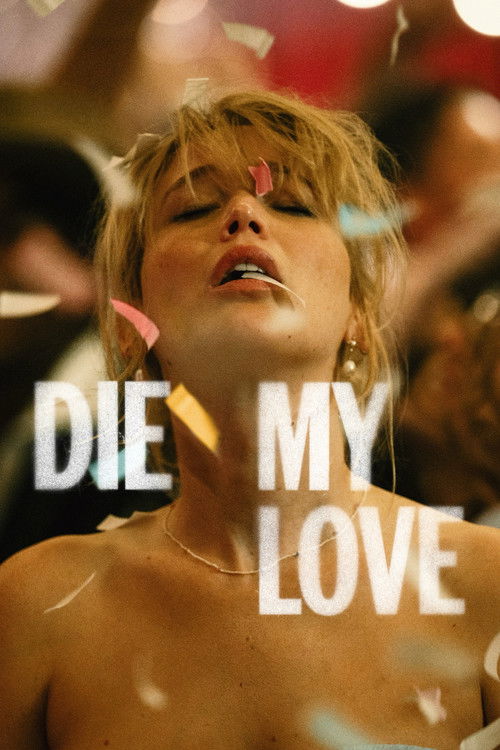
Die My Love
2025 · Lynne Ramsay
When you want to be shaken rather than soothed — a film for the mood where polite dramas feel like lies and you want something that bites. Absolutely not a cozy watch.
What it's about
Grace, a writer, follows her partner Jackson from New York to a remote inherited house in Montana, where they have a baby — and where the marriage quietly starts to rot. As Jackson absents himself and the isolation closes in, Grace's loneliness and stalled ambition curdle into something feral: a psychological free-fall the film plays as horror, black comedy, and love story all at once. It's postpartum crisis rendered from the inside, with the volume all the way up.
The experience
Abrasive, darkly funny, and genuinely unnerving — it puts you inside Grace's skin and refuses to let you out, alternating wild comic jolts with stretches of dread. You come out rattled, which is exactly the point.
Performances
Jennifer Lawrence goes further than she ever has — a fearless, full-body performance that swings from deadpan comedy to raw animal distress without a seam. Robert Pattinson plays Jackson's uselessness with sly precision, making the marriage's failure feel painfully ordinary.
The craft
Lynne Ramsay builds the film out of sensation — needling sound design, jagged cuts, images that slide between the real and the hallucinated — adapting Ariana Harwicz's knife-edged novel into pure subjective cinema. It sounds as aggressive as it looks; good speakers make it more uncomfortable, in the best way.
Why it matters
Ramsay's first film in eight years, and an instant landmark in the recent wave of cinema willing to show motherhood without sentimentality.
Snapshot
Die My Love is Lynne Ramsay's fifth feature and her first in eight years, following You Were Never Really Here (2017). Adapted from the Argentine writer Ariana Harwicz's 2012 novel Matate, amor (translated into English as Die, My Love by Sarah Moses and Carolina Orloff for Charco Press in 2017, and shortlisted for the International Booker Prize), the film transplants Harwicz's interior, knife-edged narrative of a young mother's unraveling from the rural France of the source to a remote house in Montana. Jennifer Lawrence plays Grace, a writer who follows her partner Jackson (Robert Pattinson) into an inherited country property; the birth of their child, Jackson's growing absence, and the suffocation of isolation send Grace into a feral psychological descent that the film stages as something between postpartum crisis, erotic hunger, and creative asphyxiation. The film premiered in competition at the 2025 Cannes Film Festival, where it was a Palme d'Or nominee and drew a lengthy standing ovation, and it was acquired in a landmark deal by MUBI. It is a work of pure Ramsay sensibility — sensory, elliptical, unsentimental about the violence of love — anchored by a performance of total commitment from Lawrence, who also produced.
Industry & production
The film sits at an unusual intersection of star-driven American production and rigorous European art cinema. It was produced through Jennifer Lawrence's company Excellent Cadaver (with Justine Ciarrocchi), Black Label Media (Molly Smith, Thad and Trent Luckinbill), and Martin Scorsese's Sikelia Productions, with Andrea Calderwood among the producers; Scorsese is credited as a producer, lending the project both prestige and protective cover for Ramsay's uncompromising method. That a director as deliberate and difficult-to-finance as Ramsay could mount a 35mm feature with two of the most bankable actors of their generation reflects Lawrence's deployment of her own capital — financial and reputational — in service of an auteur she sought out. After its May 17, 2025 Cannes premiere, MUBI acquired distribution rights across North and Latin America, the UK and Ireland, much of Europe, and other territories for a reported $24 million, described as the streamer-distributor's largest acquisition to date, paired with a substantial theatrical commitment (reported as roughly 1,500 U.S. screens). The U.S. theatrical release followed on November 7, 2025. The runtime is 119 minutes. A precise production budget is not part of the reliable public record, so I won't assign one.
Technology
Die My Love was photographed on 35mm film and composed in the boxy 1.33:1 Academy ratio — a deliberately archaic, near-square frame that walls the protagonist into the image. The choice of celluloid and the constricting aspect ratio are of a piece with Ramsay's broader rejection of contemporary digital gloss: grain, weight, and the physical chemistry of film become expressive tools for a story about bodies, instinct, and decay. The Academy frame also carries a specific cinephile lineage, evoking the claustrophobic domestic horror of an earlier era. Beyond format, the film does not foreground technological novelty; its modernity lies in craft rather than apparatus, and any claims about specific cameras, lenses, or lab processes beyond the 35mm/1.33:1 basis would go past what is documented.
Technique
Cinematography
The film reunites Ramsay with cinematographer Seamus McGarvey, who shot We Need to Talk About Kevin (2011). Reporting around the film indicates the visual approach drew explicitly on Roman Polanski's "apartment" horror — Repulsion and Rosemary's Baby — and that inheritance is legible in the conception: the square frame, the house as a psychic enclosure, the slippage between domestic surface and subjective dread. Ramsay's camera has always privileged the haptic and the fragmentary — close textures, bodies cut by the frame, light as mood rather than illumination — and McGarvey's work here serves that grammar, rendering the Montana property as both expansive wilderness and tightening trap. The 1.33:1 ratio is itself a cinematographic argument: it refuses the landscape its breadth and keeps Grace pinned at the center of a narrowing world.
Editing
The film was edited by Toni Froschhammer, notably not Ramsay's longtime collaborator Joe Bini, who cut You Were Never Really Here. Ramsay's editorial signature is elliptical and associative — she compresses, withholds, and lets sensation carry information that dialogue would otherwise spell out — and the film's structure reportedly favors a fractured, subjective montage that tracks Grace's deteriorating perception rather than a clean chronological account. Ramsay has spoken in interviews around the film about reworking the cut after Cannes, underscoring her habit of treating editing as an extension of authorship rather than mere assembly.
Mise-en-scène / staging
The single dominant setting — the inherited rural house and the land around it — is the film's organizing space, functioning the way confined interiors do throughout Ramsay's filmography: as an externalization of an interior state. Staging emphasizes Grace's physicality, her restlessness within rooms, her movement between the controlled domestic interior and the open, animal world outside. The presence of Jackson's parents — Nick Nolte as Harry and Sissy Spacek as Pam — and the neighbor Karl (LaKeith Stanfield) populate the isolation with figures who variously fail to reach, contain, or tempt Grace, keeping the drama anchored in concrete human encounters even as it pushes toward the hallucinatory.
Sound
Sound is central to Ramsay's cinema — she has described constructing films aurally as much as visually — and her work characteristically uses dense, tactile sound design and pointed musical juxtaposition to render subjectivity. Die My Love is credited to a music team of George Vjestica, Raife Burchell, and Ramsay herself, the director's compositional credit signaling how integral the sonic architecture is to her conception. (This departs from the high-profile Jonny Greenwood score of You Were Never Really Here.) Consistent with her practice, the film is expected to deploy needle-drops and abrasive sonic contrasts as instruments of mood and irony; specific track choices, however, are beyond what I can reliably document.
Performance
The film is a showcase for Jennifer Lawrence in a register far from her studio work — a raw, bodily, sometimes frightening portrait of postpartum disintegration that critics singled out as the film's center of gravity. Robert Pattinson's Jackson supplies the absent, evasive counterweight, continuing the actor's run of art-cinema collaborations. Sissy Spacek and Nick Nolte bring weathered gravity as Jackson's parents, and LaKeith Stanfield's Karl introduces a charged outside presence. The ensemble functions less as a network of psychologized characters than as figures orbiting Grace's consciousness, which is the film's organizing perspective.
Narrative & dramatic mode
The dramatic mode is subjective and expressionist rather than realist. Like its source novel — written in a feverish, first-person present tense that fuses desire, rage, and despair — the film privileges Grace's perception over external plotting, so that events arrive filtered through a deteriorating, eroticized, and at times unreliable consciousness. The arc is one of descent: an attempt at renewal curdles into entrapment, and the conventional beats of a relationship drama (a move, a baby, a strained marriage) are colonized by something closer to psychological horror. Ramsay characteristically refuses tidy causation or therapeutic explanation; the film withholds the reassurance of diagnosis even as it engages postpartum psychosis as subject. The result is a narrative that operates by intensity, repetition, and rupture rather than exposition.
Genre & cycle
Die My Love resists clean genre placement, sitting at the meeting point of the marital/psychological drama and the domestic horror film. Its reported debt to Polanski locates it within a lineage of films about women unraveling in confined domestic space, and it belongs to a broader contemporary cycle of "maternal horror" and unsentimental motherhood narratives that interrogate the gap between sanctioned images of new motherhood and lived psychological reality. It also fits within the prestige literary adaptation cycle and within MUBI's strategy of positioning auteur-driven art films for theatrical and awards attention. The film's marketing and some catalog listings tag it as a drama and thriller, but its truest affiliation is with the art-house psychodrama.
Authorship & method
This is unmistakably a Ramsay film. Across Ratcatcher (1999), Morvern Callar (2002), We Need to Talk About Kevin, and You Were Never Really Here, she has built a body of work defined by sensory immersion, fractured subjectivity, a fascination with grief, guilt, and violence, and a refusal of conventional psychological explanation — and Die My Love extends every one of those preoccupations, particularly the maternal anguish she explored from the other side in We Need to Talk About Kevin. The screenplay is credited to Ramsay with the playwright Enda Walsh and the dramatist-screenwriter Alice Birch (known for incisive, formally daring work on motherhood, female interiority, and adaptation), a collaboration that pairs Ramsay's image-led instincts with two of the most distinctive theatrical and screen writers working in the adaptation of difficult interior fiction. Key collaborators include cinematographer Seamus McGarvey (a returning partner), editor Toni Froschhammer, and the music team of George Vjestica, Raife Burchell, and Ramsay. Ramsay's method — protracted development, hands-on shaping of sound and cutting, post-premiere recutting — is well attested and consistent with her reputation as a deliberate, control-conscious auteur who works infrequently and on her own terms.
Movement / national cinema
Ramsay is a Scottish filmmaker who emerged from the British social-realist and art-cinema tradition of the late 1990s, though her sensibility has always been more poetic and continental than the kitchen-sink lineage suggests. Die My Love is a transnational production: a Scottish director and a British cinematographer adapting an Argentine novel (itself often associated with a wave of bold contemporary women writers in Latin American literature), shot in the United States with American stars and American and international financing. It thus belongs less to a single national cinema than to a globalized art-cinema circuit — the festival-to-MUBI pipeline — in which authorship travels across borders. Its DNA mixes British art cinema, European modernist subjectivity, and American independent and prestige production.
Era / period
The film is a product of the mid-2020s art-cinema economy, in which streaming-affiliated distributors like MUBI compete aggressively for festival premieres and pair them with theatrical runs to build prestige. Its arrival in 2025 also reflects a period in which major movie stars — Lawrence here, Pattinson across his recent career — have used their leverage to back uncompromising auteurs, and in which narratives of maternal ambivalence and postpartum crisis have gained cultural prominence. The use of 35mm and the Academy frame, meanwhile, marks a self-conscious mid-2020s tendency among art filmmakers to reclaim analog, "classical" formats as a stance against digital ubiquity.
Themes
The film's governing themes are motherhood and its discontents; the collision of love with isolation; female desire, rage, and creative frustration; and the porous boundary between sanity and breakdown. Grace's postpartum descent is rendered not as pathology to be solved but as a total existential condition — at once erotic, violent, and despairing — that exposes how romantic and domestic ideals can become forms of confinement. The film engages the gap between the cultural script of new motherhood and its psychic reality; the way rural isolation can amplify interior crisis; and the tension between identity and self-erasure. As in much of Ramsay's work, animality and the body recur as motifs, and the home becomes a site of dread. The title's imperative — die, my love — captures the fusion of tenderness and annihilation that the film treats as inseparable.
Reception, canon & influence
Die My Love premiered in competition at Cannes on May 17, 2025, as a Palme d'Or nominee, where it received a sustained standing ovation (reports of its length vary, in the range of roughly six to nine minutes). Critical reception was generally favorable but polarized: aggregators recorded a majority-positive critical consensus (around 75% on Rotten Tomatoes; a Metacritic score in the low 70s), with widespread praise for Lawrence's performance and Ramsay's direction, while general audiences responded far more coolly — a reported CinemaScore of D+ underscores how far the film's confrontational, anti-cathartic mode diverged from mainstream expectations set by its star casting. That split is itself characteristic of Ramsay, whose films tend to divide viewers along exactly this line.
Looking backward, the influences on the film are clear and largely acknowledged: Harwicz's novel as source; Polanski's Repulsion and Rosemary's Baby as a visual and tonal template for domestic horror in the Academy frame; and Ramsay's own oeuvre, especially the maternal terror of We Need to Talk About Kevin. One can also situate it within a longer tradition of cinema about women's psychological extremity in confined spaces, from Polanski through later art-house psychodramas.
Looking forward, the film's legacy is still being written — it is too recent for a settled critical verdict. Its most immediate significance is as evidence that uncompromising auteur cinema can still command major stars, premium financing, and a large distribution deal, reinforcing MUBI's emergence as a heavyweight in prestige distribution and strengthening the case for star-backed, director-driven adaptation of demanding literary fiction. Within Ramsay's career it stands as a long-awaited return that consolidates rather than redirects her concerns. Any claims about specific later films it has influenced would be premature, and I won't manufacture them.
Sources consulted for verification include the film's Wikipedia entry, the Festival de Cannes listing, and trade coverage from Deadline and Variety.
A Deleuzian reading
Start with the shape of the picture.
The full Deleuzian reading of Die My Love →
Reception
It arrived at Cannes 2025 as the festival's hottest ticket — a six-minute ovation and MUBI's splashy $24M deal — then left without a prize, and by its November release the buzz had settled into a genuine split: awe at Jennifer Lawrence, shrugs at the film around her.
How Die My Love was received, from release to now →
How to watch Die My Love: what to notice on a first viewing
- Notice the frame's shape: a near-square box, not widescreen. Ramsay and cinematographer Seamus McGarvey shoot Montana, one of the widest landscapes in America, in the boxy 1.33:1 Academy ratio, refusing the land its breadth around Grace. The frame narrows before anything happens to Grace. The format itself starts closing in on her.
- Watch how often Jennifer Lawrence moves close to the floor. Lawrence plays Grace crawling, prowling, and restless, moving between the house's controlled interior and the open field outside rather than simply standing and talking. Her body carries the disintegration that the dialogue never states directly.
- Watch how rarely the film leaves the inherited house and its land. The single dominant setting recurs and tightens around Grace, functioning the way confined interiors do throughout Ramsay's films, as the outside of an inside state. The house is not a backdrop. It is the shape of what is happening to her.
- Listen for abrupt needle drops breaking the quiet. Ramsay, credited alongside George Vjestica and Raife Burchell for the music, builds dense tactile sound design and sudden musical juxtapositions rather than a conventional score. The sound swings your mood before you consciously register why, the way Grace's own mood swings without warning.
- Notice the close, textured shots of skin, carpet, and surfaces. Ramsay's camera stays haptic and fragmentary throughout, favoring close textures and light used as mood over clean illumination or wide establishing views. The closeness keeps you inside sensation rather than at a safe, explaining distance from Grace.
The whole guide to watching Die My Love, with the keys for a rewatch →
Influences: the films it descends from and the films it influenced
- Repulsion (1965) — The template for staging a woman's psychosexual disintegration inside a single apartment, using spatial distortion, swelling textures, and amplified ambient sound to externalize a subjective unraveling — the explicitly acknowledged blueprint for the film's domestic-horror grammar.
- Rosemary's Baby (1968) — Recodes maternal anxiety and ordinary domestic ritual into creeping paranoid dread within the home, the second Polanski apartment film Ramsay cites as a tonal model for pregnancy/motherhood as horror.
- A Woman Under the Influence (1974) — Builds a domestic psychodrama entirely around a wife-mother's unraveling held in long, unsparing performance takes — the Gena Rowlands lineage of raw, uncomfortable, non-explanatory acting that Lawrence's postpartum performance extends.
- We Need to Talk About Kevin (2011) — Ramsay's own prior maternal-terror film with the same DP Seamus McGarvey: fractured non-linear montage, saturated color and tactile motifs (red, water, texture), and sound-led subjectivity, here approached from the same maternal-anguish vantage.
- Morvern Callar (2002) — Establishes Ramsay's signature use of needle-drop pop tracks as subjective emotional counterpoint and haptic, skin-close close-ups that render a woman's interiority through texture rather than dialogue.
- Jeanne Dielman, 23 quai du Commerce, 1080 Bruxelles (1975) — Codifies the confined domestic interior as a pressure chamber of feminine labor and routine, where durational staging of household space becomes the engine of psychological rupture.
- Possession (1981) — Channels marital and maternal collapse into hysterical, full-body physical performance, using the apartment as an arena for bodily extremity and animal abjection.
- Persona (1966) — The foundational use of facial close-up and elliptical, rupturing montage to dramatize the fragmentation and merging of a woman's identity.
- Don't Look Now (1973) — Pioneers the elliptical, associative editing that fuses grief, premonition, and eroticism across non-linear time — the cutting grammar behind the film's subjective expressionist descent.
- Images (1972) — Stages a woman's psychotic break in an isolated domestic setting, using sound design and unmarked cuts to dissolve the boundary between the real and the hallucinated.
- Saint Maud (2019) — Extends the British art-house psychological-horror lineage with a woman's subjective religious descent rendered through tactile sensory design and sound, body, and skin foregrounded over plot.
- Nightbitch (2024) — Pushes postpartum maternal identity into literal animality and the body, sharing the film's theme of motherhood dissolving the boundary between human and creature.
- The Lost Daughter (2021) — Dramatizes ambivalent, transgressive motherhood through fragmentary subjective flashback and tactile, anxious close-ups that keep the maternal interior unresolved and unjudged.
- Antichrist (2009) — A grief-stricken couple isolated in a remote home where maternal anguish is routed into animality, the body, and violence — the same yoking of motherhood, nature, and bodily horror in the academy-adjacent art-horror register.
- The Piano Teacher (2001) — Renders female psychosexual extremity and self-harm through austere domestic framing and a performance-forward refusal of psychological explanation.
- mother! (2017) — A claustrophobic, house-bound subjective POV horror locked to a besieged woman, escalating domestic space into expressionist nightmare through relentless close handheld proximity.
- The Babadook (2014) — Literalizes maternal grief and exhaustion as domestic horror inside a confined house, with an ambivalent, frayed mother at its center rather than a victim or monster.
- Fish Tank (2009) — The British art-cinema sibling: handheld, haptic naturalism and boxed academy-ratio framing built to immerse the viewer in a volatile woman's bodily, sensory subjectivity.
Similar films
- Morvern Callar (2002) — influence & lineage
- mother! (2017) — influence & lineage
- Possession (1981) — influence & lineage
- If I Had Legs I'd Kick You (2025) — shared sensibility
- The Currents (2025) — shared sensibility
- The Lobster (2015) — shared sensibility
- Love Letters (2025) — shared sensibility
- Sound of Falling (2025) — shared sensibility