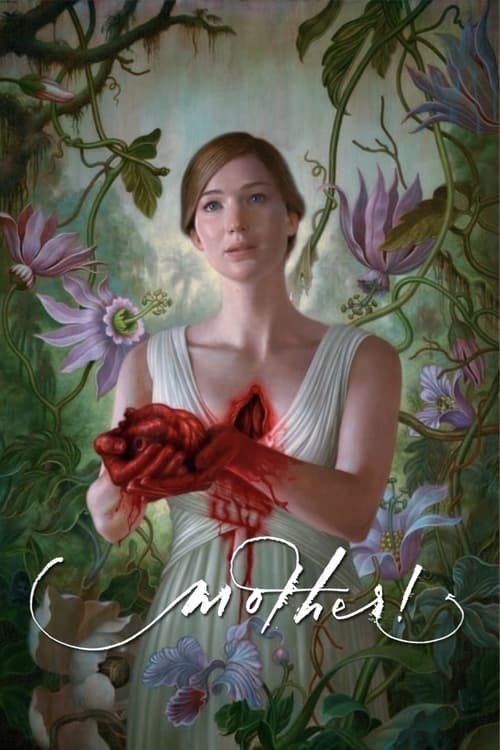
mother!
2017 · Darren Aronofsky
For a night when you want cinema as a dare — something confrontational you'll be dissecting with someone for days afterward. Emphatically not comfort viewing; reach for it when you're up for being provoked.
What it's about
A young woman is lovingly restoring a secluded country house for her husband, an older poet stalled on his writing, when a stranger knocks at the door. Her husband welcomes him in, then his wife, then more — and the trickle of uninvited guests becomes a flood that treats her home, her marriage, and finally her body as things to be used. What starts as an awkward houseguest drama keeps escalating into something far stranger and more violent, a fever dream about creation, worship, and how much one person can be asked to give.
The experience
It starts as a slow, skin-crawling social nightmare — that feeling of guests who won't leave, multiplied — and then accelerates into pure delirium, with a final act that plays like the walls of the film coming down around you. It's punishing, disorienting, and genuinely audacious; you come out shaken and immediately wanting to argue about what it all meant.
Performances
Jennifer Lawrence carries nearly every frame, playing mounting bewilderment and violation with the camera inches from her face, while Michelle Pfeiffer is deliciously venomous as a houseguest whose every line feels like a probing insult. Javier Bardem gives the poet a warmth that curdles into something needier and more unnerving.
The craft
Aronofsky shoots almost the entire film from the heroine's point of view — over her shoulder, on her face, wandering the house with her — so the invasion happens to you, not just to her. There's no conventional score; the film runs on creaking, murmuring, increasingly apocalyptic sound design, and the single-house staging makes the final act's scale feel impossible. Loud speakers and a dark room turn it from strange to overwhelming.
Why it matters
One of the most divisive wide releases a studio ever put out — it earned a rare F CinemaScore and became the flashpoint in the late-2010s argument over how far 'art horror' could go in multiplexes. It's now a fixture of any conversation about allegory, audience revolt, and directors spending mainstream capital on private obsessions.
Horror · Art-horror · Religious horror · Home invasion. Uninvited guests flood a secluded house in a claustrophobic allegory that builds slowly, then spirals into feverish, punishing delirium.
Snapshot
mother! is Darren Aronofsky's chamber-piece apocalypse: a home-invasion horror that swells, over roughly two hours confined to a single house, into a full biblical and ecological allegory. A young woman (Jennifer Lawrence) restores a country house for her much older husband, a blocked poet (Javier Bardem), while strangers steadily colonize their home and, by the film's delirious final act, dismantle it and her. Released by Paramount in the autumn of 2017 after a Venice competition premiere, it is among the most deliberately alienating films ever given a wide studio release — a fact the industry registered when audiences handed it a rare "F" CinemaScore. It sits at the center of the late-2010s argument about "art horror" as a commercial category, and it functions as a compendium of Aronofsky's abiding obsessions: bodily suffering, creation and the artist's ego, faith, and the woman as sacrificial vessel.
Industry & production
mother! was produced by Aronofsky's Protozoa Pictures and distributed by Paramount Pictures, a major studio releasing a formally hostile auteur film — an unusual bet that frames much of the picture's reception history. It was mounted on a comparatively modest budget for a film headlined by an Oscar-winning star at the peak of her Hunger Games/X-Men box-office power; I won't assign a precise figure, but the production was scaled as a controlled, largely single-location shoot rather than a tentpole. Principal photography took place in Montreal, where the entire house — the film's only real location — was constructed as a purpose-built, 360-degree set on a soundstage, engineered so the camera could move continuously through rooms and up stairs without conventional wild walls breaking the space. That architectural decision is the production's central creative fact: the film's claustrophobia and its escalating spatial chaos are functions of a set designed to be a single continuous organism.
The marketing, by contrast, is part of the story. Paramount sold the film on the ambiguous promise of a Jennifer Lawrence horror vehicle and a cryptic teaser campaign, which set audience expectations at a genre register the film explosively refuses. The gap between that positioning and the delivered allegory is widely understood as a driver of the punishing audience response. The film premiered in competition at the Venice Film Festival in 2017, contending for the Golden Lion, before its September theatrical release — a festival-to-multiplex path that underscores its split identity as both auteur object and studio product.
Technology
The film was shot photochemically on 16mm rather than digitally or on larger-gauge stock, a choice that suffuses the image with visible grain and a tactile, unglamorous intimacy at odds with Lawrence's star image. (I state the gauge with reasonable confidence; if any doubt remains it concerns the exact stock, not the decision to shoot on film for grain and closeness.) The technological signature of mother! is less about novel apparatus than about the marriage of that grainy film image to an intensely mobile, operator-driven camera and to a purpose-built revolving set that let takes run long and continuous. Its most conspicuous "effect" is in fact the near-total suppression of one: the film carries no conventional non-diegetic musical score, so its sonic architecture is built entirely from designed sound. The escalation of the climax — crowds, fire, collapse, violence — leans on practical crowd staging, physical set destruction, and sound design more than on foregrounded digital spectacle, keeping the technological work largely invisible in service of immersion.
Technique
Cinematography
Matthew Libatique, Aronofsky's most enduring visual collaborator, organizes the entire film around Jennifer Lawrence's face and point of view. The camera is almost always with her: over-the-shoulder as she moves through the house, or locked in unforgiving close-up on her reactions, or executing a subjective following shot that turns the audience into her nervous system. This is a rigorous, near-programmatic scheme — we rarely see anything she cannot see, and rarely leave her proximity — so that the mounting invasion registers first as a somatic pressure on a single face. The 16mm grain, shallow focus, and restless handheld/Steadicam movement build a documentary-adjacent intimacy that the second half detonates into vertiginous chaos. Libatique's coverage of the climactic apocalypse — pushing Lawrence through a house that has become a warren of atrocities — sustains the subjective grammar even as the space turns nightmarishly plastic, which is what makes the sequence feel less like spectacle than like drowning.
Editing
Andrew Weisblum, another long-standing Aronofsky editor, structures the film as a slow-burn accelerando. The first movement is patient, almost tense-domestic, holding on discomfort and social awkwardness; the second collapses time and cause, cutting faster and more associatively as the house fills and burns. Because the camera stays tethered to Lawrence, the editing cannot cross-cut to relieve pressure or explain events elsewhere — the cutting instead compresses her experience, so that the audience shares her disorientation about how much time has passed and how the crowd multiplied. The rhythm is the argument: a controlled build that becomes a headlong, near-continuous rush toward the sacrificial climax.
Mise-en-scène / staging
Every element serves the allegorical machine. The house is the film's body and its cosmos — the crystal in Bardem's study, the mysterious wound in the floorboards, the basement furnace, the endlessly repainted and re-violated rooms. Staging is theatrical in the strict sense: a single set, escalating occupancy, entrances and exits treated as intrusions. Aronofsky choreographs the second half as a Boschian tableau, a house-sized crowd scene of worship, riot, war, and desecration staged in continuous passage. The production design's neutral, timeless domesticity — no phones or clear period markers to anchor it — keeps the space legible as symbol rather than as a specific home.
Sound
Sound is arguably the film's primary expressive instrument. With no orchestral score, the world is rendered through designed diegetic sound and an intensified interior soundscape — creaks, breath, heartbeat-like low frequencies, the swelling roar of the crowd. Jóhann Jóhannsson, initially attached to compose, worked with Aronofsky toward the decision to forgo a traditional score and is credited for his contribution to the film's sound/music design rather than for a conventional score. The result is a soundtrack that behaves like subjective physiology, tightening around Lawrence's character and turning ambient noise into dread. The absence of music removes the audience's usual emotional guide-rail, which is central to the film's disorienting, unprotected feeling.
Performance
Jennifer Lawrence anchors the film almost entirely through reaction — hers is a role of watching, absorbing, and being violated, and the camera's fixation makes her micro-expressions the narrative. It is a physically punishing, deliberately un-showy performance that inverts her established star persona. Javier Bardem plays the poet-creator with an expansive, self-regarding warmth that curdles into vanity, embodying the allegory's God/artist figure. Ed Harris and Michelle Pfeiffer, as the first invaders, bring a needling, insinuating naturalism — Pfeiffer in particular is corrosive and funny — that grounds the escalating unreality in recognizable social menace. Domhnall and Brian Gleeson stage the Cain-and-Abel fratricide that tips the house toward chaos.
Narrative & dramatic mode
The film operates as sustained allegory rather than psychological realism, and it withholds the interpretive key for a long time, so that first-time viewers experience it as escalating domestic horror before the symbolic scaffolding declares itself. Characters are unnamed; the protagonist is credited as "mother." Dramatically it runs on intrusion and dispossession — the heroine's home and body are progressively taken from her by others' needs and her husband's hunger for adoration. The structure is bipartite: a chamber first half of unwelcome guests, and a second half that abandons plausibility for a compressed run through creation, worship, sin, war, and destruction. The mode is closest to a fever dream or a passion play, demanding to be read symbolically even as it assaults the viewer literally.
Genre & cycle
Nominally horror-drama, mother! is a hybrid: it borrows the machinery of the home-invasion thriller and the "apartment horror" of paranoid domestic entrapment, then routes both into surrealist allegory. It belongs to the late-2010s wave of ambitious, divisive "elevated" or art-horror, though it is a studio release rather than an A24 title, which makes it an outlier — a major-studio attempt at the register that independent distributors were cultivating in the same years. It is also legible within a lineage of allegorical-apocalyptic cinema and of films built as single-location pressure cookers.
Authorship & method
This is a maximal Aronofsky film — written and directed by him, and reportedly composed as a screenplay in a very short burst (accounts describe a matter of days), consistent with his description of the film as an urgent, expulsive act. It concentrates his recurring preoccupations: the suffering body (Requiem for a Dream, The Wrestler, Black Swan), the destructive collision of art/faith and ego (The Fountain, Black Swan), and biblical/creation myth (Noah, which immediately preceded it and shares its ecological anxiety). His key collaborators are the throughline of his authorship: cinematographer Matthew Libatique (with him since Pi), editor Andrew Weisblum, and, in the sound design that replaces score, Jóhann Jóhannsson. The absence of a traditional composer is itself an authorial statement from a filmmaker whose earlier work (Clint Mansell's Pi/Requiem/Black Swan scores) was defined by insistent music; here Aronofsky strips that support away. Aronofsky has openly offered the environmental and biblical readings — mother as Mother Earth/creation, the poet as a demanding God, the house as the world consumed by its inhabitants — which makes mother! one of his most explicitly programmatic films.
Movement / national cinema
mother! is a work of American studio-financed auteur cinema with no strong national-movement affiliation; its lineage is aesthetic rather than geographic, running through European surrealism (Buñuel) and the paranoid modernism of Polanski more than through any contemporary national school. Its production in Montreal is a matter of studio economics and set-building logistics rather than an engagement with Québécois or Canadian cinema. If it belongs to a "movement," it is the diffuse international current of festival-launched art-horror.
Era / period
The film is a product of the mid-2010s moment when auteur horror was ascending critically and commercially and when a major studio might gamble on a formally extreme film built around a bankable star. Its ecological allegory speaks directly to the period's intensifying climate anxiety, and its portrait of a swelling, entitled, self-devouring crowd reads against a late-2010s culture of mass attention and desecration. Deliberately unmoored from period detail on screen, it nonetheless registers as a 2017 object in its very existence — the studio-scale art-horror provocation, and the CinemaScore controversy that surrounded it.
Themes
The film's dominant themes are creation and consumption: the artist/God who creates in order to be adored, and the world/woman consumed to feed that need. It is at once an environmental parable (Earth as a woman despoiled by humanity's occupancy) and a biblical compression from Genesis to Revelation — the couple in an Eden, the first guests and their sons as Adam, Eve, Cain, and Abel, the escalating congregation as humanity's sins, war, and idolatry, and a final sacrificial cycle that begins again. It is also a caustic study of the artist's marriage and ego, of a woman's home and body claimed by others, and of faith as both creation and destruction. The film insists these registers are the same story.
Reception, canon & influence
Critical reception was sharply polarized — the film drew serious critical defenders who prized its formal audacity and allegorical ambition alongside detractors who found it hectoring, punishing, or self-important — and that split is itself the film's defining reception fact. The most cited data point is the audience response: mother! received an "F" CinemaScore, one of the very small number of films ever to earn that grade, a striking outcome for a wide studio release headlined by a major star and a marker of how far its delivery diverged from marketed expectations. It underperformed commercial hopes; I'll refrain from asserting exact grosses, but its reputation as a costly provocation rests on the collision between its star wattage and its audience rejection.
Its influences run backward to Luis Buñuel's bourgeois-siege surrealism (the dinner-party logic of The Exterminating Angel), to Roman Polanski's paranoid domestic horror (Rosemary's Baby, Repulsion), to the passion-play and apocalyptic traditions, and to Aronofsky's own Noah and The Fountain. Forward influence is, honestly, still emerging — the film is recent enough that its legacy is not yet settled, and I won't overstate it. What can be said is that mother! has become a durable reference point in the ongoing debate about how far mainstream distribution can accommodate deliberately alienating art-horror, and a touchstone for the polarizing, allegory-forward horror that defined the late 2010s. Its afterlife lives partly in criticism and cinephile argument — a film routinely invoked when the question is how much difficulty an audience will bear — rather than in a clear school of imitators.
A Deleuzian reading
A woman walks into a room and the camera comes in behind her shoulder and does not leave.
The full Deleuzian reading of mother! →
Reception
Booed at its Venice premiere, slapped with a rare F CinemaScore, and abandoned by mainstream audiences in 2017 — yet it never faded; it's since hardened into a passionately defended cult film whose champions insist the mass rejection was the point.
How mother! was received, from release to now →
How to watch mother!: what to notice on a first viewing
- Watch the camera stay over Lawrence's shoulder as she crosses the house. Libatique keeps the lens locked to her point of view; you rarely see a room before she does, and rarely leave her side. The invasion reaches you as pressure on one body before it reaches you as plot.
- Listen for creaks, breath, and low heartbeat-like frequencies instead of music. Aronofsky and Jóhannsson build the entire soundtrack from designed diegetic noise; there is no score to tell you how to feel. Without a musical guide-rail, ordinary house sounds start to feel like your own nervous system.
- Notice how much Lawrence's character cleans, repaints, and tidies the house. Her hands stay busy through the whole film, hosting, fixing, asking guests to leave, and none of it changes anything. She has action without effect, a mismatch that is the real horror underneath the intruders.
- Watch how many strangers enter through the front door and never leave. Each newcomer is treated as an intrusion the house absorbs; the rooms fill but the film never cuts away to show anywhere else. The house becomes a closed world where everything you fear has to come in through that one door.
The whole guide to watching mother!, with the keys for a rewatch →
Influences: the films it descends from and the films it influenced
- Rosemary's Baby (1968) — Tethers the camera to a pregnant woman inside a single apartment so the audience only knows what she knows, turning domestic hospitality and invasive 'helpful' guests into creeping paranoid horror — the exact confined-subjectivity template mother! adopts.
- Repulsion (1965) — Renders an apartment as an unstable psychic membrane — cracking walls, grasping hands, warping space — using subjective distortion of a domestic interior as the primary horror device rather than an external monster.
- The Tenant (1976) — Builds dread from neighbors/intruders colonizing the protagonist's dwelling until his sense of ownership and self dissolves, the persecuted-in-your-own-home siege logic mother! escalates to apocalypse.
- The Exterminating Angel (1962) — Establishes the surreal-siege grammar of bourgeois guests who inexplicably will not leave and degrade a hosting household into chaos — the absurd 'they keep coming and won't go' escalation Aronofsky cites directly.
- Teorema (1968) — Uses a mysterious visitor entering a household as a rigorously programmatic allegory, staging characters as theological ciphers rather than psychological people — the same parable-first construction mother! deploys.
- The Passion of Joan of Arc (1928) — Carries an entire drama on sustained close-ups of a suffering woman's face and her reactions to tormentors, the reaction-acting-in-close-up mode Libatique glues to Lawrence throughout.
- Come and See (1985) — Pins the camera to a protagonist's shell-shocked face while subjective, ringing sound design and a relentless accelerando drag the viewer through a widening nightmare — the sensory-assault escalation mother! mirrors.
- The Fountain (2006) — Aronofsky's own earlier creation-and-mortality allegory with Libatique, working myth as explicit programmatic structure and foreshadowing mother!'s cyclical-creation ending.
- Black Swan (2010) — Perfects the handheld Steadicam locked to the back and face of a single unraveling woman, keeping her in shallow-focus close-up while reality frays at the edges — the precise camera method reused in mother!
- Noah (2014) — Immediately precedes mother! and supplies its biblical-creation scaffolding and ecological anxiety, treating scripture as raw material for an environmental parable.
- Festen (The Celebration) (1998) — Uses jittery handheld camerawork to detonate a family gathering inside a single house, a domestic ritual disintegrating into collective violence — the confined-house-party-collapse staging mother! amplifies.
- Possession (1981) — Locks a handheld camera to a single overwhelmed woman while the household escalates into operatic hysteria, replicating Possession's tempo of mounting domestic apocalypse.
- Hereditary (2018) — Treats the family house as a slowly invaded diorama and builds a slow-burn accelerando toward an apocalyptic climax, extending late-2010s elevated art-horror's reliance on reaction acting and domestic-space dread.
- Antichrist (2009) — Deploys punishing art-horror allegory around a couple in an isolated setting, using formal audacity and unscored dread as deliberate provocation aimed at alienating rather than comforting the audience.
- Melancholia (2011) — Stages a cosmic apocalypse entirely through a bourgeois estate and a disintegrating house party, making a domestic celebration the microcosmic vessel for world-ending allegory.
- Son of Saul (2015) — Locks a shallow-focus handheld lens to the nape and face of one protagonist while the horror blurs at the frame's edges, an extreme subjective-immersion tactic parallel to Libatique's face-glued camera.
- Sicario (2015) — Uses Jóhann Jóhannsson's drone-and-texture 'score-as-sound-design' method — sustained sonic pressure replacing melody — the same collaborator approach that lets mother! run without a conventional score.
- The Killing of a Sacred Deer (2017) — Frames a home invasion as a merciless mythic parable in which an intruder methodically dismantles a family per an allegorical logic, deadpan and punishing rather than psychologically naturalistic.
- Alien: Covenant (2017) — Renders creation as Genesis/Paradise Lost allegory with an artist-god protagonist who destroys what he makes, sharing Covenant's literary creation-myth frame.
- Midsommar (2019) — Shares the strategy of an escalating allegorical ordeal staged as total environment, with a woman's psyche externalized into the house/commune around her and a crowd turning ritually, even cannibalistically, upon her.
- Die My Love (2025) — A claustrophobic, house-bound subjective POV horror locked to a besieged woman, escalating domestic space into expressionist nightmare through relentless close handheld proximity.
- Suspiria (2018) — Allegorical art-horror that escalates a closed domestic space into bodily apocalypse, a parallel bet that horror can carry dense historical/mythic allegory.
- Beau Is Afraid (2023) — Subjective-claustrophobic anxiety escalation locking a passive protagonist inside an allegorical house that mutates around maternal/creation guilt — Beau's sustained-discomfort editing rhythm.
Similar films
- Black Swan (2010) — influence & lineage · often watched together
- Hereditary (2018) — influence & lineage
- Antichrist (2009) — influence & lineage
- The Killing of a Sacred Deer (2017) — influence & lineage
- Us (2019) — same viewing thread
- Funny Games (1997) — same viewing thread
- Funny Games (2008) — same viewing thread
- Midsommar (2019) — often watched together
All the films related to mother! →
Watch it with: curated runs of related films
- When Everyone Finally Snaps — A run of films where an ordinary scene — a birthday dinner, a small town, a quiet house, a man at the end of his patience — gets pushed past its breaking point until the whole social order detonates.
- The Fear of God — A run of horror where faith is the battleground: believers, doubters and zealots meet the devil, damnation and an afterlife that answers back, from Puritan farms and Roman convents to the catacombs under Paris.
- Uninvited: The Home Under Siege — A run of films where the threat gets inside the house, whether it knocks politely, cons its way in, rings from upstairs or was already living in the basement. Watched together, they show how one premise moves from 1950s noir and the 60s thriller through slashers and French extremity to class satire.