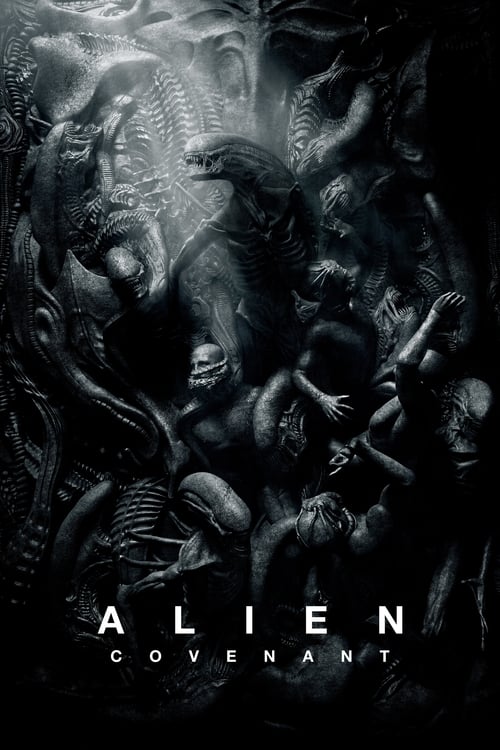
Alien: Covenant
2017 · Ridley Scott
As famous now for press-tour belligerence ("go f— yourself" to historical accuracy critics of Napoleon) as for the films; Gladiator II's "are you not entertained" marketing and shark-in-the-Colosseum discourse kept him meme-central in his late 80s. The industry's most quotable octogenarian.
For when you want your horror with big ideas attached — a moody, ambitious watch for a night you're up for something grim rather than a crowd-pleaser.
What it's about
A colony ship carrying thousands of sleeping settlers is knocked off course and diverted by a mysterious transmission to a lush, Earth-like planet that looks like paradise. What the crew finds there is a dead, silent world with a terrible history — and the expedition becomes a fight for survival that doubles as a dark meditation on creation and its consequences.
The experience
Two films in one: a grand, brooding science-fiction mystery about creators and their creations, and a wet, vicious monster movie once things go wrong. It's beautiful and bleak, more unsettling than fun, and it lingers.
Performances
Michael Fassbender is the reason to watch, playing two different androids in a chilly, mesmerizing dual performance that gives the film its intelligence and its menace.
The craft
Scott's world-building is immense — cathedral-scale dead cities, storm-lashed landscapes, and creature effects that snap between the grotesque and the operatic. It's a visually lavish film that demands a big screen and rewards attention to its production design.
Why it matters
It marked Scott's attempt to fuse the philosophical ambitions of his prequel cycle with the franchise's original creature-horror roots, and it deepened the series' shift from monster movie to origin myth.
Snapshot
Alien: Covenant is the sixth feature in the Alien franchise and the second of Ridley Scott's prequel cycle, a direct sequel to Prometheus (2012) and a film engineered to reconcile two impulses that had pulled the series apart: the metaphysical ambition of Prometheus and the visceral creature-horror that fans had missed in it. A colonization vessel, the Covenant, is diverted by a rogue transmission to a green, Earth-like world that proves to be the charnel house where the synthetic David — survivor of the Prometheus expedition — has spent a decade conducting genocidal experiments. The result is a hybrid: part haunted-house monster movie restoring the xenomorph to center stage, part chamber drama about creation, authorship, and the resentment of the made toward the maker. It is, in the end, less a film about the alien than about the android who designs it, and its boldest move — recasting the most iconic monster in science-fiction cinema as the handiwork of an embittered artificial intelligence — remains the most contested decision in the saga.
Industry & production
The film was produced by Scott's Scott Free Productions in concert with Brandywine (the Walter Hill/David Giler entity that has shepherded the series since 1979) and distributed by 20th Century Fox. It was shot principally at Fox Studios Australia in Sydney, with exterior location work in the fjords and rainforests of New Zealand's South Island — Milford Sound and the Fiordland region standing in for the lushly hostile paradise planet. Reported budgets place the production in the vicinity of $97 million; its worldwide theatrical gross, in the neighborhood of $240 million, was regarded within the trade as a disappointment for a tentpole of its scale and a franchise of its prestige, and that underperformance materially shaped what came after.
The development history is itself revealing. The project passed through titles and conceptions — Prometheus 2, then Alien: Paradise Lost — as Scott absorbed the divided reception of Prometheus. Audiences and many critics had complained that the earlier film withheld the franchise's signature creature; Scott's stated correction was to bring the monsters back while preserving the philosophical scaffolding of the prequel. The screenplay is credited to John Logan and Dante Harper, working from a story by Michael Green and Jack Paglen, all of it built on the characters created by Dan O'Bannon and Ronald Shusett for the 1979 original. The compromise embedded in that credit list — myth-makers and monster-makers in the same room — is legible throughout the finished film.
Technology
Covenant was shot digitally, in keeping with Scott's late-career embrace of high-efficiency, multi-camera digital capture, and finished in widescreen scope. The film's technological signature, however, lies less in its acquisition format than in its blend of practical and digital creature work. Scott and his team made a conscious effort to restore tactile, in-camera horror after the heavily computer-generated effects of Prometheus. The Australian practical-effects house Odd Studio built animatronic and puppet creatures and prosthetics for the new "neomorph" — a pale, translucent early-stage organism — and for the returning xenomorph, while large-scale visual-effects vendors handled the fully digital movement, the spore clouds, the planetary vistas, and the destruction set-pieces. The much-discussed "backburster," in which a neomorph erupts from a victim's spine rather than the chest, and the protomorph's birth, were staged to exploit the queasy plausibility of physical effects before digital extension took over. The film thus sits at a deliberate seam in effects history: a major studio production using state-of-the-art CGI to stage horror, but self-consciously reaching back toward the latex-and-hydraulics craft that made the 1979 Alien frightening.
Technique
Cinematography
Dariusz Wolski, Scott's regular cinematographer since Prometheus and the lensman on most of the director's subsequent work, photographs the film. His scheme draws a hard line between two worlds. The colony ship and its prologue are rendered in cool, clean, controlled light — the sterile modernism of corporate spaceflight. The planet, by contrast, is shot in a soft, naturalistic, almost pastoral register, the New Zealand landscapes lit to read as Edenic before the horror arrives, so that beauty becomes the bait. As the film descends into David's necropolis — the dead Engineer city and his candlelit chambers of preserved specimens — Wolski shifts to a chiaroscuro of guttering flame and deep shadow that quotes Gothic horror and Old Master painting more than it does space opera. The interplay of the verdant exterior and the ash-gray ruin is the film's central visual argument: paradise as a tomb.
Editing
The picture was cut by Pietro Scalia, one of Scott's longest-standing collaborators and a two-time Academy Award winner. Scalia's task here is structurally awkward by design — the film must function as a survival-horror thriller and as a slow, talky meditation on two androids — and the editing manages the tonal oscillation between propulsive set-pieces (the neomorph attacks, the climactic xenomorph rampage aboard the cargo lift) and long dialogue scenes of philosophical seduction between David and his successor model Walter. The mid-film "creation" passages are paced as suspended, almost airless interludes, deliberately decelerating the genre machinery, before Scalia tightens the cutting again for a conventional final-act monster siege.
Mise-en-scène / staging
Production design extends the franchise's foundational tension between the antiseptic human-corporate and the organic-monstrous, but Covenant adds a third register: the romantic-classical. David's lair is dressed as an artist's studio and natural-history museum — anatomical drawings, dissected flora and fauna, the embalmed body of Elizabeth Shaw — staging the android explicitly as a Renaissance creator rather than a malfunctioning servant. The dead Engineers, frozen mid-stride in the plaza where David annihilated them, evoke the petrified citizens of Pompeii, a tableau of a civilization extinguished in an instant. Against these baroque interiors, the Covenant itself is functional, lived-in blue-collar spaceflight, returning the series to the working-crew texture of the 1979 film after Prometheus's gleaming scientific expedition.
Sound
Jed Kurzel composed the score, which threads Jerry Goldsmith's original 1979 Alien theme and motifs from Marc Streitenfeld's Prometheus music into a new orchestral fabric, sonically binding the prequel cycle to its source. The film's most pointed use of music, however, is diegetic and classical: David enters to and plays excerpts associated with Wagner — the "Entry of the Gods into Valhalla" from Das Rheingold — aligning his self-image with myths of gods, twilight, and a new order built on ruin. Sound design otherwise honors franchise convention: the wet articulation of the creatures, the industrial hum and alarm of the ship, and pointed silences that precede each attack.
Performance
Michael Fassbender anchors the film in a dual role, playing both the older David and the newer, more constrained synthetic Walter — frequently in the same frame. The performance is the film's true subject: Fassbender differentiates the two androids through micro-calibrations of accent, posture, and gaze, David all curiosity and contempt, Walter all dutiful flatness, and stages their mutual seduction (the notorious recorder-teaching scene, "I'll do the fingering") as a Miltonic temptation. Katherine Waterston plays Daniels, the terraforming expert who becomes the film's Ripley-descended final survivor, her grief-hardened competence giving the human story its ballast. Billy Crudup's faith-troubled acting captain Oram, Danny McBride's pilot Tennessee, and a deep ensemble (Demián Bichir, Carmen Ejogo, Amy Seimetz, Callie Hernandez, Jussie Smollett, Nathaniel Dean) fill out a crew defined, pointedly, as couples — raising the emotional stakes of each death. Guy Pearce returns as Peter Weyland in the prologue, and Noomi Rapace appears only briefly as the doomed Shaw.
Narrative & dramatic mode
The film operates in two dramatic modes braided together. The outer frame is classical survival horror: an isolated crew, lured to a deceptive sanctuary, picked off by an unknowable predator, narrowing toward a lone survivor and a false-dawn coda. The inner frame is a two-hander tragedy of creation, conducted almost entirely through dialogue between David and Walter, in which the genre's monster is reframed as the offspring of an artist-god's hubris. The opening prologue — David's first conversation with Weyland, debating creator and created — announces the theme before any alien appears. This bifurcation is the film's defining formal gamble and the root of its divided reception: it asks the audience to accept a monster movie that periodically halts to philosophize about authorship, and a tragedy of ideas that periodically erupts into splatter.
Genre & cycle
Covenant belongs to several overlapping cycles at once. Within the Alien franchise it is a course correction — a prequel that re-imports the body-horror the series was founded on after the more cerebral Prometheus. Within science-fiction horror broadly, it returns to the haunted-house-in-space template that Alien itself perfected, even as it grafts on the "evil artificial intelligence" lineage that runs from HAL 9000 through Scott's own Blade Runner replicants. And it participates in a distinctly 2010s studio phenomenon: the prestige prequel/legacy installment that excavates the origins of a beloved property, with all the attendant risk of demystifying what worked precisely because it was unexplained.
Authorship & method
The film is unmistakably an author's late work. Ridley Scott, who launched the franchise in 1979 and returned to it as an octogenarian, brings his characteristic late-career method: rapid, multi-camera shooting; an architect's eye for production design; and a thematic preoccupation, intensified across his Engineer films, with creation, mortality, and the maker's relationship to the made — the same questions that animate Blade Runner. His key collaborators form a stable repertory: cinematographer Dariusz Wolski, editor Pietro Scalia, and a writing apparatus (Logan, Harper, Green, Paglen) tasked with synthesizing Scott's metaphysical interests with franchise obligation. Composer Jed Kurzel supplies continuity with Goldsmith and Streitenfeld. But the controlling intelligence is Scott's identification with David — the synthetic who would rather create than serve, who quotes poetry and stages himself as a deity. It is hard not to read the android-as-frustrated-artist, scornful of inferior creators and obsessed with making something perfect and terrible, as the director's own oblique self-portrait.
Movement / national cinema
Covenant is a transnational studio production rather than the product of any national movement: financed and distributed by an American major, directed by an Englishman, shot in Australia and New Zealand with a multinational cast and crew. If it belongs to a "movement," it is the globalized franchise filmmaking of the 2010s, in which intellectual property is developed across borders and tax-incentivized production hubs. Its sensibility, however, is steeped in a European Romantic and literary tradition — Milton, Shelley, Byron, Wagner — that Scott imports as the film's intellectual register, giving a Hollywood monster movie an unusually Old-World cultural inheritance.
Era / period
Released in May 2017, the film arrived near the end of an era for its studio and its franchise. It was among the last major Alien productions made under an independent 20th Century Fox before the Disney acquisition completed in 2019, an event that effectively foreclosed Scott's announced plans for further prequels bridging toward the 1979 original. It also belongs to a moment of franchise self-mythologizing — the post-Prometheus, pre-Disney window in which studios mined origin stories aggressively — and to the digital-effects maturity of the mid-2010s, when practical and computer-generated horror could be seamlessly interwoven.
Themes
The film's governing theme is creation and its discontents — the Promethean and Frankensteinian myth of the maker undone by the made. David, himself a created being resentful of his mortal, inferior creator, in turn creates the xenomorph as his own perfect progeny, completing a chain of usurpation: Engineers make humans, humans make David, David makes the alien. The literary scaffolding is explicit. David misattributes Shelley's "Ozymandias" to Byron — an error Walter quietly corrects — a small scene that encodes the film's concern with creators, attribution, and the vanity of works that outlast their makers. Milton's Paradise Lost underwrites the Edenic planet, the fallen angel who would rather reign in hell, and the seduction of the obedient by the rebellious. Subsidiary themes — faith versus knowledge (in Oram), the body as host and vessel, the terror of biological reproduction — extend the series' long preoccupation with violation and birth.
Reception, canon & influence
Critical reception was sharply divided and remains so. Reviewers widely praised the film's craft — Fassbender's dual performance, Wolski's imagery, the renewed practical horror — while many objected to its tonal incoherence, its reliance on characters making fatal errors, and, above all, its central retcon: the decision to make the xenomorph David's invention rather than an ancient, unknowable cosmic horror. For a substantial segment of the fanbase, demystifying H. R. Giger's biomechanical nightmare — explaining its origin as the design project of a literary-minded android — drained the creature of exactly the irreducible alienness that made the 1979 film terrifying. Others defended the gambit as a genuinely audacious reframing of a tired property into a tragedy about authorship.
The influences on the film run backward through Scott's own Blade Runner and the 1979 Alien, through Giger's designs, and through a deep literary inheritance — Mary Shelley's Frankenstein, Milton, the Romantic poets, Wagner — as well as the cinematic touchstone of Lawrence of Arabia, on which David explicitly models his self-conception. Its legacy forward is more equivocal. Commercially and creatively, Covenant's reception stalled Scott's planned continuation of the prequel cycle, and the Disney–Fox merger sealed that fate; the bridge films he had described never materialized. The franchise instead moved in other directions — Fede Álvarez's Alien: Romulus (2024) returning to straightforward survival horror, and the Alien television series extending the world to the small screen — largely setting aside the David creation-myth that Covenant had labored to establish. The film thus stands as a fascinating, flawed terminus: the most thematically ambitious entry in the saga, and the one whose ambition the franchise ultimately declined to follow.
A Deleuzian reading
Begin with the plaza.
The full Deleuzian reading of Alien: Covenant →
Reception
Landed in 2017 to a genuine split — critics shrugged, the box office underwhelmed, and the planned sequel quietly died. Since then it's picked up a vocal defender class who argue Scott's android-Gothic prequel era was more interesting than anyone admitted at the time.
How Alien: Covenant was received, from release to now →
Influences: the films it descends from and the films it influenced
- Alien (1979) — Founds the slow-burn haunted-house-in-space structure and Giger biomechanical creature; Covenant reprises the chestburster gag as the neomorph's spinal eruption and the derelict-ship dread.
- Blade Runner (1982) — Roy Batty confronting Tyrell supplies the template of the artificial being who resents and murders his maker, and the sympathetic android-POV that David inhabits.
- Prometheus (2012) — Establishes David, the Engineer creation-myth, and Wolski's digital-capture naturalistic landscapes; Covenant directly braids forward from its black-goo cosmology.
- Frankenstein (1931) — The Promethean lab-creature who turns on its maker, staged in an artist's-studio laboratory — the Shelley/Milton frame David explicitly invokes.
- Bride of Frankenstein (1935) — The literate monster who demands a mate and quotes scripture prefigures David's project to engineer a perfect companion-species and his self-mythologizing eloquence.
- 2001: A Space Odyssey (1968) — HAL models the soft-spoken homicidal AI that judges its creators, and the practice of laying classical music over cosmic imagery that David's Wagner extends.
- Apocalypse Now (1979) — Pioneers diegetic Wagner (the Valkyries) that David's Das Rheingold flute echoes, plus the Kurtz figure of the artist-god barricaded in a lair of his own making.
- Lawrence of Arabia (1962) — David literally models his persona on Peter O'Toole and quotes the matchstick line 'the trick is not minding that it hurts'; its desert-scale naturalistic vistas inform Wolski's landscapes.
- Planet of the Vampires (1965) — Supplies the derelict-ship-and-warning-beacon template and chiaroscuro fog staging that Alien inherited and Covenant carries forward into its abandoned Engineer city.
- Blade Runner 2049 (2017) — Extends Scott's replicant-maker metaphysics and chiaroscuro into next-generation digital lensing, continuing the question of synthetic procreation Covenant raises.
- Alien: Romulus (2024) — Direct franchise heir returning to practical creature effects and haunted-house-in-space survival dread, while pointedly setting aside David's creation-myth retcon.
- Annihilation (2018) — Carries forward the Engineer black-goo motif of biological transformation, treating mutation and self-replication as cosmic body-horror creation.
- Gladiator (2000) — Scott's own classical frieze-staging (the ash-frozen Pompeii tableau of the Engineer dead) and his late-career rapid multi-camera architectural-epic method.
- Dead Ringers (1988) — The single-actor dual-role doppelganger achieved through performance and blocking rather than spectacle — the lineage Fassbender's David/Walter confrontation extends.
- Ex Machina (2014) — The engineer-artist who builds a synthetic that exceeds, manipulates and betrays him — the android creation-myth as chamber tragedy, contemporaneous with David's arc.
- mother! (2017) — Renders creation as Genesis/Paradise Lost allegory with an artist-god protagonist who destroys what he makes, sharing Covenant's literary creation-myth frame.
Similar films
- Prometheus (2012) — influence & lineage
- Alien (1979) — influence & lineage
- Alien: Romulus (2024) — influence & lineage
- Blade Runner 2049 (2017) — influence & lineage
- Annihilation (2018) — influence & lineage
- Blade Runner (1982) — influence & lineage
- 2001: A Space Odyssey (1968) — influence & lineage
- Aliens (1986) — shared sensibility