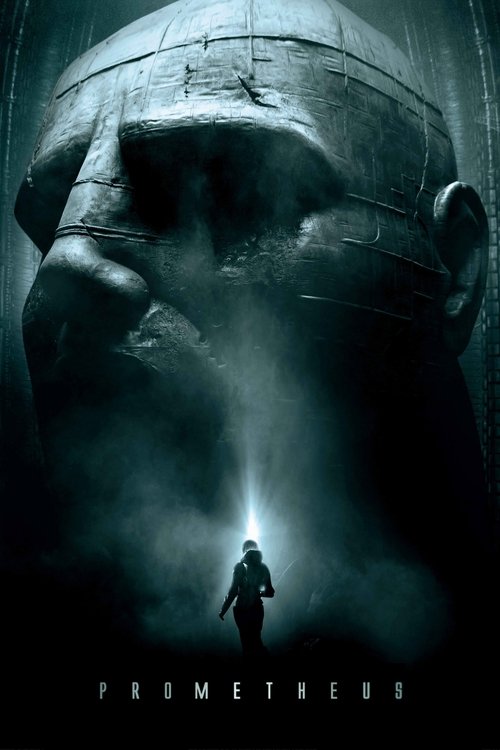
Prometheus
2012 · Ridley Scott
For when you want spectacle with a chill in it — big cosmic ideas, gorgeous menace, and a few real scares. Reach for it when you'd rather be awed and unsettled than comforted.
What it's about
Archaeologists find the same star map painted in caves across the ancient world and take it as an invitation from humanity's makers. A trillion-dollar expedition — scientists, corporate minders, and an unnervingly curious android — travels to a distant moon to meet them. What they find raises harder questions about where we came from, and why.
The experience
Slow-burning awe that tips into body-horror dread — long stretches of grandeur and mystery punctured by moments of genuinely squirm-inducing intensity, including one of the most notorious emergency-surgery scenes in modern sci-fi. It leaves you arguing about its big questions on the way out.
Performances
Michael Fassbender's android David is the film's great creation — polite, watchful, faintly wounded, and impossible to read — and Noomi Rapace grounds the horror with ferocious physical commitment.
The craft
Ridley Scott builds one of the most tactile worlds in modern science fiction: monumental sets, real vistas, and hardware you can practically touch, shot in 3D with a painter's eye. It absolutely demands the biggest screen and best sound you can find — the scale is the point.
Why it matters
One of the most divisive blockbusters of its decade, it relaunched the Alien universe as a philosophical prequel saga and reset the bar for how lavish and idea-driven studio sci-fi could look.
Snapshot
Prometheus is Ridley Scott's return to the science-fiction universe he helped originate with Alien (1979), conceived as a partial prequel that mutated, during development, into something Scott preferred to call a standalone story sharing "strands of Alien's DNA." Shot in 3D on a reported budget in the region of $120–130 million, it pairs spectacular hardware-and-vista spectacle with a deliberately metaphysical inquiry into human origins, divine abandonment, and the hubris of creation. The result is one of the most divisive major studio films of its decade: visually commanding, thematically ambitious, and narratively fractious, with characters whose decisions critics widely faulted even as they praised the craft surrounding them. It is best understood as a film at war with its own franchise obligations — torn between answering the questions Alien left open and refusing the closure that answering would require.
Industry & production
The project's gestation ran through Twentieth Century Fox across the latter 2000s. Scott had long resisted returning to the Alien property; the impetus came partly from his interest in the "Space Jockey," the fossilized pilot glimpsed in the derelict ship in Alien, a single production-design detail (originated by H.R. Giger and Ron Cobb's milieu) that Scott expanded into a whole mythology of "Engineers." An early screenplay by Jon Spaihts was substantially rewritten by Damon Lindelof, then riding high from Lost; Lindelof pushed the film away from explicit Alien iconography toward a more open-ended origin parable, a decision that shaped both its ambitions and its later reputation for unresolved threads.
Fox positioned the film as a prestige tentpole, releasing it in summer 2012 with an R rating in the United States — notable for a studio film of that scale, and a sign of confidence in Scott's brand. The production was a transnational, effects-heavy enterprise: principal photography took place largely at Pinewood Studios in England, with location work in Iceland (the volcanic landscapes of the opening) and Wadi Rum in Jordan standing in for the alien moon LV-223's exteriors. The film was marketed with an unusually elaborate viral campaign, including in-world video pieces — a Peter Weyland TED Talk set in 2023 and a David 8 android promotional spot — that extended the fiction beyond the screen and signaled the film's preoccupation with corporate futurism. A follow-up, Alien: Covenant (2017), would course-correct back toward overt franchise horror, retroactively clarifying how unsettled Prometheus's own intentions had been.
Technology
Prometheus was among the more technically aggressive studio releases of its moment, shot natively in stereoscopic 3D rather than post-converted — a choice Scott embraced as a first-time 3D director, using the RED Epic digital camera system. The native-3D pipeline shaped staging and lensing throughout, favoring deep, volumetric interiors and slow lateral moves that let the stereo depth register. The film leaned on large physical sets — the Prometheus ship interiors, the Engineer "ampule room" with its weeping ceiling of black-liquid vases, the orrery-like star map — built at Pinewood and integrated with extensive digital extension.
Visual effects were led principally by MPC, with Fuel VFX and Weta among contributors, executing the holographic interfaces, the orrery starmap sequence, the Engineer physiology and the opening dissolution of the primordial Engineer's body into a planet's biosphere. The production also made a point of physically realizing as much as possible: the medical pod, the spacesuits with their distinctive spherical helmets (allowing actors' faces to remain legible, a deliberate departure from claustrophobic suit design), and the practical creature elements. The aesthetic ambition was a "clean," corporate-luxe futurism — a pointed contrast to the lived-in, blue-collar grime of the Nostromo in Alien — registering the franchise's move upmarket in time and money.
Technique
Cinematography
Dariusz Wolski, the Polish-American cinematographer (then known for the Pirates of the Caribbean films and his work with Tim Burton), shot Prometheus, beginning a long collaboration with Scott that would continue across The Martian, Exodus, All the Money in the World and beyond. Wolski's images are cool, controlled and architecturally precise: vast wide shots that dwarf the human figures against Icelandic waterfalls and Jordanian deserts, and interiors lit with a hard, clinical clarity that suits the film's corporate sterility. The 3D photography encourages compositions in depth — corridors, the cavernous Engineer structures, the layered holographic displays — and Wolski exploits the format's capacity for scale rather than for gimmick. The palette runs to desaturated blues, grays and blacks, punctuated by the sickly amber of the black goo and the warm interior glows of the ship, a disciplined scheme that reinforces the film's themes of cold creation and indifferent cosmos.
Editing
Pietro Scalia, the two-time Oscar-winning editor and a frequent Scott collaborator (Gladiator, Black Hawk Down, American Gangster), cut the film. The editing balances stately, contemplative passages — the wordless prologue, the exploration of the Engineer dome — against bursts of crisis and body-horror urgency, most famously the medical-pod self-surgery sequence, which is cut for visceral, real-time tension. The theatrical cut's pacing has been a focus of criticism: the film moves swiftly through plot beats that arguably needed more connective tissue, contributing to the sense of characters behaving inexplicably. The home-video release included deleted and extended scenes that fleshed out certain motivations, underscoring that the released edit prioritized momentum and mystery over exposition.
Mise-en-scène / staging
Production designer Arthur Max — another long-standing Scott collaborator (Gladiator, American Gangster, Black Hawk Down) — gives the film its commanding physical presence. The design vocabulary deliberately bridges Giger's biomechanical horror with a sleeker, Weyland-corporate modernism: the Engineer architecture is monumental and organic, full of vaulted chambers and the recurring sculpted "head" motif, while the human spaces are bright, glassy and product-designed. Staging consistently emphasizes scale disparity — humans as small intruders in spaces built by and for giants — visually arguing the film's thesis about humanity's diminished place in a created order. The costuming and the David android's grooming (modeled in-story on Peter O'Toole's Lawrence of Arabia) thread character psychology through the décor.
Sound
Marc Streitenfeld, who scored several of Scott's films of this period, composed the music, with an additional contribution by Harry Gregson-Williams; the score moves between hushed, ominous textures and surging orchestral grandeur, including a notably hopeful, almost pastoral main theme ("Life") that sits in pointed tension with the horror around it. Sound design renders the hard surfaces and vast volumes of the Engineer structures with cavernous reverberation, and the film's set-piece horrors — the medical pod, the storm, the creature attacks — are built on aggressive, tactile sound work. The contrast between the serene musical motifs and the brutal sound events mirrors the film's central irony: the search for benevolent makers that uncovers only violence.
Performance
The ensemble is anchored by Noomi Rapace as Elizabeth Shaw, the archaeologist-believer whose faith survives every horror; Rapace plays her as earnest and physically resilient, the self-surgery sequence demanding a sustained register of agony and resolve. Michael Fassbender's David, the android, is the film's critical and creative triumph — a performance of polished, ambiguous courtesy concealing curiosity, resentment and cruelty, modeled visibly on O'Toole and pitched with deliberate uncanny stillness. Charlize Theron is glacial and brittle as the corporate overseer Meredith Vickers; Idris Elba brings grounded warmth as the captain Janek; Guy Pearce appears under heavy old-age prosthetics as Weyland, a casting choice tied to the film's transmedia campaign. The supporting scientists have drawn the harshest commentary, their reckless behavior often cited as a screenplay rather than performance failing.
Narrative & dramatic mode
Prometheus operates in the mode of metaphysical science fiction crossbred with creature horror — a quest narrative whose object is not treasure or survival but theological knowledge. Its dramatic engine is the gap between question and answer: Shaw seeks to meet humanity's makers and ask why, and the film systematically withholds satisfying replies, staging the encounter as catastrophe rather than revelation. Structurally it is a descent narrative, moving from awe to dread, with the body-horror climaxes (infection, monstrous birth, transformation) functioning as the cosmos's brutal reply to spiritual inquiry. The film's much-debated "incoherence" is partly a function of this design: it is built around mysteries it deliberately refuses to close, an approach that reads as either profundity or evasion depending on the viewer. The dramatic irony deepens through David, whose own status as a created being mirrors humanity's relationship to the Engineers, making creation-and-abandonment the recursive structure beneath every plot turn.
Genre & cycle
The film sits at the intersection of several cycles. As a quasi-prequel it belongs to the early-2010s wave of franchise reactivation and "legacy" filmmaking, in which established properties were extended backward into origin stories. As science fiction it joins the "ancient astronaut" tradition — the speculative notion, popularized by Erich von Däniken's Chariots of the Gods? (1968), that extraterrestrials seeded or shaped human civilization — giving that pseudo-archaeological mythos a prestige-cinema treatment. As horror it carries the Alien lineage of bodily violation and reproductive terror. And as 3D spectacle it belongs to the post-Avatar (2009) boom in stereoscopic tentpole filmmaking. Its uneasy straddling of contemplative SF and visceral horror is precisely what made it hard to categorize and easy to argue about.
Authorship & method
Prometheus is unmistakably a Ridley Scott film in its painterly visual grandeur, its fascination with architecture and scale, and its recurring preoccupation with artificial humans — a thread running from Roy Batty in Blade Runner (1982) through Ash in Alien to David here. Scott works as a visual maximalist and a thematic provocateur, often more committed to image and idea than to airtight plotting, and Prometheus concentrates both his strengths and that tendency. His key collaborators form a recognizable repertory company: cinematographer Dariusz Wolski (beginning here a sustained partnership), editor Pietro Scalia, production designer Arthur Max, and composer Marc Streitenfeld, all fluent in Scott's blend of spectacle and atmosphere. The screenplay's authorship is itself a site of the film's tensions: Jon Spaihts's more conventional Alien prequel was reconceived by Damon Lindelof into an open-ended origin myth, and the friction between those conceptions — franchise service versus standalone parable — is legible throughout. David's centrality reflects Scott's career-long interest in what it means to be made by an indifferent creator, arguably the film's truest authorial signature.
Movement / national cinema
The film is a product of transnational, Anglo-American blockbuster production rather than any national-cinema movement: financed and distributed by an American studio (Fox), directed by a British filmmaker, shot principally in the United Kingdom with European and Middle Eastern location work, and crewed by an international team. Scott himself, a product of British advertising and the Royal College of Art, brings the design-forward sensibility that has long distinguished British-trained directors working in Hollywood. If it belongs to any "movement," it is the globalized prestige-blockbuster mode of the 2010s, in which large-scale genre filmmaking is assembled across national boundaries around a marquee auteur brand.
Era / period
Prometheus is a film of the early-2010s franchise economy, when studios increasingly mined existing intellectual property and when 3D, in Avatar's wake, was briefly mandatory for event films. Its R rating and metaphysical ambitions mark it as an attempt to make the tentpole respectable — to wed spectacle to "big ideas" — at a moment when that combination was commercially fashionable. Its production design also reflects the period's aesthetics of clean, Apple-adjacent corporate futurism, a contrast to the analog texture of late-1970s science fiction that the original Alien embodied. The film's diegetic near-future (set in the 2090s, with the prologue at the dawn of life and the campaign's Weyland materials bridging to the 2020s) reflects a contemporary fascination with techno-corporate power and the ethics of artificial intelligence.
Themes
The film's governing theme is creation and abandonment: the desire to meet one's maker and the terror of discovering that the maker is indifferent or hostile. This nests recursively — Engineers make humans, humans make David, and each creator proves unworthy of, or murderous toward, its creation. Faith is a second axis: Shaw's persistent belief, symbolized by her cross, is tested but not destroyed, and the film treats the will to believe as both folly and survival mechanism. Knowledge as transgression — the Promethean theft of fire, embedded in the title — frames the human drive to know origins as a hubris that invites punishment. Bodily violation and corrupted reproduction, the franchise's deep grammar, render these abstractions visceral: the black liquid that mutates and destroys is a perverse genesis, life-giving substance turned to horror. Underlying all of it is the question of whether existence has a purpose, and the film's refusal to answer is itself a thematic statement about cosmic silence.
Reception, canon & influence
Critical reception was sharply divided and remains so. Reviewers broadly admired the film's visual scale, design, and Fassbender's David, while many faulted the screenplay for opaque motivations, characters making implausible decisions, and mysteries left dangling — a split between craft-praise and story-skepticism that has defined its reputation. It performed solidly at the global box office without becoming a runaway phenomenon, enough to sustain the franchise but not to vindicate its more contemplative gambits commercially. (Precise figures should be verified against authoritative sources rather than cited from memory here.)
Looking backward, the film draws on a dense web of influences: H.R. Giger's biomechanical art and the original Alien's production design; the ancient-astronaut speculation of von Däniken; the metaphysical SF of Stanley Kubrick's 2001: A Space Odyssey (1968), whose monolithic awe and human-origins arc echo throughout; Mary Shelley's Frankenstein and the Promethean myth itself; and the lonely, self-aware androids of Scott's own Blade Runner. Lawrence of Arabia is directly invoked through David's modeling on Peter O'Toole.
Looking forward, Prometheus reoriented the Alien franchise around the Engineer mythology and, above all, around David, whose arc became the spine of Alien: Covenant (2017) — the sequel that fused this film's creation themes back into explicit Alien horror, effectively making David the franchise's new author of monsters. The film also became a touchstone in popular criticism for the "characters behaving stupidly in prestige SF" debate, and its self-surgery sequence entered the canon of memorable body-horror set pieces. Its larger legacy is as a fascinating, flawed experiment in smuggling theology into the summer blockbuster — admired and argued over precisely because it reached for more than its form usually permits, and grasped it only in part.
A Deleuzian reading
David is alone.
The full Deleuzian reading of Prometheus →
Reception
Landed in 2012 as one of the decade's most divisive blockbusters — gorgeous, ambitious, and script-shredded on arrival — and it's been relitigated ever since, with a steady 'Prometheus was actually good' reappraisal wave gaining ground over the years.
How Prometheus was received, from release to now →
Influences: the films it descends from and the films it influenced
- 2001: A Space Odyssey (1968) — Establishes the contemplative-awe grammar Prometheus borrows wholesale: a human-origins arc gated by an inscrutable monument, classical/serene scoring set against cosmic vastness, and patient wide-held compositions that dwarf astronauts against architecture.
- Alien (1979) — Supplies the literal DNA — Giger's biomechanical derelict and Space Jockey are reverse-engineered here into the Engineer mythology, alongside the treacherous synthetic crewmember (Ash) that David rewrites, and the scale-disparity of tiny humans inside vast alien forms.
- Blade Runner (1982) — Roy Batty's confrontation with his maker ('I want more life, father') is the template for David's creator-and-creation theme, plus the atmospheric deep-staged production design where smoke, depth and light do narrative work.
- Frankenstein (1931) — The Promethean engine itself: a being made and then abandoned by an indifferent creator, whose resentment of that abandonment (David toward Weyland and the Engineers) drives the horror of creation-as-transgression.
- Lawrence of Arabia (1962) — Directly invoked in-text — David studies Peter O'Toole's bearing and bleached hair to construct his persona — and its widescreen deep-staging of a lone figure against epic landscape models Prometheus's planetary vistas.
- Solaris (1972) — Pioneers the metaphysical-SF tempo Prometheus reaches for: slow, faith-and-knowledge interrogation in deep space where the alien is a mirror for human longing rather than a monster to be fought.
- Quatermass and the Pit (1967) — The ancient-astronaut spine — a buried alien craft revealing that extraterrestrials seeded and shaped human evolution — which Prometheus restages as the Engineers' creation of mankind.
- The Thing (1982) — Codifies the isolated-crew body-horror set piece with practical, tactile creature effects and trust-collapse paranoia that Prometheus channels in its mutation and contamination sequences.
- Alien: Covenant (2017) — Directly continues David's arc, making the android the franchise's new author of monsters and fusing Prometheus's creation-and-abandonment theology back into explicit Alien body horror.
- Life (2017) — Written by Prometheus's original screenwriter Jon Spaihts, it returns to the lean creature-loose-on-a-ship mechanics, inheriting the deep-staged claustrophobic stalking Spaihts first drafted for the prequel.
- Ex Machina (2014) — Extends the Fassbender-David model of the uncanny, too-poised android whose courteous surface masks an agenda, restaging the creator/created power inversion as intimate chamber drama.
- Annihilation (2018) — Carries forward the contemplative-vs-body-horror editing rhythm and serene-score-over-grotesque-transformation, treating alien contact as transgressive self-dissolution rather than combat.
- The Martian (2015) — Continues Scott's partnership with cinematographer Dariusz Wolski begun on Prometheus, applying the same desaturated, deep-staged planetary-landscape photography to a lone figure on an alien world.
- Alien: Romulus (2024) — Romulus braids in the prequel mythology's black pathogen and Engineer biotechnology as its third-act body-horror engine, inheriting the Weyland-Yutani corporate-exploitation-of-life thematics established here.
- Event Horizon (1997) — Shares the descent-structure into a hostile vessel as a journey toward forbidden metaphysical knowledge, where reaching past human limits is punished with literal bodily damnation.
- Sunshine (2007) — Pairs a serene, awe-struck score and sun-worshipping contemplation against a third-act turn to brutal horror — the same serene-vs-brutal tonal whiplash and theological reach Prometheus attempts.
- Interstellar (2014) — Pursues the same scale-disparity cosmic awe and human-origins quest, using large-format deep-staging to stage tiny figures against monumental phenomena while smuggling metaphysics into blockbuster form.
- Oblivion (2013) — A contemporaneous big-budget SF film built on 4K-digital photography and immaculate industrial-design hardware, prioritizing world-as-surface spectacle over narrative coherence.
- Doctor Strange (2016) — Shares screenwriter Jon Spaihts's structural DNA—the awe-before-the-cosmic-unknown origin architecture—whose earlier Strange draft Derrickson and Cargill rewrote, linking both to the 'ordinary expert confronts vast metaphysics' template.
Similar films
- Alien: Covenant (2017) — influence & lineage
- Alien (1979) — influence & lineage
- 2001: A Space Odyssey (1968) — influence & lineage
- The Martian (2015) — influence & lineage
- Interstellar (2014) — influence & lineage
- Annihilation (2018) — influence & lineage
- The Thing (1982) — influence & lineage
- Blade Runner (1982) — influence & lineage
All the films related to Prometheus →
Watch it with: curated runs of related films
- Galaxies to Get Lost In — Watch these when you want to disappear into an entire built world — hostile planets, star empires, colonial expeditions gone wrong — at full blockbuster scale.