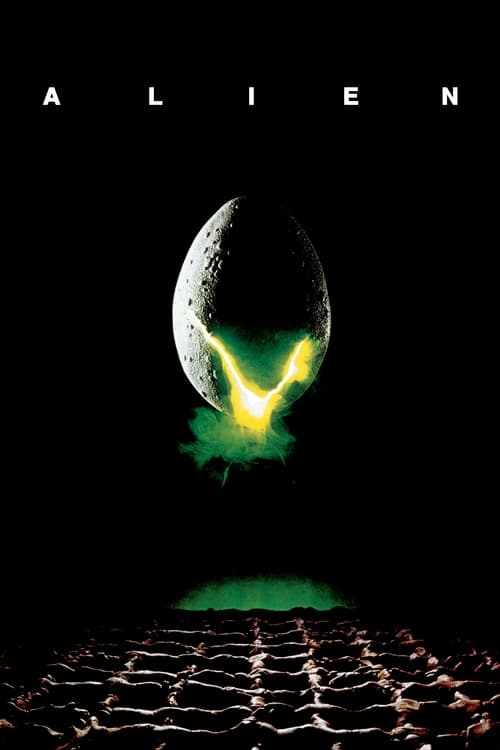
Alien
1979 · Ridley Scott
As famous now for press-tour belligerence ("go f— yourself" to historical accuracy critics of Napoleon) as for the films; Gladiator II's "are you not entertained" marketing and shark-in-the-Colosseum discourse kept him meme-central in his late 80s. The industry's most quotable octogenarian.
For when you want to be properly scared by something that's also drop-dead gorgeous — a lights-off, phone-away horror night. A challenge, not a comfort, and all the better for it.
What it's about
The crew of a commercial towing ship, woken early from deep sleep, is ordered to investigate a distress signal from a barren world. What they bring back aboard turns their vast, dripping industrial vessel into a hunting ground, and the crew — working stiffs, not heroes — must figure out how to survive something perfectly designed to kill them.
The experience
Dread distilled: slow, hushed, and claustrophobic, then savage when it strikes. It's a haunted-house movie in deep space that gets under your skin — the fear is as much biological as it is jump-scare, and the silence between attacks is the worst part.
Performances
Sigourney Weaver's Ripley — practical, stubborn, and increasingly steely — created the modern action-horror heroine, and Ian Holm is memorably unnerving as the ship's science officer.
The craft
H.R. Giger's biomechanical creature and derelict-ship designs remain some of the most disturbing images ever put on film, and Scott shoots the Nostromo like a real, grimy workplace — all steam, shadow, and humming machinery. The sound design and Jerry Goldsmith's score reward the best speakers you can find.
Why it matters
It founded the entire tradition of body-horror science fiction, spawned one of cinema's most durable franchises, and its blue-collar-crew-meets-monster template has been borrowed by four decades of films and games.
Snapshot
A commercial spacecraft intercepts a distress beacon and discovers an ancient derelict on a barren moon. One crew member is parasitized; the thing he carries gestates and kills; what emerges hunts the rest in the dark. Ridley Scott's second feature is the foundational document of cosmic body-horror cinema: a film that fused the "haunted house" template with hard-edged industrial science fiction, introduced one of the medium's most tenacious heroines, and permanently altered what audiences expected the genre to contain. Its influence radiates forward across four decades of film, television, and game design, while its own roots reach back through pulp science fiction, Italian horror, and Swiss surrealist painting.
Industry & production
Alien arrived at a particular convergence of industrial ambition and genre opportunity. The success of Star Wars (1977) had demonstrated that science fiction on an epic physical scale was commercially viable; the concurrent renaissance of American horror — running from The Exorcist (1973) through Halloween (1978) — had established that studio genre pictures could command mainstream audiences. Alien synthesized both currents.
The film originated with writer Dan O'Bannon and producer Ronald Shusett, who developed the screenplay from O'Bannon's earlier, unproduced material. O'Bannon had spent exhausting months in Paris working on Alejandro Jodorowsky's aborted adaptation of Dune (circa 1974–75), an experience that, though commercially disastrous, brought him into contact with a circle of visionary designers — H.R. Giger, Jean Giraud (Moebius), Chris Foss — whose aesthetic he would later channel into Alien. Brandywine Productions (Gordon Carroll, David Giler, and Walter Hill) acquired the script and brought it to 20th Century Fox, which greenlit it as a prestige science fiction production. Giler and Hill substantially rewrote O'Bannon's draft — a source of lasting acrimony — but the architectural DNA of the original remained: the crew as blue-collar workers, the Company as institutional villain, the creature's three-stage life cycle.
Ridley Scott, fresh from The Duellists (1977), was hired after an earlier director departed. Scott was not a genre veteran but a commercial director of exceptional visual precision; his appointment was a calculated bet on craft over franchise experience. Principal photography took place largely at Shepperton Studios in England, lending the production a distinctly British character. The design team assembled around Scott was extraordinary in its range: Giger for the alien world and creature; Ron Cobb for the Nostromo's interior hardware; Chris Foss for initial spacecraft concepts; Moebius for the crew's spacesuits. Production designer Michael Seymour coordinated these disparate aesthetics into a coherent whole. The budget was modest by later franchise standards — widely reported at approximately eleven million dollars — yet the film's physical density gives it a weight that money alone could not have purchased.
Technology
Alien arrived at the frontier of practical effects before digital compositing existed as a viable tool. The alien creature was realized through an interlocking set of physical constructions: the "facehugger," a mechanical puppet; the "chestburster," another mechanical device used in a single, unrepeated, largely unrehersed take (cast members not briefed on the extent of the blood spray); and the adult xenomorph, which was embodied by Bolaji Badejo, a Nigerian design student of exceptional height, wearing a suit designed by Giger and constructed by Carlo Rambaldi and others. The elongated, skeletal biomechanical form was designed to move in ways that the eye could not fully parse — Badejo's unusual proportions were essential to achieving this.
The derelict spacecraft and its interior — the "Space Jockey" chamber — were built as large-scale sets at Shepperton. Atmospheric effects were achieved through extensive use of steam, smoke, and rear-projection rather than optical compositing. Motion-control photography, still relatively new technology in the post-Star Wars industry, was used for the exterior spacecraft sequences, though modestly compared to contemporaneous films. The Nostromo itself is a marvel of forced-perspective model work, suggesting immensity through careful staging rather than scale.
Derek Vanlint, the director of photography, had an extensive background in high-end British television commercials — the same world that had trained Scott — and brought to the film a fluency in lighting at speed, in creating atmospheric depth within constrained spaces. The wide-format anamorphic frame (2.39:1) was used not to display spectacle but to press the viewer into corridors: horizontal space that becomes claustrophobic by its very narrowness.
Technique
Cinematography
Vanlint's photography establishes and sustains a principle of productive obscurity: the Nostromo's lighting is motivated, industrial, and partial. Backlit corridors dissolve into darkness; ventilation shafts are glimpsed in silhouette; the alien is almost never seen in full illumination. The camera is rarely static — it drifts, probes, loses — but this movement is measured rather than agitated, contributing to a dread that feels geological in its slowness. The contrast between the warm, amber-lit crew quarters (the film's "safe" zones, already threatened from within) and the cold, phosphorescent surfaces of the alien vessel is one of the most precisely administered tonal systems in genre filmmaking.
Editing
Terry Rawlings, the film's primary editor, understood that Alien required a tempo alien to conventional thriller construction. The first hour is deliberately, almost provocatively slow: the crew wakes, eats, bickers, explores. Rawlings calibrates this exposition not as setup to be endured but as a form of dread in its own right — a duration that the audience senses cannot be sustained. When violence arrives, it arrives against a background of accumulated quiet. The chestburster sequence is cut to exploit exactly this: the duration between Kane's discomfort and the eruption is stretched until it becomes physically uncomfortable.
Mise-en-scène / staging
Scott's staging throughout is governed by a single principle: the environment is never neutral. Every space on the Nostromo — the vast refineries, the cramped air ducts, the claustrophobic mess hall — has been used, worn, partially understood by its occupants and therefore semi-legible to the audience. The production design of Ron Cobb and Michael Seymour gave the crew's world the texture of an offshore oil rig or a long-haul freighter: decals, coffee rings, hanging cables, flickering monitors. Against this readability, the alien vessel is staged as pure inscription — Giger's biomechanical forms carry meanings that resist decoding. Scott plays the contrast without underlining it: the two worlds are simply placed alongside each other, and the horror is partly taxonomic (which world are we in now?).
Sound
Jerry Goldsmith's score is simultaneously one of the finest and most misused in Hollywood history. Goldsmith composed a full orchestral work; Scott replaced significant portions with pre-existing recordings, most notably Howard Hanson's Second Symphony, used in the climactic escape sequence. The resulting score is fragmented, internally inconsistent, and — whatever Goldsmith's intentions — oddly effective in its disjunctions. The ambient sound design is the more fundamental achievement: the Nostromo breathes, hisses, and groans throughout; the alien's approach is signaled partly through negative sound, through a sudden wrongness in the ship's sonic environment. Sound editor Jim Shields and the broader sound team established a template for industrial science-fiction sound design that persists to the present.
Performance
Scott made two decisive casting choices that shaped the film's legacy. He cast Sigourney Weaver as Ellen Ripley in what was effectively her film debut in a major studio picture; and he maintained the original screenplay's gender-neutral character list, casting against type in several roles. Weaver's Ripley is not constructed as a heroine — she is constructed as a professional, the only one on the ship who consistently follows procedure. Her authority is accrued through competence rather than charisma, which makes her survival feel earned rather than generic. Ian Holm's Ash — quietly, methodically wrong in every interaction, retrospectively terrifying — is one of the screen's great villain performances, the more chilling for being invisible the first time through. Harry Dean Stanton and Yaphet Kotto, as the ship's maintenance workers, ground the ensemble in a working-class specificity that other science fiction films of the period had not attempted.
Narrative & dramatic mode
Alien operates through a three-act structure that the film itself seems reluctant to acknowledge. The first act is an extensive, almost anthropological survey of working life aboard an interplanetary freighter — this portion of the film is closer to kitchen-sink drama than genre cinema, and it is essential. The second act is a classical haunted-house sequencing: isolation, attrition, the creature eliminating the crew in turn. The third act is essentially a chase film, stripped to its bones, with Weaver and the xenomorph alone in a ship that is about to be destroyed.
The dramatic mode is one of systemic betrayal: the alien is the most visible threat, but the Company — Weyland-Yutani, represented aboard the ship by the android Ash — is the deeper antagonist. The revelation of Ash's nature is the film's pivotal structural turn: it transforms a survival horror narrative into something closer to a paranoid thriller, one where institutional power is revealed to value the alien specimen above the lives of the crew. This doubled antagonism — the visible monster and the invisible corporation — would become one of the most widely replicated structures in science fiction cinema.
Genre & cycle
Alien belongs to multiple genre traditions simultaneously, and its achievement is partly one of productive recombination. Its debt to the haunted-house film is explicit: a confined space, a dwindling cast of characters, a predator whose rules are discovered too late. Its debt to Gothic literature — the ancestral pile as source of contamination — is structural. Its science-fiction credentials are impeccable, but it largely dispenses with science fiction's characteristic interest in ideas in favor of sensation and dread. The creature's life cycle (implantation, gestation, birth, maturity) introduces a specifically bodily horror — what O'Bannon later identified as a horror about male rape anxiety — that had not been articulated in science-fiction cinema in quite this form.
The "haunted house in space" cycle that Alien established is extensive: Event Horizon (1997), Pandorum (2009), Life (2017), and dozens of lesser works have worked in its shadow. The film also established a subgenre of "corporate horror" — narratives in which institutional complicity is as threatening as the nominal monster — that runs through RoboCop (1987), The Thing (1982), and into prestige television.
Authorship & method
Ridley Scott arrived at Alien as an image-maker rather than a storyteller in the auteurist sense. His background in advertising and commercials had given him an extraordinary facility for creating visually dense, emotionally immediate frames, and an unusual comfort with delegation — working with the best available specialists and integrating their contributions into a coherent vision. Alien demonstrates this method at its most effective: Giger's world is not domesticated by Scott's direction, but it is organized. The film is not "Giger's movie" any more than it is "O'Bannon's movie" or "Weaver's movie," but it would not exist without any of them.
H.R. Giger, the Swiss Surrealist painter and sculptor, designed the alien creature, the derelict spacecraft, the Space Jockey, and the egg chamber. His "Necronom IV" (1976), from the Necronomicon artbook, was the direct precursor to the xenomorph design. Giger's aesthetic — biomechanical, explicitly sexualized in its morphology, rooted in Surrealist body horror — provided the film with a conceptual depth that props and makeup alone could not have supplied. His Academy Award, shared with the visual effects team, was one of the stranger confluences of commercial cinema and fine art of the decade.
Dan O'Bannon (screenplay) brought to the project a cinephile's knowledge of science-fiction and horror antecedents, a dry gallows humor that inflects even the film's darkest sequences, and the foundational creative insight: that horror and science fiction were not opposing impulses but natural partners.
Jerry Goldsmith (composer) produced a score that was partly dismantled in post-production, yet what remains is essential. His alien leitmotifs and orchestral textures established a musical language for cosmic horror that subsequent composers have borrowed from repeatedly.
Derek Vanlint (cinematography) contributed a visual grammar of productive darkness that has been imitated but rarely matched.
Movement / national cinema
Alien is a British-American co-production in both practical and aesthetic terms. Shot at Shepperton Studios, crewed largely by British technicians, directed by a British filmmaker, and populated with British character actors, it belongs to a tradition of British genre filmmaking that includes Hammer horror and the science-fiction films produced at Pinewood and Shepperton in the preceding decades. Yet it is financed and distributed by a major American studio, and its protagonist is American; it occupies the same hybrid industrial space as many significant British films of the late 1970s, when Hollywood financing had become the primary engine for British studio production. The film sits outside any coherent "national cinema" category in the strict sense, which is itself a marker of the internationalization of big-budget genre filmmaking that accelerated through the 1970s.
Era / period
Alien is a film of the post-Star Wars reconfiguration of Hollywood science fiction, but it understands that reconfiguration as an opportunity rather than a constraint. Where Star Wars had restored the genre's romance and optimism, Alien restored its capacity for genuine dread. It shares with films like Close Encounters of the Third Kind (1977) and 2001: A Space Odyssey (1968) an interest in the material conditions of space travel — the boredom, the machinery, the contractual relationships — but inflects this against the darker currents of 1970s American cinema: the paranoid thriller, the body-horror film, the post-Watergate suspicion of institutions. It is a film that could only have been made in the specific industrial and cultural moment between Star Wars and the consolidation of the blockbuster as Hollywood's dominant form.
Themes
The film's themes are partly available on the surface and partly latent, and this double availability has sustained its critical life. The explicit themes are those of institutional betrayal: the crew of the Nostromo are employees, disposable assets, protected by no one. Their deaths serve a corporate agenda they were never permitted to understand. The alien is, in this reading, a weapon — literally, as the Company intends it — but also a figure for the lethal indifference of extractive capital.
The bodily themes are more complex and have generated the film's most sustained critical literature. The alien's reproductive strategy — forced implantation, gestation within a human host, violent birth — articulates anxieties about bodily autonomy, penetration, and the loss of somatic integrity that critics including Barbara Creed have read through a psychoanalytic lens. The "monstrous feminine" of the alien queen (as subsequently developed) has its seeds here in the egg chamber. The fact that these anxieties are channeled primarily through male characters (Kane as victim; the male crew as the first to die), while a woman survives, gives the film a feminist valence that was not entirely intentional but has proven historically durable.
The film is also, in its quieter moments, a meditation on the limits of competence. The crew of the Nostromo are not stupid; they make reasonable decisions. The horror is not that they fail to think clearly, but that thinking clearly is insufficient against a threat for which no protocol exists. This is a specifically modern anxiety, distinct from the monster-movie tradition of human hubris, and it connects Alien to Lovecraft's cosmic horror as much as to any cinematic antecedent.
Reception, canon & influence
Critical reception at release was mixed-to-positive rather than uniformly rapturous. Reviewers recognized the film's craft and its visceral effectiveness, but several critics found its deliberate pacing unsatisfying and its borrowings from horror conventions too transparent. Pauline Kael's skepticism was characteristic of a critical establishment that was not yet certain how to evaluate studio genre cinema as a serious form. The film was a major commercial success by any measure — it performed strongly across its initial run and subsequent re-releases — and it received the Academy Award for Best Visual Effects (Special Achievement Award) in 1980.
Influences on the film (backward): The most direct antecedents are It! The Terror from Beyond Space (1958, Edward L. Cahn), which establishes the basic premise of a predatory alien entity hunting a spaceship crew; and Mario Bava's Planet of the Vampires (Terrore nello Spazio, 1965), which contributes the discovery of an ancient derelict spacecraft and its unsettling biomechanical environment — an influence O'Bannon acknowledged. The Thing from Another World (1951) and its 1982 John Carpenter remake provide the claustrophobic, Antarctic-isolation template. Kubrick's 2001: A Space Odyssey (1968) underwrites the film's interest in the material aesthetics of space travel and the threat posed by institutional (here: corporate) AI. H.P. Lovecraft's prose horror — cosmic indifference, the incomprehensible entity from outside human categories — provides a literary model that O'Bannon drew on explicitly.
Legacy and influence (forward): Alien's franchise legacy is vast and uneven. James Cameron's Aliens (1986) is the most distinguished sequel and a significant film in its own right — it transforms the horror template into action-thriller, and its influence on subsequent science-fiction cinema is nearly as extensive as the original's. The subsequent sequels — Alien 3 (1992, David Fincher's disputed debut), Alien: Resurrection (1997, Jean-Pierre Jeunet), and the prequel cycle beginning with Prometheus (2012) — are of diminishing artistic consequence, though Fincher's film has been reassessed more generously in recent decades.
Beyond the franchise, Alien's influence on genre cinema is pervasive. Its spatial grammar — the ship as a series of nested enclosures, each smaller and more dangerous — has been replicated so many times that it now reads as convention rather than invention. Its xenomorph design has saturated popular visual culture; Giger's biomechanical aesthetic, exported through the film, has become a recognizable idiom in graphic design, game art, and music video imagery. The film's specific contribution to horror — the body as a site of violation and colonization by an entity that uses the human form for its own reproductive purposes — has a lineage running through The Thing, The Fly (1986), and into contemporary prestige horror.
Ripley herself is perhaps the film's most consequential legacy. Not because female protagonists in genre cinema were unknown, but because Ripley was constructed without the conventions of femininity as survival mechanism — no romance, no hysteria, no sacrifice — that had previously defined the women who lived. The "Ripley template" has been borrowed from, argued against, and built upon in virtually every subsequent major action-horror film with a female lead. That this template was partly accidental — the result of gender-neutral scripting and Weaver's particular intelligence — does not diminish its historical force. The film placed a woman at the center of blockbuster genre cinema and demonstrated that this was not a commercial liability but a strength.
A Deleuzian reading
Kane goes down into the derelict alone, on a winch, into a chamber nobody built for human visitors.
The full Deleuzian reading of Alien →
Reception
In 1979 plenty of critics shrugged it off as a glorified haunted-house B-movie in space; now it's National Film Registry canon and routinely called one of the greatest films ever made, with Ebert himself upgrading it to his Great Movies list decades later.
How Alien was received, from release to now →
Influences: the films it descends from and the films it influenced
- It! The Terror from Beyond Space (1958) — Dan O'Bannon's acknowledged structural source: a single alien creature systematically hunts crew through the locked corridors of a spacecraft, providing the haunted-house-in-space genre template Alien inherits and escalates.
- Planet of the Vampires (1965) — The sequence in which explorers discover a derelict spacecraft crewed by fossilized giant alien remains directly prefigures the Space Jockey chamber; O'Bannon explicitly cited Bava's staging of this discovery as a visual source for that scene.
- 2001: A Space Odyssey (1968) — Alien inherits both the slow-burn editing tempo of space travel as mundane labor and the doubled-antagonist structure: HAL 9000 as hidden institutional machine enemy is the direct template for Ash, Alien's android agent of corporate betrayal.
- Rosemary's Baby (1968) — Establishes body-horror through parasitic violation as a genre grammar: the protagonist's bodily autonomy is overridden by institutional forces who treat her body as a vehicle for something else — the structural template for the chestburster sequence and Alien's corporate-complicity plot.
- Dark Star (1974) — O'Bannon wrote, starred in, and designed this film, establishing his blueprint of a bickering blue-collar space crew aboard a deteriorating vessel; Alien is O'Bannon's re-refinement of the same premise transposed from satirical to serious register.
- The Texas Chain Saw Massacre (1974) — Hooper's visual grammar of functional decay — tools repurposed as weapons, industrial spaces made sinister by accumulated residue and detritus — establishes the used-world aesthetic that Ron Cobb and Scott systematized in the Nostromo's grimy, lived-in interior.
- Jaws (1975) — Spielberg's necessity-driven restraint in withholding the shark's full appearance — keeping it off-screen or glimpsed in shadow — codified productive-obscurity as a viable monster-film technique that Scott and Vanlint deploy systematically to keep the xenomorph in darkness and partial silhouette.
- Halloween (1978) — Carpenter's slow-burn editing rhythm — long stretches of normalcy punctuated by bursts of violence — and the implacable, partially-glimpsed killer whose opacity amplifies dread were the immediate genre precedent Scott refined into Alien's even more attenuated tempo and creature staging.
- The Exorcist (1973) — Scott inherits The Exorcist's premise of the human body as horror battleground — the chest-burster as body-violated-from-within — and executes it with A-list craft in a clinical, cold environment (the Nostromo as antiseptic ward), deploying Ben Burtt's designed soundscape as the primary atmospheric dread instrument rather than conventional orchestral score.
- The Andromeda Strain (1971) — The Nostromo's deck-plan spatial coherence is as rigorously maintained as Wildfire's level-by-level grammar; the crew's procedural response to a biologically unknown organism — quarantine protocols, specimen isolation, containment breach — extends the biohazard-thriller genre grammar Wise established.
- Silent Running (1972) — The lived-in industrial-hull realism and Dykstra-lineage motion-control miniatures stage the same organic-life-versus-cold-machinery contrast that defines the Valley Forge's dome-against-hull design.
- Planet of the Apes (1968) — Pairs Jerry Goldsmith's atonal, disorienting orchestral score with a creature grounded by suited-performer physicality, both craft methods pioneered on Apes.
- Blade Runner (1982) — Scott transfers Alien's full craft toolkit into an urban register: the same used-world aesthetic of functional decay, the same anamorphic-claustrophobic widescreen compression of corridors and interiors, and the same corporate-horror framework — Tyrell Corporation as Weyland-Yutani transplanted to Earth.
- The Thing (1982) — Carpenter and effects artist Rob Bottin push the practical-effects body-horror tradition Alien established: biological invasion that violates and transforms the human body through elaborate physical constructions, with an isolated working-class ensemble as victims.
- Aliens (1986) — Cameron inherits Ripley's competence-based heroine and the xenomorph life-cycle but substitutes Alien's slow-burn isolation tempo with militarized ensemble action, demonstrating how the same creature and protagonist can anchor entirely different genre registers.
- Event Horizon (1997) — Anderson applies Alien's haunted-house-in-space formula to a derelict vessel as locus of cosmic horror, replicating the productive-obscurity staging in near-total darkness and drawing on Giger-adjacent biomechanical production design for the Event Horizon's interior architecture.
- Sunshine (2007) — Boyle and composer John Murphy construct an industrial-ambience sound palette from electronic drones and mechanical textures to sustain spacecraft dread; the blue-collar mission crew under institutional pressure mirrors Alien's ensemble, and the film's mid-point genre rupture replicates Alien's structural tonal shift.
- Life (2017) — A direct formal replication of Alien's genre mechanics: confined station, single creature whose intelligence escalates, institutional complicity in suppressing the threat, and systematic ensemble elimination staged in darkness — functioning as a near-diagram of Alien's narrative architecture.
- Annihilation (2018) — Garland deploys body-horror through biological hybridization realized via practical creature work and post-production morphing, with a competent female scientist ensemble and productive obscurity of the alien encounter sustained by refusing to resolve its foreignness into legible motivation.
- Total Recall (1990) — Dan O'Bannon and Ronald Shusett wrote both scripts; Alien's template — a space-labor protagonist exploited by an off-screen corporate power, existential threat delivered through Rob Bottin-lineage practical creature design — is the direct screenwriting and production-design DNA transplanted into Total Recall's Rekall corporation and Martian grotesquerie.
- The Abyss (1989) — Cameron absorbed Scott's production design principle that futuristic installations must look inhabited and labored-in: Deepcore's tool-scattered corridors, worn wet suits, and diegetic-source lighting share Scott's logic that convincing science fiction requires the visual residue of work, a vocabulary Cameron had extended in Aliens and deepened here.
- Moon (2009) — Source of 'the Company' expendable-employee logic and the lived-in functional industrial set-design grammar — Moon's miniatures were even built by Alien model veteran Bill Pearson.
- The Martian (2015) — Scott's foundational space procedural: fully realized functional set design establishes spatial logic the audience learns alongside characters, and diegetic mechanical sound design grounds science fiction in procedural reality — methods carried forward intact into The Martian's Hab sequences.
- A Quiet Place Part II (2021) — The creature-feature axiom that a monster's threat is primarily established through audio cues — crew listening, the sound of movement before any visual confirmation, the use of breathing and ambient sound as dread architecture — is the proximate ancestor of AQP's creature grammar; Scott's rule that the creature is heard before it is seen is the template Krasinski systematizes.
- The Fly (1986) — Cronenberg extends Alien's body-horror grammar through intimate transformation: elaborate practical prosthetics and mechanical effects chart staged biological corruption from within, applying the chestburster's logic of bodily betrayal as a sustained dramatic engine rather than a single rupture.
- Jurassic Park III (2001) — Shares the confined-space creature-stalking craft — corridors and enclosures used to dole out predator reveals — that JP3 echoes in its derelict-compound and aviary sequences.
- Godzilla (1998) — The desaturated, rain-and-shadow nocturnal lighting that hides a biomechanical predator, the visual register Ueli Steiger applies to the Madison Square Garden nest sequence.
- Ikarie XB 1 (1963) — Extends the 'used future' lived-in ship of blue-collar professionals eating, arguing and working shifts — the deromanticized crew ensemble Ikarie originated.
- Invasion of the Body Snatchers (1978) — Extends the same wet, organic creature-sound design and enclosed-community slow-burn escalation, dread accreting until trust and safety collapse.
- Watership Down (1978) — Terry Rawlings carried his Watership Down method straight over — violence assembled from fragments too brief to read fully, the collision cut on impact and the cutaway before the wound resolves, so the Bigwig/Woundwort fight and the chestburster are constructed on the same principle of withheld continuity.
Similar films
- Event Horizon (1997) — influence & lineage · same viewing thread
- Annihilation (2018) — influence & lineage · same viewing thread
- Aliens (1986) — influence & lineage
- The Thing (1982) — influence & lineage
- Blade Runner (1982) — influence & lineage
- 2001: A Space Odyssey (1968) — influence & lineage
- The Texas Chain Saw Massacre (1974) — influence & lineage
- Alien: Romulus (2024) — same viewing thread
All the films related to Alien →
Watch it with: curated runs of related films
- Crossing Into the Zone — A run of crews and expeditions that step across a threshold into a hostile unknown — a derelict, a shimmer, a forbidden Zone — that rewrites biology, sanity, and who comes back; watch them in sequence to feel the same dread deepen from pulp to the sublime.