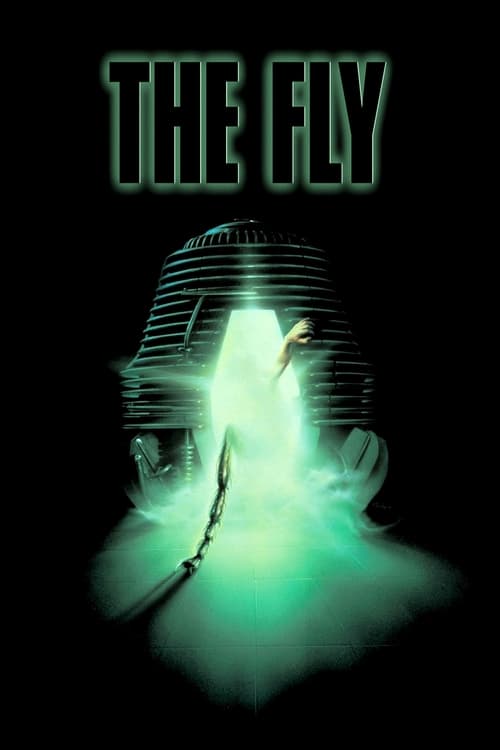
The Fly
1986 · David Cronenberg
For when you want a horror film with a heart under the viscera — a scare that earns real emotion. Reach for it when you're up for being disturbed and devastated in the same ninety-five minutes.
What it's about
Seth Brundle, a brilliant and awkward scientist, has built teleportation pods in his Toronto warehouse loft — and he's falling for Veronica, the journalist covering his breakthrough. In a night of drunken, jealous bravado he tests the device on himself, not noticing the housefly that slips into the pod with him. The machine fuses them at the genetic level, and what begins as a rush of newfound vitality becomes a slow, terrible transformation — with Veronica forced to watch the man she loves change.
The experience
Genuinely horrifying and genuinely moving at once — a love story that decays in front of you. The dread builds slowly, the gross-out moments are all-timers, and the ending leaves a bruise. Not for the squeamish, but far sadder than its reputation suggests.
Performances
Jeff Goldblum gives a career-best performance, tracking Brundle from twitchy charm through manic euphoria into something no longer human while keeping the man visible inside the monster. Geena Davis grounds it all — the horror lands because her grief does.
The craft
The Oscar-winning makeup effects chart the metamorphosis stage by grisly stage, all practical, all still convincing. Cronenberg keeps the scale intimate — essentially three people and a laboratory — so it plays like a chamber tragedy, and Howard Shore's operatic score treats it as one. The prosthetics reward (and punish) a big screen.
Why it matters
A rare thing: a body-horror film that was also a mainstream hit, it became the high-water mark of 1980s practical creature effects and the film that defines its director's obsession with the treacherous flesh. It set the standard every transformation story since has been measured against.
Snapshot
The Fly is David Cronenberg's body-horror masterwork and his most commercially successful film, a tragedy of the flesh disguised as a creature feature. Seth Brundle (Jeff Goldblum), a brilliant, socially awkward scientist, has built a set of "telepods" capable of teleporting matter through space; courting the journalist Veronica "Ronnie" Quaife (Geena Davis), he solves the problem of teleporting living tissue and, in a moment of drunken, jealous bravado, tests the device on himself. A common housefly slips into the pod with him, and the computer — unable to distinguish two organisms — splices them at the genetic-molecular level. What follows is not a sudden monstering but a slow, agonizing metamorphosis: Brundle's body and mind decay into "Brundlefly," an insect-human hybrid, even as his love affair with Ronnie deepens into a vigil over his own dissolution. Loosely adapted from George Langelaan's 1957 short story and Kurt Neumann's 1958 film, Cronenberg's version discards the original's gothic shock for a sustained meditation on disease, aging, and mortality. It won the Academy Award for Best Makeup, became a touchstone of 1980s horror, and is widely regarded as one of the finest remakes ever made.
Industry & production
The Fly was produced by Brooksfilms, the company of Mel Brooks, with Stuart Cornfeld as producer; Brooks, who had backed prestige dramas such as The Elephant Man (1980), kept his name off the credits so audiences would not expect a comedy. Cornfeld had developed a screenplay by Charles Edward Pogue and brought it to Cronenberg, who had recently left the long-gestating Total Recall project and was looking for his next film. Cronenberg substantially rewrote Pogue's draft — deepening the romance, reconceiving the transformation as a gradual disease rather than an instantaneous accident — and the two share the final screenplay credit.
The film was shot in Toronto, Cronenberg's home base, where he had built his career and his recurring crew. It was released by 20th Century Fox on August 15, 1986. Made on a relatively modest budget (reported in the range of roughly $9–15 million), it became a substantial hit, grossing on the order of $40 million domestically and considerably more worldwide — by a wide margin Cronenberg's biggest commercial success to that point and the film that consolidated his transition from cult provocateur to bankable auteur. Precise budget and gross figures vary across sources and should be checked against a reliable reference, but the film's strong profitability relative to its cost is firmly established. Its success spawned a sequel, The Fly II (1989), directed by the makeup designer Chris Walas.
Technology
The Fly is a landmark of practical, pre-digital effects craft. The metamorphosis was realized entirely through prosthetic makeup, animatronics, and creature fabrication by Chris Walas Inc., with key makeup artist Stephan Dupuis; their work won the Academy Award for Best Makeup and is often cited as a high-water mark of the form. The film's design proceeds in carefully calibrated stages — coarsening skin, lost fingernails and teeth, sprouting bristles, oozing sores — so that Goldblum's degeneration reads as pathology rather than spectacle, each stage requiring its own elaborate appliances. The climactic "Brundlefly" and the final telepod-fused creature are full animatronic and puppet constructions.
The film's grimmest set-pieces are physiological: Brundlefly's external digestion, in which he vomits a corrosive enzyme onto food (and, horrifyingly, onto a human arm), and the famous nightmare in which Ronnie gives birth to a giant maggot — a sequence featuring Cronenberg himself in a cameo as the gynecologist. Notoriously, a "monkey-cat" hybrid scene was filmed and cut for being too repellent even by the film's standards, surviving only in stills and script. Shot photochemically on 35mm, the production's technological signature lies wholly in the tactile, in-camera materiality of its effects — a body you believe in because it was physically built, lit, and operated on set.
Technique
Cinematography
Mark Irwin, Cronenberg's cinematographer through the formative run of Scanners, Videodrome, and The Dead Zone, shot The Fly — his last collaboration with the director before Peter Suschitzky took over from Dead Ringers onward. The photography is clean, clinical, and largely confined to Brundle's loft laboratory, a single dominant space that the camera comes to know intimately. Irwin lights the telepods with a cold, otherworldly glow against the warm clutter of the lab, and the relatively classical, unshowy compositions serve the performances and effects rather than competing with them. The restraint is strategic: by keeping the camera composed and observational, the film lets the horror emerge from what is happening to the body within the frame rather than from stylistic agitation.
Editing
Ronald Sanders, Cronenberg's regular editor, cuts the film for emotional clarity and escalating dread. The structure is essentially a chamber three-hander tracking a single accelerating curve of decline, and the editing patiently marks each stage of the transformation, allowing scenes to breathe so that the romance and the horror develop in lockstep. The pacing tightens as Brundle deteriorates, but the film never rushes the makeup reveals; Sanders trusts duration, holding on the actors and the prosthetics long enough for revulsion to give way to grief.
Mise-en-scène / staging
The film is almost a chamber piece, staged predominantly in Brundle's brick-walled warehouse loft — laboratory, bedroom, and prison in one. The telepods, designed as sleek, organic-industrial chambers, dominate the space as both miracle machine and instrument of doom. As Brundle decays, the loft accumulates the detritus of his condition — the "museum" where he hoards his shed body parts is a grotesque externalization of his loss of self. The confinement of the staging mirrors the narrowing of Brundle's existence: the world contracts to a single room as the disease consumes him, and the three principals are repeatedly framed within this closing space.
Sound
Howard Shore's score is one of the defining elements of the film and a cornerstone of his long partnership with Cronenberg. Rather than scoring horror, Shore writes grand, surging, romantic-tragic orchestral music that frames the story as opera — elevating Brundle's fate to the level of grief and doomed love. The score was substantial enough that Shore later expanded the material into a full-fledged opera, The Fly (2008), directed by Cronenberg with a libretto by David Henry Hwang. Sound design otherwise leans into the visceral textures of the body and the machines — the hum and concussion of the telepods, the wet sounds of transformation and feeding — grounding the fantastical in unsettlingly physical detail.
Performance
The film rests on Jeff Goldblum's performance, widely regarded as the finest of his career and one of the great pieces of acting in the horror genre. He begins as a charming, voluble eccentric — fast-talking, boyishly enthusiastic — and charts the full arc into something monstrous, sustaining recognizable humanity and even humor deep into the makeup. His mid-transformation monologue, in which Brundlefly describes himself as "an insect who dreamed he was a man," is the film's tragic core. Geena Davis (Goldblum's partner at the time) grounds the film emotionally as Ronnie, whose love and horror coexist; John Getz plays her editor and ex-lover Stathis Borans, the abrasive third point of the triangle. The intimacy between Goldblum and Davis gives the central relationship a tenderness rare in body horror.
Narrative & dramatic mode
The Fly is structured as tragedy rather than as a monster movie. There is no external villain; the antagonist is biology itself, and the dramatic engine is the irreversible, accelerating decay of a man the audience has come to love. The mode is intimate and romantic — a love story interrupted by catastrophe — and its horror is inseparable from its tenderness. The narrative follows a remorseless downward curve familiar from disease narratives: hope, denial, deterioration, and the terrible mercy of the ending, in which the fused creature wordlessly guides Ronnie's hand to end its suffering. This grafting of operatic romantic tragedy onto graphic body horror is the film's signal achievement and the source of its enduring emotional power.
Genre & cycle
The film is a foundational text of "body horror," the subgenre Cronenberg did more than anyone to define, in which dread arises from the mutation, betrayal, and dissolution of one's own flesh. It belongs to the rich 1980s cycle of effects-driven horror remakes and creature films — John Carpenter's The Thing (1982) is its closest cousin — a period when practical makeup artists became stars in their own right. Yet The Fly stands apart from the era's slasher and splatter output by foregrounding character, romance, and pathos, and by treating its horror as a vehicle for serious thematic inquiry rather than as an end in itself. It is at once a genre exemplar and a transcendence of genre.
Authorship & method
The Fly is a quintessential Cronenberg film, continuous with his career-long obsession with the body as a site of transformation, disease, and the collapse of the boundary between mind and flesh — the "body horror" or "venereal horror" that runs from Shivers and Rabid through Videodrome and on to Dead Ringers and Crash. It is also, tellingly, his warmest and most accessible film, the point at which his clinical intellectualism fused with genuine emotional generosity. Cronenberg's method — Toronto-based production, a loyal recurring crew, and a willingness to push physical effects to their limit in service of ideas — is fully on display.
His key collaborators were central to the result. Cinematographer Mark Irwin gave the film its cool, controlled look; editor Ronald Sanders shaped its escalating tragic rhythm; composer Howard Shore supplied the operatic emotional architecture that recast the material as romantic tragedy; and the makeup team led by Chris Walas and Stephan Dupuis made the transformation physically credible. Charles Edward Pogue's original adaptation provided the structural premise that Cronenberg then remade in his own image. The film is a model of how a director's sensibility can suffuse and unify the work of a tight, long-running collaborative team.
Movement / national cinema
The Fly is a product of English-Canadian cinema and specifically of Cronenberg's Toronto-centered body of work, which gave Canadian film one of its most internationally prominent auteurs. Like much of his output, it was made within a co-production and studio-financed framework (here, an American studio release shot in Canada) that blurs national lines, but its creative DNA — crew, location, and authorial vision — is Canadian. Cronenberg is the central figure of a distinctly Canadian strain of horror and the so-called "Toronto New Wave" milieu, and The Fly represents the moment his idiosyncratic national-cinema sensibility achieved full Hollywood-scale visibility without being absorbed by it.
Era / period
The film is firmly of the mid-1980s, the golden age of practical creature effects before the digital turn, when artists like Rob Bottin, Rick Baker, and Chris Walas defined the look of studio horror and science fiction. It also arrived at the height of the AIDS crisis, and the film has been persistently and influentially read as an allegory of the epidemic — the spectacle of a body wasting from an incurable, intimately transmitted affliction, watched helplessly by a lover. Cronenberg himself has resisted the narrowly AIDS-specific reading, framing the film instead as a broader metaphor for disease, aging, and mortality — the universal human experience of watching a body, one's own or a loved one's, decay. Both readings coexist in the film's reception and are part of why it resonated so powerfully in its moment.
Themes
The governing theme is the frailty and treachery of the flesh — the body as something that can turn against the self and dissolve identity from within. The Fly dramatizes disease and physical decline with unusual directness, and beneath it lies the deeper subject of mortality: the terror and grief of watching a mind persist inside a failing body. Aging, the loss of self, and the indignity of physical breakdown are rendered with clinical specificity and surprising compassion. Counterpoised against the horror is love — Ronnie's devotion, and the question of how love endures, or cannot endure, in the face of bodily ruin. The film also engages the classic theme of scientific hubris, the lone genius destroyed by his own creation, but subordinates this cautionary frame to its more intimate concerns. The pregnancy subplot extends the theme into anxieties about reproduction, contamination, and what one might pass on.
Reception, canon & influence
The Fly was both a critical and commercial success, an unusual feat for serious horror. Reviewers praised Goldblum's performance, the emotional weight Cronenberg brought to lurid material, and the artistry of the makeup; it was embraced as a rare horror film of genuine tragic dimension. Its Academy Award for Best Makeup was a significant moment of mainstream recognition for the craft and for genre filmmaking generally. The film is now firmly canonical — routinely ranked among the best horror films of the 1980s, among the best remakes in film history, and as one of Cronenberg's defining works.
Looking backward, the film's influences include George Langelaan's 1957 short story and Kurt Neumann's 1958 original (with its iconic "Help me!" climax), which supplied the premise that Cronenberg radically reconceived; the classical Hollywood tradition of the mad-scientist film and the Universal monster tragedy, in which the creature is a figure of pathos; and Cronenberg's own prior body-horror cinema, whose preoccupations the film brings to their fullest expression. The operatic romantic framing drew on a melodramatic, tragic sensibility uncommon in the genre.
Looking forward, The Fly profoundly shaped the body-horror genre and elevated its dramatic ambitions, demonstrating that visceral physical horror could carry serious emotional and thematic weight. It helped cement the cultural prestige of practical effects artistry at its 1980s peak and influenced a generation of horror and science-fiction filmmakers drawn to the body as subject. Its imagery and lines — the telepods, "Brundlefly," the warning "Be afraid… be very afraid" (Ronnie's line, which entered popular idiom) — became part of the broader culture. Cronenberg's subsequent expansion of the score into an opera testifies to the work's unusual reach across forms, and the film remains the most accessible gateway into one of contemporary cinema's most distinctive bodies of work.
A Deleuzian reading
Brundle stands at the bathroom mirror and works a fingernail loose from his finger.
The full Deleuzian reading of The Fly →
Reception
Unusually for Cronenberg, it was a hit right away — his biggest box office success and a critical winner in 1986 — but its stature has only grown since, from 'great gross-out' to consensus pick for the best horror remake ever made and the moment body horror broke into the mainstream.
How The Fly was received, from release to now →
Influences: the films it descends from and the films it influenced
- The Fly (1958) — Supplied the teleportation-accident premise and human-insect splice, including the famous 'Help me!' web climax that Cronenberg inverted from a shock ending into a sustained tragic arc.
- Bride of Frankenstein (1935) — Established the Universal-monster template of the creature as a figure of pathos and tragic melodrama rather than mere threat — the emotional register Cronenberg grafts onto lurid material.
- Shivers (1975) — Originated his 'venereal horror' method of disease spreading through and rewriting the body, the conceptual seed of Brundle's cellular corruption.
- The Brood (1979) — Externalized inner psychological states as literal physical growths, the body-as-symptom logic that The Fly renders as a man reading his own decay clinically.
- Videodrome (1983) — Fused flesh and technology through Rick Baker's practical mutating-body effects, the immediate precursor whose 'new flesh' obsession The Fly brings to fuller dramatic expression.
- Altered States (1980) — Drove a physical-regression transformation through a scientist's reckless self-experimentation, pairing lab hubris with operatic visual delirium in the way Cronenberg pairs it with Shore's score.
- The Thing (1982) — Rob Bottin's elaborate practical creature effects defined the same 1980s golden-age aesthetic of grotesque organic transformation achieved through animatronics and prosthetics.
- Invasion of the Body Snatchers (1978) — Advances the early-'80s body-horror wave the remake precedes, foregrounding practical-effects transformation of the self as the locus of terror.
- Dead Ringers (1988) — Reunites the core crew (Irwin's clinical lens, Sanders's escalating cut, Shore's romantic-tragic score) to stage another chamber tragedy of bodily and psychic disintegration.
- The Fly II (1989) — Directed by The Fly's own Oscar-winning makeup-effects supervisor, extending the Brundle creature design and animatronic-puppetry craft directly into a sequel.
- Tetsuo: The Iron Man (1989) — Radicalized the man-merging-with-machine body horror into frenetic metal-flesh fusion, inheriting Cronenberg's organism-as-mutating-technology premise.
- Society (1989) — Screaming Mad George's 'surrealistic' prosthetic body-melding effects pushed the practical-creature grotesquerie of the 1980s peak that The Fly canonized.
- Naked Lunch (1991) — Extends Chris Walas-style animatronic creature work into hallucinatory living body-objects, continuing the director's practical-effects-as-idea method.
- eXistenZ (1999) — Develops the flesh-and-technology fusion into bio-organic machinery plugged directly into the body, the Brundle telepod logic taken to soft, glistening prosthetics.
- Splice (2009) — A Canadian body-horror successor pairing genetic-engineering hubris with a creature whose tragic, sympathetic arc deliberately echoes Brundle's doomed humanity.
- Titane (2021) — Stages flesh-and-metal bodily transformation as transgressive tragedy, carrying the Cronenbergian body-horror sensibility into a new auteur generation.
- Possessor (2020) — Extends the family's clinically restrained framing and unflinching practical gore, treating the violated body as the literal site of identity collapse.
- The Substance (2024) — Revives prosthetic-driven body horror as tragedy of physical decay and self-destruction, reasserting the emotional-plus-visceral mode The Fly pioneered for the genre.
- District 9 (2009) — Blomkamp inherits Cronenberg's body-horror grammar of involuntary interspecies transformation charted through escalating practical makeup and effects work, using the protagonist's physical deterioration as the dramaturgical engine for simultaneous psychological dissolution and audience empathy transfer.
- Annihilation (2018) — The defining body-horror grammar of gradual cellular fusion — a protagonist documenting their own transformation into something else with clinical fascination — underlies Lena's video-log study of mutating bodies.
- An American Werewolf in London (1981) — Rick Baker's on-screen man-into-beast metamorphosis pioneered the slow, painful, prosthetic-staged bodily transformation that Goldblum's incremental Brundlefly arc extends into character drama.
- Alien (1979) — Cronenberg extends Alien's body-horror grammar through intimate transformation: elaborate practical prosthetics and mechanical effects chart staged biological corruption from within, applying the chestburster's logic of bodily betrayal as a sustained dramatic engine rather than a single rupture.
- The Elephant Man (1980) — Chris Walas's progressive prosthetic transformation system — staged across the runtime to chart human dissolution in visible increments — applies body-horror mechanics to produce a character study of interiority eroding under physical change, the same horror-adjacent sympathetic-protagonist structure Lynch uses but driven by science-fiction metamorphosis rather than Victorian pathology.
- Eastern Promises (2007) — Establishes Cronenberg's signature of anatomically exact, unglamorous bodily damage rendered with medical detachment — the clinical gaze on wounds and mutilation that governs the throat-cutting and bathhouse violence here.
- Scanners (1981) — Chris Walas, who built the exploding head on Scanners under Dick Smith, is promoted to effects designer here; the film extends the Scanners principle that transformation must be a staged, physically present prosthetic event photographed straight, never a dissolve.
Similar films
- Videodrome (1983) — influence & lineage
- The Brood (1979) — influence & lineage
- Dead Ringers (1988) — influence & lineage
- Tetsuo: The Iron Man (1989) — influence & lineage
- Naked Lunch (1991) — influence & lineage
- Possessor (2020) — influence & lineage
- Bride of Frankenstein (1935) — influence & lineage
- The Thing (1982) — influence & lineage
All the films related to The Fly →