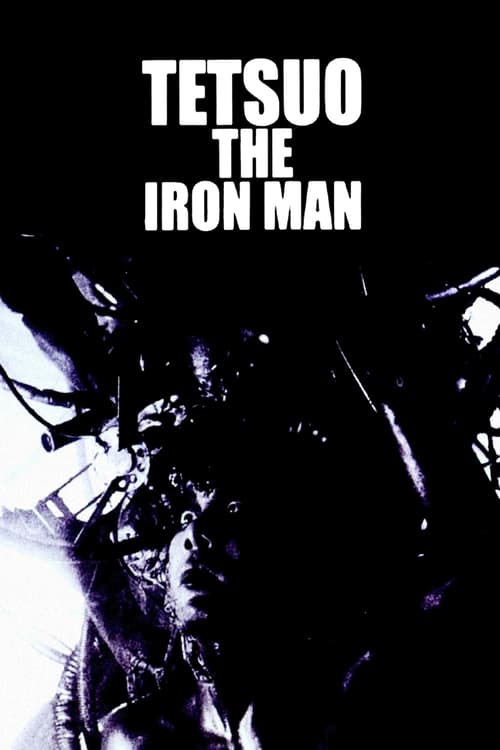
Tetsuo: The Iron Man
1989 · Shinya Tsukamoto
For when you're craving the hardest thing on the shelf — midnight-movie energy, strong stomach required. Absolutely not a comfort watch; absolutely unforgettable.
What it's about
A Tokyo businessman and his girlfriend run down a strange man in the night — a 'metal fetishist' who embeds scrap iron into his own flesh — and quietly dispose of the body. Soon the businessman finds his own flesh beginning to turn to metal, a transformation that escalates into a delirious war between body and machine in the cramped corners of the industrial city.
The experience
Sixty-seven minutes of pure sensory assault: machine-gun editing, shrieking industrial noise, bodies skittering through streets in stop-motion. It's exhilarating, repulsive, funny, and genuinely overwhelming — less watched than survived.
The craft
Shinya Tsukamoto shot it on grainy 16mm black-and-white in cramped Tokyo apartments, essentially alone after his crew kept quitting — directing, writing, editing, and playing the metal fetishist himself. Stop-motion animation, ferocious cutting, and Chu Ishikawa's clanging industrial score fuse into something closer to assault than narrative. Turn the sound up: the noise is the point.
Why it matters
It became the defining artifact of Japanese cyberpunk and a landmark of do-it-yourself extremity — proof that one obsessive with a 16mm camera could detonate an entire aesthetic.
Shinya Tsukamoto's 67-minute detonation remains the defining artifact of Japanese cyberpunk: a salaryman's flesh erupting into scrap metal, shot on grainy 16mm black-and-white in cramped Tokyo apartments with a crew that kept quitting until Tsukamoto was essentially making the film alone — directing, writing, editing, and playing the vengeful 'metal fetishist' himself. The technique is pure ferocity: stop-motion that sends bodies skittering through streets like glitches, machine-gun editing, and Chu Ishikawa's clanging industrial score, all fused into something closer to assault than narrative. Underneath the noise is a coherent nightmare about the industrial city colonizing the human body — eros and machinery welded together with a perversity that earns the Cronenberg comparisons while feeling wholly homegrown, heir to Eraserhead's midnight-movie delirium but faster, angrier, cheaper. It won the top prize at Fantafestival in Rome and made Tsukamoto an international name; three decades of body horror, extreme cinema, and music video aesthetics bear its scorch marks. Tsukamoto went on to a remarkable career as both director and actor (he's in Scorsese's Silence), but he has never fully left this junkyard — and neither has anyone who's seen it.
Reception
In 1989 it was a baffling 16mm midnight object that broke out only after winning the grand prize at Rome's Fantafestival; today it's canonized as the defining work of Japanese cyberpunk and a fixture of every body-horror syllabus.
How Tetsuo: The Iron Man was received, from release to now →
Influences: the films it descends from and the films it influenced
- Eraserhead (1977) — Establishes the black-and-white midnight-movie template Tsukamoto works in: immersive, unbroken industrial sound design used as continuous dread-texture rather than scored music, married to organic-mechanical body horror.
- Un Chien Andalou (1929) — Model for assaultive, anti-narrative shock-cut editing where images collide to provoke a visceral reaction instead of telling a story — Tetsuo's editing logic is Surrealist montage, not continuity.
- Ballet Mécanique (1924) — Pioneers rhythmic montage that equates the human body with machine parts, making mechanical repetition itself the cutting principle — the formal seed of Tetsuo's metal-flesh rhythm.
- Man with a Movie Camera (1929) — Single-artist 'kino-eye' virtuosity — stop-motion, pixilation, undercranking and frantic city-machine montage produced largely by one hand, prefiguring Tsukamoto's one-man-crew technical arsenal.
- Videodrome (1983) — The literal 'new flesh' fusion of body and technology via practical prosthetic effects — the biomechanical-mutation body horror Tetsuo pushes to abstraction (hence the standing Cronenberg comparison).
- The Evil Dead (1981) — DIY low-budget kineticism: undercranked chase-cam frenzy, aggressive handheld POV and homemade stop-motion gore proving a tiny crew could generate relentless visual velocity.
- The Terminator (1984) — Stop-motion metal endoskeleton tearing out from human flesh — the man-becomes-machine transformation achieved through frame-by-frame animation that Tsukamoto adopts for the metal's growth.
- Dimensions of Dialogue (1982) — Tactile object-animation and pixilation that gives dead matter aggressive, devouring life — the stop-motion grammar behind Tetsuo's crawling, self-assembling scrap metal.
- The Fly (1986) — Radicalized the man-merging-with-machine body horror into frenetic metal-flesh fusion, inheriting Cronenberg's organism-as-mutating-technology premise.
- 964 Pinocchio (1991) — Direct Japanese-cyberpunk offspring: frenzied handheld camerawork, screaming meat-and-metal freakout and machine-gun cutting lifted straight from Tsukamoto's playbook.
- Rubber's Lover (1996) — Extends the industrial-scored, high-contrast monochrome assault and eros-machinery grotesquerie into a full ether-drug body-horror lineage descendant.
- Tetsuo II: Body Hammer (1992) — Tsukamoto's own color-blooded expansion of the one-man-crew flesh-gun aesthetic, scaling the metal-fetishist transformation into a larger industrial-Tokyo canvas.
- Pi (1998) — Reprises the DIY high-contrast black-and-white, throbbing industrial-electronic score and paranoid hip-hop-montage/snorri-cam overload as a portrait of a body/mind colonized by machinery.
- Rubber Johnny (2005) — Convulsive, spasm-edited music-video body horror — flesh contorting toward the mechanical under strobing monochrome — inheriting Tetsuo's fusion of extreme cinema and the music-video pulse.
- Meatball Machine (2005) — Revives Tetsuo's weaponized-body subgenre wholesale: humans forcibly rebuilt into biomechanical fighting machines via grungy practical FX and frantic gore cutting.
- Ichi the Killer (2001) — Tsukamoto's jittery handheld camera, metal-meets-flesh body-horror prosthetics and percussive industrial sound design are folded directly into Ichi — and made literal by casting Tsukamoto himself as the gangster Fujiwara.
- Titane (2021) — Supplies the flesh-becoming-metal transformation and the industrial mechanical-organic sound design — grinding, clanging, biomechanical noise standing in for interior states — that Ducournau's sound team echoes around the titanium plate.
- Pulse (2001) — Japanese techno-body horror fusing flesh and technology, the domestic precursor to Pulse's machine-mediated dissolution.
- Kotoko (2011) — Tsukamoto's DIY 16mm handheld frenzy and stop-motion-adjacent staccato cutting invented the body-as-battleground aesthetic Kotoko redirects from metal fusion to psychological doubling.
- Upgrade (2018) — Pioneers the camera physically bound to a body-in-transformation, using whip-fast rigged movement so the apparatus itself performs the machine's takeover — the kinetic ancestor of Upgrade's embodied-rig fights.
- Tokyo Fist (1995) — The direct source-code: stop-motion-inflected percussive montage of metal against flesh cut in rhythmic lockstep to Chū Ishikawa's industrial clangor, which Tokyo Fist transplants from mutation into the boxing ring.
- Akira (1988) — Contemporary Japanese-cyberpunk vision of uncontrollable biomechanical body-mutation swelling out of a neon-industrial Tokyo — the same movement, arriving one year earlier in animation.
- Begotten (1990) — Wordless, heavily-processed high-contrast monochrome pushed into pure visceral body-assault — a parallel experiment in film-as-physical-ordeal with no conventional narrative.
- Hardware (1990) — Low-budget industrial-scored cyberpunk built on a self-reassembling machine colonizing human space, scored with clanging metal-music aesthetics like Tetsuo's.
- Gozu (2003) — Japanese body-horror lineage of flesh mutating and emitting, with desire and transformation fused — the bodily-fluid-as-rebirth motif Gozu renders in its lactating-innkeeper and birth finale.
- August in the Water (1995) — Core Japanese-punk-cinema peer: Tsukamoto's body-as-cosmic-conductor and industrial sound-design share Ishii's conviction that the human form is an antenna for larger energies.
Similar films
- Akira (1988) — influence & lineage · same viewing thread
- Videodrome (1983) — influence & lineage · often watched together
- Mad God (2021) — same viewing thread
- Neon Genesis Evangelion: The End of Evangelion (1997) — same viewing thread
- Un Chien Andalou (1929) — influence & lineage · often watched together
- Eraserhead (1977) — influence & lineage · often watched together
- Man with a Movie Camera (1929) — influence & lineage · often watched together
- Pulse (2001) — often watched together
All the films related to Tetsuo: The Iron Man →
Watch it with: curated runs of related films
- Bodies at the End of the World — A run of visionary, punishing films where flesh is scarred, melted, mechanized or sacrificed while the world tips into its last days — watch these back to back when you want cinema at its most extreme and transcendent.