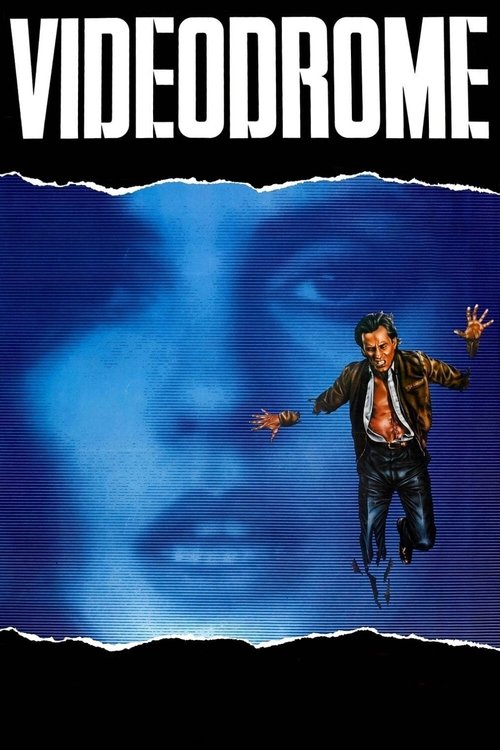
Videodrome
1983 · David Cronenberg
For when you want a movie that messes with your head — something strange, transgressive, and unsafe-feeling. Absolutely not a comfort watch; it's for the night you want cinema to feel dangerous again.
What it's about
Max Renn runs a sleazy Toronto TV station and is hunting for something shocking enough to hook viewers. He finds it in a pirated broadcast called Videodrome — plotless scenes of torture with no credits and no explanation — and decides he has to have it. As he chases the signal's source, along with a radio host whose appetites match the show's, the line between what Max watches and what's happening to his own body starts to dissolve.
The experience
Queasy, hypnotic, and genuinely disorienting — it starts as a grubby thriller and slides into full hallucination, so you're never sure what's real, and neither is Max. It gets under your skin in the most literal way a film can.
Performances
James Woods is perfectly cast — twitchy, sleazy, and oddly sympathetic as a man losing his grip on reality — and Debbie Harry brings a cool, unnerving magnetism as the lover who's drawn to what repels everyone else.
The craft
The practical effects are the legend here: flesh and technology merge in prosthetic creations that still look wrong in ways CGI never manages, all shot in a grimy, low-lit Toronto that feels like late-night UHF static made physical. Howard Shore's score hums with electronic dread. It rewards a dark room and good speakers — this is a film about screens that knows exactly what a screen can do to you.
Why it matters
A commercial flop that became one of the most prophetic films of its decade — its vision of media that rewires its audience only looks more accurate every year, and it stands as the purest statement of Cronenberg's early career.
Snapshot
Videodrome is David Cronenberg's hallucinatory parable about television, desire, and the corruptibility of the human body. James Woods plays Max Renn, the sleazy programmer of a marginal Toronto UHF station who, hunting for ever more transgressive content, intercepts a pirate broadcast of plotless torture called "Videodrome." His pursuit of the signal — and of his masochistic new lover, radio personality Nicki Brand (Debbie Harry) — draws him into a conspiracy in which the broadcast itself induces brain tumors, hallucinations, and physical mutation, weaponizing the viewer's own flesh. The film fuses Cronenberg's "body horror" with a media-theory polemic indebted to Marshall McLuhan, and it remains his most concentrated statement on the screen as an organ of the body. Commercially disappointing on release, it has since become a touchstone of 1980s genre cinema and a perennial reference point for debates about media, virtuality, and embodiment. Its closing mantra — "Long live the new flesh" — is among the most quoted lines in horror.
Industry & production
Videodrome belongs to the period of Canadian filmmaking shaped by the federal Capital Cost Allowance ("tax shelter") regime, which through the late 1970s and early 1980s incentivized private investment in domestic features. Cronenberg had built his commercial standing through a run of genre pictures — Shivers (1975), Rabid (1977), The Brood (1979), and the breakout Scanners (1981) — that proved a Canadian director could make profitable horror. Videodrome was produced through this Canadian framework (Filmplan International, with producer Claude Héroux) and distributed in the United States by Universal Pictures, giving a modestly budgeted Toronto production studio backing and reach.
The shoot took place in and around Toronto. By Cronenberg's own later accounts the production was difficult: the screenplay continued to evolve during filming, the elaborate makeup effects were costly and time-consuming, and the ending was reworked. The film was a box-office disappointment in North America; I will not assign specific figures here, as the precise budget and gross are reported inconsistently across sources. What is well established is that the picture underperformed relative to Scanners and that its reputation was rebuilt over subsequent decades through home video, repertory screenings, and critical reassessment — culminating in a Criterion Collection edition that helped canonize it.
Technology
Technology is Videodrome's subject as much as its medium. The film is saturated with the consumer-electronics texture of its moment: cathode-ray television sets, the Betamax/VHS videocassette, pirate satellite interception, and the closed-circuit feel of low-wattage broadcasting. The fictional "Cathode Ray Mission" and the prophet-figure Brian O'Blivion, who exists only as a library of pre-recorded videotapes, literalize the idea that personality and presence can be stored and replayed on magnetic tape. The film's imagination of a signal that physically alters its receiver anticipates later anxieties about pervasive media, though it is grounded entirely in the analog hardware of the early 1980s rather than the digital networks that would later seem to fulfill its prophecy.
Behind the camera, the film's most consequential technology was practical special makeup effects. Rick Baker — then at the height of his reputation after An American Werewolf in London (1981) — supervised the creature and transformation work. The signature images are achieved through mechanical and prosthetic means: the vaginal videocassette slot that opens in Max's abdomen, the "breathing" television set that bulges toward Nicki's lips, the fleshy pulsating videotapes, and the hand that fuses with a pistol into a "hand-gun." These were realized with foam latex, bladders, pneumatics, and puppetry rather than optical trickery, and their tactile, secretion-heavy quality is central to the film's effect.
Technique
Cinematography
Mark Irwin, Cronenberg's regular cinematographer of the era, shot Videodrome in a cool, clinical register that keeps even the most grotesque material legible and unsensationalized. The palette favors muted institutional tones — grays, sickly greens, the blue glow of screens — against which the reds of flesh and blood register strongly. Irwin's framing tends toward steady, observational compositions that treat hallucination and reality with the same flat, documentary calm, so the viewer, like Max, loses the ability to distinguish broadcast from world. The recurring motif of the television screen-within-the-frame, often the brightest object in a dim room, organizes the film's visual grammar around the act of looking.
Editing
Editor Ronald Sanders — another long-term Cronenberg collaborator — manages the film's escalating slippage between the real and the hallucinated. Rather than signaling subjective episodes with conventional dissolves or distortions, the cutting frequently presents Max's visions as continuous with ordinary scenes, withholding the cue that would let us bracket them as fantasy. This refusal of a stable point of orientation is the editorial engine of the film's paranoia; by the final act the narrative has effectively abandoned any reliable distinction between events and Max's tumor-induced visions.
Mise-en-scène / staging
The film's production design moves from the grubby naturalism of Max's apartment and the cramped Channel 83 offices toward increasingly charged, womb-like or clinical interiors — the Cathode Ray Mission, the Spectacular Optical premises, the rotting industrial spaces of the climax. Props are staged as quasi-living things: the television set as a desiring body, the videocassette as flesh, the gun as prosthetic. Cronenberg's staging repeatedly places Max in postures of penetration and submission to machines, inverting the usual relation of operator to apparatus so that the human becomes the device's interface.
Sound
Howard Shore's score — an early entry in what became one of the most enduring director-composer partnerships in modern cinema — is built largely on electronic textures, reportedly realized with computer-based synthesis blended with orchestral elements. The synthetic timbres mirror the film's theme of mediated, technologized experience, while swelling string-like figures lend the body-horror set pieces a mournful, almost romantic weight. The overall sound design leans on the hums, static, and signal artifacts of broadcast technology, keeping the ambient presence of the screen constant on the soundtrack.
Performance
James Woods anchors the film with a performance of nervy, fast-talking opportunism that gradually curdles into bewildered passivity as Max loses control of his own perceptions; his everyman sleaziness is essential to making the escalating unreality feel grounded. Debbie Harry, the lead singer of Blondie, brings a knowing, languid sensuality to Nicki Brand, whose appetite for pain prefigures the film's argument about the seductiveness of mediated violence. Sonja Smits plays Bianca O'Blivion with cool conviction, and Jack Creley gives the television-prophet Brian O'Blivion a measured, oracular gravity that the film treats as both visionary and absurd.
Narrative & dramatic mode
Videodrome operates as a paranoid conspiracy thriller that decays, by design, into a subjective nightmare. It begins in a recognizable register — a noir-inflected investigation, with Max as a compromised detective figure following a signal to its source — and methodically dismantles that structure. As Max's hallucinations intensify, the film's epistemology collapses: the audience is denied any vantage from which to verify what is "really" happening. The dramatic mode is therefore less about plot resolution than about the dissolution of the protagonist's selfhood. The narrative withholds clean answers about the Videodrome conspiracy (its corporate front Spectacular Optical, the ideological war between O'Blivion's utopianism and the conspirators' reactionary aims), prioritizing sensation and metaphor over exposition.
Genre & cycle
The film sits at the intersection of horror and science fiction, and it is the most theoretically articulate entry in Cronenberg's cycle of "body horror" — the strain of horror, which he did much to define, where the locus of dread is the mutation and betrayal of one's own physical form. Within the early-1980s genre landscape it stands apart from the slasher cycle then dominant in North American horror, offering instead a cerebral, idea-driven nightmare closer in spirit to paranoid 1970s conspiracy cinema crossed with speculative satire. It also belongs to a small lineage of films about television and media as malign forces, alongside works such as Network (1976) and Cronenberg's own later media-and-virtuality companion piece eXistenZ (1999).
Authorship & method
Videodrome is among Cronenberg's most personal films, written as well as directed by him, and it crystallizes the preoccupations that define his authorship: the body as unstable site, technology as an extension and invader of the flesh, disease and mutation as forms of transformation rather than mere threat. His method here was notably exploratory — the script developed through production, and the film's meaning was discovered partly in the editing — which accounts for both its conceptual density and its narrative opacity.
The film also showcases the collaborators who shaped Cronenberg's signature: cinematographer Mark Irwin's clinical lensing, editor Ronald Sanders's controlled slippages, and composer Howard Shore, whose work here marks an early step in a collaboration that would run for decades. Rick Baker's makeup effects were arguably co-authors of the film's imagery. Intellectually, the decisive influence is Marshall McLuhan: the character Brian O'Blivion is widely understood as a McLuhan figure, and the film dramatizes — and pushes to a literal extreme — McLuhan's dictum that media are extensions of the human sensorium and that "the medium is the message."
Movement / national cinema
Videodrome is a landmark of English-Canadian cinema and of the tax-shelter era's genre output, and it is central to the critical construction of Cronenberg as the figure who put Canadian horror on the international map. Its Toronto settings — unglamorous, wintry, institutional — give it a specifically Canadian texture distinct from American horror of the period. The film is frequently discussed in relation to a Canadian intellectual lineage, both through McLuhan's media theory and through a recurring national-cinema interest in mediation, surveillance, and the manufactured image.
Era / period
The film is a deeply 1980s artifact, responding to the proliferation of cable and satellite television, the home-video boom, and contemporaneous moral-panic debates about pornography and screen violence. Its anxieties about who controls the signal, and about the viewer's complicity in consuming degradation, are legible against the early-Reagan-era media landscape and the period's culture wars over explicit content. Yet its core conceit — that the screen reaches back into the body — has allowed it to be continually re-read through each successive media shift, from the VCR to the internet to immersive and addictive digital media.
Themes
The film's governing theme is the merger of the body and the media apparatus: the screen as a bodily orifice, the videotape as living tissue, the broadcast as a virus. From this flow its other concerns — the eroticization of violence and the question of whether watching is itself a form of participation; the manipulation of consciousness by hidden corporate and ideological powers; and the prospect of bodily transcendence framed by O'Blivion's followers as evolution into the "new flesh." Cronenberg refuses to resolve whether this transformation is liberation or annihilation, and the film's famous final image and incantation hold both readings open at once. Throughout, the film insists that there is no neutral, disembodied position from which to consume images: media reshape the perceiver.
Reception, canon & influence
On release Videodrome divided critics and underperformed commercially; its graphic effects and willful narrative obscurity alienated mainstream audiences while a minority recognized its ambition. Its standing rose steadily through home video and repertory exhibition, and it is now widely treated as one of Cronenberg's major achievements and a canonical work of intellectual horror, a status reinforced by its inclusion in the Criterion Collection and by extensive academic attention from film and media studies.
Looking backward, the film draws on Marshall McLuhan's media theory above all, on the paranoid conspiracy thrillers of the 1970s, and on Cronenberg's own developing body-horror idiom from Shivers through Scanners. Looking forward, its influence is broad and frequently cited: it stands as a key precursor to the 1990s cinema of virtuality and mediated reality, including The Matrix (1999) and Cronenberg's own eXistenZ (1999), as well as films concerned with recorded experience and screen-mediated violence such as Strange Days (1995). Its imagery — the breathing television, the videotape-fed body, the gun-hand — and its slogan "Long live the new flesh" have become shorthand in critical and popular discourse for the entanglement of technology, media, and the human body, ensuring its continued citation well beyond the horror genre.
A Deleuzian reading
Start with the television set that learns to breathe.
The full Deleuzian reading of Videodrome →
Reception
A box-office bomb in 1983 that Universal barely knew how to market, Videodrome has since been reappraised as eerily prophetic — every decade of screen-saturated life since (cable, internet, streaming) has made it look smarter, and Criterion canonized it along the way.
How Videodrome was received, from release to now →
Influences: the films it descends from and the films it influenced
- Shivers (1975) — Establishes Cronenberg's parasite-erupting-from-the-body idiom — the venereal organism that bursts through abdominal flesh is the direct template for Videodrome's stomach-slit VCR cavity.
- The Brood (1979) — Pioneers his method of externalizing interior psychology into literal practical-effect bodily growths ('the shape of rage' made flesh), the procedure by which Videodrome turns mental conditioning into mutated organs.
- Scanners (1981) — Treats the human nervous system as a receiver/transmitter apparatus and uses Dick Smith's exploding-head prosthetic gag as the immediate precursor to Videodrome's gun-hand and pulsing-television practical effects.
- Peeping Tom (1960) — Camera-as-weapon that records the death it causes, implicating the spectator's gaze — the founding gesture for Videodrome's broadcast signal that murders the people who watch it.
- Persona (1966) — Bares the cinematic apparatus itself (the burning film strip, the projector) and dissolves identity through screen-within-frame, the formal grammar Videodrome adopts for its collapsing reality.
- The Parallax View (1974) — Its brainwashing-montage sequence literally reprograms perception through assembled imagery, modeling the conspiracy-thriller-decay and signal-conditioning that drives Videodrome's plot.
- The Conversation (1974) — Builds unreliable epistemology entirely from recorded media, destroying a protagonist who can no longer trust the mediated evidence of his own senses — Videodrome's hallucinatory paranoia in audio form.
- Network (1976) — Stages television as an autonomous, prophetic organism that speaks through a guru-broadcaster, the McLuhan-inflected media critique that Brian O'Blivion's talking-head-on-a-screen literalizes.
- An American Werewolf in London (1981) — Showcases Rick Baker's on-screen agonized transformation makeup — the same artist and slow-mutation method Baker brought directly to Videodrome's new-flesh effects.
- Seconds (1966) — Carries the surgical/body-horror transformation thread — flesh remade by an institution — into explicit physical mutation.
- Altered States (1980) — Hallucination rendered as an immersive, threatening bodily environment, extending the conceit of the flesh itself as the site of metaphysical breakdown.
- Tetsuo: The Iron Man (1989) — Pushes the body-media/body-machine merger into industrial metal erupting through skin, extending Videodrome's analog-hardware horror into stop-motion techno-fetish.
- Naked Lunch (1991) — Realizes props-as-living-bodies to their limit (the talking typewriter-insect), Cronenberg reworking Videodrome's technology-as-breathing-organism through Chris Walas's creature effects.
- Strange Days (1995) — Its SQUID device plays recorded experience straight into the nervous system, updating Videodrome's screen-mediated violence and video-fed body into first-person sensory playback.
- eXistenZ (1999) — Reworks Videodrome's hallucinatory reality-collapse epistemology through an organic bio-port jacked into the spine — human-as-apparatus-interface made explicitly biological.
- The Matrix (1999) — Plugs the body into a controlling signal via a spinal port and stages reality as a manipulable broadcast, the cinema-of-virtuality premise Videodrome seeded a generation earlier.
- Ringu (1998) — Makes a cursed analog videotape and its broadcast artifacts the literal vector of death, inheriting Videodrome's conceit of a lethal signal that crosses from screen into flesh.
- Possessor (2020) — Uses a neural implant to pilot another person's body, inheriting the clinical-detachment lensing and human-as-hardware-interface staging directly from his father's Videodrome.
- Total Recall (1990) — Cronenberg — who developed an early Total Recall screenplay — built the structural model of a protagonist whose perceptual experiences may be real or media-induced hallucination, using body horror sound design and visceral imagery to externalize epistemological crisis; Total Recall's Rekall mechanism and its mid-film doctor-with-a-pill scene inherit this template directly.
- Crash (1996) — The flesh-technology merger — hand absorbing gun, stomach opening to receive cassette — staged as body-horror through affectively flattened performance and clinical framing; Crash strips away Videodrome's pulp-thriller mechanics to pursue the identical preoccupation at essay-film remove.
- Mickey 17 (2025) — Cronenberg uses the body's physical instability — Renn's pulsing abdominal slot — as the horror register for ideological inscription on flesh; Mickey 17's Expendable body, endlessly consumed and reproduced by colonial mission logic, extends this body-horror encoding of institutional power into social satire.
- The Substance (2024) — The body as permeable inscription surface for media and ideological gaze; flesh rendered malleable and hallucinatory via practical effects as a metaphor for the image-industry's colonization of selfhood — the exact logic Fargeat applies to the Hollywood beauty apparatus.
- The Fly (1986) — Fused flesh and technology through Rick Baker's practical mutating-body effects, the immediate precursor whose 'new flesh' obsession The Fly brings to fuller dramatic expression.
- The Thing (1982) — Rob Bottin's biomechanical practical effects reorganize flesh into impossible living apparatus, the contemporaneous peak of the same latex-and-pneumatics body-horror craft Videodrome deploys.
- Possession (1981) — Pairs Carlo Rambaldi's tentacular creature with extreme performance of bodily abjection, rendering a prop-as-living-body lover that rhymes with Videodrome's breathing television and fleshy cassette.
- Dead Ringers (1988) — Shares the Howard Shore score, the body-as-destiny thesis, and Cronenberg's method of treating bodily transformation with clinical calm over spectacle.
- A History of Violence (2005) — Cronenberg's own template for the body as the site where identity destabilizes and violence is literally embodied — the body-horror obsession here migrated from mutating flesh into the violent reflexes housed in Tom Stall's hands.
- Until the End of the World (1991) — Anticipates the seed film's screen-addiction thesis as physical craft — the cathode image as an addictive, body-invading technology — dramatizing 'seduction of the image' a decade before the outback lab does.
- Eastern Promises (2007) — The Cronenberg ancestor that first literalized the body as an inscribable, readable surface (the abdominal 'slot,' flesh as media); Eastern Promises displaces that obsession onto tattooed skin as a document that can be authored, forged, and read.
Similar films
- Tetsuo: The Iron Man (1989) — influence & lineage · often watched together
- Possession (1981) — influence & lineage · often watched together
- Scanners (1981) — influence & lineage
- eXistenZ (1999) — influence & lineage
- Naked Lunch (1991) — influence & lineage
- Possessor (2020) — influence & lineage
- The Brood (1979) — influence & lineage
- Perfect Blue (1998) — same viewing thread · often watched together
All the films related to Videodrome →
Watch it with: curated runs of related films
- Screens That Swallow You — A run of films where the screen — a pirate broadcast, a haunted website, a monitor, a late-night monster-of-the-week show — stops being a window and becomes a doorway that pulls the watcher bodily through into unreality.