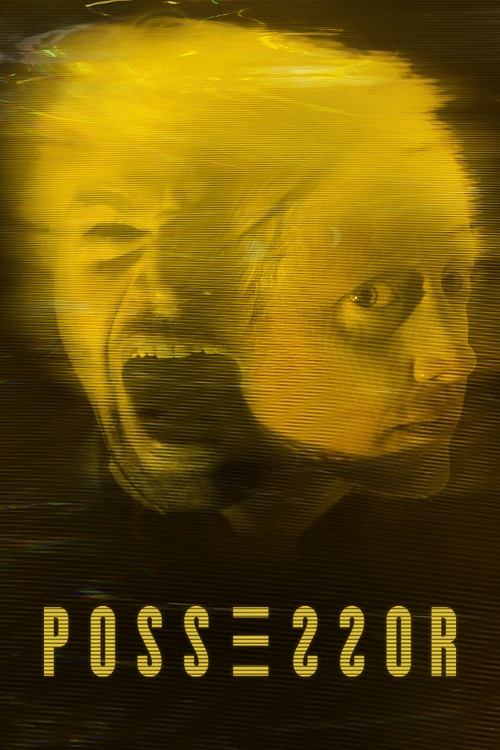
Possessor
2020 · Brandon Cronenberg
For when you're craving something genuinely disturbing and are ready to be challenged, not comforted — a late-night watch for strong stomachs that want their horror to come with ideas about identity attached. Absolutely not date-night material.
What it's about
Tasya Vos kills people for a corporation, but never with her own hands: a brain implant beams her consciousness into an unwitting host, who does the murder and takes the fall while she pulls back out into her own body. Her latest assignment puts her inside Colin, a young man positioned close to a data-mining magnate. The job should be routine — except Vos is fraying, and the mind she's occupying doesn't intend to go quietly.
The experience
Cold, hallucinatory, and genuinely brutal — a slow strangle of dread broken by bursts of graphic violence and melting, strobing imagery as two identities grind against each other. It gets under your skin and stays there; this is the kind of film you feel in your body afterward.
Performances
Andrea Riseborough is chillingly hollowed-out as Vos, a woman rehearsing her own personality like a script. Christopher Abbott has the harder trick — playing one man, then another person wearing that man — and makes the struggle between them physically legible and frightening.
The craft
Brandon Cronenberg favors practical, in-camera nightmare imagery — melting faces, fractured light, bodies as costumes — over digital tricks, and the gore effects are viscerally handmade. The sound design and score keep a low electrical hum of wrongness under everything. It rewards good speakers and a dark room.
Why it matters
The film that established Brandon Cronenberg as a major horror voice in his own right rather than a famous name's son, and a standard-bearer for the new wave of cerebral, art-inflected body horror.
Snapshot
Possessor is the second feature by Brandon Cronenberg, and the film that established him as a major genre voice in his own right rather than merely the inheritor of a famous surname. A science-fiction body-horror thriller set in a near-future of corporate surveillance and contract killing, it follows Tasya Vos (Andrea Riseborough), an elite assassin who carries out her work not with her own hands but by hijacking other people's bodies: a brain-implant device downloads her consciousness into an unwitting host, who commits the murder and is then disposed of — typically by a staged suicide — leaving Vos to "pull out" back into her own dormant body in the company's lab. The film's central assignment sends her into the body of Colin Tate (Christopher Abbott), a young man whose girlfriend's father, the data-mining magnate John Parse (Sean Bean), is the target. When the extraction fails and Vos becomes trapped inside Colin's mind, the two consciousnesses begin to contend for control of a single body, and the film becomes a vertiginous study of identity dissolution, alienated labor, and the violence — psychic and physical — that the work exacts on the person who performs it. Premiering at the Sundance Film Festival in January 2020 and released theatrically later that year in an uncut form, Possessor drew wide critical praise for its uncompromising practical gore, its hallucinatory imagery, and the twinned performances of Riseborough and Abbott. It stands as one of the defining works of the early-2020s art-horror current and as a confirmation that the Cronenbergian project of body horror could be carried into a second generation and a new register — from the mutating flesh of the father to the colonized mind of the son.
Industry & production
Possessor was produced as a Canadian–British co-production, with Rhombus Media (the long-running Toronto company associated with much of Canada's auteur cinema) joined by the British genre outfit Rook Films, run by Andy Starke, a producer closely linked to the work of Ben Wheatley and to a strain of stylish, transgressive British horror. The collaboration married a Canadian production base — Cronenberg is a Toronto filmmaker, and the film was shot in Canada — to a UK creative partnership that supplied several key below-the-line collaborators. The picture arrived eight years after Cronenberg's debut feature, Antiviral (2012), an unusually long gap for a director with such a promising start; Antiviral had premiered in Un Certain Regard at Cannes and announced many of the preoccupations Possessor would deepen, but the second feature took years to finance and mount.
The film's release strategy became part of its identity. It was distributed in the United States by Neon under the title Possessor Uncut, a deliberate framing that foregrounded the decision to release the film unrated and with its graphic violence intact rather than trimming for an MPAA rating — a marketing posture that doubled as a statement of artistic intent. The casting was central to its ambitions: Andrea Riseborough, an actress known for chameleonic, interior performances, anchors the film, while Christopher Abbott carries the larger share of screen time as the possessed host. The supporting ensemble includes Jennifer Jason Leigh as Girder, Vos's handler and mentor within the assassination firm — a piece of casting that quietly invokes Leigh's own history in body-horror and David Cronenberg's eXistenZ (1999) — along with Sean Bean as the surveillance magnate Parse, Tuppence Middleton as Colin's girlfriend Ava, and Rossif Sutherland and Raoul Bhaneja in further roles. The record on budget and box office is comparatively thin for a film of this profile, and it would be irresponsible to assign specific figures; what is clear is that Possessor was conceived and received as a festival-launched art-horror release rather than a wide commercial play.
Technology
The film's technological premise — a brain-implant that allows one consciousness to drive another person's body by remote — places it squarely in the science-fiction tradition, but Possessor treats the apparatus with deliberate, almost analog physicality rather than sleek futurism. The implant procedure is rendered as invasive surgery: a device is seated into the host's skull, and Vos's own body lies wired into a clinical rig while she operates the borrowed flesh. The "calibration" ritual that bookends her assignments — in which she handles totemic objects and recites memories to confirm that she is still herself — frames the technology less as a marvel than as a precarious, failure-prone system whose breakdown is the film's engine.
Crucially, Possessor's most distinctive technical achievement is not the fictional implant but the methods used to depict it. Cronenberg and his team leaned heavily on practical, in-camera effects to visualize the merging and tearing-apart of two identities: melting prosthetic faces, masks, and physically constructed transformation imagery rather than purely digital morphing. The violence, similarly, is achieved through practical gore and special makeup effects — the film's killings are graphic, tactile, and lingering by design, a choice that aligns its means with its themes of bodily violation. This commitment to the handmade is itself a kind of technological argument: in a story about disembodiment and remote control, the film insists on the weight and resistance of real flesh and material.
Technique
Cinematography
The cinematography is by Karim Hussain, Cronenberg's key visual collaborator (Hussain also shot Antiviral), and it is one of the film's signal strengths. Hussain works in saturated, controlled color — clinical whites and cold institutional surfaces for the assassination firm's facilities, set against richer, more sensuous palettes elsewhere — and reserves his most extreme effects for the sequences of consciousness transfer and identity collapse, which erupt into psychedelic abstraction: distended faces, smeared color, and superimpositions that render the dissolving boundary between Vos and Colin as pure visual event. The camera is precise and often coolly composed, lending the film a glassy, dissociated surface that mirrors Vos's own estrangement from the lives she invades. The contrast between the antiseptic order of the framing narrative and the violent, overheated interiors of the possession is a structuring visual principle.
Editing
The editing, by Matthew Hannam, manages the film's most difficult formal problem: keeping the audience oriented within a story whose protagonist is literally two people in one body, and whose climax stages a contest for control between them. The cutting builds the procedural rhythm of the assignment, then progressively destabilizes it as the extraction fails, interleaving Vos's fracturing perspective with Colin's reassertions of self so that point of view itself becomes unstable. The editing is patient where it needs to be — the film takes its time establishing the mechanics and the ennui of Vos's double life — and ruthless in the violence, holding on acts of brutality long enough to deny the viewer the relief of a cutaway.
Mise-en-scène / staging
Possessor's production design and staging articulate a near-future that is recognizably our own world tilted a few degrees toward dread. The most pointed conceit is Colin's job: he works for a data-mining firm, sitting at a terminal and watching strangers through their own webcams, cataloging the contents of their homes for marketing data — a banal dystopia of surveillance labor that rhymes precisely with Vos's own occupation of other people's lives. The domestic spaces are styled with an affluent, slightly sterile modernism; the firm's premises are clinical and anonymous. Staging repeatedly emphasizes watching, screens, and the act of looking into private lives, building a thematic architecture in which surveillance, data, and bodily possession are made continuous. The violence is staged with confrontational directness, refusing the elegant elision that genre convention often permits.
Sound
The score is by Jim Williams, a composer whose work on Ben Wheatley's A Field in England and Julia Ducournau's Raw had already marked him as a leading voice in contemporary art-horror music. For Possessor, Williams supplies a score of swelling, dissonant unease that underwrites the film's atmosphere of psychic disintegration without resorting to conventional jump-scare cueing. The sound design more broadly is attentive to the disorienting acoustics of consciousness transfer and to the clinical hush of the firm's procedures, using sonic texture to mark the boundary — and its erosion — between Vos's mind and Colin's body.
Performance
The performances are the film's human core, and they are unusually demanding. Christopher Abbott carries the heaviest load: for much of the running time he must play a single body inhabited by two people, registering Vos's cold competence, Colin's bewildered reassertions of himself, and the moments where the two bleed into one another — a feat of bifurcated acting that the film's whole conceit depends upon. Andrea Riseborough's Vos is a study in depletion and detachment: even outside the possessions, in her own body, she is a woman increasingly unable to feel her way back into her own life, her scenes with her estranged husband and young son shadowed by a frightening affectlessness. Jennifer Jason Leigh's Girder supplies a chilling maternal-managerial presence, the company woman who frames Vos's hollowing-out as professional excellence. Sean Bean's Parse is a portrait of casual, monied cruelty. The ensemble's restraint makes the film's eruptions of violence and abstraction land all the harder.
Narrative & dramatic mode
The film's dramatic mode is the psychological thriller pushed into existential horror. Its narrative architecture is that of the professional-assignment story — a skilled operative takes a job, the job goes wrong, and the operative must survive the consequences — but Cronenberg empties this familiar frame of its usual reassurances. There is no heist-movie competence fantasy here; the "job" is the methodical murder of strangers through the violation of innocent host bodies, and the protagonist's mounting crisis is not external danger but the erosion of her own self. The central reversal — the failed extraction that traps Vos inside Colin — converts a procedural into a two-handed interior siege, and the film's tension derives less from who will die than from who, by the end, Vos will be. The mode is finally tragic and clinical at once: a drama of dissociation observed with cold precision, in which the protagonist's victory, such as it is, is indistinguishable from her annihilation. The film withholds easy moral framing, presenting its violence neither as thrilling nor as straightforwardly condemned, but as the grinding cost of a kind of work.
Genre & cycle
Possessor belongs to several overlapping currents. Most obviously it is body horror, the subgenre indelibly associated with David Cronenberg — but where the elder Cronenberg's work centered on the mutation and revolt of the flesh, Possessor relocates the horror to the mind and to identity, making the body a contested vessel rather than a transforming organism. It is also a clear entry in the wave of ambitious, festival-launched art-horror — sometimes labeled "elevated horror," a term many of its practitioners resist — that flourished through the 2010s and into the 2020s, the milieu of Neon and A24 releases and of directors like Ari Aster, Robert Eggers, and Julia Ducournau, the last of whom shares Williams as a composer and a comparable appetite for the visceral. The film simultaneously draws on the science-fiction lineage of consciousness-transfer and remote-control narratives, and on the corporate-assassin thriller, which it estranges and moralizes. Within this cycle Possessor is notable for its refusal of the genre's occasional tastefulness: its commitment to graphic practical violence aligns it with a more confrontational, transgressive tradition.
Authorship & method
Possessor is unmistakably an auteur film, written and directed by Brandon Cronenberg, and any account of its authorship must address the inheritance it both claims and reworks. The thematic DNA of David Cronenberg is everywhere — the fusion of technology and the body, the clinical eroticism of violence, the interest in media and surveillance, the casting of eXistenZ's Jennifer Jason Leigh — and the film is plainly in conversation with that legacy. Yet the younger Cronenberg's preoccupations are distinct: where his father anatomized the flesh, Brandon Cronenberg anatomizes identity, labor, and dissociation, and Possessor extends the concerns of his debut Antiviral (which imagined celebrity worship as literal infection) into a fully realized vision of the self as something that can be occupied, automated, and used up.
The authorship is also a matter of collaboration with a tight creative team. Cinematographer Karim Hussain is the indispensable visual partner across both features, responsible for the film's saturated palette and its hallucinatory transformation imagery. Composer Jim Williams supplies its tone of dread. Editor Matthew Hannam solves the formal puzzle of dual consciousness. And the film's practical-effects artisans — working in prosthetics, makeup, and in-camera transformation — give Cronenberg's abstractions their disturbing physical reality; the special-effects designer Dan Martin is associated with the film's practical gore, and the insistence on tactile, handmade effects is itself an authorial signature. The method throughout privileges the physical and the constructed over the digital, a choice consonant with a film about the irreducible weight of the body.
Movement / national cinema
Possessor sits at the intersection of Canadian and British genre filmmaking. As a Canadian production, shot in Canada and made by a Toronto director through Rhombus Media, it belongs to a national cinema with a deep and specific body-horror lineage — most obviously through David Cronenberg, but more broadly through a Canadian tradition of cool, intellectually rigorous genre work. The film thus carries an almost dynastic relationship to Canadian cinema's most internationally recognized horror auteur. At the same time, its partnership with Rook Films ties it to a contemporary British strain of stylish, transgressive horror associated with Andy Starke's productions and the Wheatley orbit, and several of its key collaborators come from that milieu. The result is a film that reads as transnational art-horror, launched through the international festival circuit (Sundance) and distributed by a specialty American label, rather than as a product of any single national industry — characteristic of how ambitious genre cinema circulates in the present moment.
Era / period
The film is a precise artifact of its early-2020s moment, both industrially and thematically. Industrially, it exemplifies the late-2010s/early-2020s economy of festival-premiered, boutique-distributed art-horror, with its unrated theatrical release functioning as both aesthetic statement and marketing hook. Thematically, it is saturated with the anxieties of the surveillance-capitalist present: Colin's job mining personal data by watching strangers through their own devices, the rendering of intimate domestic life as harvestable information, and the larger metaphor of the body as something to be remotely operated all speak directly to a culture of pervasive monitoring, gig-economy alienation, and the colonization of private life by corporate systems. The near-future setting is only barely displaced from the contemporary world, which is the point: the film's dystopia is an intensification of present conditions rather than a fantasy of a distant one.
Themes
At its center Possessor is about the dissolution of the self under the pressure of work. Vos's profession requires her to repeatedly evacuate her own identity and inhabit others, and the film's horror is the slow discovery that she can no longer find her way back — that the boundary between self and role, between her own desires and the violence she performs, has eroded past recovery. This is a parable of alienated labor in the most literal possible terms: a worker so thoroughly instrumentalized that her personhood becomes a casualty of the job. Braided through this is the theme of identity as contested territory, dramatized by the struggle between Vos and Colin for control of one body — a horror of possession that asks who, if anyone, owns a self. The film is also a study of violence and its cost, refusing both the thrill and the easy condemnation of murder, and forcing the viewer to sit inside its physical brutality. Surveillance and data extraction form a continuous thematic field with bodily possession: to mine a person's data, to watch them through their own camera, and to drive their body are presented as versions of the same violation. And beneath all of it runs an inquiry into intimacy and estrangement — Vos's inability to feel her way back into her marriage and motherhood — that gives the film's clinical horrors a desolating emotional undertow.
Reception, canon & influence
Possessor was received with strong critical acclaim following its Sundance premiere and subsequent theatrical release, and the response coalesced around several points: the audacity and craft of its visuals, the uncompromising practical violence, the intelligence of its science-fiction premise, and above all the performances of Riseborough and Abbott. Many critics read it as the film that decisively established Brandon Cronenberg as a significant filmmaker independent of his father, while also acknowledging the rich and deliberate dialogue between the two bodies of work. The film performed well on the genre-festival circuit and gathered recognition within the horror and fantastic-cinema community; the precise tally of its awards is best left unspecified here rather than misreported, but its standing among the most acclaimed horror films of its year is not in doubt.
Influences on the film run backward most conspicuously to the body-horror tradition of David Cronenberg, whose fusion of technology, media, and the violated body Possessor both honors and transforms, and to the broader science-fiction lineage of consciousness-transfer and mind-control narratives. The contemporary art-horror sensibility of its distributor's catalog and of peers like Julia Ducournau — with whom it shares composer Jim Williams — forms its immediate aesthetic context. Its commitment to practical effects situates it within a longer tradition of handmade horror craftsmanship.
Its influence forward is still consolidating, as befits a recent film, and claims about a fully formed legacy would be premature. What can be said is that Possessor substantially raised Brandon Cronenberg's profile and helped extend the contemporary appetite for serious, visually ambitious, viscerally uncompromising horror that treats genre as a vehicle for ideas about technology, labor, and the self. It strengthened the case that body horror could migrate from the mutating flesh of the twentieth century to the colonized mind and the surveilled, data-harvested subject of the twenty-first, and it stands as a key text in any account of how the Cronenbergian project has been carried forward into a new generation.
A Deleuzian reading
Open on the ritual.
The full Deleuzian reading of Possessor →
Reception
Dropped into the pandemic autumn of 2020 after a Sundance premiere, it was barely seen in cinemas but critics raved — and it's since hardened into one of the decade's consensus horror picks, the film that made Brandon Cronenberg a name rather than a surname.
How Possessor was received, from release to now →
Influences: the films it descends from and the films it influenced
- Videodrome (1983) — Establishes the template Possessor reworks: media/control technology penetrating and rewriting flesh, rendered through hallucinatory in-camera prosthetic transformation rather than digital effect.
- Scanners (1981) — Models psychic invasion of another person's mind paired with the practical exploding-gore set-piece (Dick Smith/Chris Walas), the handmade-violence idiom Dan Martin extends in Possessor.
- eXistenZ (1999) — Bio-tech pods that immerse an operator inside another reality and blur host from user; Possessor literally recasts Jennifer Jason Leigh from it as the handler running the implanted operative.
- Seconds (1966) — A corporate program transplants a client's self into a remade body and discards the husk; James Wong Howe's distorting wide-angle subjective lenses anticipate Possessor's dissociated POV.
- The Manchurian Candidate (1962) — The programd assassin who kills under remote external control and is then disposable supplies Possessor's core operational premise of murder-by-proxy.
- Being John Malkovich (1999) — Literalizes occupying and puppeteering a host body as a paid, bureaucratized job — the alienated-labor framing of consciousness-renting that Possessor industrializes.
- Strange Days (1995) — First-person recorded-sensorium technology shot as long subjective POV, treating another person's lived experience as a harvested commodity, prefiguring Possessor's POV instability.
- Brainstorm (1983) — Builds the apparatus that records and plays back another's raw consciousness/experience, the hardware-of-mind-transfer lineage Possessor inherits.
- Persona (1966) — The composited two-faces-merging-into-one image and bifurcated performance of dissolving identity directly underwrite Possessor's host/operator face-melding.
- Performance (1970) — Jagged associative montage that splices two selves into a single fused consciousness is the editing grammar Matthew Hannam adapts for dual occupancy.
- The Thing (1982) — Rob Bottin's in-camera practical transformation effects define the tactile, handmade body-horror craftsmanship Possessor deliberately chooses over CGI.
- Crash (1996) — Deploys the metallic cold palette, flesh-technology merger imagery, and anti-cathartic editing of Crash as inherited methodology — practical body-horror effects against industrial surfaces with affectively flattened performance — a conscious formal inheritance that treats the father's visual system as both subject and technique.
- Titane (2021) — Carries forward the Jim Williams collaboration and practical-prosthetic body violation, extending the identity-occupation-through-the-flesh project into the next year's art-horror.
- Enter the Void (2009) — Floating, disembodied first-person camera and strobing psychedelic abstraction render consciousness untethered from body, the same unstable-POV/abstraction toolkit Karim Hussain deploys.
- Under the Skin (2013) — Affectless, observational performance of an entity wearing a borrowed human body, with clinical abstraction standing in for interiority — Possessor's detached-occupier register.
- Antiviral (2012) — Cronenberg's own debut sets the clinical white-tech body-horror palette and Karim Hussain partnership, treating the self as infectable, automated, used-up.
- Beyond the Black Rainbow (2010) — Retro mind-control-lab science fiction rendered through saturated psychedelic abstraction and analog dread, the elevated-art-horror aesthetic Possessor shares.
- Holy Motors (2012) — A performer serially inhabits other identities as a scheduled day's labor, framing body-occupation as exhausting alienated work like Possessor's contract killings.
- Raw (2016) — Shares composer Jim Williams's dread-tone scoring and a commitment to practical body-horror effects within the same elevated-horror moment.
Similar films
- eXistenZ (1999) — influence & lineage
- Scanners (1981) — influence & lineage
- Videodrome (1983) — influence & lineage
- The Invisible Man (2020) — shared sensibility
- When Evil Lurks (2023) — shared sensibility
- Talk to Me (2023) — shared sensibility
- Bring Her Back (2025) — shared sensibility
- Mandy (2018) — shared sensibility