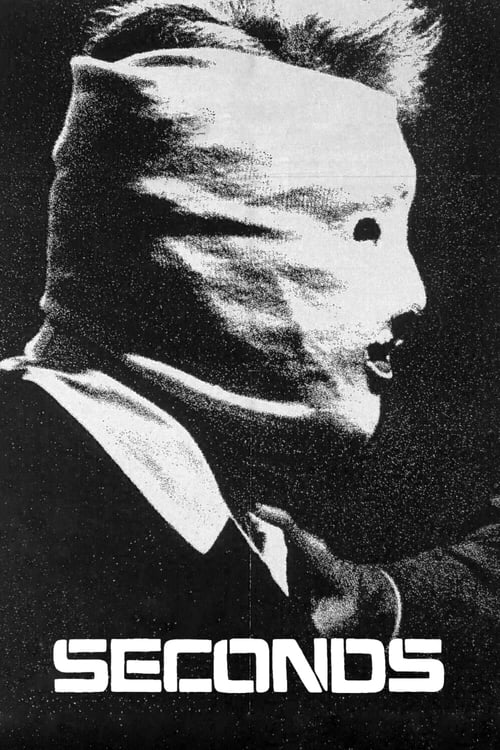
Seconds
1966 · John Frankenheimer
For when you want to be properly disturbed by an idea, not a monster — a midnight movie for anyone who's ever fantasized about walking out of their own life. Challenge, not comfort: it gets under your skin and stays there.
What it's about
A wealthy, exhausted middle-aged banker gets a phone call from a friend who is supposed to be dead, and it leads him to a secret corporation that sells the ultimate product: a new life. They fake his death, rebuild his face through surgery, and set him up as a handsome young painter in a Malibu beach house. The catch is that a manufactured self has to be lived in — and the man inside it starts to crack.
The experience
Genuinely unnerving — it plays like a horror film wearing a sci-fi premise, all clammy paranoia and creeping dread. The camera gets uncomfortably close and the world tilts and warps around the hero, so you feel his suffocation rather than just watch it. It builds slowly, then tightens like a fist.
Performances
Rock Hudson, cast brutally against his matinee-idol image, gives the performance of his career as a man trapped behind a beautiful new face — his drunken unraveling at a party is devastating. John Randolph is just as vital as the gray, hollowed-out original self.
The craft
James Wong Howe's black-and-white cinematography is the star turn: fisheye lenses, distorting close-ups, and cameras strapped to actors make ordinary rooms feel like traps, and a Saul Bass title sequence sets the queasy tone before a word is spoken. Jerry Goldsmith's organ-driven score sounds like a funeral in progress. It rewards a dark room and full attention.
Why it matters
A flop on release that became one of the great American cult films, it's now the acknowledged dark peak of Frankenheimer's 1960s paranoia run and a key ancestor of identity-horror and conspiracy cinema.
Snapshot
Seconds is a paranoid science-fiction thriller about a man who buys a second life and discovers it is a trap. Arthur Hamilton (John Randolph), a hollowed-out, affluent middle-aged banker in suburban Scarsdale, is contacted by a shadowy corporation — known only as "the Company" — that fakes his death and, through radical plastic surgery and psychological reconditioning, "reborns" him as Antiochus "Tony" Wilson (Rock Hudson), a younger, handsomer painter installed in a Malibu beach house with a staff and a new biography. The promised freedom curdles: Wilson cannot inhabit the manufactured self, his nostalgia for his old life endangers the Company's secrecy, and the firm reclaims its failed product — wheeling him into surgery not for another transformation but to serve as the fresh cadaver needed to stage some future client's death. Directed by John Frankenheimer at the height of his early-1960s run, photographed by the veteran James Wong Howe in radically distorted black-and-white, scored by Jerry Goldsmith, and titled by Saul Bass, the film was a commercial failure and a Cannes scandal on release before being reclaimed as one of the great American films of dread about identity, conformity, and the emptiness behind the postwar American Dream. It is the bleak, science-fictional capstone of Frankenheimer's loose "paranoia trilogy" alongside The Manchurian Candidate (1962) and Seven Days in May (1964).
Industry & production
Seconds was produced by Edward Lewis (a frequent Kirk Douglas and Frankenheimer collaborator) for companies associated with the Douglas–Lewis orbit — the production is generally credited to Joel Productions and Gibraltar/John Frankenheimer Productions — and released by Paramount Pictures. It was adapted from the 1963 novel Seconds by David Ely, with a screenplay by Lewis John Carlino. Principal photography moved between East Coast locations (New York City, including a Grand Central Station sequence, and the Westchester suburbs) and California (Malibu and a Santa Barbara wine-festival setting), grounding the fantastical premise in recognizable American affluence.
The most historically charged production fact concerns casting. Several key roles went to actors who had been blacklisted during the McCarthy era: John Randolph, in the pivotal role of the original Arthur Hamilton, was making one of his first major Hollywood film appearances after years barred from the screen; Jeff Corey (Mr. Ruby) and Will Geer (the avuncular, chilling "Old Man" who heads the Company) had likewise been blacklist casualties. Frankenheimer's willingness to hire them gives the film a quiet political subtext about an America that destroys and discards people, layered beneath its science-fiction surface.
The casting of Rock Hudson was the production's gamble and, in hindsight, its richest irony. Hudson — then one of Hollywood's biggest stars, known for glossy romantic comedies and melodramas — sought to be taken seriously as a dramatic actor and lobbied for the part. He plays the surgically remade "second" man, a figure living a fabricated identity under constant threat of exposure. Because Hudson was a gay star compelled to conceal his private life behind a manufactured public persona, the film has been read, especially after his death in 1985, as an almost unbearably resonant text about the closet and the performance of a false self — a reading the filmmakers did not advertise but that the casting makes nearly impossible to ignore.
On release the film was a box-office disappointment and was met with hostility at the 1966 Cannes Film Festival, where it competed for the Palme d'Or; accounts of the screening describe a cold or jeering reception that wounded Frankenheimer, who regarded the film as among his best work and felt it had been misunderstood. Its critical and cult reappraisal came over subsequent decades, aided by repertory screenings and home-video restoration.
Technology
The "technology" Seconds depicts is speculative bio-medical and bureaucratic rather than electronic: a turnkey corporate service that combines faked death (a substituted, disfigured corpse passed off as the client), extensive plastic and reconstructive surgery, dental and physical reconditioning, and intensive psychological coaching to install a new identity. The film treats this not as gleaming futurism but as a discreet, paperwork-driven business — contracts, blackmail leverage (the Company secretly films clients to coerce compliance), waiting rooms, and a sterile surgical suite. The horror is that rebirth is rendered as a transaction, complete with a product lifecycle: clients who fail to thrive become the raw material — the cadavers — for the next sale. In production terms, the surgical and "reborn" conceit is conveyed almost entirely through performance, makeup, bandaging, and the substitution of one actor (Randolph) for another (Hudson), rather than through effects spectacle; the disquiet is generated by Howe's camera and Frankenheimer's staging, not by gadgetry.
Technique
Cinematography
The film's visual signature belongs to James Wong Howe, the great Chinese-American cinematographer, whose work here earned an Academy Award nomination for black-and-white cinematography. Howe and Frankenheimer pursue an aesthetic of subjective distortion and surveillance. Extreme wide-angle and fisheye lenses bend faces and rooms into instability; deep-focus compositions and high-contrast lighting flatten or oppress the human figure; and the camera repeatedly adopts a watching, prowling, or disoriented point of view. Howe is widely credited with pioneering body-mounted and handheld camera work in the film, strapping the camera to actors so that the frame lurches with them — most famously in the opening Grand Central sequence, where Hamilton is shadowed through a crowd, and in the climactic gurney ride, shot as a first-person plunge toward the operating table. The result is one of the most formally aggressive studio films of its era, using the black-and-white image as an instrument of psychological entrapment.
Editing
The cutting (the credited editors are Ferris Webster, Frankenheimer's regular collaborator on The Manchurian Candidate and Seven Days in May, with David Newhouse) sustains a deliberate, mounting unease rather than thriller-style velocity. Editing is most expressive in two registers: the fragmented, surveillance-like assembly of the opening pursuit, and the near-hallucinatory California wine-festival/grape-stomping bacchanal, where rapid cutting and bodily chaos break the film's controlled surfaces. Elsewhere the rhythm is patient and clinical, letting dread accumulate in long, watchful takes before the cutting tightens at the surgical climax.
Mise-en-scène / staging
Frankenheimer stages the film as a study in environments that imprison. The Hamilton household in suburbia is a tomb of dead marriage and dead routine; the Company's offices and the dry-cleaning-front through which clients enter are banal and bureaucratic; the surgical and recovery spaces are antiseptic and dehumanizing. Against these, Tony Wilson's sun-struck Malibu existence is offered as liberation and quickly revealed as another stage set, populated by Company plants. The recurrent staging of figures watched, framed through doorways, or dwarfed by architecture turns space itself into the apparatus of control.
Sound
Jerry Goldsmith's score is built around a foreboding pipe-organ theme that lends the film an almost liturgical, funereal grandeur — appropriate to a story of death, resurrection, and damnation. The organ's churchy associations ironize the Company's promise of rebirth, scoring a secular salvation that is really a death sentence. Sound design contributes to the surveillance atmosphere as well, with the film alert to ambient unease and the menace of overheard, recorded, and coerced speech.
Performance
The film hinges on a relay between two lead performances representing one soul. John Randolph gives Arthur Hamilton a gray, suffocated weariness — a man already spiritually dead before the Company finds him. Rock Hudson, as the reborn Tony Wilson, delivers what is widely regarded as his finest dramatic work: beneath the new handsome surface he plays mounting confusion, panic, and grief, culminating in a harrowing breakdown. (The Santa Barbara bacchanal, in which a disinhibited Wilson is drawn into a nude grape-stomping revel, is often cited in production lore as having involved real intoxication on set; the specifics should be treated as anecdote rather than documented fact.) Will Geer's soft-spoken "Old Man" is a masterstroke of banal evil, and Salome Jens as Nora, Wilson's beach companion, and Murray Hamilton as Charlie, a fellow "reborn," round out a world in which nearly everyone may be an agent of the firm.
Narrative & dramatic mode
Seconds is a tragedy in the shape of a paranoid thriller, structured as a three-act descent: recruitment and faked death; the failed new life; and reclamation/destruction. Its dramatic mode is subjective and claustrophobic — we are bound to the protagonist's limited, increasingly unreliable understanding of who around him belongs to the Company. The narrative withholds and reveals the firm's true economy gradually, so that the ending's logic (the failed client becomes the next client's corpse) lands as both a shock and an inevitability foretold by the premise. The film refuses catharsis: its protagonist gains no escape, only the knowledge of the trap as the surgical drill descends.
Genre & cycle
The film sits at the intersection of science fiction, horror, and the paranoid political thriller. It belongs to the broader 1960s American cinema of conformity-anxiety and institutional dread, and is the science-fictional member of Frankenheimer's paranoia trilogy. Its premise — a covert organization that manufactures new identities — connects it to the Twilight Zone tradition of speculative parable (Carlino and Frankenheimer both worked in that mode of moral-allegorical SF), and its bodily horror of surgical remaking anticipates the body-horror cycle that would mature in the 1970s and 1980s. As a "second chance gone wrong" fable it also stands within a long anti-Faustian lineage, with the Company as a corporatized Mephistopheles.
Authorship & method
Seconds is a signature Frankenheimer film: technically virtuosic, politically suspicious of institutions, and obsessed with men trapped inside systems larger than themselves. His method here — extreme lenses, deep focus, restless and body-mounted camera, surveillance framing — extends the formal aggression of The Manchurian Candidate into a more existential register. The authorship is genuinely collaborative: cinematographer James Wong Howe is arguably co-author of the film's meaning, his distortions making subjective dread visible; composer Jerry Goldsmith supplies its sacral-sinister tone; screenwriter Lewis John Carlino adapts David Ely's novel into a tightening allegory; editor Ferris Webster shapes its mounting unease; and title designer Saul Bass opens the film with a celebrated sequence of fragmented, rippling facial features — eyes, lips, distorted in a kind of warped mirror — that announces the theme of the disassembled self before a scene has played. Frankenheimer regarded the film highly and defended it against its initial reception throughout his life.
Movement / national cinema
The film is an American studio production but bears the imprint of the early-1960s convergence between Hollywood and European modernist influence: its subjective camera, alienation themes, and refusal of consolation align it with the art-cinema sensibility that the festival circuit (and Frankenheimer's own ambitions) prized, even as it was financed and released through Paramount. It does not belong to an organized national movement; its affiliations are authorial (Frankenheimer's paranoid-thriller cycle) and thematic (the American literature and cinema of postwar conformity and the hollow organization man). The presence of blacklisted actors ties it specifically to the political wounds of mid-century American film culture.
Era / period
Made and set in mid-1960s America, Seconds distills the anxieties of the affluent postwar society at the moment its confidence was fracturing: the "organization man," suburban emptiness, consumer abundance experienced as spiritual death, and a dawning distrust of corporations and institutions that the later 1960s and 1970s would amplify. Its diegetic world is contemporary and recognizable — commuter trains, suburban kitchens, corporate offices — which is precisely what makes its science-fiction conceit so unsettling. The film reads now as a hinge between the buttoned-down conformity critiques of the 1950s and the full-blown institutional paranoia of 1970s American cinema.
Themes
The governing theme is the manufactured self and the impossibility of escaping who one is: Hamilton's misery is internal, so a new face and life cannot cure it. Around this cluster identity and authenticity (the dread of living a fabricated persona), the hollowness of the American Dream (wealth and success as a kind of living death), conformity and the corporate organization (freedom sold as a product by an institution that owns its customers), mortality and false rebirth (resurrection rendered as a transaction that ends in literal death), and surveillance and coercion (the Company's filmed blackmail, its agents everywhere). The film's later resonance as an allegory of the closet — the exhausting performance of a self designed to be socially acceptable — emerges directly from the Hudson casting and has become central to its critical afterlife, though it operates as subtext rather than stated intent.
Reception, canon & influence
On release Seconds failed commercially and was received coldly, its Cannes premiere reportedly hostile; contemporaneous American reviews were mixed, some critics finding its style overwrought even as others recognized its power. James Wong Howe's cinematography drew the clearest acclaim, earning an Academy Award nomination. Over the following decades the film underwent a thorough reappraisal and entered the canon as a landmark of paranoid American cinema and one of Frankenheimer's and Hudson's finest achievements, helped by repertory revival and a restoration distributed on home video.
The influences on the film are clear: David Ely's source novel; the Twilight Zone tradition of allegorical science fiction; the anti-Faustian "deal with the devil" fable; the postwar sociology of conformity and the "organization man"; and the modernist, subjective camera of contemporary art cinema. Frankenheimer's own earlier paranoia thrillers set its political temperature.
The influence of the film runs through the subsequent history of identity-dread cinema. It is frequently cited as a forerunner of the 1970s American paranoia thrillers (its surveillance dread and institutional menace anticipate films like The Parallax View), of body-horror and surgical-transformation cinema, and of a recurring premise in which a secret organization remakes or replaces the self for profit. Critics and filmmakers have repeatedly invoked Seconds as an antecedent for later works about purchased second lives and bodily appropriation — Jordan Peele's Get Out (2017), with its covert procedure for seizing other people's bodies, being among the most commonly drawn comparisons — and for narratives, from television's Mad Men onward, built on a protagonist living under an invented identity. Its reputation today is that of a once-rejected film vindicated: a cold, formally daring nightmare about the lie that you can buy your way out of being yourself.
A Deleuzian reading
A man crosses Grand Central, and a stranger presses a slip of paper into his coat.
The full Deleuzian reading of Seconds →
Reception
Booed at Cannes in 1966 and a box-office flop that briefly ended Frankenheimer's hot streak, it slowly climbed via repertory screenings and a Criterion release into consensus cult-classic status — now routinely called the great overlooked '60s paranoid thriller.
How Seconds was received, from release to now →
Influences: the films it descends from and the films it influenced
- The Manchurian Candidate (1962) — Frankenheimer's own deep-focus wide-angle compositions and brainwashing/surveillance montage establish the formal grammar Seconds pushes into an existential register.
- Seven Days in May (1964) — Completes Frankenheimer's paranoia cycle with the same institutional-menace staging — men dwarfed and watched inside vast bureaucratic interiors.
- Sweet Smell of Success (1957) — James Wong Howe's high-contrast deep-focus nocturnal cinematography, the same operator whose lens distortions make Seconds' dread visible.
- Hud (1963) — Howe's wide-angle deep-focus black-and-white framing of figures isolated in oppressive space, a method he carries directly into Seconds.
- Citizen Kane (1941) — Gregg Toland's deep-focus, low-ceilinged imprisoning compositions that Howe extends into Seconds' fish-eye claustrophobia.
- The Trial (1962) — Welles's extreme wide-angle distortion and Kafkaesque imprisoning architecture model the bureaucratic-nightmare lensing Seconds adopts.
- Vertigo (1958) — Saul Bass's spiraling fragmented-face titles and subjective identity-dread POV that Bass and Frankenheimer reprise in Seconds' rippling-features opening.
- Psycho (1960) — Bass's slashing, disassembling title graphics and the voyeur-subjective camera that prefigure Seconds' announcement of the broken self before story begins.
- Invasion of the Body Snatchers (1956) — The conformity-replacement premise — a self quietly substituted by an unseen system — that Seconds recasts as a paid corporate transaction.
- Dark Passage (1947) — Frankenheimer makes surgical identity transformation the film's central mechanism; James Wong Howe's distorting wide-angle handheld shots extend Dark Passage's first-person POV grammar into paranoid subjective distortion, particularly in the bank and reorientation sequences following the protagonist's emergence with a new face.
- Eyes Without a Face (1960) — Frankenheimer's surgical facial reconstruction as instrument of bourgeois desire: the new face given to the protagonist is simultaneously liberation and imprisonment, structurally identical to Christiane's situation, and the film extends Franju's logic by asking what happens after the surgery succeeds — the reconstructed face becomes a second confinement rather than a release.
- The Parallax View (1974) — Inherits the surveillance-montage and faceless-corporation menace, with a shadowy organization remaking identities for profit.
- The Conversation (1974) — Extends the surveillance-framing dread — the protagonist watched and dissolved by the apparatus he serves.
- The Game (1997) — Builds on the secret-organization-sells-you-a-remade-life premise, sustaining paranoid ambiguity about who controls the protagonist's reality.
- Jacob's Ladder (1990) — Deploys distorting wide-angle and subjective hallucination to render bodily and psychic dread, a direct heir to Howe's POV distortions.
- Videodrome (1983) — Carries the surgical/body-horror transformation thread — flesh remade by an institution — into explicit physical mutation.
- Get Out (2017) — Reprises the covert surgical procedure by which an organization seizes and inhabits another person's body, the most-cited modern echo of Seconds.
- Possessor (2020) — Literalizes corporate appropriation of bodies, extending the manufactured-self premise into hijacked consciousness for hire.
- Enemy (2013) — Wide-angle, sickly-toned doppelgänger dread about a man confronting a manufactured duplicate self, formally indebted to Seconds' subjective unease.
- Klute (1971) — James Wong Howe's extreme telephoto compression and the sustained use of high-angle concealed framings to render the protagonist perpetually observed created the paranoia-cinema optics vocabulary Willis refined — particularly the sense that spatial flatness itself encodes surveillance.
- Gattaca (1997) — The narrative conceit of a protagonist who physically assumes another man's identity within a corporate-institutional system that validates the biological replacement — shot by James Wong Howe in anamorphic widescreen with bodies placed inside institutional corridors — is the direct structural and formal ancestor of Gattaca's identity-theft plot and its anamorphic compositions of figures dwarfed by architecture.
- The Truman Show (1998) — Modeled the paranoid reveal that an entire life and the people in it are a covertly staged corporate production surrounding one unwitting subject.
- The Cremator (1969) — James Wong Howe's fish-eye and body-mounted distorting lenses turn ordinary faces monstrous — the immediate technical precursor to Milota's warped, looming predatory close-ups.
- Point Blank (1967) — Fragmented elliptical editing and body-mounted subjective camera tracking a disoriented man through hostile institutional space, contemporaneous with Seconds' devices.
- Repulsion (1965) — James Wong Howe's ultra-wide-angle cinematography systematically deforms the geometry of rooms and corridors to register the protagonist's psychological disorientation, the same lens strategy Gilbert Taylor employs inside Repulsion's engineered flat.
- The Ipcress File (1965) — James Wong Howe's extreme wide-angle, body-mounted, and obstructed compositions parallel Furie's surveillance-paranoia framing of figures trapped in distorting foreground space.
- The Face of Another (1966) — Same-year sibling: surgical rebirth into a wholly new face and life as an existential experiment, shot in James Wong Howe's warping wide-angle distortions that estrange the reconstructed self — a Western mirror of Nakadai's plot.
Similar films
- The Conversation (1974) — influence & lineage · same viewing thread
- The Parallax View (1974) — influence & lineage · same viewing thread
- Point Blank (1967) — influence & lineage · same viewing thread
- Seven Days in May (1964) — influence & lineage
- The Manchurian Candidate (1962) — influence & lineage
- Invasion of the Body Snatchers (1956) — influence & lineage
- Videodrome (1983) — influence & lineage
- The Face of Another (1966) — shared sensibility
All the films related to Seconds →
Watch it with: curated runs of related films
- The Paranoid and the Obsessed — A run of stylish thrillers about lone men consumed by a hidden pattern, a betrayal, or a truth they can't stop chasing — each staged with more virtuosity than the plot strictly needs.