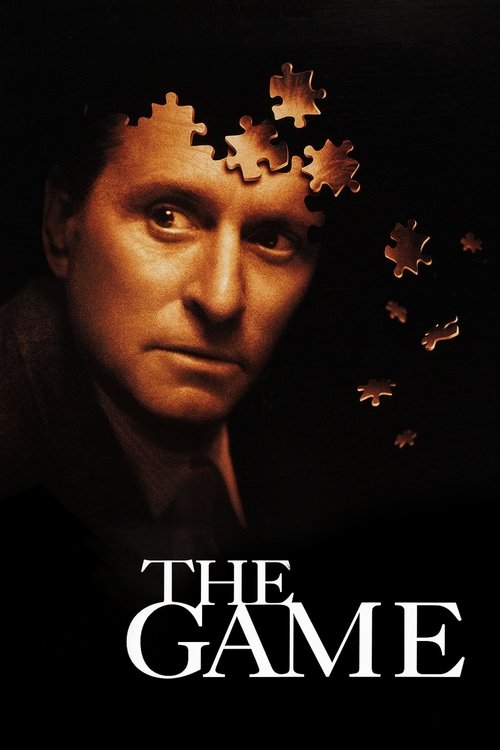
The Game
1997 · David Fincher
The Killer and his Netflix marriage keep the "master craftsman in a streaming cage" discourse alive; every rumored project (the Chinatown prequel series, a Squid Game English remake rumor cycle) trends instantly.
For a night when you want to be toyed with — a twisty, chew-on-it thriller for viewers who like feeling one step behind. Best watched cold, knowing as little as possible.
What it's about
Nicholas Van Orton is a San Francisco investment banker so wealthy and so sealed-off that his life runs like a spreadsheet — until his wayward younger brother gives him a strange birthday present: enrollment in a 'game' run by a shadowy company. No rules are explained. Soon the game starts bleeding into his bank accounts, his house, his sense of what's real, and Nicholas can't tell whether he's playing it or it's playing him.
The experience
A cold, coiled paranoia machine — it tightens scene by scene until you're second-guessing everything on screen right along with its hero. Unsettling and sleek rather than scary, and genuinely hard to pause.
Performances
Michael Douglas is ideal casting: he starts as the untouchable master of the universe and lets you watch the polish crack, layer by layer. Sean Penn brings a live-wire unpredictability as the brother who sets it all in motion.
The craft
Fincher directs with surgical control — mahogany boardrooms, fog-wrapped San Francisco, shadows that seem to be hiding something in every frame — and the film is built like a trap, every detail placed with intent. It rewards a dark room and full attention; half-watched, it loses its grip.
Why it matters
Overshadowed on release between Se7en and Fight Club, it has since been reclaimed as a key Fincher film and a forerunner of the puzzle-box thrillers that dominated the following two decades.
Snapshot
A cold, immaculate paranoia engine dressed in corporate mahogany and San Francisco fog. The Game follows Nicholas Van Orton — wealthy, sealed-off, tyrannized by routine — as a mysterious "game" purchased by his brother dismantles every certainty in his life. Fincher's third feature is the bridge between the moral horror of Se7en and the self-demolishing fury of Fight Club: all three films concern men who must be broken open before they can feel anything, but The Game is the most formal and controlled of the trio, a precision mechanism that turns paranoia into phenomenology. It did not ignite the cultural conversation its successors would, yet its structural thinking — the film as puzzle that implicates the viewer in its own deceptions — seeded discussions that would resurface across two decades of puzzle-box cinema, alternate-reality gaming, and immersive entertainment design.
Industry & production
The Game was produced by Propaganda Films and PolyGram Filmed Entertainment and distributed in North America by PolyGram/Gramercy Pictures. Fincher came to the project following the commercial and critical breakthrough of Se7en (1995), which had rehabilitated a career damaged by the troubled production of Alien 3 (1992). With Se7en, Fincher had demonstrated that austere, demanding studio thrillers could find a mass audience; the commercial logic of The Game rested on that precedent.
The screenplay was written by John Brancato and Michael Ferris, a team whose subsequent credits — the Terminator sequels — suggest a comfort with high-concept genre machinery. The script had circulated in various forms before Fincher became attached, and its central conceit — an elaborate, personalized game whose rules are never disclosed — offered a rare structural opportunity: a thriller in which the audience genuinely cannot know what counts as "real" within the diegesis because the protagonist does not know either. This dissolves the usual dramatic irony of the genre and repositions the viewer as co-victim rather than observer.
Michael Douglas was cast as Nicholas Van Orton, a choice that carried its own intertextual freight: Douglas had spent much of the late 1980s and early 1990s playing men of dangerous confidence — Gordon Gekko in Wall Street, Nick Curran in Basic Instinct — and The Game exploits the audience's accumulated reading of that persona, before systematically humiliating it. Sean Penn appears sparingly as Conrad, the younger brother who initiates the game, a casting choice that signals something more than plot function: Penn's association with raw, undefended emotion plays against Douglas's controlled surface.
Production was anchored in San Francisco — principally the Financial District, Pacific Heights, and the city's foggy perimeter — with additional photography in Mexico. The city was not a neutral backdrop; its particular atmosphere of Gilded Age wealth, Pacific light, and vertiginous geography became constitutive of the film's visual argument.
Technology
The Game was shot on 35mm in the Super 35 format, a choice consistent with Fincher's preference for the latitude and grain structure that film offered for extensive post-production color work. The production employed extensive practical locations rather than stages, requiring a rigorous production design workflow to transform real San Francisco interiors into the sealed environments the film required.
The film arrived before digital intermediate color grading was standard practice, so its distinctive desaturated palette was achieved through photochemical means — a bleach-bypass process applied in certain sequences to drain warmth and flatten the image toward the silver-gray of surveillance photography and financial documentation. This choice was deliberate and aggressive: color became ideological, associated with presence, feeling, life; its removal signaled the deadening that Nicholas Van Orton has allowed to overtake him.
Fincher would soon become one of the early adopters of digital cinematography and digital intermediate in Hollywood (most visibly in Zodiac, 2007, and The Social Network, 2010), but The Game belongs to his photochemical period, where control was achieved through the chemistry of the lab as much as through the lens.
Technique
Cinematography
Harris Savides — who would become one of the defining cinematographers of the late 1990s and 2000s through collaborations with Fincher, Gus Van Sant, Sofia Coppola, and others — shot The Game. Savides was known for his resistance to the prevailing grammar of commercial cinematography: he favored available-light approaches, minimized fill, and pursued images that looked as if they had always existed rather than as if they had been manufactured. For The Game, this meant working within San Francisco's deep shadow and diffuse fog to create interiors of mahogany claustrophobia and exteriors of silver indeterminacy.
The camera is largely cool and observational, aligned with no one's interiority. Close-ups of Nicholas are withheld in the film's early sections, as if the camera is respecting — or endorsing — his refusal of intimacy. As his control erodes, the framing becomes more erratic, handheld registers creep in, and the geometry of the Financial District's right angles begins to feel less like architecture than trap. The San Francisco mansion at the film's center — vast, impeccable, empty — is shot with the wide, static compositions of institutional photography: this is the visual language of wealth as pathology.
Editing
James Haygood edited the film, as he would Fight Club two years later. The editing of The Game is calibrated to produce maximum disorientation without announcing itself: cuts are placed not to orient the viewer spatially but to strip away landmarks, so that the geography of each scene remains unstable. This is editing in service of epistemology rather than action — the cut as instrument of doubt. The tempo is controlled rather than frenetic, because rushing the audience would relieve rather than sustain anxiety. Haygood and Fincher understand that paranoia is an endurance state, not a spike.
Mise-en-scène / staging
Fincher's approach to blocking and staging in The Game is architectural. The San Francisco mansion is used as a set of increasingly violated spaces: rooms that were private become infiltrated, objects that seemed stable turn out to be planted. The staging communicates ownership and its gradual revocation. Corporate interiors — marble lobbies, glass towers, the bland offices of Consumer Recreation Services — are staged with the flat formality of power, then slowly made sinister through the same formal means. Nothing in the décor announces itself as threatening; the threat accrues through repetition and context.
The film deploys a repeated vertical motif — staircases, elevator shafts, the eventual fall through a skylight — that is connected to the backstory of Nicholas's father, who fell from a rooftop on his 48th birthday. This vertical axis is not merely compositional; it is the film's governing symbolic structure, tracing a fall that must be chosen and survived rather than accidental and terminal.
Sound
Howard Shore composed the score, working in a register quite different from his contemporaneous work with David Cronenberg or his later orchestral grandeur for The Lord of the Rings trilogy. For The Game, Shore produced music that functions more as atmospheric field than dramatic punctuation — long held tones, unsettled harmonics, a score that inhabits the frequency range of anxiety rather than announcing it. The sound design reinforces this: CRS's offices are characterized by a barely audible electronic hum, the mansion by an absence that reads as presence. The film is careful not to over-signpost its shocks with conventional stingers; many of its most effective moments land in near-silence.
Performance
Douglas gives one of the finest performances of his career, in part because the film requires him to be wrong about almost everything and to make that wrongness legible without sympathy. Van Orton is not simply cold — he is a man who has armored himself so completely against the memory of his father's suicide that he has confused the armor for a self. Douglas's performance in the film's middle sections, as that armor is stripped away, is calibrated and committed: he finds the specific quality of humiliation available to men who have never been humiliated, which is something close to bewilderment at the laws of physics. Penn, in far less screen time, operates at a different register entirely — warm, vulnerable, watchful — and the contrast between the two actors' energies gives the fraternal relationship its emotional heft without requiring the film to explain it.
Narrative & dramatic mode
The Game operates in a mode that might be called epistemological thriller: the dramatic question is not "what will happen?" but "what is real?" The film systematically dismantles the viewer's ability to distinguish the game from non-game reality, a project it shares with The Game's protagonist. This is structurally unusual: most thrillers maintain some reliable narrative ground from which to measure danger; here, the ground itself is the source of vertigo.
The film draws on the tradition of Kafkaesque protagonist-as-victim — a man caught in a bureaucratic or institutional apparatus whose rules he cannot learn, whose operators he cannot identify, whose purpose he cannot discern until it is too late to resist. The debt to The Trial is atmospheric rather than precise: Van Orton is not Joseph K., but the experience of being processed by an opaque system that seems to know you better than you know yourself is recognizably the same existential predicament.
The twist ending — in which the game is revealed to have been orchestrated by Conrad as a birthday gift, an elaborate therapeutic intervention, and the apparent death of a stranger is revealed to have been staged — has attracted the most critical debate of anything in the film. For some viewers, the revelation too neatly resolves what felt like genuinely irresolvable dread; for others, the film's argument is precisely that reintegration with feeling requires a fall, and that the manufactured fall is indistinguishable, at the phenomenological level, from the real one. Whether the ending succeeds depends largely on whether the viewer finds the resolution emotionally or philosophically satisfying, a division in response that has sustained discussion of the film across its afterlife.
Genre & cycle
The Game belongs to the paranoia thriller, a genre with deep roots in Cold War cinema — the 1970s cycle of The Parallax View (Pakula, 1974), All the President's Men (Pakula, 1976), and Three Days of the Condor (Pollack, 1975) established the template of the lone individual confronting an institutional conspiracy that is everywhere and legible only in parts. The Game inherits this framework but relocates its anxiety from political to existential ground: the conspiracy here is therapeutic rather than governmental, designed not to harm Nicholas but to cure him, which makes it — in some ways — more troubling.
The film also participates in a late-1990s cluster of films preoccupied with constructed realities and the instability of the given world: The Truman Show (Weir, 1998), eXistenZ (Cronenberg, 1999), and The Matrix (Wachowski, 1999) all appeared within two years of The Game and share its concern with the permeability of the real. The Game is arguably the most realist of these — it never posits a science-fictional apparatus, only human organization and human resources — which gives its paranoia a particular texture: this could actually be done to you, with enough money and coordination.
Authorship & method
By 1997 Fincher had established the working methods that would characterize his mature career. His background in music video and commercial direction (he helmed significant campaigns and videos for Madonna, among others, in the late 1980s before moving to features) had given him an unusually comprehensive understanding of the image as designed artifact: every frame in a Fincher film is the result of decisions made at multiple levels, and the decisions are visible as decisions, not as naturalistic accident. This is sometimes called a "cold" style, but the coldness is purposeful — it puts the viewer at a formal distance that has emotional consequences.
Fincher is known for shooting extraordinary numbers of takes, not from indecision but from a philosophy of exhaustion: he believes that performances freed from conscious performance emerge only after actors have used up their prepared choices. This methodology requires actors who can sustain concentration over multiple iterations and who trust the director's vision of the accumulated result; Douglas, a producer as well as actor with long industry experience, was a capable partner for this approach.
Harris Savides's contribution cannot be overstated. The visual philosophy Savides brought — anti-glamour, available light as ethical choice, grain as honesty — was perfectly aligned with what Fincher needed: a world that looked like the world Nicholas Van Orton thinks he inhabits, stripped of the beautification that would signal the film's complicity with his values.
Howard Shore's score and Haygood's editing complete the core creative team for this production, a team whose work is mutually reinforcing in a way that distinguishes the film from the formula thriller: every department is making the same argument in a different register.
Movement / national cinema
The Game is unambiguously an American studio film and participates in the tradition of the Hollywood thriller, but its specific Americanness is worth locating. San Francisco here is not the city of counterculture, technology, or civic democracy but of Gilded Age capital: mansions in Pacific Heights, the Financial District's glass and granite, private clubs, old money. The film is a critique of a particular strain of American class formation — the WASP financial elite that confuses emotional unavailability with dignity — and its chosen city makes that critique specific and pointed. Fincher is a Californian director, and his California is never the sun-drenched myth: it is always a place where the surfaces are beautiful and the interiors are damaged.
Era / period
The film arrives at a particular cultural moment: the late Clinton-era confidence in markets, institutional competence, and rational self-interest was at its height, and The Game subjects exactly that confidence to systematic assault. Nicholas Van Orton is the era's ideal subject — a man who believes that mastery of financial systems constitutes mastery of life — and the film's pleasure is in its demolition of that conviction. In retrospect, the film can be read as a late-decade elegiac address to a certain kind of American self-assurance, made a few years before the events that would puncture it more historically.
The late 1990s also saw the emergence of interactive entertainment, ARGs (alternate reality games), and early forms of immersive experience, and The Game can be understood as a prescient fable about what it might mean to purchase a fully engineered experience of contingency. Consumer Recreation Services is, in this reading, a satire of the experience economy — the commodification of the illusion of genuine risk.
Themes
Inherited trauma and the compulsion to repeat. Nicholas's father jumped from the roof of their home on his 48th birthday; Nicholas is himself turning 48. The film's organizing logic is that the son has unconsciously been rehearsing the father's death his entire adult life, mistaking the rehearsal for successful repression. The game forces the repetition to become conscious and survivable.
Control and its illusions. Van Orton's professional life is the management of risk; the game systematically removes every instrument of that management. The film proposes that the management of risk — financial, emotional, relational — is itself a form of death-in-life; the willingness to fall is a precondition of living.
Authenticity and manufacture. The game succeeds by being indistinguishable from reality, which raises the question the film is ultimately most interested in: what, if anything, is the difference between a manufactured experience and an authentic one, if their phenomenological contents are identical? The therapeutic outcome is real even though the danger was not. This is the film's most genuinely philosophical claim, and it is also its most contestable.
Wealth as pathology. The film is unambiguous that Nicholas's wealth is not incidental to his damage — it is its enabling condition. The mansion, the office, the accounts: these are the materials of his fortification against feeling. The game strips them away not arbitrarily but because they are the problem.
Reception, canon & influence
The Game received generally positive but somewhat reserved reviews on release. Critics admired the film's formal control and Douglas's performance while expressing ambivalence about the ending — a reservation that has persisted in subsequent critical accounts. The film performed respectably at the box office but did not achieve the cultural saturation of Se7en before it or Fight Club after it, and for a period occupied a middling position in accounts of Fincher's career: better regarded than Alien 3, less celebrated than what followed.
Looking backward, the film's influences are legible across its texture. The paranoia thrillers of 1970s Hollywood provide the structural template, with Alan Pakula's work most immediately relevant. Hitchcock's ordinary-man-in-extraordinary-circumstances model — North by Northwest, The 39 Steps — underlies the film's premise of a competent, settled man whose competencies become useless. Kafka's The Trial shapes the institutional nightmare. Roman Polanski's The Tenant (1976) and Rosemary's Baby (1968) contribute to the tradition of the besieged urban protagonist who cannot determine whether persecution is real or imagined. From American cinema, John Frankenheimer's The Manchurian Candidate (1962) and Seconds (1966) — the latter particularly resonant, concerning a man who purchases a new life and finds it a prison — are clear precursors.
Looking forward, the film's legacy is more dispersed and perhaps more consequential than its canonical position suggests. The Game is regularly cited by creators of alternate reality games and immersive experience design as a founding text — the dramatization of what it would feel like to be inside such a construction. The television series Mr. Robot acknowledged the film as a significant influence on its construction of a protagonist who cannot trust his own perception of reality. Puzzle-box cinema of the 2000s and 2010s — from Nolan's Memento (2000) to the broader tradition of twist-ending prestige thrillers — developed in an atmosphere partly created by The Game's demonstration of what formal rigor could accomplish within the genre.
Within Fincher's body of work, the film is now understood as a hinge piece: it consolidates the visual and tonal methods of Se7en and deploys them toward a more explicitly psychological argument that Fight Club would radicalize. The three films form a loose triptych of male damage, late-century American masculinity confronted with its own poverty — The Game is the most formally composed and emotionally restrained of the three, which may explain why it remains the least celebrated and perhaps the most underestimated.
A Deleuzian reading
Watch what color does here — or rather, what Fincher does to it.
The full Deleuzian reading of The Game →
Reception
In 1997 it landed as the respectable-but-minor Fincher sandwiched between Se7en and Fight Club, a solid thriller that critics liked without loving. A 2012 Criterion release and years of 'actually, it's great' advocacy have turned it into the go-to pick for most underrated Fincher.
How The Game was received, from release to now →
Influences: the films it descends from and the films it influenced
- The Parallax View (1974) — The mid-film audiovisual 'test' sequence — a constructed montage designed to psychologically profile the protagonist as he watches it — is the direct structural ancestor of CRS's elaborately staged, personalized simulation; both films turn being-tested into an epistemological trap the viewer cannot see out of.
- All the President's Men (1976) — Gordon Willis's low-key cinematography — pools of hard light in institutional darkness, Financial District architecture read as conspiracy infrastructure — established the visual grammar that Savides extended in The Game's desaturated San Francisco, treating the built environment of capital as the spatial language of paranoia.
- Blow-Up (1966) — The epistemological thriller form in which protagonist and viewer genuinely cannot determine what constitutes evidence — Antonioni dissolves the genre's conventional dramatic irony so the audience shares rather than observes the protagonist's uncertainty, the formal move The Game inherits and industrializes.
- Vertigo (1958) — The elaborately staged private performance designed to psychologically undo one specific man within San Francisco's vertiginous geography is the structural template: both films premise that the protagonist's experienced reality is a managed production authored by others for his benefit.
- Se7en (1995) — Darius Khondji and Fincher pioneered the aggressive photochemical bleach-bypass desaturation — stripping warmth toward silver-gray to make the image feel post-vital — that Harris Savides then applied and refined as The Game's governing color ideology.
- The Conversation (1974) — Walter Murch's sound design turned surveillance audio into an epistemological puzzle — the protagonist's certainty about what he heard is progressively undermined by the same recording — establishing the precedent for treating recorded evidence as unstable rather than authoritative.
- House of Games (1987) — The long-con film in which a professional marks a single target through an elaborately staged performance while the mark believes she is the observer not the object; the structure of a deception designed by specialists specifically for one person is the direct generic precursor to CRS's operation.
- Seconds (1966) — Builds on the secret-organization-sells-you-a-remade-life premise, sustaining paranoid ambiguity about who controls the protagonist's reality.
- Fight Club (1999) — James Haygood edits both films, and the spatial-disorientation technique — cuts placed to strip landmarks rather than establish them — is carried from The Game into full unreliable diegesis here, completing the structural experiment in epistemological cutting that The Game initiated.
- Memento (2000) — Epistemological cutting extended to structural principle: the film's editing physically enacts the protagonist's inability to determine what is real, making the viewer share the limitation rather than observe it — a direct formalization of the disorientation strategy The Game deploys through plot.
- Zodiac (2007) — Harris Savides returns as cinematographer, pushing the available-light minimal-fill philosophy toward forensic austerity; the film converts The Game's epistemological thriller structure into archival procedural, treating incomplete information as both subject matter and formal condition.
- Gone Girl (2014) — The elaborate privately staged performance designed to deceive one specific target returned within Fincher's filmography; Jeff Cronenweth's desaturated palette continues the photochemical philosophy Savides established on The Game, while the unreliable narrator now operates at the level of the film's own narration rather than only its diegesis.
- Headhunters (2011) — Trap-structure narrative in which the protagonist cannot distinguish real threat from engineered scenario, combined with rigorous first-act setup/payoff discipline and a cool, desaturated color palette — both the formal strategy and the narrative DNA Headhunters absorbs.
- Intacto (2001) — Supplies the mystery-box premise of an invisible organization that has quietly rigged the protagonist's reality, withholding its rules until a late elliptical revelation.
- The Truman Show (1998) — The constructed-reality thriller in which every element of one man's world is managed production released the following year; it inverts The Game's perspective from the player-as-victim to the audience-of-construction, mapping the same formal premise onto a media-satire register.
- Caché (2005) — Surveillance footage deployed as epistemological trap — Haneke refuses to identify who sent the tapes, positioning the viewer as unable to distinguish evidence from coincidence or guilt from anxiety, extending the paranoia-thriller's strategy of implicating the audience in its own hermeneutic failure.
- Shutter Island (2010) — A therapeutic constructed-reality in which an institution stages an elaborate environmental simulation for one patient's benefit — the premise that a protagonist's lived experience may be a managed design for psychological purposes directly extends The Game's CRS conceit into a clinical register.
- Mulholland Drive (2001) — The film constructs an elaborate diegetic reality, then retroactively frames it as fantasy, forcing the viewer to re-read every prior scene as manufactured wish-fulfillment — extending The Game's strategy of staging the diegesis as a designed experience the viewer cannot decode from inside.
Similar films
- Fight Club (1999) — influence & lineage · same viewing thread
- Zodiac (2007) — influence & lineage
- House of Games (1987) — influence & lineage
- Se7en (1995) — influence & lineage
- Memento (2000) — influence & lineage
- Gone Girl (2014) — influence & lineage
- Caché (2005) — influence & lineage
- The Social Network (2010) — same viewing thread
All the films related to The Game →
Watch it with: curated runs of related films
- The American Male Comes Apart — A run of self-made men — brokers, founders, dealers, drifters — hollowed out by the very thing they chase, each film pressing the same nerve where ambition curdles into alienation and violence.