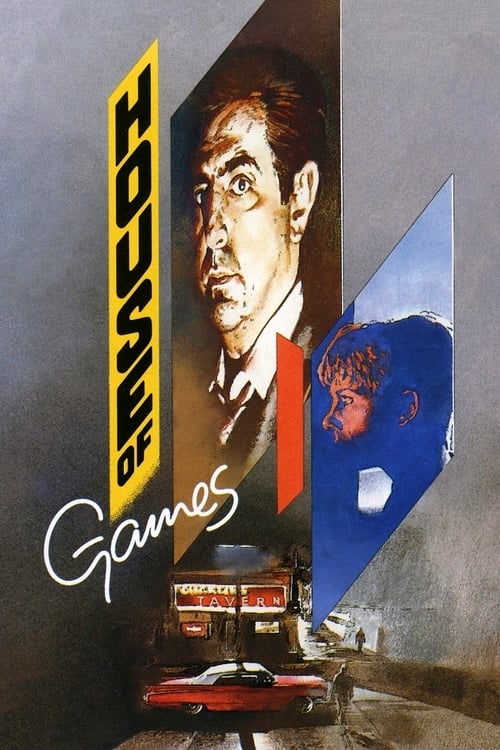
House of Games
1987 · David Mamet
When you want to be outsmarted — a puzzle-box night in for people who love cons, poker faces, and dialogue with a blade in it. Best with your full attention and someone to compare theories with after.
What it's about
A buttoned-up psychiatrist and bestselling author, trying to help a patient crushed by gambling debt, walks into a backroom poker joint to confront the con man he owes. Instead of scaring him off, she's fascinated — and he offers to show her how confidence games really work. She follows him into the world of stings and short cons as research, telling herself she's still the one in control.
The experience
Chilly, hypnotic, and wickedly clever — the stylized, flat-affect dialogue takes a few minutes to tune into, then becomes the whole pleasure. You watch it the way a mark watches a card trick: certain you see everything, certain you're wrong.
Performances
Joe Mantegna is silk and menace as the grifter Mike, delivering Mamet's language like it's his native tongue, while Lindsay Crouse's deliberately controlled stillness as the psychiatrist is a riskier choice that pays off the deeper the film goes.
The craft
David Mamet's first film as director, and the writing is the star: clipped, ritualistic, endlessly quotable dialogue about how trust gets manufactured. The lacquered neo-noir look — pool halls, hotel rooms, pools of lamplight — matches the story's air of elegant deceit.
Why it matters
It announced Mamet as a filmmaker, not just a playwright, and became the modern reference point for the con-artist movie — the film every later grifter story gets measured against.
Snapshot
House of Games is David Mamet's feature directorial debut, a chilly, lacquered thriller about a successful psychiatrist who is drawn out of her clinical detachment and into the world of professional con men. Dr. Margaret Ford (Lindsay Crouse), a best-selling author on compulsive behavior, seeks out the gambler Mike (Joe Mantegna) on behalf of an indebted patient and is instead seduced — intellectually, erotically, and finally catastrophically — by the craft of the short con and the long con. The film operates simultaneously as a genre exercise and as a meta-fictional trap: every lesson Mike teaches Margaret about how marks are made is, the picture reveals, being run on her, and by extension on the viewer. Mamet, already a Pulitzer-winning playwright (Glengarry Glen Ross) and an established screenwriter (The Postman Always Rings Twice, The Verdict, The Untouchables), here transposes his theatrical preoccupations — language as a tool of manipulation, the transactional nature of all human contact, the con as the master metaphor for American life — into a directorial signature of deliberate, anti-naturalistic stylization. The result is one of the most distinctive American directorial debuts of the 1980s and the founding text of Mamet's career behind the camera.
Industry & production
House of Games was produced by Michael Hausman, Mamet's frequent producer and a veteran line producer and assistant director, and released through Orion Pictures, the independent-minded studio that during the late 1980s cultivated exactly this kind of writer-driven, mid-budget adult drama (Orion's roster in these years included Woody Allen, Jonathan Demme, and the Coens). The budget was modest — this was a small picture by studio standards, shot largely in Seattle standing in for an unnamed American city — and its commercial ambitions were correspondingly limited; it was conceived and sold as a prestige item rather than a wide-release thriller. Precise box-office figures are not something I can reliably cite here, and the film's reputation rests on critical and cultural standing rather than theatrical gross.
The crucial industrial fact is that Orion and Hausman gave a first-time director near-total authorial control. Mamet wrote the screenplay (from a story developed with the comedian and writer Jonathan Katz) and directed without the dilution that typically attends a playwright's Hollywood adaptation. He brought with him a repertory company drawn from his Chicago and New York theater world — the St. Nicholas Theatre and the Atlantic Theater Company circle — so that the cast was populated by actors trained in his particular cadences. This continuity of personnel, more than money, defined the production's character.
Technology
House of Games is a conventionally photographed 35mm film of its period, and its technological interest lies not in any innovation of apparatus but in the disciplined restriction of means. There are no optical pyrotechnics, no elaborate camera rigs, no reliance on the era's emerging electronic tools. The most significant "technology" in the film is, fittingly, pre-cinematic and analog: the mechanics of the confidence trick itself. Mamet engaged the sleight-of-hand artist and scholar Ricky Jay — who also appears in the cast as the con man George — as a consultant and performer, so that the card handling, the short cons, and the psychology of misdirection on screen are grounded in genuine expertise rather than movie approximation. The film's authenticity is a matter of craft knowledge, not equipment.
Technique
Cinematography
The cinematography is by Juan Ruiz Anchía, the Spanish-born director of photography who would become one of Mamet's key early collaborators (he also shot Things Change and Homicide). Anchía's images are cool, controlled, and faintly sinister — a palette of muted greens, browns, and shadow that gives the titular gambling den and the nocturnal city a noir-adjacent murk without lapsing into pastiche. The camera tends toward stillness and the medium shot; Mamet and Anchía favor compositions that hold characters at a slight, observational distance, refusing the emotional close-up where another filmmaker would reach for it. This restraint is purposeful: it keeps the viewer in the position of the analyst — watching, reading, trying to detect the "tell" — and withholds the reassurance of conventional identification.
Editing
Trudy Ship edited the film. The cutting is precise and unhurried, matched to Mamet's preference for letting scenes play in sustained, dialogue-driven takes rather than fragmenting them. The editing logic is theatrical-classical: scenes are constructed to deliver information and misdirection in measured beats, so that the audience is given exactly what it needs to feel knowing — and exactly what it needs to be fooled. The rhythm of revelation, the timing of when a con's machinery is exposed, is fundamentally an editorial as well as a writerly achievement.
Mise-en-scène / staging
The staging is the most overtly "Mametian" dimension of the film and the one that most divides viewers. Mamet, coming from the stage, blocks his actors with a deliberate, almost ceremonial flatness. Bodies are arranged with a stillness that reads as composed rather than lifelike; gestures are economical. Spaces — the green-felt back room of the House of Games, Margaret's antiseptic office, a hotel room, a bus-station Western Union — are rendered as enclosed sets of social ritual, arenas where transactions are conducted. Production designer Michael Merritt, another Mamet regular from the Chicago theater, gives these environments a stripped, functional clarity that suits the film's diagrammatic intelligence.
Sound
Alaric Jans, a longtime Mamet collaborator, composed the score, which is spare and unsettling, used sparingly to mark the film's tonal shifts rather than to underline emotion continuously. The more important sonic element is the dialogue itself, which functions as a kind of music. Mamet's lines — clipped, repetitive, overlapping, profane, built on incantatory rhythms and the strategic withholding of plain meaning — are delivered as scored speech. The sound design keeps the world quiet and close, so that language dominates the aural field, as it must in a film where words are the primary weapons.
Performance
The acting style is the film's most debated formal choice. Mamet directs his cast toward a deliberately affectless, anti-naturalistic delivery — lines spoken on a level, drained of conventional inflection, as if the characters were reciting a liturgy of manipulation. Lindsay Crouse (Mamet's wife at the time) plays Margaret with a brittle, controlled precision that some read as wooden and others as a brilliant rendering of a woman whose professional composure is a mask. Joe Mantegna, the definitive Mamet actor, gives Mike a silken, seductive plausibility that makes the audience complicit in being conned. The supporting players — Mike Nussbaum, Ricky Jay, J.T. Walsh, and others from Mamet's troupe — sustain the same stylized register. The effect is alienating by design: the performances refuse psychological warmth precisely because the film is about the impossibility of trusting surfaces.
Narrative & dramatic mode
The film's dramatic engine is the nested con. On its surface it is a thriller of education and seduction: a repressed professional is initiated into an illicit world by a charismatic guide, transgresses, and pays. Beneath that runs the structural revelation that the entire sequence of events has been an elaborate sting designed to fleece Margaret, and that the audience — invited to feel clever as it "learns" the con man's secrets — has been positioned as a mark too. Mamet thus builds a self-reflexive machine in which the pleasures of plot (suspense, reversal, the click of a scheme falling into place) are themselves shown to be the mechanics of deception. The climactic turn extends the moral logic further, as Margaret's victimhood curdles into something darker and she takes the con's lesson — that the world is divided into those who take and those who are taken — to its end point. The dramatic mode is closer to fable or morality play than to psychological realism: a parable about trust, executed with the cold elegance of a proof.
Genre & cycle
House of Games belongs to the lineage of the con-artist film — a tradition running through The Lady Eve, The Sting, and Paper Moon — but it strips that genre of its customary charm and uplift. Where the classic caper invites the audience to root for the rogue, Mamet's film implicates the audience in the swindle and refuses catharsis. It also draws on film noir: the femme-fatale dynamic is inverted, with a woman as the protagonist drawn into the underworld, and the visual idiom borrows noir's nocturnal unease. As part of a cycle, the film inaugurated Mamet's own recurring genre — the con/deception thriller — which he would return to repeatedly in Things Change (1988), Homicide (1991), The Spanish Prisoner (1997), and Heist (2001). It sits, too, within the late-1980s revival of intelligent adult thrillers made by writer-directors working at the margins of the studio system.
Authorship & method
The film is a near-total authorial statement, and its method is the transposition of theatrical practice into cinema. David Mamet wrote and directed it; the screenplay derives from a story he developed with Jonathan Katz. Mamet's directorial theory — later codified in his polemical book On Directing Film — holds that a film should be built from a sequence of simple, uninflected shots that convey only essential information, with meaning generated by juxtaposition rather than by acting or camera "expression." House of Games is the first and clearest demonstration of that doctrine. His key collaborators form a repertory: cinematographer Juan Ruiz Anchía, composer Alaric Jans, production designer Michael Merritt, editor Trudy Ship, producer Michael Hausman, and the acting company anchored by Joe Mantegna and Lindsay Crouse, with Ricky Jay supplying both performance and expert con-craft. The authorship is inseparable from this troupe; Mamet's cinema is a theater company's cinema, carrying its ensemble and its house style onto film.
Movement / national cinema
House of Games is a work of American independent-adjacent filmmaking — produced through Orion, but writer-driven and authorially controlled in a way that aligns it with the broader 1980s emergence of the playwright- and screenwriter-turned-director. It is not part of any organized movement, but it can be situated within the American tradition of theatrically rooted cinema, descending from the writer-directors and stage émigrés who brought the discipline of the script to Hollywood. Its sensibility is distinctly American in subject — the con as a national archetype, the cash transaction as the basic unit of human relation — even as its formal coldness owes something to a more European, Brechtian impulse toward alienation and demonstration.
Era / period
The film is a product of the late Reagan-era 1980s, and its preoccupations resonate with that moment's culture of speculation, hustle, and the valorization of the deal. Its vision of a society organized around taking and being taken, of confidence as currency, reads as an oblique commentary on the decade's transactional ethos — a quieter, more clinical cousin to the era's louder fables of greed. Stylistically it stands apart from the dominant 1980s thriller idiom of high-gloss action and pop scoring; its austerity is almost a rebuke to the period's commercial cinema, which is part of why it has aged into something that looks less dated than much of its moment.
Themes
The governing theme is confidence — in both senses: trust and the trick that exploits it. Mamet treats the con as a universal model of human exchange, drawing an explicit parallel between the grifter's manipulation and the psychiatrist's: both read people, both extract, both traffic in the management of belief. From this flows a cluster of concerns: the unknowability of other minds and the impossibility of verifying any surface; desire and transgression, as Margaret's repression gives way to a hunger for the forbidden; the seductiveness of expertise and initiation; and the moral corrosion that follows from learning to see the world as marks and players. The film is also, self-consciously, about theater and storytelling themselves — about how fiction works on an audience the way a con works on a mark — making it a meditation on its own medium. Its final movement raises questions of guilt, retribution, and self-forgiveness that resist easy resolution.
Reception, canon & influence
Critically, House of Games was received as a striking and intelligent debut. It premiered on the festival circuit — including at the Venice Film Festival — and drew strong notices from influential American critics; Roger Ebert, among others, championed it warmly. Reviews tended to split along the fault line of Mamet's stylized acting: admirers read the flat, ritualized performances as a bold and coherent aesthetic, while detractors found them stilted. That very debate, however, established Mamet immediately as a director with a recognizable method rather than a playwright dabbling behind the camera.
Influences on the film (backward): It draws on the con-artist comedy and the caper film, on film noir's visual and moral universe, and on the gamesmanship of card-sharp and grifter lore made authentic through Ricky Jay's expertise. More deeply, it carries the inheritance of Mamet's own theater and of the Brechtian, demonstrative approach to performance, alongside the influence of his stated cinematic models, including the constructivist montage theory he absorbed and proselytized.
Legacy (forward): The film launched Mamet's directorial career and defined a personal genre of deception thriller that he would mine for decades, with The Spanish Prisoner its most direct descendant. It cemented the "Mamet speak" as a recognizable, much-imitated, and often-parodied screen idiom, and it advanced the careers of his ensemble, Joe Mantegna foremost among them. More broadly, it stands as a touchstone for the twist-driven, audience-implicating thriller — a precursor in spirit to the 1990s vogue for narratives that con the viewer — and as a perennial reference in discussions of how performance style and directorial restraint can themselves carry a film's meaning. Its standing in the canon is secure as both a superior con-game thriller and the cornerstone of one of American cinema's most idiosyncratic writer-director bodies of work.
A Deleuzian reading
Watch the first card scene.
The full Deleuzian reading of House of Games →
Reception
A critical hit right out of the gate — Roger Ebert crowned it the best film of 1987 — though it made barely a ripple at the box office; decades and a Criterion release later, it's settled in as the urtext of the modern con movie.
How House of Games was received, from release to now →
Influences: the films it descends from and the films it influenced
- Battleship Potemkin (1925) — Mamet's On Directing Film doctrine — uninflected shots conveying only essential information, with meaning manufactured by juxtaposition rather than acting — is lifted wholesale from Eisenstein/Kuleshov constructivist montage, and House of Games is its first demonstration.
- Pickpocket (1959) — Bresson's affectless 'model' performances and his documentary-precise rendering of a thief's hand-craft are the template for Mamet's ceremonial flatness and for showing Ricky Jay's con-mechanics straight and unglamorized.
- The Lady Eve (1941) — Establishes the card-sharp/female grifter working a mark, with the technical mechanics of the con played as a seduction the victim never sees coming.
- Nightmare Alley (1947) — Supplies the carny-mentalist grifter lore and the cold-reading con rendered with insider authenticity, the same documented expertise Mamet sources from Ricky Jay.
- Out of the Past (1947) — Provides noir's fatalist moral economy and the femme fatale who out-maneuvers the protagonist — the visual palette and the structure of a mark doomed by his own desire.
- Sweet Smell of Success (1957) — Its percussive, hyper-stylized urban dialogue treated as rhythmic music is a direct forebear of 'Mamet speak' as a deliberately anti-naturalistic screen idiom.
- The Sting (1973) — Codifies the nested long-con whose final reveal retroactively re-stages everything the audience just watched, the architecture House of Games rebuilds with a single mark.
- Sleuth (1972) — A two-hander of theatrical gamesmanship and one-upmanship that springs a constructed trap, foregrounding artifice and performance-as-deception over realism.
- The Postman Always Rings Twice (1981) — Mamet's directing debut grows directly out of the screenwriting career Postman inaugurated, extending his signature engagement with confidence games, betrayal and male appetite.
- The Verdict (1982) — Mamet carries his spare, percussive dialogue idiom and unsentimental view of self-deceiving protagonists from screenwriting into his own direction.
- The Spanish Prisoner (1997) — The most direct descendant: same repertory ensemble, same observational-distance shooting and flat delivery, and the same nested-con architecture turned on a single naive mark.
- Homicide (1991) — Extends the identical method — repertory cast (Mantegna), sustained uninflected takes, and ceremonial flatness — applied to a cop conned by a larger scheme.
- The Grifters (1990) — A near-contemporary grifter film that foregrounds the technical execution of the short con as observed craft rather than thematic backdrop.
- The Usual Suspects (1995) — Inherits the audience-implicating unreliable reveal — the narrative cons the viewer in lockstep with the on-screen mark, the 1990s vogue House of Games anticipated.
- Matchstick Men (2003) — Built on a long-con reveal engineered to deceive both the protagonist-mark and the audience simultaneously, the signature House of Games sting structure.
- The Prestige (2006) — Stages magic-as-misdirection as its very narrative structure, with Ricky-Jay-grade craft authenticity and the trick deliberately played on the viewer.
- Heist (2001) — Late repertory deployment of the nested double-cross plot delivered in the same anti-naturalistic, clipped cadence and restrained, information-only camera.
- The Game (1997) — The long-con film in which a professional marks a single target through an elaborately staged performance while the mark believes she is the observer not the object; the structure of a deception designed by specialists specifically for one person is the direct generic precursor to CRS's operation.
- The Outfit (2022) — Mamet's clipped declarative dialogue functions as professional concealment, and confidence expertise becomes an instrument of control; Moore applies this template exactly — his cutter's technical mastery is simultaneously his shield, his weapon, and the audience's misdirection.
- Nine Queens (2000) — Models the con as dialogue-driven verbal performance in near-real-time, with a seasoned grifter tutoring a novice, ending on a reversal that exposes the apparent apprentice/observer as the true mark.
- Glengarry Glen Ross (1992) — Mamet-scripted, it weaponizes the same 'dialogue-as-music' idiom and the transaction-as-relation ethos — the salesman's pitch as a con — in ensemble form.
Similar films
- Sleuth (1972) — influence & lineage
- The Maltese Falcon (1941) — shared sensibility
- 12 Angry Men (1957) — shared sensibility
- Wall Street (1987) — shared sensibility
- Double Indemnity (1944) — shared sensibility
- The Killing of a Chinese Bookie (1976) — shared sensibility
- Margin Call (2011) — shared sensibility
- Molly's Game (2017) — shared sensibility