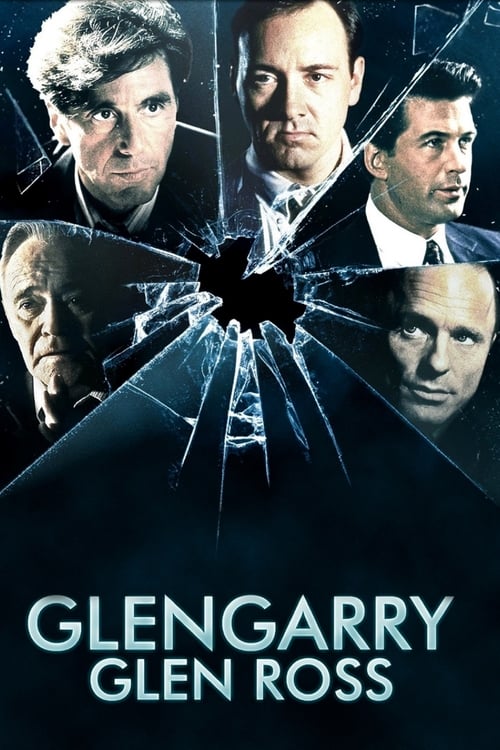
Glengarry Glen Ross
1992 · James Foley
For when you want to watch great actors go for each other's throats — a film for lovers of dialogue, tension, and workplace dread rather than comfort viewing. Perfect when you're in the mood for something lean, mean, and quotable.
What it's about
Four real-estate salesmen at a shabby office are told the monthly sales contest now has real stakes: winners keep their jobs, losers are out. The good leads — the Glengarry leads — are locked away until they earn them, and over one rain-soaked night and the following morning, desperation curdles into scheming. When the office is robbed and the leads go missing, everyone becomes a suspect, and everyone keeps selling.
The experience
Electric and merciless — nearly all talk, but talk as blood sport, with profane arias of persuasion, pleading, and rage. It's darkly funny, then quietly devastating; you come out wired and a little bruised.
Performances
Jack Lemmon is heartbreaking as the fading Shelley Levene, flop-sweat and false cheer barely covering panic, opposite Al Pacino's silky, Oscar-nominated Ricky Roma. Alec Baldwin's single scene as the motivator from downtown is one of the most famous monologues in American film, with Ed Harris, Alan Arkin, and Kevin Spacey completing a murderers' row.
The craft
David Mamet's stage play reaches the screen with its clipped, circling, weaponized dialogue intact — language so rhythmic it plays like music. Foley shoots the cramped office and neon-lit rain like a film noir, keeping the camera close enough that you feel trapped in the room with them.
Why it matters
It became the definitive screen portrait of high-pressure sales culture — endlessly quoted in offices, comedy, and business writing — and a benchmark for ensemble acting.
Snapshot
Glengarry Glen Ross is the screen adaptation of David Mamet's 1984 Pulitzer Prize–winning play, a savage chamber drama about a handful of real-estate salesmen squeezed to the breaking point by the office that employs them. Set across roughly twenty-four hours at a downmarket Chicago land-sales operation transplanted to a rain-soaked New York, the film observes four salesmen — the once-great Shelley "the Machine" Levene (Jack Lemmon), the swaggering, ascendant Ricky Roma (Al Pacino), the resentful Dave Moss (Ed Harris), and the timid George Aaronow (Alan Arkin) — as they are informed that the bottom performers on the new monthly sales board will be fired. Lording the leads over them is the cold office manager Williamson (Kevin Spacey); presiding over the threat is a visitor from "downtown," Blake (Alec Baldwin), whose contemptuous pep talk sets the film's machinery in motion. When the valuable "Glengarry" leads are stolen overnight, the second half becomes a police-procedural pressure cooker in which desperation, betrayal, and self-delusion are wrung out of men who have staked their entire identities on the act of selling. Built almost entirely from Mamet's serrated, profane, hyper-rhythmic dialogue and from a once-in-a-generation ensemble of actors working at the top of their powers, the film has become a touchstone for screen acting and a defining American statement on the brutality of commission-driven capitalism.
Industry & production
The film originated as a play. Mamet's Glengarry Glen Ross premiered at the Royal National Theatre in London in 1983, directed by Bill Bryden, and opened on Broadway in 1984 in a production directed by Gregory Mosher; it won the 1984 Pulitzer Prize for Drama and was widely honored on both sides of the Atlantic. Mamet, already established as one of America's most distinctive playwrights and increasingly active in film (he had written The Postman Always Rings Twice and The Verdict, and had begun directing with House of Games), adapted his own play for the screen.
The production was an independent, modestly budgeted affair, produced through Stanley R. Zupnik's company with Jerry Tokofsky, and distributed in the United States by New Line Cinema. Its most frequently cited production legend — well attested in the film's lore — is that the ensemble agreed to work for substantially reduced fees because the material and the company were so attractive, and that the cast jokingly referred to the project as "Death of a Fucking Salesman," a nod both to Arthur Miller's play and to Mamet's relentless profanity. James Foley, a director who had made the intense father-son crime drama At Close Range (1986) and the Jim Thompson adaptation After Dark, My Sweet (1990), was engaged to direct.
The single most consequential industrial-creative decision was Mamet's addition, for the film, of a character and scene that do not exist in the play: the "downtown" enforcer Blake, played by Alec Baldwin, whose roughly seven-minute monologue — built around the mantra "Always Be Closing" and the jeer that "coffee is for closers" — was written expressly for the screen. This invented prologue supplies a villainous on-screen embodiment of the off-stage corporate pressure that the play only implies, and it has become, paradoxically, the film's most famous single sequence. The casting otherwise assembled an extraordinary roster: Jack Lemmon, a veteran of Hollywood's studio era seeking late-career dramatic heft; Al Pacino at the height of an early-1990s resurgence; Ed Harris and Alan Arkin as the conspiring mid-tier salesmen; a young Kevin Spacey as the despised manager; and Jonathan Pryce as Roma's quarry, the wavering buyer James Lingk.
Technology
Glengarry Glen Ross is a conventionally photographed early-1990s production shot on 35mm film, and it makes no claim to technological innovation; it is, by design, a film of words, faces, and confined spaces. Its technical interest lies not in apparatus but in the deliberate constriction of means: two principal locations (a Chinese restaurant and bar, and the cramped real-estate office), shot largely at night and in continuous rain, with the weather generated practically on set. The wet, neon-smeared darkness is a production-design and lighting choice rather than an effects achievement, and the film's power comes from photochemical rendering of cramped interiors and exhausted faces rather than from any optical novelty. The record offers no indication of unusual technical processes, and it would be invention to claim otherwise.
Technique
Cinematography
The cinematography is by Juan Ruiz Anchía, the Spanish-born cinematographer who had already collaborated with Mamet on House of Games and Things Change. Anchía's work here is a study in claustrophobia and nocturnal mood: the palette runs to rain-streaked blacks, sodium ambers, and the cold fluorescent pallor of the office, with the restaurant scenes bathed in a warmer, boozy red-gold light that flatters Roma's seductive patter. The persistent rain on windows and the reflections it throws turn the glass surfaces of the office and the diner into a visual motif of entrapment — men sealed inside boxes, watched and watching. The camera favors tight framings that crowd the actors together, and it tends to hold on faces through Mamet's long verbal arias, trusting performance over coverage. The overall effect is of a pressurized, almost theatrical space rendered cinematic through the textures of wet night and artificial light.
Editing
The editing, credited to Howard E. Smith, faces the structural challenge inherent in adapting a dialogue play: how to give cinematic shape to long, near-unbroken speeches without fragmenting their rhythm. The solution is restraint. The cutting generally lets Mamet's exchanges play in sustained takes and measured shot/reverse-shot, allowing the verbal music — the interruptions, the repetitions, the explosive obscenities — to dictate pace. The film's architecture preserves the play's two-part design: a first movement of discrete two-handed scenes in the restaurant (Levene begging Williamson; Moss recruiting Aaronow; Roma seducing Lingk) and a second movement set the following morning in the burgled office, where the rhythm tightens into the interrogation. The editing's job is to honor that build — patient and conversational at first, then increasingly knotted and tense as the theft investigation closes in — rather than to impose an external tempo.
Mise-en-scène / staging
Foley and his designers map a complete moral geography out of two shabby rooms. The office is a cramped warren of desks, frosted glass, filing cabinets, and the all-important sales board on which the men's names are ranked — a literal scoreboard of survival that dominates the space. The restaurant booth, where Roma works his magic on Lingk, is a pool of intimate light in which the film's most insidious seduction unfolds. Costuming dramatizes status with precision: the salesmen's suits range from Roma's relative sharpness to Levene's slightly dated, fraying respectability, every man's wardrobe a claim about where he stands and where he fears he is sliding. The staging keeps bodies close and exits blocked; the rain outside seals the world shut. Within these confines Foley arranges the actors in shifting alliances and isolations — Levene cornered, Roma commanding the floor, Aaronow perpetually on the margin — so that physical position on screen continually registers the characters' fluctuating power.
Sound
The film's true score is Mamet's dialogue, and its sound design foregrounds the human voice above all. The famous "Mamet-speak" — clipped, profane, stutteringly rhythmic, full of interruption, repetition, and aborted thought — is the film's music, and the recording and mixing serve it by keeping every overlapping curse and half-finished sentence legible. Around the voices, the relentless rain provides a constant sonic floor, a hiss of weather that underscores the men's entrapment. The original score is by James Newton Howard, whose jazz-inflected music — built around a smoky, after-hours idiom appropriate to the nocturnal milieu — frames the drama without competing with the dialogue. The sound world is otherwise naturalistic: traffic, telephones, the clink of glasses, the ambient hum of a low-rent office, all grounding the verbal pyrotechnics in a lived, unglamorous environment.
Performance
Performance is the reason the film exists and the reason it endures. The ensemble is frequently cited as one of the finest ever assembled for an American film, and the acting is its overwhelming achievement. Jack Lemmon's Shelley Levene is the emotional center: a fading salesman clinging to memories of past glory, oscillating between wheedling charm, manic false confidence, and naked terror, in a performance many regard as the summit of Lemmon's late career. Al Pacino's Ricky Roma is its flamboyant counterweight — a verbal predator whose restaurant seduction of the hapless Lingk is a virtuoso aria of improvised philosophy and manipulation, and whose Best Supporting Actor Academy Award nomination recognized the bravura. Ed Harris and Alan Arkin make the conspiring Moss and Aaronow a study in resentment and weakness; Kevin Spacey's Williamson is a portrait of bureaucratic coldness that the salesmen's contempt cannot dent; Jonathan Pryce's Lingk is heartbreaking as the buyer too polite to escape Roma's web. And Alec Baldwin, in his single invented scene, delivers a monologue of such concentrated cruelty — the "brass balls" speech — that it became instantly iconic. The film functions, in effect, as a filmed acting masterclass.
Narrative & dramatic mode
The dramatic mode is naturalistic tragedy compressed into a pressure-cooker structure. The narrative is bifurcated: the first half is a series of two-character scenes that establish each man's desperation under the new sink-or-swim regime; the second half, after the overnight theft of the prized leads, becomes a quasi-procedural in which a detective interrogates the salesmen one by one and the mystery of the burglary resolves into a study of betrayal and self-destruction. But the whodunit is, as in the best of Mamet, almost beside the point. The true subject is the moral and psychological collapse of men whose worth has been reduced entirely to their place on a sales board. The film's great structural irony — handled here without spoiling its turns for the uninitiated — binds Levene's fortunes to the theft in a way that converts his moment of apparent triumph into catastrophe. This is tragedy in a recognizably American key: the small man destroyed by a system that has persuaded him to measure himself by its terms, the dignity of labor hollowed out into a con. The mode is unsparing, claustrophobic, and finally pitiless, though shot through with a bleak, profane comedy.
Genre & cycle
The film resists easy genre placement, sitting at the intersection of the workplace drama, the chamber tragedy, and the heist-mystery. It belongs most clearly to a particular American lineage of plays-of-business-and-disillusion that runs from Arthur Miller's Death of a Salesman — Mamet's most obvious forebear and ironic touchstone — through the broader theatrical tradition of indicting the American Dream from within the sales force that supposedly embodies it. As cinema, it participates in a small but distinguished cycle of Mamet adaptations and Mamet-authored films of the late 1980s and early 1990s (House of Games, Things Change, Homicide) defined by their stylized, profane, rhythmically precise dialogue. The theft-and-interrogation structure lends it the surface mechanics of the crime film, but it deploys those mechanics in service of character study rather than suspense. It also anticipates a later cycle of corporate and finance-world dramas about predatory salesmanship and masculine self-destruction, to which it stands as a foundational text.
Authorship & method
Glengarry Glen Ross is, before anything else, a David Mamet work: the authorship resides overwhelmingly in the source play and the screenplay, both his. The film is the fullest screen vehicle for the "Mamet-speak" idiom — the percussive, obscene, fragmentary verbal style that turns ordinary business talk into a kind of brutal poetry — and its themes of confidence games, masculine performance, and the moral rot beneath American commerce are central Mamet preoccupations. The decision to write Blake's monologue for the film is itself a key authorial gesture, externalizing the corporate menace the stage version kept off-stage.
Director James Foley's contribution is one of disciplined service to the text and the actors: he resists "opening up" the material in any superficial way, keeping the film tight, rainy, and confined, and trusting his ensemble to carry it. His prior work in claustrophobic, morally charged dramas suited him to the task. Among the key collaborators, cinematographer Juan Ruiz Anchía — a Mamet regular — supplied the nocturnal, entrapped visual world; composer James Newton Howard provided the smoky jazz frame; editor Howard E. Smith shaped the dialogue's rhythm into cinematic form. But the film's authorship is ultimately a triangulation between Mamet's words, Foley's restraint, and the ensemble's interpretive genius — above all Lemmon and Pacino, whose performances are so complete that they function as co-authors of their characters. It would overstate the record to attribute specific moments to improvisation absent clear documentation; the film's achievement reads as a faithful, intensely acted realization of an already great text.
Movement / national cinema
The film is a product of the American independent sector of the early 1990s — financed and released outside the major studios, by New Line Cinema, at a moment when independent distribution was expanding the space for adult, dialogue-driven, prestige material. It belongs less to any visual movement than to a literary-theatrical strand of American filmmaking in which the adaptation of serious contemporary plays (and the migration of playwrights into film) produced a cinema of language. As national cinema, it is a quintessentially American work: its subject is the American myth of self-made success and the human wreckage that myth produces, and its idiom — the cadences of the American sales pitch turned vicious — is inseparable from the national vernacular it anatomizes.
Era / period
The film is an artifact of the American early 1990s and the long hangover of the 1980s culture of aggressive salesmanship and deregulated greed. Its world of high-pressure, ethically dubious land sales — selling worthless or marginal real estate to vulnerable buyers through manipulation — captures a specifically American anxiety about the predations of a commission economy. The recession-shadowed atmosphere of the early 1990s gives the men's terror of the firing line its bite; these are workers in their middle years facing obsolescence in an economy that discards them without ceremony. The picture also registers a particular vision of besieged masculinity — men whose entire sense of self is bound up in their ability to "close," confronting their own diminishment — that resonates with the period's broader cultural reckoning with the costs of the macho, money-driven ethos of the preceding decade.
Themes
The film's governing theme is the dehumanizing logic of commission capitalism: a system that reduces human worth to a number on a board and pits desperate men against one another for survival. From this flow its interlocking concerns. There is the corrosion of the American Dream — the promise of success through hustle revealed as a rigged game in which the "good leads" are withheld from those who need them most, and honesty is a liability. There is masculinity in crisis: the salesmen's identities are so fused with their ability to sell that failure becomes a kind of castration, and the film's relentless profanity and bluster are the sound of men performing a manhood they fear they are losing. There is the theme of the con itself — selling as a form of seduction and deceit, with Roma's manipulation of Lingk standing as the purest expression of a worldview in which every human relationship is a transaction. There is loyalty and betrayal among men bound together only by shared desperation. And beneath it all runs an unsentimental vision of dignity destroyed — the spectacle of Levene's collapse functioning as a modern Death of a Salesman, a tragedy of the ordinary man ground down by the very system he has devoted his life to serving.
Reception, canon & influence
On its 1992 release Glengarry Glen Ross was received with strong critical respect, the praise concentrated overwhelmingly on its screenplay and, above all, its ensemble acting, which was widely hailed as among the finest of the era. Al Pacino received an Academy Award nomination for Best Supporting Actor, and the performances of Lemmon and Baldwin in particular drew sustained acclaim. The film was a modest theatrical performer rather than a commercial hit — its appeal was always to a more adult, dialogue-attuned audience — but its critical standing and reputation have grown steadily, and it is now firmly canonized as one of the great American acting films and a landmark screen adaptation.
Influences on the film run backward to Mamet's own theatrical sources and method, and beyond him to Arthur Miller's Death of a Salesman, the foundational American drama of the salesman's tragedy that Glengarry both echoes and brutally updates. The Mamet-speak idiom draws on a lineage of stylized American vernacular dramaturgy, and the heist-and-interrogation structure borrows the surface of the crime genre. Mamet's earlier films with Anchía established the visual and tonal vocabulary the film inherits.
Its influence forward has been considerable and lasting. The film entrenched the cultural currency of Mamet's dialogue and made several of its lines — "Always Be Closing," "coffee is for closers," the "brass balls" challenge — permanent fixtures of American business and popular vocabulary, endlessly quoted, parodied, and invoked in discussions of sales culture. It became a model for the dialogue-driven ensemble drama and a recurrent reference point for later films about salesmanship, finance, and predatory masculinity. For actors and acting students it stands as a canonical text in screen performance, studied for its long-take monologues and its layered ensemble dynamics. And it consolidated the wider cultural status of Mamet as the great chronicler of the American con — securing Glengarry Glen Ross a durable place in the canon of American cinema as the definitive screen indictment of the salesman's bargain.
A Deleuzian reading
Watch Shelley Levene work a phone.
The full Deleuzian reading of Glengarry Glen Ross →
Reception
A box-office non-event in 1992 that critics loved mostly for its acting, it has steadily climbed to stone-cold classic status — now routinely cited as one of the great ensemble showcases of the decade.
How Glengarry Glen Ross was received, from release to now →
Influences: the films it descends from and the films it influenced
- 12 Angry Men (1957) — The model for single-location ensemble drama escalating through tightening framing, proving a confined room of arguing men can be made cinematic purely through staging, blocking, and lens length rather than 'action.'
- The Verdict (1982) — Mamet's verbal-power-as-violence idiom delivered by a stage-trained ensemble in chiaroscuro interiors, the screen extension of his Verdict method.
- Long Day's Journey Into Night (1962) — Ensemble-acting showcase from a revered play that values spoken-text delivery and actor confrontation over cinematic flourish.
- Margin Call (2011) — Transposes the format to overnight finance: a nocturnal, glass-walled chamber ensemble of men talking their way through moral collapse, sustaining tension through dialogue and confinement exactly as Glengarry does.
- The Outfit (2022) — Foley's transfer of Mamet's play to a working environment demonstrates how professional hierarchy under existential pressure generates theatrical suspense in confined cinematic space; the structure of competence-as-survival that Moore adapts to the tailor's shop is modeled here.
- Steve Jobs (2015) — Mamet's wall-to-wall overlapping profane dialogue staged as filmed theater of cornered men, the prose-as-music register Sorkin's backstage scenes inherit.
- One Night in Miami... (2020) — Stage-to-screen adaptation that refuses to expand its playing space and instead gives each performer a sustained monologue turn inside a hard practical-source interior, letting cast dynamics rather than locations generate movement.
- Fences (2016) — Foley cuts to Mamet's written cadence rather than to physical action, holding stage-trained actors in two-shot through overlapping runs of speech so the edit serves the meter — the speech-rhythm cutting Hughes Winborne uses to shape Wilson's arias.
- Death of a Salesman (1951) — The foundational American salesman-tragedy whose structure of a man destroyed by the gospel of selling Mamet directly inherits and brutalizes, down to the worn-down older closer (Lemmon's Levene) as a Willy Loman in extremis.
- A Streetcar Named Desire (1951) — Set the template for the 'faithful' stage-to-screen transfer that refuses to open the play up, trusting a Method ensemble to carry the chamber confinement and the text's verbal rhythms intact.
- Sweet Smell of Success (1957) — Supplies the direct visual-aural ancestry: rain-slick nocturnal Manhattan, predatory men trading stylized venomous dialogue (Odets/Lehman) as verbal blood-sport, all scored to smoky jazz — the exact register Anchía and James Newton Howard reprise.
- The Hustler (1961) — Black-and-white nocturnal world of con and hustle where masculine worth is settled through verbal predation and the long game, prefiguring Glengarry's framing of selling as a rigged contest among desperate men.
- Network (1976) — Pioneered the sustained, theatrically-pitched monologue-as-aria indicting corporate rapacity — the direct ancestor of Blake's 'Always Be Closing' set-piece as externalized capitalist menace.
- House of Games (1987) — Mamet's directorial debut that first translated Mamet-speak and the confidence-game structure to screen, with Juan Ruiz Anchía establishing the entrapped, nocturnal visual grammar Glengarry inherits wholesale.
- Things Change (1988) — Continued the Mamet–Anchía partnership, refining the controlled tonal palette and dialogue-led visual restraint that Foley adopts as service to the text.
- Tin Men (1987) — A contemporaneous sibling portrait of aluminum-siding salesmen whose patter, leads-and-marks ethics, and bruised masculine camaraderie share Glengarry's anthropology of the American hustle, in a lighter key.
- Oleanna (1994) — A two-hander chamber piece that distills the same authorial method — Mamet-speak as weaponized interruption and power-shift in a single confined room — into its purest adversarial form.
- American Buffalo (1996) — Another single-set Mamet play-to-film in which small-time men plot a score through fragmentary, obscene, percussive dialogue — the closest formal cousin to Glengarry's junk-shop-scale chamber drama.
- Boiler Room (2000) — An explicit homage whose characters literally recite Glengarry and whose sales-floor motivational-cruelty and boiler-room sales-board dramaturgy are lifted directly from Mamet's office.
- Killing Them Softly (2012) — Extends the predatory-capitalism-as-American-tragedy strain through long, profane, dialogue-driven two-handers in cars and bars, treating crime and commerce as one continuous con.
Similar films
- The Wolf of Wall Street (2013) — influence & lineage · same viewing thread
- Killing Them Softly (2012) — influence & lineage · same viewing thread
- Margin Call (2011) — influence & lineage · same viewing thread
- The Big Short (2015) — influence & lineage
- The Hustler (1961) — influence & lineage
- House of Games (1987) — influence & lineage
- Network (1976) — influence & lineage
- Wall Street (1987) — same viewing thread
All the films related to Glengarry Glen Ross →
Watch it with: curated runs of related films
- The American Male Comes Apart — A run of self-made men — brokers, founders, dealers, drifters — hollowed out by the very thing they chase, each film pressing the same nerve where ambition curdles into alienation and violence.