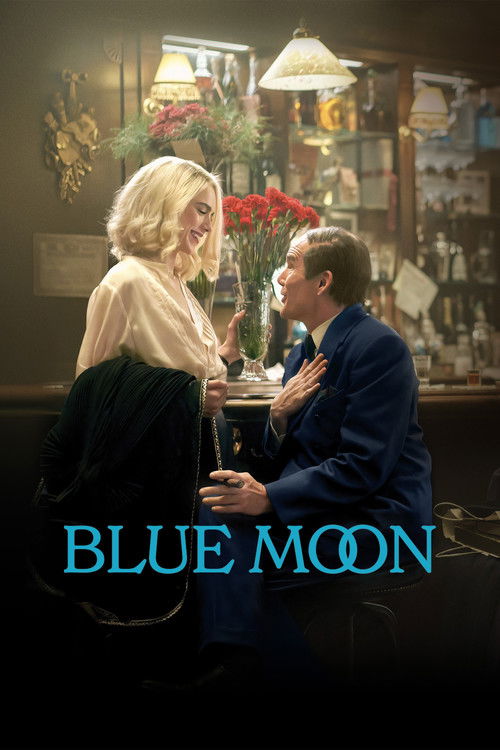
Blue Moon
2025 · Richard Linklater
When you want brilliant conversation and a lump in your throat — a grown-up, bittersweet night at the bar rather than spectacle. It's a good cry disguised as a comedy.
What it's about
On the night of March 31, 1943, lyricist Lorenz Hart holds court at Sardi's bar in New York while, a few blocks away, his former partner Richard Rodgers celebrates the triumphant opening of Oklahoma! — the show that made Hart's brand of wit suddenly look old-fashioned. Over one long evening of drinks and dazzling talk, Hart charms the bartender, pines for a young woman he adores hopelessly, and braces for Rodgers to walk through the door.
The experience
Talky in the best way — funny, quick, and then quietly devastating, like watching the wittiest man in the room realize the party has moved on without him. It plays out in near–real time, so you feel every minute he's stalling.
Performances
Ethan Hawke is remarkable as Hart, a fountain of brilliance running dry — self-lacerating, seductive, and heartbreaking by turns — with Andrew Scott as Rodgers, Bobby Cannavale as the bartender absorbing it all, and Margaret Qualley as the object of Hart's hopeless tenderness.
The craft
Linklater confines the film to a single evening and essentially a single room, and the discipline pays off: the screenplay does the heavy lifting, dense with period wit and barbed self-portraiture, staged with the unforced naturalism he's spent a career refining. It's built for close listening — the pleasure is in the language and the faces.
Why it matters
It captures a real hinge point in American culture — the night the musical changed — and continues Linklater's long fascination with time, talk, and single-night structures.
Snapshot
Blue Moon is a chamber piece in miniature: a single evening, a single barroom, and a single ruined man talking to keep the dark at bay. On March 31, 1943, the lyricist Lorenz Hart retreats to Sardi's while, a few blocks away, his former partner Richard Rodgers enjoys the rapturous opening night of Oklahoma! — the show, written with Oscar Hammerstein II, that would remake the American musical and leave Hart's brand of urbane, ironic wit looking suddenly antique. Richard Linklater stages this as near–real time, holding Hart in the amber of one long, garrulous, self-immolating night. Ethan Hawke plays Hart as a fountain of brilliance running dry; Andrew Scott is Rodgers, Bobby Cannavale the bartender who absorbs it all, and Margaret Qualley the young woman on whom Hart has pinned a hopeless tenderness. The film premiered in competition at the 75th Berlinale in February 2025 and was released in the United States by Sony Pictures Classics in October 2025. It belongs to Linklater's lineage of talk-driven, time-bound films — closer to Tape and the Before pictures than to his sprawling experiments — and it doubles as an elegy for an entire mode of American songwriting at the precise moment it was eclipsed.
Industry & production
Blue Moon is a modestly budgeted independent production assembled through Linklater's longstanding network rather than a studio development pipeline. It was written by Robert Kaplow, whose novel Me and Orson Welles Linklater had previously adapted (2008) — a renewed collaboration that gives the project a clear pedigree in literate, period, backstage storytelling. The screenplay is described as having been inspired by the real letters of Elizabeth Weiland to Hart, the documentary thread that anchors Qualley's character. Producers include Mike Blizzard and John Sloss, the latter a fixture of Linklater's business affairs across decades, with financing supported by a roster of executive producers (among them several with Irish production ties, consistent with the film's partial Irish shooting base). Sony Pictures Classics — a distributor with a deep history of shepherding prestige, dialogue-forward adult dramas — handled US release, slotting the film into the autumn awards corridor following its Berlin bow. The economics here are those of the single-location prestige drama: a contained set, a small principal cast, and a short shoot, with value concentrated in writing and performance rather than spectacle. As with most films at this scale, hard production figures (budget, gross) are not reliably part of the public record, and I won't invent them.
Technology
The film's defining technical problem is a biographical one: the historical Lorenz Hart was extraordinarily short — roughly five feet — while Hawke is of average height. Linklater's solution drew on the oldest tools in the kit rather than heavy digital effects: forced perspective, careful blocking that keeps Hart seated or framed against taller players, sightline management at the bar, and compositional choices that diminish his stature without calling attention to a single trick. Critics divided sharply on the result — Tara Brady in The Irish Times, while praising the ensemble, called the height illusion an "aesthetic gamble" distracting enough to nearly sink the film — which is itself evidence that the effect lives in staging and lens choice rather than seamless post-production. Beyond this, Blue Moon is a conventional contemporary capture in service of period illusion: the technological ambition is inward, spent on making a barroom feel like 1943 and on letting long takes run without the safety net of coverage-heavy editing. Precise camera-and-format specifications are not well documented in the public record, and I won't guess at them.
Technique
Cinematography
Shot by Shane F. Kelly, Linklater's frequent director of photography, Blue Moon is an interior film — warm, lamplit, the burnished browns and reds of a theater-district bar. Kelly's camera privileges the human face and the listening reaction over architectural display; the visual grammar is built from sustained two-shots and patient singles that let Hawke's monologues unspool. Lighting motivates from practical sources — table lamps, the back-bar glow — to keep the space intimate and slightly boozy. Crucially, the cinematography is yoked to the height illusion described above: framing, lens length, and the placement of figures in depth all work to shrink Hart relative to those around him, so that the camera is never neutral but always quietly managing the lie at the film's center.
Editing
Sandra Adair, who has cut nearly all of Linklater's features, edits for breath rather than tempo. In a near-real-time film the editor's discipline is restraint: holding shots past the point a conventional drama would cut, trusting performance and dialogue rhythm to carry momentum. The cutting tracks the social choreography of a filling barroom — the arrival of celebrants, the entrance of Rodgers, the orbit of Weiland — using entrances and exits as natural punctuation rather than imposing an external rhythm. The effect is of time experienced rather than compressed, the audience kept in the room with Hart for the duration of his unraveling.
Mise-en-scène / staging
Sardi's is the film's whole world, and the staging treats it as a stage. Hart is the man who will not leave the bar; the production design crowds the frame with the iconography of Broadway success — the caricatures, the waiting tables, the gathering opening-night party — so that the celebration of Oklahoma! physically encroaches on Hart's refuge. The blocking is theatrical in the best sense: characters are positioned for sightlines and overhearing, the bar functioning as a confessional where Cannavale's bartender becomes audience and witness. Period detail (1943 wartime New York, dress, the photographer Weegee glimpsed in the milieu) grounds the talk without museum stiffness.
Sound
Music is both subject and texture. The Rodgers and Hart songbook — and the title song "Blue Moon" (1934), the one Rodgers-and-Hart standard born outside a show and rewritten repeatedly before it stuck — hangs over the film as Hart's lost inheritance, set against the new pastoral idiom of Oklahoma!. Graham Reynolds, Linklater's regular composer, supplies score that supports the period atmosphere without overwhelming the dialogue, which is the film's true soundtrack. The sound design favors the close, conversational presence of voices in a confined room — clinking glass, party murmur, the acoustic of a bar that grows louder and more festive as Hart grows quieter and more alone.
Performance
Performance is the film's reason for being. Hawke gives a verbose, mercurial Hart — wit as defense, charm curdling into need, the self-aware gallows humor of a man who knows his moment has passed. Reviewers across the spectrum, from Time to The Guardian's four-star notice, singled it out as among his finest work. Andrew Scott plays Rodgers with controlled tact — the successful partner managing an obligation he can no longer carry — a turn that won the Silver Bear for Best Supporting Performance at Berlin. Cannavale grounds the film as the bartender, and Qualley brings a fragile warmth to Weiland, the object of Hart's last romantic illusion. The ensemble is a true chamber group: the drama lives in how they listen.
Narrative & dramatic mode
Structurally the film is unities-tight — one place, near-continuous time, a tightly bounded action — which aligns it with the theatrical chamber tradition and with Linklater's own real-time experiments. There is little plot in the conventional sense; the engine is dramatic irony. We know, as Hart cannot fully admit, that Oklahoma! is a watershed and that his own end is near (the historical Hart died in November 1943, months after this night). Every witticism is shadowed by decline. The mode is conversational and confessional: a great talker performing fluency while his life empties out, the comedy and the tragedy carried in the same breath. The film trusts the audience to hold the historical context and to feel the gap between Hart's verbal command and his actual powerlessness.
Genre & cycle
Blue Moon sits at the crossing of the backstage musical drama, the biographical portrait, and the talk-driven character study. It is a "music film" with almost no performance of music — about songwriting rather than singing — which places it nearer to dramas of artistic obsolescence than to the conventional musical biopic. Within the 2020s cycle of single-night, single-location prestige dramas built around a virtuoso lead performance, it is a clean example: small canvas, large interior. It also belongs to the perennial cycle of films about the artist at the moment of eclipse — the master rendered obsolete by a changing of the guard.
Authorship & method
The film is a dense node in Linklater's authorial network. With writer Robert Kaplow, it renews the partnership behind Me and Orson Welles, extending Linklater's recurring fascination with theater, performance, and mid-century American cultural life. With star Ethan Hawke, it continues one of the most sustained actor-director collaborations in American cinema, running from Before Sunrise through Boyhood and beyond. Cinematographer Shane F. Kelly, editor Sandra Adair, and composer Graham Reynolds are all core members of Linklater's Austin-centered repertory company, which lends the production its unforced, ensemble-built feel. Methodologically, Blue Moon is recognizably Linklater: the privileging of talk over incident, the interest in time as lived duration, and the conviction that character emerges through conversation. It is a more classically constructed, theatrically derived work than his formal gambits (Boyhood, the Before films' shooting-years apart), but it shares their patience and their faith that two people talking can be cinema.
Movement / national cinema
The film is American independent cinema by sensibility — Linklater remains a foundational figure of the post-1990 US indie tradition — produced with international (notably Irish) collaboration and premiered through the European festival system at Berlin. It is not aligned with any formal movement so much as with Linklater's own decades-long body of humane, conversation-driven films. Its subject is emphatically national: the Broadway songbook, Tin Pan Alley wit, and the mid-century American musical theater at a hinge point in its history.
Era / period
Blue Moon is a 2025 film set on a single 1943 night, and it is acutely conscious of that historical threshold. March 31, 1943 is, in musical-theater history, a genuine watershed: Oklahoma! inaugurated the fully "integrated" book musical, in which song and dance advance character and story — a model that would dominate Broadway for a generation and displace the looser, wittier, more revue-like idiom in which Rodgers and Hart had thrived for roughly a quarter century (Pal Joey, Babes in Arms, On Your Toes, and others). The film stations its protagonist exactly at the moment his era ends and another begins, with wartime New York as backdrop. The period is not decoration but argument: the film is about what is gained and lost when sincerity supplants irony.
Themes
The governing theme is obsolescence — the artist who outlives his moment and watches a former partner ascend on a new aesthetic. Around it cluster Linklater's familiar preoccupations: time and its passage; the consolations and failures of language; the gap between public brilliance and private collapse. Addiction and self-destruction run beneath the wit, as does unrequited love in Hart's devotion to Weiland — a yearning for a future the film and history both deny him. There is a meditation on collaboration and its dissolution, on what one partner owes another, and on the loneliness of the man whose gift for words cannot save him. Finally, the film weighs irony against earnestness as cultural values, refusing to declare a simple winner even as it mourns the passing of Hart's mordant urbanity.
Reception, canon & influence
Critical reception was strongly favorable, with the consensus crediting Hawke's performance as the film's center of gravity; aggregated notices ran high (Rotten Tomatoes reported a large majority of positive reviews), and individual critics from Time, The Guardian, Rolling Stone, and RogerEbert.com praised the lead turn while some, like The Irish Times, balked at the height illusion. The film's awards trajectory was substantial: Andrew Scott took the Silver Bear for Best Supporting Performance at the 75th Berlinale, and Hawke and the screenplay drew major season recognition, including reported nominations at the Golden Globes and the 98th Academy Awards (Best Actor for Hawke; Best Original Screenplay for Kaplow) — recognition I report as attributed to those bodies rather than verified independently here.
Looking backward, the film's influences are the chamber play and the real-time drama; Linklater's own Tape (2001) is its nearest formal cousin, and the Before trilogy its kin in talk and duration. Its historical substance derives from the documented lives of Hart, Rodgers, and Hammerstein and from the Weiland letters that seeded the script, with Me and Orson Welles as the clear precedent for Linklater and Kaplow's theatrical-period mode. Looking forward, the film's legacy is still forming and any claim of lasting influence would be premature; its most durable contribution is likely to be Hawke's Hart as a benchmark portrayal of artistic decline, and the film's demonstration that a single-room, near-real-time conversation piece can still command festival prizes and a serious awards run. As a Sightlines node, Blue Moon is best read as a terminal point in one lineage — the witty, ironic pre-Oklahoma! songbook — captured at the very instant a new line of influence, the integrated Rodgers-and-Hammerstein musical, supersedes it.
A Deleuzian reading
A short man sits at the end of a bar and will not go home.
The full Deleuzian reading of Blue Moon →
Reception
Premiered at Berlinale in February 2025 to warm reviews, then got a quiet fall arthouse rollout from Sony Pictures Classics — it's already being talked about as the smaller, more personal half of Linklater's remarkable two-film 2025, opposite Nouvelle Vague.
How Blue Moon was received, from release to now →
How to watch Blue Moon: what to notice on a first viewing
- Notice that the film never leaves this one bar. Linklater confines the whole night to Sardi's, crowding the frame with the iconography of Broadway success closing in on Hart's one refuge. The party he cannot escape is literally built into the walls of the room he is sitting in.
- Watch how small the camera makes Hart look next to everyone. Linklater uses blocking, sightlines, and framing rather than effects to shrink Hawke toward Hart's real height, so the camera is always quietly managing an illusion. The camera never stops making him small, the same way the night is doing it in every other way.
- Notice how long the film holds a shot before it cuts. Adair edits for breath rather than tempo, letting entrances and exits punctuate the room instead of imposing an outside rhythm on the scene. You feel every minute of the night pass, because the cutting refuses to speed it up.
- Listen for how rarely music covers up what people are saying. Reynolds's score supports the room's atmosphere without ever competing with the talk, which the film treats as its true soundtrack. The words are doing what music usually does in a film like this.
- Watch how much of Hart's performance is just words, not action. Hawke plays him as a fountain of wit running dry, charm curdling into need, talking because talking is the only move left to him. He cannot fix anything happening around him. All he has left is his own fluency.
The whole guide to watching Blue Moon, with the keys for a rewatch →
Influences: the films it descends from and the films it influenced
- Tape (2001) — Linklater's own real-time three-hander confined to a single motel room is the direct formal template — an entire drama compressed into one continuous location, built from sustained coverage of nothing but talk.
- Before Sunset (2004) — Establishes the Hawke collaboration's near-real-time grammar where screen time equals story time, carried on long walk-and-talk takes and sustained two-shots rather than cutting for incident.
- Me and Orson Welles (2008) — The prior Linklater–Robert Kaplow screenplay partnership and meticulously recreated period-theater milieu, the same backstage, mid-century playhouse register Blue Moon reprises.
- My Dinner with André (1981) — Feature-length conversation pinned to a single restaurant table, with a dialogue-forward shot/reverse and two-shot grammar that makes talk itself the entire event.
- Rope (1948) — The foundational proof that the classical unities can be a camera strategy: a single apartment played in near-real time out of disguised long takes.
- Who's Afraid of Virginia Woolf? (1966) — A boozy single-house chamber piece driven by virtuoso verbal performance under high-contrast practical interior lighting (Haskell Wexler), the model for sustained spoken duels lit like a real room.
- The Iceman Cometh (1973) — O'Neill's barroom play of deluded drinkers staged inside one saloon through long monologue and dialogue — the closest setting-and-subject precedent: a bar, an illusion, an artist's decline.
- 12 Angry Men (1957) — Single-room chamber ensemble in which Lumet progressively lengthened lenses to compress the space — the working model for using focal length as forced-perspective dramaturgy.
- Long Day's Journey Into Night (1962) — A theatrical adaptation that preserves the classical unities and subordinates the camera to long, unbroken actor takes of confessional speech.
- Sleuth (1972) — A two-hander of chamber gamesmanship staged within one set, structured entirely around dueling virtuoso performances rather than locations.
- The Whale (2022) — A single-room chamber piece engineered around a transformed, prosthetic-aided virtuoso performance and tight practical confined lighting, observing unity of place.
- The Lord of the Rings: The Fellowship of the Ring (2001) — Popularized the in-camera forced-perspective scaling that Blue Moon repurposes to shrink Ethan Hawke into the diminutive Lorenz Hart.
- Birdman or (The Unexpected Virtue of Ignorance) (2014) — A backstage theatrical drama staged as continuous long takes through practical-lit interiors, extending the single-building, near-real-time conceit to a working playhouse.
- Carnage (2011) — A real-time single-apartment chamber play observing the classical unities, with escalating talk confined to one room as the whole of the action.
- Locke (2013) — Pushes the single-location, near-real-time form to its limit as a vehicle for one virtuoso lead, the entire story unspooling through dialogue alone.
- Glengarry Glen Ross (1992) — A Mamet-scripted chamber ensemble of men facing professional obsolescence, built from dialogue-forward staging and virtuoso monologue set-pieces.
Similar films
- Before Sunset (2004) — influence & lineage
- Jay Kelly (2025) — same viewing thread
- All of Us Strangers (2023) — same viewing thread
- Ghostlight (2024) — same viewing thread
- Twinless (2025) — same viewing thread
- Before Sunrise (1995) — shared sensibility
- Boyhood (2014) — shared sensibility
- Before Midnight (2013) — shared sensibility
All the films related to Blue Moon →
Watch it with: curated runs of related films
- Funny Because It Aches — A run of tender, deadpan dramedies where love, grief, and the panic of becoming yourself all get metabolized through jokes — watch these when you want to laugh and cry in the same scene.