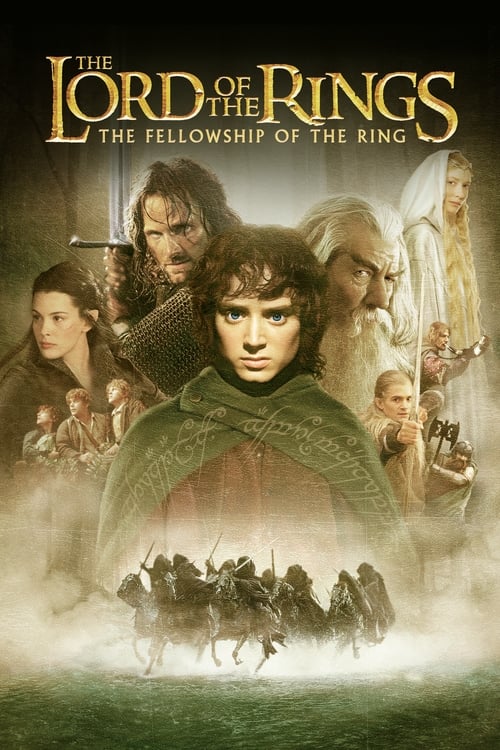
The Lord of the Rings: The Fellowship of the Ring
2001 · Peter Jackson
For when you want to be swept away — a full-evening epic to disappear into, comfort viewing at the grandest possible scale and the ideal start to a trilogy marathon.
What it's about
A young hobbit, Frodo Baggins, inherits a ring from his uncle and learns it's the most dangerous object in his world — the lost weapon of a dark power now hunting for it. To keep it from its maker he must leave his sheltered valley, and a fellowship of hobbits, men, an elf, a dwarf, and a wizard forms around him to carry the ring toward the one place it can be destroyed.
The experience
Sweeping and immersive, but warmer and more intimate than its scale suggests — essentially a walking film about friendship under a gathering shadow, punctuated by terror and wonder. Three hours that move like one.
Performances
Ian McKellen's Gandalf — grandfatherly warmth over genuine gravity and dread — anchors the whole enterprise, and the ensemble around Elijah Wood's Frodo, from Sean Astin's steadfast Sam to Sean Bean's conflicted Boromir, gives the quest its human weight.
The craft
Peter Jackson turned Tolkien into cinema through sheer density of craft: Alan Lee and John Howe's production design, WETA's miniatures (the crew called them 'bigatures'), forced-perspective trickery letting same-height actors share a frame at different scales, and Howard Shore's leitmotif-driven score, among the richest ever written for film. It demands the biggest screen and best speakers you have.
Why it matters
An unprecedented gamble — three films shot back-to-back in New Zealand — that redefined what fantasy could be on screen, launched the modern era of prestige franchise filmmaking, and made Peter Jackson's career.
Peter Jackson, then best known for splatter comedies and the haunted lyricism of Heavenly Creatures, persuaded a mid-tier studio to bankroll three films shot back-to-back in New Zealand — a gamble with no real precedent in Hollywood history. The first installment sends a hobbit out of his sheltered valley with an artifact of terrible power, and turns Tolkien's foundational quest narrative into cinema through sheer density of craft: Alan Lee and John Howe's production design, WETA's blend of miniatures (the crew called them 'bigatures'), forced-perspective trickery that let actors of identical height share a frame at different scales, and Howard Shore's leitmotif-driven score, among the richest ever composed for film. Fellowship is the trilogy's most intimate chapter — a walking film, essentially, about fellowship earned and tested — and many hold it the best. Its success rewrote the industry's assumptions about fantasy, long-form adaptation, and where blockbusters could be made; New Zealand's film economy was transformed overnight. Beneath the spectacle runs Jackson's genuine feeling for smallness against vastness: four tiny figures crossing a ridgeline, dwarfed by mountains that are entirely real.
A Deleuzian reading
Four figures crossing a ridgeline, small as commas, and behind them a mountain nobody built.
The full Deleuzian reading of The Lord of the Rings: The Fellowship of the Ring →
Reception
No flop-to-classic arc here — it landed as an instant phenomenon in 2001 (13 Oscar nominations, a fantasy film taken seriously overnight) — but its stock has somehow still risen: Fellowship is now routinely called the best of the trilogy, and 'they don't make them like this anymore' rewatches have pushed it into best-of-the-century conversations.
How The Lord of the Rings: The Fellowship of the Ring was received, from release to now →
Influences: the films it descends from and the films it influenced
- King Kong (1933) — The forced-perspective and miniature-integration tradition Jackson venerates — matting live actors against scaled model environments to sell a giant against small figures — is the direct template for Fellowship's hobbits-and-humans size gags and 'bigature' sets.
- Jason and the Argonauts (1963) — Ray Harryhausen's stop-motion creature choreography (the skeleton-army duel) is the artisanal-monster lineage WETA modernized into the cave-troll and Moria set pieces, prioritizing tactile creature weight over slick CG.
- Metropolis (1927) — The Schüfftan process and forced-perspective miniatures that fused actors with towering scale models pioneered the in-camera scale illusions Fellowship revived with sliding forced-perspective rigs for Gandalf and Frodo.
- Star Wars (1977) — Established motion-control miniature/model photography as the engine of blockbuster spectacle — the 'bigature' philosophy of shooting detailed physical models rather than painting everything — and cemented the Wagnerian leitmotif score as franchise architecture.
- The Adventures of Robin Hood (1938) — Erich Wolfgang Korngold's operatic leitmotif scoring — assigning recurring musical themes to characters and factions in the Wagnerian manner — is the tradition Howard Shore extends with distinct motifs for the Shire, Rohan, and the Ring.
- Lawrence of Arabia (1962) — Lean's compositional signature of dwarfing solitary figures against vast landscapes — the human speck in an overwhelming natural frame — is the exact 'smallness against vastness' grammar Jackson applies to the Fellowship crossing New Zealand's mountains and plains.
- Excalibur (1981) — Boorman's insistence on treating myth with operatic, unironic gravity and richly built painterly production design proved fantasy could be shot as high tragedy rather than camp — the tonal register Jackson adopts wholesale.
- Conan the Barbarian (1982) — Basil Poledouris's thematically-organized orchestral score elevated pulp sword-and-sorcery to mythic seriousness, modeling how a leitmotif-driven soundtrack could carry the emotional weight of a fantasy epic.
- The Dark Crystal (1982) — A fully-realized secondary world where every creature, costume, and prop was hand-crafted with no contemporary human reference — the total production-design commitment, carried into LOTR partly through concept designers in the Brian Froud/Alan Lee illustrative lineage.
- Willow (1988) — Lucasfilm's earlier swing at a Tolkienesque fantasy blockbuster, complete with ILM effects and a small-hero quest structure — the commercially underwhelming prototype whose ambitions LOTR finally delivered on.
- Heavenly Creatures (1994) — Jackson's own film that birthed WETA Digital and established his method of morphing between practical and CG imagery for fantasy interludes — the in-house effects pipeline that made a self-financed Middle-earth possible.
- Back to the Future Part II (1989) — Its simultaneous shooting of a multi-film arc as one continuous production is the industrial descendant of Part II and III being filmed back-to-back to preserve continuity and cast.
- The Lord of the Rings: The Two Towers (2002) — Shot back-to-back with Fellowship on the same production, it extends the craft by pushing WETA's motion-capture pipeline into a fully performance-driven digital lead in Andy Serkis's Gollum.
- The Chronicles of Narnia: The Lion, the Witch and the Wardrobe (2005) — Directly inherits the LOTR blueprint — WETA Workshop creatures and armor, a New Zealand production base, and the literary-fantasy-as-prestige-blockbuster template Fellowship proved viable.
- King Kong (2005) — Jackson and WETA refine the Gollum breakthrough into a photoreal, emotionally-legible performance-capture protagonist, industrializing the actor-driven digital-creature method Fellowship prototyped.
- Avatar (2009) — Cameron built his performance-capture and full-CG world pipeline on WETA Digital's Gollum foundation, scaling the LOTR-era motion-capture and virtual-production techniques into an entire synthetic ecosystem.
- Game of Thrones (2011) — The long-form faithful fantasy adaptation as prestige serial — legitimized commercially and creatively by Fellowship — pairing practical-plus-digital world-building with a leitmotif-structured score to sustain a sprawling ensemble saga.
- The Hobbit: An Unexpected Journey (2012) — Jackson returns to Middle-earth and replaces the physical forced-perspective rigs with digital scaling and green-screen doubles, extending — and industrializing — the exact size-illusion and design craft Fellowship established.
- I Am Legend (2007) — Lawrence hired director of photography Andrew Lesnie specifically because his LOTR anamorphic work had solved the compositional problem of integrating CGI creatures into practical location photography; the performance-capture pipeline developed for Gollum is the direct technical lineage from which the Dark Seekers' production methodology descends.
- Harry Potter and the Philosopher's Stone (2001) — The concurrent other franchise launch built on the same wager — a faithful, serialized long-form adaptation of a beloved literary property engineered as a multi-film blockbuster arc with locked continuity of cast and design.
- Blue Moon (2025) — Popularized the in-camera forced-perspective scaling that Blue Moon repurposes to shrink Ethan Hawke into the diminutive Lorenz Hart.
- Big Fish (2003) — Same-era forced-perspective scale work: the in-camera trickery Jackson used to shrink hobbits beside full-size actors is the technique Burton uses for the giant Karl and the grown Edward towering over Ashton.
Similar films
- The Lord of the Rings: The Two Towers (2002) — influence & lineage · same viewing thread
- The Hobbit: An Unexpected Journey (2012) — influence & lineage · same viewing thread
- The Chronicles of Narnia: The Lion, the Witch and the Wardrobe (2005) — influence & lineage
- The Lord of the Rings: The Return of the King (2003) — same viewing thread
- Jason and the Argonauts (1963) — influence & lineage · same viewing thread
- Avatar (2009) — influence & lineage · same viewing thread
- The Hobbit: The Battle of the Five Armies (2014) — same viewing thread
- Harry Potter and the Deathly Hallows: Part 2 (2011) — same viewing thread
All the films related to The Lord of the Rings: The Fellowship of the Ring →
Watch it with: curated runs of related films
- Studio-Sized Mythmaking — A run of blockbuster quest epics — fellowships forged, dark lords faced, and long roads home — that rhyme on scale, world-building, and the pull of a saga you can lose a weekend inside.