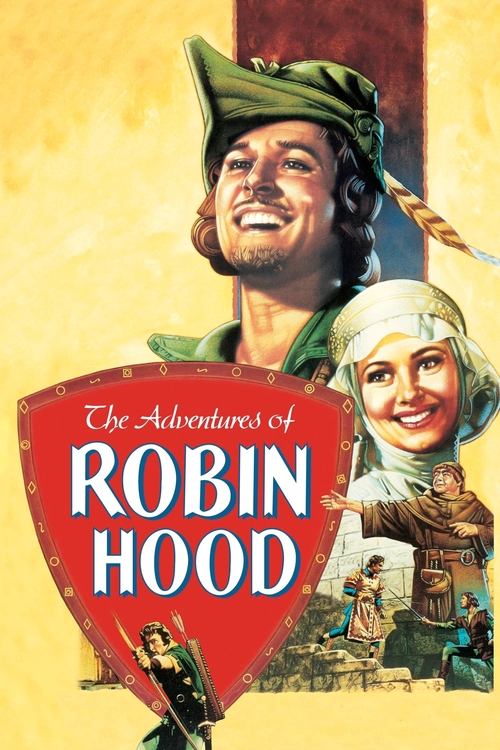
The Adventures of Robin Hood
1938 · William Keighley
When you want to feel like a kid again — rousing, generous, all-ages entertainment for a night when you want heroes to be heroic and the good guys to win with style. Maximum comfort.
What it's about
With King Richard held for ransom abroad and his brother Prince John bleeding England dry, the Saxon knight Robin of Locksley takes to Sherwood Forest as an outlaw — robbing the rich, feeding the poor, humiliating the scheming Sir Guy of Gisbourne, and courting the King's ward, Maid Marian, who isn't sure whether he's a bandit or the only honest man in Nottingham. Archery contests, ambushes, disguises, and castle raids follow.
The experience
Pure, buoyant adventure — swift, bright, and played with an infectious grin. There's no cynicism in it anywhere; it moves from banquet to swordfight to romance with total confidence, and its energy is still contagious nearly a century later.
Performances
Errol Flynn is the definitive swashbuckling hero — athletic, laughing, apparently having the time of his life — opposite Olivia de Havilland's warm, quick-witted Marian, with Basil Rathbone supplying silky menace as Gisbourne and Claude Rains purring through Prince John.
The craft
Warner Bros. at full stretch: an early triumph of lavish three-strip Technicolor, with greens and scarlets that still look hand-painted, and Erich Wolfgang Korngold's symphonic score practically inventing the sound of Hollywood adventure music. The climactic duel, all shadows and staircases, remains the model swordfight — this one genuinely rewards the biggest, brightest screen you can find.
Why it matters
The definitive screen Robin Hood and the swashbuckler perfected — the template every later version answers to, and a landmark that showed what the studio system could achieve with all departments firing at once.
Snapshot
The Adventures of Robin Hood is the film in which Hollywood's studio system demonstrated what it could do when every one of its departments was working at full stretch and pointed at the same target. It is Warner Bros.' first genuinely lavish three-strip Technicolor production, the most expensive picture the studio had made to that date, and the definitive statement of the sound-era swashbuckler — a genre it more or less closed by perfecting.
One correction to the credit line above, which the film itself makes necessary: the picture is a two-director film. William Keighley began it and shot much of the outdoor material; Michael Curtiz replaced him partway through production and completed it. Both men are credited on screen, and any serious account of the film's authorship has to treat it as a co-directed object — or, more accurately, as a producer's film, since the through-line connecting the two shooting periods is Hal B. Wallis and the Warner production apparatus rather than either director's sensibility.
What survives is a work of extraordinary poise: 102 minutes of near-continuous forward motion, saturated color used as moral shorthand, Erich Wolfgang Korngold's operatic score running almost wall to wall, and Errol Flynn giving the performance that fixed him permanently in the culture. It won three Academy Awards and was nominated for Best Picture, and it entered the National Film Registry in 1995.
Industry & production
The project's origins lie in the mid-1930s, when Warner Bros. reportedly developed a Robin Hood vehicle for James Cagney. Cagney's contract walkout in 1936 shelved it. By the time the studio revived the property, it had a better-fitted star: Errol Flynn, an unknown when Curtiz cast him in Captain Blood (1935), had become the studio's costume-adventure asset through The Charge of the Light Brigade (1936) and The Prince and the Pauper (1937).
Wallis served as executive producer, with Henry Blanke as associate producer — the pairing responsible for much of Warners' prestige output. The budget is generally reported at slightly over $2 million, an enormous sum for a studio whose house identity was built on fast, cheap, contemporary program pictures. Technicolor was the single largest driver of that cost: the process required licensed cameras and Technicolor technicians, roughly three times the illumination of black-and-white shooting, and dye-transfer printing controlled by the corporation itself.
The change of directors is the production's most-discussed episode. Keighley shot exteriors in and around Bidwell Park in Chico, California, whose oaks stood in for Sherwood, and Warner's ranch locations. Wallis, reviewing footage, judged the action insufficiently vigorous, and Curtiz — a faster, more pictorially aggressive director who had already made three pictures with Flynn — took over. The conventional account assigns Curtiz the great majority of interiors and the climactic material: the Nottingham banquet, the castle assault, the final duel. The archery tournament was staged at Busch Gardens in Pasadena. Rudy Behlmer's published edition of the screenplay and his collection of Warner studio correspondence are the standard sources here, and it is worth stating plainly that the shot-by-shot division of labor has never been fully documented; claims of precision about who directed what should be treated with caution.
Release came in May 1938, and the film was among Warners' most successful pictures of the year. Reported box-office figures for studio releases of this era vary widely between sources and are not reliable enough to quote.
Technology
This is a Technicolor Process 4 film — the three-strip system, in which a beam-splitting prism inside a large, blimped camera exposed three black-and-white negative records simultaneously, from which release prints were made by dye imbibition. The technology's constraints shaped the picture in visible ways. The camera was heavy and relatively immobile; light levels had to be high, meaning banks of arc lamps and considerable heat; and the Technicolor Corporation supplied not only the equipment but a color-control regime, with Natalie Kalmus credited as color consultant on this as on essentially every Technicolor feature of the period.
Warners had come to three-strip late. The studio had experimented with the earlier two-color process at the start of the decade (Curtiz's Doctor X, 1932, and Mystery of the Wax Museum, 1933), then made its first three-strip features in 1937–38 — God's Country and the Woman and Gold Is Where You Find It — before committing to Robin Hood on a far larger scale. Taking the three-strip camera on location to Chico was a genuine logistical achievement in 1937.
The film's afterlife is also a technology story. Because the three separation records were preserved, the picture has been restorable to a degree denied to films that survive only as faded single-strip prints; modern presentations derive from the separation elements, and the 2003 home-video restoration was a landmark in demonstrating how much of the original dye-transfer look could be recovered digitally.
Technique
Cinematography
Tony Gaudio and Sol Polito share the photography credit, with W. Howard Greene — a Technicolor specialist — contributing additional work. Gaudio was Warners' senior prestige cameraman; Polito was Curtiz's habitual collaborator and the studio's most inventive stylist with a moving camera.
The approach is high-key and unashamedly saturated. Where much early Technicolor practice, under Kalmus's influence, aimed at restraint and "tasteful" desaturation, Robin Hood pushes the other way: Lincoln-green Sherwood against the reds, golds, and blacks of the Norman court; Marian's costumes shifting register as her allegiance shifts. Color is not decoration here but characterization and orientation — the viewer always knows which political world a scene belongs to before a word is spoken.
The staging favors depth and diagonal movement. The castle sets are photographed to emphasize height and recession — arches, galleries, a great staircase — and the camera tracks and cranes with more freedom than the bulky Technicolor rig would seem to allow.
Editing
Ralph Dawson won the Academy Award for Best Film Editing, his third such win after A Midsummer Night's Dream (1935) and Anthony Adverse (1936). His cutting is the film's engine. The ambush of the Norman treasure train is built from a rhythm of long establishing views and short, kinetic impacts — arrows arriving before their archers are shown, bodies falling into frame, the geography of the forest kept legible throughout. The final duel is cut to sustain spatial clarity across a long, architecturally complex chase-fight, alternating full-figure blade work with the shadow imagery that is the sequence's signature.
Warner's house tempo — the studio's reputation for pictures that never idle — is fully present. There is almost no scene in the film that exists purely for atmosphere.
Mise-en-scène / staging
Carl Jules Weyl won the Academy Award for Art Direction. His Nottingham is a set of hard verticals and stone mass, staged as an instrument of intimidation; his Sherwood, assembled from real oaks and studio augmentation, is horizontal, dappled, and communal. Milo Anderson's costumes complete the scheme.
The film's central staging idea is the banquet and its inversions: the Normans eat behind stone in ceremonial rows, the outlaws eat in the open in a sprawl. Robin's entrance into Prince John's hall with a deer across his shoulders is the film's thesis in one image — the greenwood physically carried into the castle.
Fred Cavens, the Belgian fencing master who had staged Captain Blood, choreographed the swordplay. Cavens' method was frankly theatrical: broad, high, legible blade movement designed to read on screen rather than to reproduce authentic technique. Basil Rathbone was a genuinely accomplished fencer and Flynn was not, a disparity the choreography works around and, arguably, exploits — Robin fights with athletic improvisation, Guy with correctness.
Sound
Korngold's score is the film's most consequential technical achievement and won him the Academy Award. The award's significance is partly institutional: under the earlier rules the music Oscar went to a studio's music department head, and Korngold receiving the statuette personally marked the shift toward recognizing composers as authors.
Korngold, who had arrived from Vienna as an established opera composer, is reported to have initially declined the assignment as too purely an action picture; the Anschluss of March 1938 intervened during the production period, and he accepted, later regarding the film as having kept him out of Austria. He composed in an operatic manner, treating the picture as a wordless opera scored by leitmotif — themes for Robin, for Marian, for the Normans, developed and combined rather than merely repeated. Material from his own concert overture Sursum Corda (Op. 13) was adapted for action sequences. Hugo Friedhofer and Milan Roder handled orchestration, with Leo Forbstein heading the Warner music department.
The result is a score of unusual density — music runs under a very large proportion of the running time — and it functions as connective tissue across the Keighley/Curtiz seam, giving the film a continuity of temperament its production history did not.
Performance
Flynn's Robin is built on laughter. The performance's organizing choice is that Robin is never afraid, and that his fearlessness expresses itself as amusement — he laughs at Guy, at Prince John, at his own capture. This is not depth in a modern sense; it is a fully achieved presentational style, and it made the role uncopyable.
Rathbone gives Guy of Gisbourne a cold professional competence that is far more threatening than villainous relish, and Claude Rains plays Prince John as a purring bureaucrat of usurpation. Olivia de Havilland's Marian carries the film's only real character arc — the shift from Norman loyalty to Saxon sympathy — and de Havilland plays it as moral education rather than romantic capitulation. The supporting bench (Eugene Pallette's Friar Tuck, Alan Hale's Little John, Melville Cooper's Sheriff, Una O'Connor's Bess) works in the broad comic register Warners had perfected. Hale had played Little John in the 1922 Fairbanks version and would play it again in 1950 — a small piece of continuity linking the silent and sound traditions.
Narrative & dramatic mode
The screenplay by Norman Reilly Raine and Seton I. Miller performs a specific structural operation on legend material: it takes an episodic, centuries-old ballad corpus and welds it to a goal-directed causal chain of the kind classical Hollywood required. The through-line — restore King Richard, thwart John, marry Marian — absorbs the traditional set pieces (the quarterstaff fight, the archery contest, the rescue from the gallows) as steps rather than digressions.
Notably, there is no origin story. Robin arrives already formed, already outlawed in spirit, already committed. The film has no interest in explaining him, which distinguishes it sharply from nearly every later version. The dramatic mode is romance in the literary sense — a world of clear moral coordinates in which the hero's virtue is a given and the question is only whether force will suffice.
Genre & cycle
The picture sits at the crest of the 1930s sound swashbuckler cycle, which had been building since Treasure Island and The Count of Monte Cristo (both 1934) and Captain Blood (1935), and which included The Prisoner of Zenda (1937). That cycle was itself a sound-era revival of Douglas Fairbanks's silent adventure films — The Mark of Zorro (1920), The Three Musketeers (1921), Robin Hood (1922), The Black Pirate (1926).
There is also a specifically Warner-internal genealogy. The studio's defining 1930s form was the gangster picture, curtailed by Production Code enforcement after 1934, and the social-problem film. Robin Hood is legible as those energies displaced into costume: the outlaw with a code, the corrupt authorities, the redistributive violence — now safely medieval and therefore Code-proof.
Authorship & method
This is the clearest case in the Warner canon for producer-centered authorship. Wallis's supervision — his intervention over Keighley, his oversight of the score, his tempo demands — is the consistent agency across the production. Curtiz's contribution is nonetheless stylistically identifiable: the pictorial density, the shadow play, the compositional aggression in the castle sequences accord with his work on Captain Blood, The Sea Hawk (1940), and Casablanca (1942). Keighley, a competent studio professional with a lighter touch, is the harder figure to trace, and it would be dishonest to assign him sequences with confidence.
The collaborators carry equal weight: Gaudio and Polito for the color image, Dawson for the tempo, Weyl for the architecture of the moral world, Cavens for the fights, and above all Korngold, whose score is the film's most-imitated element. Raine and Miller's script supplies the structure that holds it.
Movement / national cinema
Classical Hollywood at its apex, and specifically the Warner Bros. variant of it — vertically integrated, department-driven, built for speed. The film is also a monument to Hollywood's émigré and Anglophone-expatriate labor pools: Curtiz was Hungarian, Korngold Austrian, and the principal cast was drawn almost entirely from the British colony in Los Angeles (Flynn Australian, Rains and Rathbone British, de Havilland of British parentage). The 1930s American appetite for English literary and historical settings, and the availability of trained British stage actors, made a Hollywood picture about Saxon England plausible in a way that had little to do with any English film industry.
Era / period
1938 is a hinge year. Domestically, the recession of 1937–38 had renewed Depression anxieties; the New Deal's redistributive politics gave "rob from the rich" an immediate resonance that no viewer of the period could have missed. Internationally, the Anschluss came in March and Munich in September. Warner Bros. was the most explicitly anti-fascist of the major studios — it would release Confessions of a Nazi Spy the following year — and the film's story of an illegitimate regime, an oppressed people defined by descent, and organized resistance in the name of a rightful order reads, without strain, as a fable of its moment. Whether that allegory was deliberate is not something the production record settles; what is clear is that the material was chosen and shaped by people acutely aware of what was happening in Europe.
Industrially, the year also brought the federal antitrust action against the majors that would eventually dismantle the studio system that made this film possible.
Themes
The film's politics are carefully conservative in form and radical in sentiment. Robin is a loyalist: he steals, kills, and rebels in order to restore a legitimate king, and the outlaw band dissolves the moment Richard returns. The redistribution is temporary and corrective, not systemic.
Against that, the greenwood functions as a genuine utopian counter-polity — a society of shared food, elected loyalty, and unhierarchical laughter, set against the castle's stone hierarchy. The Saxon/Norman opposition, inherited from Walter Scott, frames tyranny as ethnic domination, giving the film a vocabulary of oppression and resistance more pointed than its restorationist plot admits.
Marian's arc supplies the moral argument: she is shown the suffering of the Saxon poor and changes sides. Courtship here is political conversion. And running through everything is the theme of play — Robin's defining weapon is not the bow but the refusal to take his enemies seriously, which the film treats as a form of moral confidence.
Reception, canon & influence
Contemporary reviews were broadly enthusiastic, praising the color, the spectacle, Korngold's music, and Flynn above all; the film was nominated for Best Picture (losing to You Can't Take It with You) and won for Art Direction, Editing, and Score. It has never suffered a serious critical reversal — a rarity for 1930s spectacle — and it entered the National Film Registry in 1995.
Backward, its debts are to a long tradition rather than a single source: the medieval ballad corpus and the Gest of Robyn Hode; Joseph Ritson's 1795 collection, which consolidated the outlaw as a redistributive folk hero; Scott's Ivanhoe (1819), which supplied the Norman/Saxon frame, the Richard/John politics, and the archery contest; Howard Pyle's The Merry Adventures of Robin Hood (1883), whose illustrations shaped the visual costume tradition and whose episodic structure shaped the plotting; the popular late-Victorian stage tradition; and, cinematically, Allan Dwan's Fairbanks vehicle of 1922, which the Warner film answers with sound, color, wit, and a lighter hero.
Forward, its influence is disproportionate. It became the standard against which every subsequent Robin Hood is measured — the 1955–59 television series, Disney's animated version (1973), Richard Lester's elegiac Robin and Marian (1976), the 1980s Robin of Sherwood, Prince of Thieves (1991), Ridley Scott's 2010 revision — most of which define themselves by departing from it.
Its deepest legacy is musical. Korngold's leitmotivic, symphonic, near-continuous scoring became the template for Hollywood's orchestral idiom, and John Williams has repeatedly identified Korngold and his contemporaries as the model for his own work from Star Wars (1977) onward — the through-line by which a 1938 Warner Bros. picture is audible in the blockbuster scoring of the present day. The broader adventure mode it perfected — a fearless, humorous hero, legible geography, physical stunt work, wall-to-wall music — was consciously revived in the Lucas–Spielberg adventure films of the late 1970s and 1980s, of which Raiders of the Lost Ark (1981) is the most direct descendant. Few studio pictures of the classical era have been so thoroughly absorbed into the grammar of what came after.
A Deleuzian reading
He walks into Prince John's banquet hall with a poached deer across his shoulders and drops it on the table.
The full Deleuzian reading of The Adventures of Robin Hood →
Reception
A smash hit and Best Picture nominee in 1938, it never needed rescuing — it went straight from box-office triumph to the permanent template of the Hollywood swashbuckler, and its three-strip Technicolor now looks better than ever on restoration.
How The Adventures of Robin Hood was received, from release to now →
How to watch The Adventures of Robin Hood: what to notice on a first viewing
- Notice the green of Sherwood against the reds and golds. Sherwood comes in Lincoln green and dappled light. The Norman court runs on red, gold and black. Marian's costumes change register as her loyalties do. Early Technicolor usually aimed for restraint and this pushes the other way. You know which political world a scene belongs to before anybody in it speaks.
- Listen for music under almost every minute of the film. Erich Wolfgang Korngold, an opera composer newly arrived from Vienna, wrote separate themes for Robin, for Marian and for the Normans, then develops and combines them instead of repeating them. The score carries the atmosphere, so no scene has to stop and supply any. That is why nothing here idles.
- Watch how often Flynn laughs at people threatening him. Robin laughs at Guy, at Prince John, at his own capture. He is never afraid at any point. Flynn puts amusement exactly where another actor would put doubt. The laugh occupies the pause before acting. Confidence becomes a gesture you can watch happen.
- Watch who eats sprawled out and who eats in rows. The Normans dine behind stone in ceremonial lines. The outlaws eat on the ground in the open air. Carl Jules Weyl built one world vertical and one horizontal, and the film keeps setting them beside each other. The politics live in the architecture and the table manners. Robin walks a poached deer into the hall and the argument is made.
- Watch the arrows arrive before you see any archers. In the treasure-train ambush Ralph Dawson alternates long establishing views with short impacts. An arrow lands and only then do you learn a man was up that tree. The forest stays geographically clear throughout. Sherwood feels full of outlaws because of what the film declines to show you.
The whole guide to watching The Adventures of Robin Hood, with the keys for a rewatch →
Influences: the films it descends from and the films it influenced
- Robin Hood (1922) — Established the outlaw film's spectacle grammar — the vast forced-perspective castle whose scale is measured by the hero's body moving through it — which the 1938 film answers by trading Fairbanks's monumental sets and drapery-slide acrobatics for Technicolor forest depth and dialogue-driven wit.
- The Thief of Bagdad (1924) — Codified the laughing-hero performance mode — the athletic protagonist who grins mid-danger and whose stunts are comic beats rather than peril — the direct model for Flynn's hands-on-hips laugh, plus the design-first production method (Menzies) in which the art department precedes the script.
- The Black Pirate (1926) — First proved color could carry an adventure picture, using two-strip Technicolor's restricted palette to key costume against sea and sail; its lesson — that a swashbuckler's color scheme must be designed as costume-versus-ground rather than naturalistically — underwrites Weyl and Anderson's Lincoln-green-against-Norman-crimson scheme.
- Becky Sharp (1935) — The first three-strip Technicolor feature and the origin of color-as-dramaturgy: Mamoulian's ball sequence escalates emotion by moving actors through progressively hotter costume colors, the technique Robin Hood systematizes into saturated-color-as-characterization under the same Kalmus color-control apparatus.
- Captain Blood (1935) — The literal prototype — Curtiz directing, Flynn opposite Rathbone and de Havilland, Fred Cavens choreographing a beach duel in long takes with full-figure framing, and Korngold's first Hollywood swashbuckler score establishing that the fight would be scored continuously as a symphonic movement rather than cut to effects.
- A Midsummer Night's Dream (1935) — Brought Korngold to Warner Bros. and taught him to time music to the cut — his adaptation of Mendelssohn required scoring to frame counts and shooting to playback — while its dappled, mist-lit enchanted wood is the direct lighting precedent for the Chico, California Sherwood shot in high-key Technicolor.
- Anthony Adverse (1936) — Korngold's first original Hollywood score, where he transplanted operatic practice wholesale — character leitmotifs developed and recombined across the picture, near-continuous underscore, orchestration decisions made at the piano against the moviola — the exact method he then perfected on Robin Hood.
- The Charge of the Light Brigade (1936) — Curtiz's massed-action laboratory: the second-unit method of covering large-scale movement with multiple cameras at differing heights so that the cutting preserves screen-direction and legible geography, the same spatial-clarity discipline that governs Robin Hood's castle assault.
- The Public Enemy (1931) — Supplied the Warner house grammar the film displaces into Sherwood — the loyal gang as surrogate family, the rival boss muscling in on protected territory, terse cause-and-effect scene construction with no wasted exposition — so that Prince John's court plays as a rackets operation in chainmail.
- Ivanhoe (1952) — MGM's Technicolor return to the same Scott source material, lifting the Norman/Saxon frame and the ransom-of-Richard plot, and rebuilding the castle-siege set piece with the trebuchet-and-boiling-oil escalation staged for the same directional clarity Curtiz's assault established.
- Scaramouche (1952) — Pushes the duel-as-set-piece to its limit — roughly six minutes through a theater's boxes, aisles and catwalks — extending the Cavens principle that a fight is choreographed geography rather than a flurry, with Technicolor costume saturation used to keep the two combatants separable at any distance.
- Robin and Marian (1976) — An explicit rebuttal at the level of fight choreography: the climactic Robin/Sheriff combat is staged as exhausting, graceless, heavy-armor labor with the camera holding on the fatigue, a direct critique of Cavens's balletic, gravity-free blade work and of Flynn's untiring grin.
- Star Wars (1977) — John Williams has repeatedly named Korngold as his model, and the score reproduces the method exactly — discrete character leitmotifs stated at entrance and developed contrapuntally, wall-to-wall symphonic underscore recorded by a large orchestra — reviving an idiom Hollywood had largely abandoned for source cues and jazz.
- Raiders of the Lost Ark (1981) — The most complete revival of the whole package: a hero who takes his punishment laughing, practical stunt work staged for legible screen direction, a goal-directed chain in which every scene causes the next, and a Williams leitmotif score running nearly unbroken beneath it — the 1938 template rebuilt with 1930s serials as the alibi.
- The Princess Bride (1987) — The cliffside duel is a knowing reconstruction of the Flynn/Rathbone vocabulary — both fencers trained to perform full classical phrases in wide shot, trading Bonetti and Capo Ferro banter while fighting, which only reads as comedy because the Cavens style it quotes remains legible to the audience.
- Return of the Jedi (1983) — Korngold's character-keyed Wagnerian leitmotif scoring established the symphonic model that Williams extends in Jedi with the Emperor's choral motif and the developed Force/Imperial themes.
- The Lord of the Rings: The Fellowship of the Ring (2001) — Erich Wolfgang Korngold's operatic leitmotif scoring — assigning recurring musical themes to characters and factions in the Wagnerian manner — is the tradition Howard Shore extends with distinct motifs for the Shire, Rohan, and the Ring.
- Shrek 2 (2004) — Puss in Boots' swashbuckling — flourished blade, plumed defiance, balletic swordplay staged for comic timing — is lifted from the Errol Flynn/Curtiz Technicolor duel choreography the film openly parodies.
- Pirates of the Caribbean: Dead Man's Chest (2006) — Its three-strip Technicolor high-saturation adventure palette and athletic fencing choreography are the direct forebears of Wolski's saturated, warm-toned action staging.
- Pirates of the Caribbean: The Curse of the Black Pearl (2003) — Korngold's leitmotif-per-character adventure scoring is the ancestor of the Zimmer/Badelt method of hanging a hummable identity theme on the hero and cranking it under every set-piece.
- Captain America: The First Avenger (2011) — Establishes the Korngold-lineage heroic brass march that Silvestri revives — a leitmotif-driven, unabashedly noble orchestral idiom — married to saturated Technicolor and classically composed, symmetrical adventure staging.
- The Wizard of Oz (1939) — The other great early three-strip production, solving the same technical problem in parallel — arc-lamp heat, the huge foot-candle requirement forcing flat high-key lighting, and makeup rebalanced for the process — and likewise using color assignment as moral shorthand rather than as reproduction of the visible world.
- The Sea Hawk (1940) — The same unit reassembled — Curtiz, Korngold, Cavens, Flynn, Anton Grot — extending the shipboard-to-staircase duel and the leitmotif score, but shot in black-and-white expressionist shadow, demonstrating how much of the 1938 film's effect was Grot/Curtiz composition independent of the color.
- The Mark of Zorro (1940) — Fox's direct answer, importing Cavens himself and Rathbone again for a duel built on the same theatrical principle — wide stance, long extended lines, blade work kept parallel to the lens so the audience reads every parry — the swordplay style Cavens explicitly designed to be legible from the back of a house.
- Star Wars: The Last Jedi (2017) — Korngold's symphonic, leitmotif-driven adventure scoring is the Golden Age ancestor of the Williams idiom that defines the saga's musical authorship.
- Gone with the Wind (1939) — Shares the saturated three-strip Technicolor palette under Technicolor consultant Natalie Kalmus, the late-'30s color-spectacle craft GWTW perfected.
- The Thief of Bagdad (1940) — Korngold's operatic leitmotivic scoring over Technicolor adventure — themes attached to character and reprised in development rather than underscoring mood — is the symphonic-romantic practice Rózsa works in parallel, and against which his advance-composed cues were a further step.
Similar films
- Captain Blood (1935) — influence & lineage
- The Princess Bride (1987) — influence & lineage
- The Wizard of Oz (1939) — influence & lineage
- Raiders of the Lost Ark (1981) — influence & lineage
- Star Wars (1977) — influence & lineage
- The Death of Robin Hood (2026) — shared sensibility
- The Thief of Bagdad (1940) — shared sensibility
- Time Bandits (1981) — shared sensibility