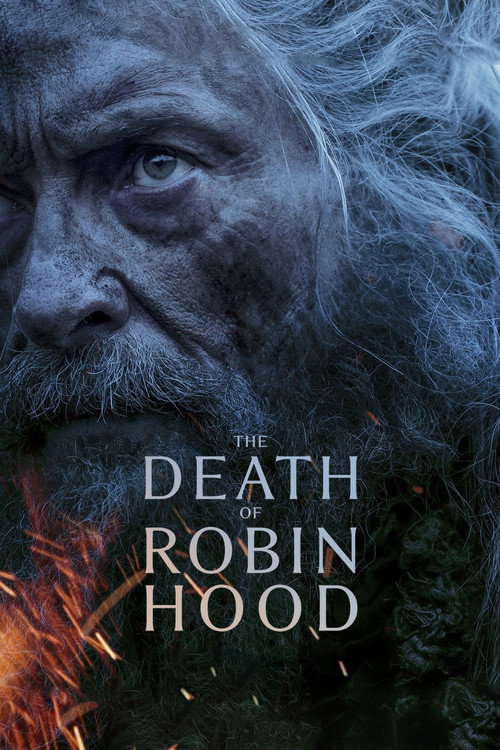
The Death of Robin Hood
2026 · Michael Sarnoski
Pig ("Nicolas Cage's quiet masterpiece") then A Quiet Place: Day One made him the model of the indie-to-franchise graduation everyone debates — plus the internet canonized the cat.
When you want your myths stripped of their shine — a brooding, contemplative take for a night when melancholy sounds better than adventure. Expect a slow burn, not merry men.
What it's about
Robin Hood, but at the end of the story: an aging outlaw haunted by a lifetime of crime and killing is left gravely wounded after what he believed would be his final battle. Taken in by a mysterious woman, he's offered a chance at something he never expected — salvation — and must reckon with what his legend actually cost.
The experience
Grim, hushed, and elegiac — closer to a fireside deathwatch than a swashbuckler, with violence that lands heavily and long stretches of wounded quiet. It's a legend told at the pace of grief.
The craft
Writer-director Michael Sarnoski, who made his name turning genre premises into intimate character studies with Pig and A Quiet Place: Day One, applies the same method to folklore: a famous costume worn by a chamber drama about mortality and atonement. Expect mood and texture over spectacle — mud, firelight, and silence doing the storytelling.
Why it matters
Part of the current wave of revisionist myth-making that asks what happens after the legend, and a marker of Sarnoski's rise as a director trusted to take iconic material somewhere personal.
Snapshot
The Death of Robin Hood is a revisionist treatment of the Robin Hood legend from writer-director Michael Sarnoski, the filmmaker behind Pig (2021) and A Quiet Place: Day One (2024). Rather than the yeoman-archer adventure that has dominated the character's screen history since the silent era, the film trades on mortality and atonement: an aging, guilt-ridden outlaw, played by Hugh Jackman, lives in isolation until he is sought out by a young woman bent on revenge, is gravely wounded in a raid undertaken with Little John to reclaim a friend's stolen farm, and takes refuge at a priory, where he befriends the prioress, Sister Brigid (Jodie Comer), and an orphaned girl. The result is an intimate, elegiac chamber drama wearing the costume of a legend — consistent with Sarnoski's demonstrated preference for genre premises pursued as interior character studies.
Distributed by A24 at a 122-minute running time, the film premiered at the Sydney Film Festival in June 2026 before its American theatrical release later that month. It is built in two formally distinct movements — a darker, violent first half shot in widescreen anamorphic, and a calmer, spiritual priory half in a narrower spherical frame — a structural gambit that became the most discussed element of its craft. Reception split: critics were close to unanimous on Jackman's performance and on the severity and visual rigor of Sarnoski's reinvention, but divided over whether the film's sustained solemnity deepened the material or smothered it, and audiences proved resistant.
Industry & production
The film is a Sarnoski-authored original — he is credited as writer and director — produced on a reported budget of twenty million dollars and released theatrically by A24, placing it squarely in the mid-budget director-driven space that has recently supported auteur genre reinventions. It fits a familiar contemporary financing logic: an established filmmaker, coming off a studio franchise assignment, redirecting that visibility into a smaller, more personal, IP-adjacent original — the Robin Hood legend being public domain and therefore free of the rights entanglements that burden most branded material.
The shoot was fast and compact: roughly thirty shooting days in February and March of 2025, based in Northern Ireland at Belfast Harbour Studios and on locations including the Silent Valley, Glenarm, and Murlough Bay, with interiors at Shane's Castle and exteriors at the Rock of Cashel in Ireland. That schedule — a period picture with battle sequences made at the pace of an independent drama — shaped the production's method throughout, favoring available landscape, practical light, and a lean, reactive camera unit over elaborate pre-visualization.
Commercially the film struggled, grossing about $9.5 million worldwide against its $20 million budget — the fate of a deliberately austere, anti-heroic take on a brand audiences associate with adventure.
Technology
The film was shot on Kodak 35mm film in the 3-perf format by cinematographer Pat Scola, with an ARRICAM LT as the primary camera and an ARRIFLEX 235 for Steadicam work; Cinelab London processed the negative and produced 4K scans. Scola worked across multiple stocks keyed to the film's two-part design: VISION3 5219 500T for low light and night work, 5207 250D for daylight, and a third stock, VERITA 5206 200D, reserved for a single late scene. The lens package divided along the same structural line — Panavision Ultra Panatar II 1.3x anamorphics for the opening section and spherical Primos for the priory half — and the production was, per Kodak, the first to pair the Ultra Panatar II with 3-perf 35mm. For distorted, impressionistic passages, the camera team used a Lensbaby Sweet 35 and, at the far end of improvisation, shot through a water-filled glass jar.
The lighting approach was equally hands-on: naturalistic exteriors, real flame supplemented by Maxi Brutes, a flickering board of 500-watt bulbs the crew nicknamed "The Dalek," LED panels playing fire footage, and a Texas Switch from a real torch to an LED one. Sarnoski has said the choice of 35mm suited the capture of natural environments, and that he and Scola already worked in a low-take, lightly shot-listed style that mapped naturally onto shooting film.
Technique
Cinematography
Scola's photography is the film's formal spine, and it is organized around a mid-film transformation: the opening "myth" section plays in 2.39:1 anamorphic, and when the story settles into the priory the frame narrows to 1.66:1 spherical — a shift from legend to chamber drama that Tim Grierson of Screen Daily noted as a defining structural move. The color follows the same arc: a bleak, gray, brutal opening palette that warms at the priory and drains back to gray in the film's closing movement. Grierson described the lensing as stark and naturalistic; Dyer Oxley of KUOW went further, likening individual frames to old oil paintings and hearing Bergman's The Virgin Spring in the film's fog and meticulous framing — an influence Sarnoski has confirmed directly. The visual references the filmmakers cited run from N.C. Wyeth's 1917 painting The Passing of Robin Hood through Vermeer, Caravaggio, and Goya to The Revenant and Braveheart: painterly chiaroscuro on one side, mud-and-weather physicality on the other, and the finished film holds both. This extends the sensibility Scola and Sarnoski established on Pig — faces held in near-darkness, shallow-focus close work, muted earthen color — onto a larger, colder canvas.
Editing
Andrew Mondshein's cut serves a deliberately meditative pace, privileging duration and stillness over momentum — a continuation of the measured, scene-driven rhythm of Sarnoski's earlier work, now organized around a clean two-part architecture: the violent first half and the quieter convalescent half, hinged at the change of aspect ratio. Grierson credited the editing with sustaining that contemplative register while judging the overall effect excessively brooding; the pacing was, in practice, the film's most polarizing craft decision, read by admirers as gravity and by detractors as inertia.
Mise-en-scène / staging
The film stages its medieval world — England, 1247 — out of real landscape rather than digital extension: the Mourne Mountains' Silent Valley, the coastline at Murlough Bay and Glenarm, the stone interiors of Shane's Castle, the Rock of Cashel. Brian Merriman, reviewing for No More Workhorse, singled out the Northern Irish landscapes as a dark-textured backdrop that grounds the period. The drama itself is spatially compressed in the Sarnoski manner — after the opening section's raids and open country, the film narrows to the priory: a sickroom, a cloister, the slow negotiation between a dying man and the community tending him, much as Pig turned kitchens and back rooms into charged moral spaces. The physical transformation of the actors is part of the design: the prosthetics and makeup work by Charlotte Betts' team, which renders Jackman nearly unrecognizable as the aged outlaw, drew particular praise from Merriman as first-class craft.
Sound
The film's sonic identity rests on Jim Ghedi's score, which Grierson characterized as folk-tinged, punctuated by occasional bellowed vocals — a raw, traditional idiom rather than orchestral medievalism. Merriman found that the folk-inspired music completes the film's sense of period, binding the score to the landscape photography. The approach is continuous with Sarnoski's established deliberation about sound: music and quiet used as expressive elements rather than connective tissue.
Performance
Performance is the film's center of gravity, and on this point the divided critics converged: Jackman's work as the dying outlaw was praised across the spectrum, from Pete Hammond at Deadline to David Ehrlich at IndieWire, who singled out the expressiveness of his eyes. Grierson credited the performance with both ferocity and sufficient sorrow — the violent past and the reckoning with it legible in the same body. Comer's Sister Brigid anchors the priory half as the film's counterweight of care and conviction, and the supporting ensemble includes Bill Skarsgård as Little John, with Murray Bartlett, Noah Jupe, Faith Delaney, Clive Russell, and Jade Croot. Not every critic found the architecture around the lead equally served: Grierson judged the supporting characters functional, instruments of the protagonist's reckoning rather than full presences.
Narrative & dramatic mode
The dramatic mode is elegiac and confessional rather than heroic. Robin Hood arrives not at the beginning of an adventure but at its end: isolated, worn down by guilt, drawn back into violence by a raid to right a small injustice, and then immobilized — forced inward, into the priory's economy of care and the question of whether a man defined by killing can be redeemed. The film's two-movement structure enacts the idea formally: the first half belongs to the legend's world of raids and reprisal, the second to convalescence, faith, and reckoning, the switch marked on screen by the change of frame and the warming of the palette. The title forecloses the traditional legend's open-ended heroism and reframes the story as an ending — an authorial statement about how a legend dies and what, if anything, is redeemed in the dying. Sarnoski has spoken of being drawn, since childhood, to the legend of Robin Hood's death, and of wanting a quiet, thoughtful death for a hero rather than a spectacular one; Dan Mecca of The Film Stage read the film as fundamentally about storytelling itself — how stories evolve and devolve — a fitting concern for a myth.
Genre & cycle
The Death of Robin Hood sits at the intersection of several traditions. It belongs, nominally, to the long screen lineage of Robin Hood pictures — from Douglas Fairbanks's Robin Hood (1922) and the definitive Errol Flynn Adventures of Robin Hood (1938) through Disney's animated version (1973), Richard Lester's autumnal Robin and Marian (1976), Kevin Reynolds's Prince of Thieves (1991), Ridley Scott's origin-story Robin Hood (2010), and the 2018 reboot. But its mode places it decisively in the revisionist, mortality-haunted branch of that lineage — above all Lester's Robin and Marian, the prior major attempt to imagine Robin aged and facing death — and in the broader contemporary cycle of elegiac genre revisions in which established heroes are deconstructed at the end of their arcs. Critics reached instinctively for the elegiac Western: Mark Keizer at MovieWeb invoked Unforgiven, and the comparison is apt — a retired man of violence, a last job, the ledger of past killing coming due. Sarnoski's own stated touchstones push the film toward the brutal-mystical end of the medieval picture: The Virgin Spring and Valhalla Rising, severity and landscape over swashbuckle. The adventure scaffolding survives chiefly in the first half; the film's heart is drama.
Authorship & method
Michael Sarnoski's authorship is the film's clearest through-line. His feature debut, Pig (2021), which he directed and co-wrote with Vanessa Block, took a premise that sounded like a revenge thriller — a reclusive truffle hunter searching for his stolen pig — and refused the genre's expected violence, delivering instead a meditative study of grief, memory, and craft. That inversion of a genre promise into an interior character study is Sarnoski's signature move, and The Death of Robin Hood repeats it at larger scale: a legend's name on the poster, a deathbed reckoning on the screen. His second feature, A Quiet Place: Day One (2024), demonstrated that he could carry the sensibility into a studio franchise, foregrounding a terminally ill protagonist's human-scaled experience amid an alien invasion. Across all three films, the consistent concerns are mortality, loss, the dignity of the wounded, and the tension between violence and grace.
The key collaboration held: Pat Scola, who shot both Pig and Day One, returned as cinematographer, and Sarnoski has described their shared method — little heavy shot-listing, few takes, a way of working that already resembled shooting on film before they committed to 35mm. New to the circle are editor Andrew Mondshein and composer Jim Ghedi, whose folk idiom replaces the orchestral textures of the earlier films. Sarnoski's own accounts of the project are notably personal: a fascination with the death-of-Robin legend dating to age nine or ten, an interest in Gilgamesh as an early deconstruction of the hero story, and a conviction, on casting Jackman, that the actor simply was Robin. The method matches the material — a filmmaker drawn to endings, given a legend that has one.
Movement / national cinema
The film belongs to no formal movement. It sits within American independent-adjacent auteur cinema operating in the mid-budget space — here under A24, the distributor most identified with that model. Its subject is English and medieval, its production geography Irish and Northern Irish, and it participates in the transatlantic Anglo-American appetite for the Robin Hood myth; but as an authorial project it reads as American auteur cinema deploying the British Isles as both setting and resource, in the long tradition of medieval pictures shot on Irish landscape.
Era / period
The film is a period piece set in England in 1247, though the Robin Hood legend has always been a flexible fiction rather than a fixed historical moment, and Sarnoski treats it as myth-time inflected with physical, weathered realism. As a contemporary artifact, it is a mid-2020s production, emerging in a moment when public-domain legends and long-established heroes are being reinterpreted through darker, mortality-conscious frames, and when auteurs pivot between franchise assignments and personal originals. Its "period," in the sense that matters critically, is this present-day revisionist turn as much as the medieval past it depicts.
Themes
The film's themes cluster tightly: mortality and the confrontation with one's own death; guilt and the weight of a violent past; redemption, and whether grace can be earned or only received; and care — the charged relationship between a dying man and the religious community that tends him. Merriman framed the central opposition as violence and vengeance set against Christian healing and redemption; Oxley read the film through paired contrasts — violent and peaceful, honest and untruthful — contrasts the film literalizes in its two halves, two aspect ratios, and two palettes. Running beneath is the theme of the story itself: what a legend is for, and what happens when the man inside it outlives it. The risk of the material — that the penitent outlaw collapses into just another flinty antihero — was named by Grierson as the line the film walks. These concerns are continuous with Sarnoski's body of work, which has consistently been drawn to broken men, the ethics of violence, and the possibility of meaning at the end of a life; staging them through Robin Hood, a figure conventionally associated with righteous violence, makes the reckoning explicit.
Reception, canon & influence
Reception was genuinely split. The film holds a 69% approval rating on Rotten Tomatoes from 189 critics, with an average score of 6.3/10, a Metacritic score of 61, and a C+ CinemaScore from opening audiences — the profile of a critical near-pass and a commercial rejection, confirmed by the $9.5 million gross against a $20 million budget. On the positive side, Guy Lodge at Variety argued the severity of the reinvention holds the attention; Jim Vejvoda at IGN (7/10) credited its blend of mournful drama and murderous action; Keizer heard Unforgiven in it; Oxley gave it four stars. The negative case — Frank Scheck at The Hollywood Reporter, Kristy Puchko at Mashable, C grades from Jacob Oller at the AV Club and Marshall Shaffer at The Playlist — converged on tedium: a film whose pursuit of gravitas, in Grierson's judgment, suffocates its own story. What no faction disputed was Jackman, whose performance drew unanimous praise, or the distinction of Scola's photography.
On influences into the film, the record is now explicit rather than inferred: Bergman's The Virgin Spring and Refn's Valhalla Rising from the director's own mouth; Wyeth, Vermeer, Caravaggio, and Goya in the image-making; Lester's Robin and Marian as the inescapable precedent within the Robin Hood canon; the elegiac Western behind it all; and Sarnoski's own Pig as the method's template. Its forward legacy is an open question this early — a divisive, money-losing film rarely spawns imitators quickly — but it consolidates two things: the viability of the intimate, mortality-focused reinvention of a legendary action figure as a mode A24-scale cinema will finance, and Sarnoski's standing as a filmmaker who bends inherited genre material toward interior, humane ends, now proven at period scale and with a movie star. Whether the film settles into the Robin Hood canon alongside Robin and Marian as the legend's other great autumn is a question for a longer horizon.
A Deleuzian reading
Somewhere around the middle of the film, the picture gets smaller.
The full Deleuzian reading of The Death of Robin Hood →
Reception
Too new for a reappraisal arc — it landed in June 2026 as A24's grim, revisionist swing at the legend and split critics on arrival: 'the Unforgiven of Robin Hood movies' to admirers, a self-serious slog to detractors. The Letterboxd crowd adopted it as a discourse object from day one.
How The Death of Robin Hood was received, from release to now →
How to watch The Death of Robin Hood: what to notice on a first viewing
- Notice the width of the frame. Pat Scola shoots the opening movement in 2.39:1 anamorphic widescreen, the shape of legend. When the story settles into the priory, the frame narrows to 1.66:1 spherical and the bleak gray palette warms. The shape of the picture tells you which film you are in: the raid or the sickroom.
- Watch Jackman's eyes under the prosthetics. Charlotte Betts's makeup team renders Jackman nearly unrecognizable as the aged outlaw, so the performance lives in what the face still does. Critics across the spectrum singled out his eyes: ferocity and sorrow legible in the same body. A man who can no longer act has only a face left, and the film bets everything on it.
- Notice how long a shot holds after the action stops. Andrew Mondshein's cut favors duration and stillness over momentum, continuing the measured rhythm of Pig. Reviewers split over the pace, gravity to admirers and inertia to detractors. The waiting is the subject; the film gives convalescence the time it takes.
- Look at the faces held in near-darkness. Scola and Sarnoski extend the look of Pig, faces in near-darkness and shallow-focus close work, onto a colder canvas. The references they cited run from Vermeer, Caravaggio, and Goya to The Revenant and Braveheart; Dyer Oxley likened frames to old oil paintings. The film wants a legend to look like a painting and feel like weather at the same time.
- Listen for the folk score and its bellowed vocals. Jim Ghedi's score is folk-tinged, punctuated by occasional bellowed vocals, a raw traditional idiom instead of orchestral medievalism. Brian Merriman found the music completes the period and binds itself to the Northern Irish landscapes. The music comes from the ground the film was shot on, not from a court orchestra.
The whole guide to watching The Death of Robin Hood, with the keys for a rewatch →
Influences: the films it descends from and the films it influenced
- Robin and Marian (1976) — The prior 'Robin in autumn' — it reframes the ballad as an aged outlaw's homecoming to die, supplying the deathbed-reckoning structure and Marian's poisoned-mercy finale that this film's mortality frame directly inherits.
- Pig (2021) — Sarnoski's own template: dressing a revenge-thriller premise (stolen truffle pig) as a grief study and withholding the promised violence — the exact genre-inversion method reapplied to a legend here.
- Unforgiven (1992) — The revisionist template of an aging man of violence forced to reckon with the physical and moral cost of killing, deglamorizing the heroic myth the character once embodied.
- The Wild Bunch (1969) — Founding elegiac-outlaw text in which men of violence confront their own obsolescence at the close of their era — the 'end of usefulness' engine driving this film.
- Ride the High Country (1962) — Builds its elegy from two aging gunmen as a paired two-hander riding toward a final reckoning — the veteran-partners chamber structure this film compresses into a single location.
- The Shootist (1976) — A dying gunfighter (John Wayne, himself terminally ill) spending his last days settling accounts — the archetypal deathbed-of-a-legend drama staged as intimate reckoning rather than spectacle.
- The Man Who Shot Liberty Valance (1962) — The 'print the legend' meditation on how myth outlives and misrepresents the man — the elegiac interrogation of heroic legend that underwrites the revisionist-legend approach.
- Pat Garrett and Billy the Kid (1973) — Its dying-outlaw mood and drawn-out death scene ('Knockin' on Heaven's Door') model the use of contemplative duration to stage mortality as lament rather than action beat.
- The Gunfighter (1950) — An early revisionist portrait of an aging gunman trapped by and weary of his own legend, awaiting an inevitable death — the proto-elegy for the outlaw undone by his myth.
- A Quiet Place: Day One (2024) — Continues the Sarnoski/Pat Scola practice of foregrounding a terminally ill protagonist's human-scaled interiority inside genre spectacle, using expressive silence as the primary dramatic register.
- The Assassination of Jesse James by the Coward Robert Ford (2007) — Roger Deakins's shallow-focus, hushed, contemplative-duration elegy for a legend's decline — the exact slow-and-close formal register (soft edges, held silences) this film adopts.
- Logan (2017) — The western-inflected, mortality-focused reinvention of a legendary action figure as a wounded, dying man — the modern model of bending franchise myth toward elegy that this film extends.
- The Green Knight (2021) — Reworks a chivalric legend into an interior, mortality-haunted chamber piece, privileging contemplative duration and staged tableaux over the adventure spectacle the source promises.
- The Old Man & the Gun (2018) — A gentle, elegiac portrait of an aging outlaw at the end of his career rendered in warm studio-scaled mid-budget auteur mode, valuing grace and craft over the caper's mechanics.
- The Rider (2017) — A naturalistic, photographic-naturalist study of a man of physical prowess confronting the end of his usefulness — the wounded-hero-facing-obsolescence framed through unshowy, close observation.
- First Cow (2019) — A contemplative-duration, quietly staged male two-hander whose tenderness and grace-over-violence ethos parallels this film's grace-and-care register within an intimate, chamber-scaled frame.
Similar films
- Logan (2017) — influence & lineage
- The Green Knight (2021) — influence & lineage
- Guillermo del Toro's Pinocchio (2022) — often watched together
- Spider-Man: Brand New Day (2026) — often watched together
- The Batman (2022) — shared sensibility
- The Adventures of Robin Hood (1938) — shared sensibility
- Puss in Boots: The Last Wish (2022) — shared sensibility
- The Dark Knight Rises (2012) — shared sensibility