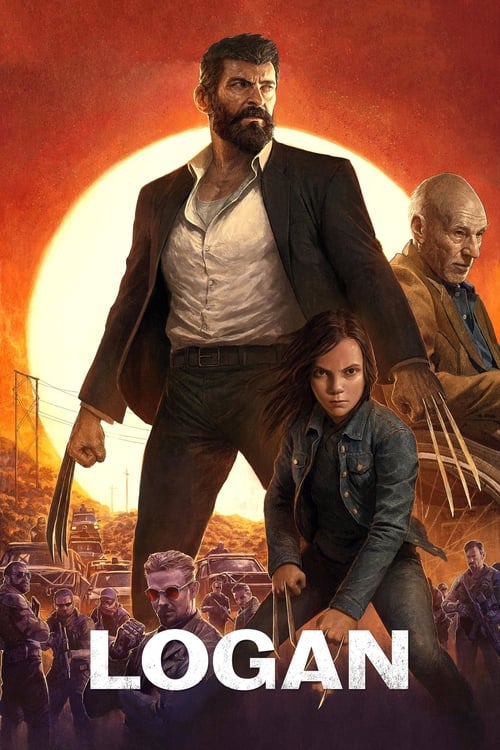
Logan
2017 · James Mangold
For when you want a comic-book movie that actually hurts — a farewell with stakes and tears, not quips. Bring some emotional stamina; it earns its heaviness.
What it's about
In 2029 the mutants are nearly gone, and Logan — aging, scarred, healing slower every year — scrapes by as a limo driver on the Texas–Mexico border while hiding Charles Xavier, whose failing telepathic mind has become dangerous to everyone around him. Then a fierce, near-silent young girl arrives with armed men on her trail, and Logan is dragged into one last protective journey north.
The experience
Brutal, mournful, and surprisingly tender — more dusty road movie than superhero spectacle. The violence lands with real weight, and between fights it sits with grief, fatigue, and stubborn love in a way comic-book films rarely dare.
Performances
Hugh Jackman gives his rawest, most lived-in turn as Wolverine, playing exhaustion and guilt as much as rage; Patrick Stewart is heartbreaking as a great mind coming apart; and young Dafne Keen, mostly without dialogue, is a genuine discovery — feral, funny, and moving.
The craft
James Mangold strips the franchise machinery away and shoots it like a late Western: sun-blasted landscapes, long quiet stretches, then sudden, R-rated savagery that makes the claws feel dangerous again for the first time. The restraint is the point — it looks and sounds like a drama that happens to contain mutants.
Why it matters
It proved a superhero film could be a somber, R-rated character piece and still be a hit, reshaping how studios think about endings and legacy chapters for long-running franchise heroes.
Snapshot
Logan is the third and final solo film centered on Hugh Jackman's Wolverine, and the tenth entry in the Fox-era X-Men franchise that began in 2000. Directed and co-written by James Mangold, it reframes the superhero exit film as a late Western elegy: a story about a dying body, a fading mind, and the burden of legacy. Set in 2029, it follows a depleted Logan working as a limo driver near the Texas–Mexico border, hiding a senile Charles Xavier (Patrick Stewart) whose telepathy has become a lethal liability, until the arrival of Laura (Dafne Keen) — a young mutant cloned from Logan's genome — forces him onto one last protective journey north. The film is notable for being the first X-Men picture released with an R rating in the United States, a decision that shaped its violence, language, and overall tonal register. More than a franchise capstone, Logan became a reference point in the broader argument that comic-book films could carry the weight of character drama and genre seriousness, and it earned a rare Academy Award nomination for a superhero film's screenplay.
Industry & production
Logan was produced by Twentieth Century Fox, which held the film rights to Marvel's X-Men properties before the Disney acquisition closed in 2019. By 2017 the franchise was commercially durable but creatively uneven, and Jackman had signaled that this would be his final outing as a character he had played since 2000 — a continuity of casting nearly unmatched in the genre. The decisive industrial context was the success of Deadpool (2016), also a Fox/Marvel production, which demonstrated that an R-rated comic-book film could be hugely profitable. That result is widely credited with giving Mangold and Jackman leverage to pursue the harder, bloodier, more adult register they wanted for Logan's send-off; multiple accounts describe Jackman accepting a reduced salary to support the R-rated budget, and the film was made at a cost modest by tentpole standards.
Mangold had already directed Jackman in The Wolverine (2013), and the working relationship carried into this project, where Mangold served as director and shared screenplay credit with Scott Frank and Michael Green, from a story by Mangold. The film drew loosely on the tone — though not the plot — of Mark Millar and Steve McNiven's comic Old Man Logan, while inventing its own narrative. Production took place largely in Louisiana, New Mexico, and Mississippi, standing in for the southwestern and central United States. The marketing leaned into the film's somber, stripped-down identity rather than spectacle, and a black-and-white version, Logan Noir, was released theatrically and on home video, reflecting Mangold's stated affection for the monochrome look of the material.
Technology
Logan was photographed digitally. Cinematographer John Mathieson shot on Panavision cameras with anamorphic lenses, a choice that gives the 2.39:1 frame its characteristic shallow depth, oval bokeh, and horizontal flare — an aesthetic associated with the classical widescreen Western and with a tactile, film-like image rather than the clean digital sheen common to the genre. The anamorphic format is integral to the film's visual argument: it situates the story in the lineage of the landscape Western as much as the comic-book film.
In its visual effects, Logan is comparatively restrained for a tentpole. Where many franchise entries are built around digital set-pieces, Logan foregrounds physical stunt work, practical locations, and prosthetic and makeup effects for its violence. Digital effects are still present — for wounds, augmentations, and the climactic confrontation with X-24, the younger Logan clone also played by Jackman, which required compositing and digital assistance to place two versions of the actor in the same frame. But the film's technological signature is its relative modesty: the spectacle is bodily and grounded, and the effects largely serve to extend practical material rather than replace it.
Technique
Cinematography
Mathieson's photography is the film's most discussed formal element. The anamorphic widescreen frame, sun-bleached palette, and dust-laden exteriors evoke the American Western, while the interiors — the collapsing smelting plant where Xavier is hidden, the cheap motels of the road — are rendered in hard, unromantic light. The camera favors a weighty, grounded coverage: handheld and Steadicam work in the action, but rarely the frenetic cutting-and-shaking that had become a genre cliché. Violence is staged legibly, the geography of each fight kept clear. The compositions repeatedly isolate Logan within the frame, emphasizing exhaustion and containment, and the landscape itself — open highway, casino strip, northern forest — carries thematic weight as a space of flight and, finally, a place to die.
Editing
Edited by Michael McCusker and Dirk Westervelt, Logan paces itself unusually for a comic-book film, giving extended room to quiet scenes — Xavier and Logan bickering, a family dinner with the Munson household — before its bursts of brutal action. The R rating shapes the cutting of the violence: the editors hold on impacts rather than eliding them, letting the consequences of Logan's claws register. The structure is a linear road movie, and the editing reinforces a sense of dwindling time and depleting resources, building toward an elegiac close rather than an escalating spectacle.
Mise-en-scène / staging
The production design renders a near-future that is recognizably our own, only more frayed: automated long-haul trucks, a depopulated mutant world, sun-baked border towns. The staging insists on physical detail — Logan's reading glasses, the limp, the tremor in his hands, the pills, the bottle. Xavier is staged as a figure of ruined grandeur, brilliant and dangerous and incontinent of his own power. The film's spaces are deliberately unglamorous; the iconography of the X-Men — costumes, the school, the team — survives only as relics, including an in-world comic book that the film treats with pointed irony, blurring the line between the characters' mythologized past and their diminished present.
Sound
Marco Beltrami's score, his third collaboration with Mangold after 3:10 to Yuma (2007) and The Wolverine, leans on spare, Western-inflected textures rather than the brass-heavy heroics typical of the franchise — guitar, strings, and restrained orchestration that match the film's elegiac mood. The sound design treats Logan's violence as visceral and unpleasant: the wet, percussive impacts of the claws are foregrounded rather than smoothed over, consistent with the film's refusal to render bloodshed as clean spectacle. Johnny Cash's recording of "Hurt" accompanies the marketing and the film's reflective register, reinforcing the mortality theme; the closing of the film is scored for grief rather than triumph.
Performance
Performance is central to Logan's reputation. Jackman, in his ninth appearance as the character, plays Logan as physically broken and emotionally cauterized — a man whose healing factor is failing and whose body now keeps the wounds. Patrick Stewart gives one of the franchise's most affecting performances as a Charles Xavier ravaged by age and neurological decline, oscillating between lucidity, helplessness, and catastrophe; the role inverts the serene authority Stewart had embodied since 2000. Dafne Keen, then a child actor, plays Laura largely without dialogue for much of the film, conveying feral rage and wary attachment through physicality. The three-hander at the film's core — a surrogate family of grandfather, father, and daughter — is what critics most often single out as the source of the film's emotional force.
Narrative & dramatic mode
Logan operates in the mode of late-career elegy and road movie rather than origin story or team adventure. Its dramatic engine is mortality: the certainty that Logan and Xavier are both dying, and that the franchise's mythology is ending with them. The structure borrows openly from the Western — a reluctant gunfighter, worn out and self-loathing, drawn into protecting the innocent on a journey across hostile country toward a notional refuge ("Eden"). The film foregrounds this lineage by having its characters watch George Stevens's Shane (1953) and quote its closing lines, making the Western not merely an influence but an explicit intertext and moral frame. The dramatic mode is tragic and intimate; spectacle is subordinated to character, and the resolution offers continuity through the child rather than personal salvation.
Genre & cycle
The film sits at the intersection of two cycles. Within the superhero cycle, it belongs to the wave of R-rated, genre-hybrid comic-book films that Deadpool had just shown to be viable, and it pushed that opening toward seriousness rather than irreverence. Within the longer history of American genre, it is a Western — specifically the aging-gunfighter, end-of-the-trail Western descended from Shane, The Gunfighter (1950, also a Western Mangold has cited as touchstone material), and the elegiac late entries of the form. Logan thus functions as a deliberate hybrid: it uses the comic-book franchise as a vehicle to revive the dying-hero Western, and it is frequently grouped with The Dark Knight (2008) as evidence that the superhero film could absorb the conventions and gravity of adjacent adult genres.
Authorship & method
James Mangold is a director associated with genre revivalism and craftsman's classicism — Cop Land (1997), Walk the Line (2005), the 3:10 to Yuma remake (2007), and The Wolverine (2013). His authorship is legible in Logan's commitment to character over spectacle, its Western framework, and its preference for grounded, legible staging. He co-wrote the screenplay with Scott Frank — a screenwriter known for hard-boiled, character-driven crime adaptations — and Michael Green, working from his own story; the script's restraint and structural clarity reflect that pedigree, and it earned an Academy Award nomination for Best Adapted Screenplay, an unusual distinction for the genre. Mangold's key collaborators on the film's texture were cinematographer John Mathieson (a frequent Ridley Scott collaborator, known for Gladiator), composer Marco Beltrami (a recurring Mangold partner), and editors Michael McCusker (a long-standing Mangold editor) and Dirk Westervelt. The method across these collaborations was a stripping-away: fewer effects, harder light, slower scenes, and a sustained tonal discipline rarely attempted in franchise filmmaking.
Movement / national cinema
Logan is a product of the American studio system at the high-water mark of the franchise era, and it is best read within national-cinema terms as an American film in dialogue with the Western — the most distinctly American of genres. It does not belong to a self-conscious movement so much as to a recognizable tendency of the 2010s: the "prestige" or "elevated" treatment of comic-book material, in which directors imported the visual and thematic seriousness of other American genres into the superhero film. Its border setting and its central refugee narrative — children fleeing across the southern border toward safety — give it a specifically American political resonance, intentional or not, that several critics noted at the time of release.
Era / period
The film arrived in early 2017, near the peak of the superhero film's commercial dominance and amid growing critical fatigue with the form's homogeneity. That context is essential to its reception: Logan was received as a corrective, a film that demonstrated the genre could end a story, age its heroes, and depict consequence. Its R rating placed it alongside Deadpool as the leading edge of a brief studio willingness to make adult-rated comic-book films, and its success contributed to that trend's continuation. As the last major X-Men-adjacent solo film of the Fox era before the Disney acquisition, it also functions as a period marker — the closing of one studio's twenty-year stewardship of the characters.
Themes
The film's central theme is mortality and the failing body — a superhero defined by invulnerability now subject to age, pain, and a slow poisoning from the adamantium bonded to his skeleton. Closely linked is the theme of legacy: what Logan owes to the children who will outlive him, and whether a life of violence can produce anything but more violence, a question literalized in X-24, the mindless clone that is Logan stripped of conscience. Surrogate family runs throughout — the improvised household of Logan, Xavier, and Laura — as does guilt and atonement, with Xavier haunted by a past catastrophe and Logan by a lifetime of harm. The recurring invocation of Shane foregrounds the theme of the gunfighter's curse: the impossibility of laying down the weapon, and the hope that the next generation might escape the cycle. Finally, the film is preoccupied with the gap between myth and reality, dramatized through the in-world X-Men comics that Laura treasures and Logan dismisses as lies.
Reception, canon & influence
Logan was met with strong critical acclaim, widely praised for its performances, its tonal seriousness, and its willingness to treat franchise characters as mortal. Critics singled out Jackman and Stewart's work and the film's elegiac departure from genre convention, and many described it as among the best films the superhero cycle had produced. Its Academy Award nomination for Best Adapted Screenplay was treated as a milestone — a rare instance of the awards establishment recognizing a comic-book film's writing — and it consolidated the critical argument, alongside The Dark Knight, that the genre was capable of serious drama.
The influences on the film are openly worn: the elegiac American Western, Shane above all, and the broader tradition of the aging-hero genre piece; the Old Man Logan comic supplied tone and the premise of a depleted, future Wolverine; and Deadpool's commercial proof-of-concept made its adult register industrially possible. Its influence forward is most visible in the studio appetite for R-rated, tonally ambitious comic-book films that followed, and in the recurring use of Logan as the benchmark for how a long-running superhero performance might be retired with gravity. The film's central image — a worn-out hero protecting a child across a hostile landscape, finding redemption in the next generation — has become a touchstone reference in discussions of genre hybridity and of the superhero film's capacity for dramatic seriousness. Beyond such broad currents, claims of specific, direct influence on later individual films should be made cautiously; the firmer legacy is Logan's standing as a proof that a franchise could grant its hero an ending.
A Deleuzian reading
A Wolverine who needs reading glasses.
The full Deleuzian reading of Logan →
Reception
Landed in 2017 to instant acclaim as 'the superhero movie all grown up,' and its stature has only hardened since — it made Oscar history and is now the reference point every 'dark, mature take' pitch invokes.
How Logan was received, from release to now →
Influences: the films it descends from and the films it influenced
- Shane (1953) — Logan stages its climax around the literal text of Shane — the child recites Stevens's "there's no living with a killing" eulogy — inheriting his framing of the gunfighter who cannot outrun his violence and the worshipful child's-eye gaze.
- Unforgiven (1992) — Supplies the revisionist-Western template of the depleted, conscience-haunted killer whose body has failed him, where each killing is costly and demythologized rather than triumphant.
- The Wrestler (2008) — Model of the late-career elegy built on a battered physical performer, making the failing body the subject and locating redemption in self-sacrifice rather than victory.
- Children of Men (2006) — Provides the structural engine of escorting a uniquely precious child through a hostile near-future, with grounded, visceral action subordinated to narrative stakes rather than spectacle.
- The Road (2009) — Guardian-and-child survival trek across a blasted American landscape, prioritizing elegiac pacing and muted naturalism over genre incident.
- Lone Wolf and Cub: Sword of Vengeance (1972) — The wandering-killer-with-a-child archetype in which the surrogate-parent bond is forged and tested through bloodshed across a road of pursuers.
- 3:10 to Yuma (2007) — Mangold's own genre-revivalist Western grammar — legible geographic staging, character over spectacle, weathered moral reckoning — carried directly into Logan's frontier register.
- The Dark Knight (2008) — Established the critical and industrial argument that a comic-book film could sustain serious adult drama with practical, legibly staged action — the precedent Logan extends into elegy.
- Deadpool (2016) — The commercial proof-of-concept that an R-rated X-Men film was viable, making Logan's adult violence and language industrially possible at a major studio.
- The Wolverine (2013) — Mangold's first pass at the character, establishing the grounded, character-focused, genre-inflected approach (the wandering ronin abroad) that Logan strips down to its elegiac core.
- Unbreakable (2000) — Mangold reconceives the superhero figure as mythological realism — stripping the genre of kinetic spectacle and shooting anamorphic widescreen with a patient, body-in-landscape camera that holds rather than propels — directly inheriting Unbreakable's visual grammar for the superhero as archetype rather than action vehicle.
- Harry Potter and the Deathly Hallows: Part 1 (2010) — A franchise capstone that matures into an elegiac, desaturated road movie about mortality and exhaustion — extending the same craft of letting a blockbuster series end in gloom and attrition.
- Joker (2019) — Extends Logan's proof that an R-rated, character-driven comic-book film could earn prestige recognition, abandoning spectacle for somber, performance-led character study.
- Nobody (2021) — Returns a worn, aging protagonist to brutal, visceral, legibly choreographed violence in a grounded register, inheriting Logan's emphasis on bodily cost over invulnerability.
- Deadpool & Wolverine (2024) — Established the elegiac, R-rated stripping of Wolverine into a mortal, aging Western hero whose funeral-weight gravity this film both quotes (the opening title card built from Logan's corpse) and deliberately undercuts.
- Thunderbolts* (2025) — Precedent for stripping a comic-book property down to grief, exhaustion, and mortality, deliberately shrinking the mise-en-scène away from franchise bombast toward intimate stakes.
- Gladiator (2000) — Shares cinematographer John Mathieson, whose hard-light, desaturated anamorphic photography of weathered, aging men translates directly into Logan's sun-bleached texture.
- True Grit (2010) — Pairs a grizzled, depleted guardian with a precocious child on a Western journey, framing the mentor's obsolescence and mortality as the emotional spine.
- No Country for Old Men (2007) — The modern elegiac Western of aging men confronting obsolescence and death in a sun-bleached borderland, trading shootout catharsis for dread and exhaustion.
- Mad Max: Fury Road (2015) — The desert road-movie chase built on practical effects and sun-bleached anamorphic widescreen, prioritizing physically legible stunt staging over digital abstraction.
- Hell or High Water (2016) — Contemporary sun-bleached Texas Western with a Western-inflected score and elegiac economy, framing violence as a worn-out way of life.
- Ford v Ferrari (2019) — The elegiac craftsman's tragedy close — in which the protagonist's death resolves rather than undermines the film's emotional argument about a life spent in service of an exacting physical discipline — is the same structural and tonal choice Mangold makes for Ken Miles; the same collaborative unit executes it in both cases.
- Man of Steel (2013) — Sibling in the 'tragic, grounded prestige superhero' turn Man of Steel helped license — desaturated realism, restrained lead performance, and treating the costumed icon as a vehicle for mortal grief and moral cost.
- Star Wars: The Last Jedi (2017) — Sibling in the elegiac-demythologizing mode — a franchise legend rendered aged, broken, and reluctant, treating heroic failure and mortality as the subject rather than the spectacle.
- No Time to Die (2021) — A legacy-franchise installment that kills its long-running protagonist to achieve genuine narrative finality, sharing the mortality-cost-of-love and tragic-death conclusion as a deliberate franchise terminus.
- The Batman (2022) — Reframes a comic-book figure through a borrowed adult genre (the elegiac Western) with subdued naturalistic craft, the 'elevated comic-book' move The Batman performs via noir instead.
- Gloria (1980) — A weary, depleted killer dragged into protecting a child marked for death across a road-chase — the reluctant-guardian melodrama-action hybrid descending straight from Gloria's pairing.
- Captain America: The Winter Soldier (2014) — Parallel project to graft a non-superhero genre (the elegiac Western/road movie) onto comic-book material with tactile, weighty, consequence-bearing violence — the same de-spectacularizing impulse.
Similar films
- The Dark Knight (2008) — influence & lineage · same viewing thread
- 3:10 to Yuma (2007) — influence & lineage
- Deadpool (2016) — influence & lineage
- Mad Max: Fury Road (2015) — influence & lineage
- No Country for Old Men (2007) — influence & lineage
- Avengers: Infinity War (2018) — same viewing thread
- Man of Steel (2013) — same viewing thread
- The Dark Knight Rises (2012) — same viewing thread
All the films related to Logan →
Watch it with: curated runs of related films
- The Superhero Movie Grows Up — Watch these as one arc — Raimi's warmth into Nolan's gravity into Logan's elegy and The Batman's rain-soaked noir — the two decades the comic-book film reached for real weight.