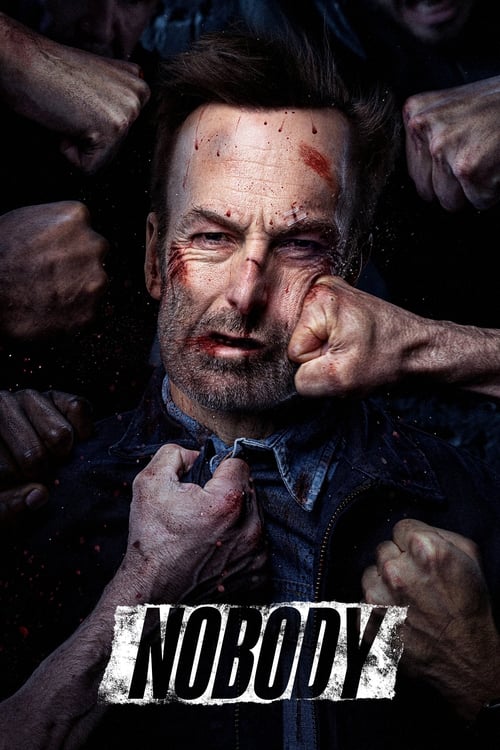
Nobody
2021 · Ilya Naishuller
For a Friday night when you want pure cathartic fun — 90-ish minutes of a doormat biting back, no homework required. Comfort food for action fans.
What it's about
Hutch Mansell is the definition of forgettable: a suburban auditor stuck in a gray routine, ignored by his family and underestimated by everyone. When two thieves break into his house one night and he lets them walk, the humiliation cracks something open — and the very dangerous man he used to be starts clawing his way back out, drawing the Russian mob down on his quiet life. It's a revenge thriller about a nobody who turns out to be anything but.
The experience
Lean, fast, and gleefully violent, with a mean streak of humor running through every brawl. The bus fight alone is worth the ticket — bruising, close-quarters action that makes you wince and grin at the same time.
Performances
Bob Odenkirk is the whole hook: a comedy-bred everyman throwing himself into brutal, unglamorous fight choreography with total commitment, and making the midlife rage underneath it genuinely felt. Christopher Lloyd is a late-film delight.
The craft
Built by the stunt-driven school of modern action filmmaking, its fights are staged with crunching practical clarity — you feel every hit land, and the needle-drop soundtrack plays the carnage for dark comedy. It rewards good speakers and a crowd.
Why it matters
A modest-budget sleeper that reinvented Odenkirk as an action star and confirmed the appetite for tight, stunt-team-crafted revenge thrillers over bloated franchise spectacle.
Snapshot
A compact, ruthlessly entertaining suburban revenge fantasy, Nobody follows Hutch Mansell — auditor, husband, father, invisible man — as a botched home invasion unlocks a suppressed identity he had spent years burying in routine. The film operates as both a high-velocity action vehicle and a sly piece of genre self-awareness, deploying the iconography of the reluctant badass with knowing wit while never letting irony drain the physical stakes. Anchored by Bob Odenkirk's wholly committed performance, it arrived as one of the more satisfying action entertainments of the pandemic-recovery release window: modestly budgeted, precisely calibrated, uninterested in franchise bloat.
Industry & production
Nobody was produced under the 87North Productions banner — the company co-founded by former stuntman and director David Leitch and producer Kelly McCormick, who had previously shepherded Atomic Blonde (2017) and the John Wick sequels through production. 87North had by this point established itself as a reliable brand for high-craft practical action, and the project carried that house imprimatur explicitly: Derek Kolstad, who had created the John Wick mythology, wrote the script for Nobody as well, making the lineage unmistakable. The studio was Universal Pictures, which distributed theatrically in late March 2021 under conditions still constrained by COVID-19 capacity limits in many markets. The film nonetheless turned a significant profit on its modest production budget, a performance that quickly put a sequel into development. Principal photography took place largely in Winnipeg, Manitoba, whose unremarkable midwestern infrastructure stood in convincingly for the film's unnamed American city — a deliberate placelessness suited to the story's allegory of suburban anonymity.
Bob Odenkirk's presence in the lead role was the production's defining gamble and its most distinctive feature. Known primarily for comedy (Mr. Show, Better Call Saul) rather than action, Odenkirk had reportedly spent several years of focused physical preparation — working with fight trainers and studying movement — in anticipation of exactly this kind of role. The casting reframes the audience's expectation structurally: where John Wick opens on a man clearly carved from violence, Nobody opens on a man who registers as soft, tired, defeated, making the first revelation of competence a genuine surprise. Kolstad and Naishuller designed the film around that gap.
Technology
Nobody was shot on digital, consistent with contemporary mid-budget action production. The production's technical signature lies less in any single camera technology than in its approach to staging and its commitment to practical execution over digital compositing. The bus fight sequence — the film's central set piece and the fulcrum on which its genre identity pivots — was accomplished through a combination of closely choreographed practical stuntwork and tight spatial editing rather than digital enhancement. Odenkirk performed a substantial portion of his own fight choreography, and the film's action coordinators were drawn from 87North's established pool of stunt and fight designers, whose work had become recognizable across the John Wick films and Atomic Blonde. The physical reality of the damage sustained by Hutch — he bleeds, limps, recovers slowly — distinguishes the film's action aesthetic from the balletic invincibility of many peers.
Technique
Cinematography
The film was shot by Pawel Pogorzelski, who had come to prominence through his work with Ari Aster on Hereditary (2018) and Midsommar (2019). That background in horror atmosphere — flat institutional lighting, domestic interiors rendered uneasy — inflects Nobody productively. The film's early passages are shot in a desaturated, fluorescent palette that codes Hutch's life as affectless: the bus ride, the office, the breakfast table all carry a slight clinical pallor. When violence erupts, the grammar does not change dramatically — there are no expressionist flares or hyper-stylized cues — which makes the chaos legible and the damage feel real. The widescreen framing holds space for bodies to move through, rather than cutting away from action; the bus sequence in particular uses the narrow tube of the vehicle as a spatial constraint that focuses and intensifies the choreography.
Editing
The film opens with a bravura editorial gambit: a compressed Groundhog Day montage of Hutch's weekly routine — the same bin missed for collection, the same seat on the same bus, the same domestic non-communication — that establishes his life as a loop he cannot break. This sequence announces the film's understanding of form as meaning: the montage doesn't just describe the character's stasis, it enacts it rhythmically. In the action sequences, the editing is tight without being incomprehensible — a deliberate counter-positioning against the Bourne-era rapid-cut style that rendered so much mid-2000s action spatially illegible. Shots are allowed to breathe long enough for geography and consequence to register.
Mise-en-scène / staging
Naishuller and Pogorzelski consistently contrast the violence against environments of conspicuous normalcy: a commuter bus, a family kitchen, a suburban living room. This contrast is the film's most sustained formal strategy. The staging takes suburban space seriously as a setting — the Mansell house is credibly middle-class rather than aspirationally styled, the neighborhood genuinely undistinguished — so that when that space is violated or defended, the symbolic stakes feel legible. The climactic set piece shifts register entirely, moving into a large industrial space that Hutch has booby-trapped in advance, and Naishuller stages that sequence as something closer to a Rube Goldberg comedy of violence: elaborately prepared, tonally lighter, the film permitting itself a more overtly cartoonish pleasure after having earned it through earlier grounded damage.
Sound
The film's sound design works in productive dialogue with its music choices, most of which are conspicuously retro. Naishuller and music supervisor Brian McNelis draw on a canon of late 1950s through 1970s pop and soul — "Mr. Sandman," "Don't Let Me Be Misunderstood" in the Animals version — deployed in ironic commentary on the images. The effect is similar to the needle-drop strategy in Tarantino or the John Wick films: familiar music applied to unfamiliar violence creates a tonal dissonance that functions as both humor and commentary on the genre's relationship to nostalgia. The sound design in the fight sequences emphasizes impact weight — the specific acoustic of a forearm against a face, the grunt of effort — which keeps the action physical rather than spectacular.
Performance
Odenkirk's work is the performance at the center of everything. The challenge was not to make a convincing action hero but to make a convincing ordinary man whose transition into an action hero reads as character revelation rather than genre transformation. He achieves this through careful calibration of posture and affect in the early scenes: rounded shoulders, a vagueness of gaze, a flatness of affect in domestic exchanges that reads as depression or dissociation rather than menace. The violence, when it comes, emerges from that register rather than replacing it — Hutch hits and is hit as someone who has not done this in a long time, who remembers the skill in the body before the mind catches up. Christopher Lloyd and RZA appear in supporting roles that function partly as in-joke casting, their genre personas activated with comic economy. Aleksei Serebryakov's Russian mob boss Yulian Kuznetsov is sketched broad enough to be an effective antagonist without requiring much psychological depth.
Narrative & dramatic mode
The film works within the "sleeping giant" narrative — the figure who appears negligible until provoked beyond endurance, at which point a hidden ferocity surfaces. This mode has a long literary genealogy, but its cinematic form runs through the American vigilante film and the action B-picture. What Nobody adds is the explicitly mundane framing: Hutch is not a grieving widower or a man of obvious stature but a functionary, a nobody by social designation. The inciting incident — a home invasion Hutch deliberately allows to proceed, realizing too late that his daughter's bracelet has been taken — is pointedly anti-heroic: he fails, he is humiliated, and the humiliation is domestic and witnessed by his son. The rage that follows is motivated less by the theft than by the loss of identity that failure represents. The film is, in this register, a mid-life crisis narrative in action-genre disguise: Hutch does not reclaim a lost love or career but a lost self.
Genre & cycle
Nobody belongs to a cycle of post-John Wick suburban action films that locate the action hero not in exotic contexts — black sites, foreign capitals, criminal underworlds — but in ordinary American landscapes. The cycle's interest lies in the gap between setting and event: how much violence can be brought to bear in a commuter bus, a ranch house, a strip-mall pawn shop. John Wick established the grammar; Nobody extends it with a different tonal emphasis, borrowing the structure but pitching the comedy higher and the mythological ambition lower. The film is also adjacent to the "revealed competence" thriller — A History of Violence (2005) being the obvious prestige predecessor — though Cronenberg's film is far more psychologically probing about the costs of that revelation. Nobody is less interested in the damage violence does to identity than in the cathartic pleasure of its release. This is not a criticism: the film is honest about its emotional project.
Authorship & method
Ilya Naishuller is a Russian-born, internationally working director whose feature debut Hardcore Henry (2015) — a first-person POV action film shot almost entirely on helmet-mounted GoPro cameras — established him as a filmmaker interested in formal experimentation within genre conventions. Nobody represents a more conventional directorial assignment: the formal audacity of Hardcore Henry is not replicated, and Naishuller largely subordinates his sensibility to the material and the 87North production framework. What persists from Hardcore Henry is an appetite for sustained, spatially coherent action sequences and a willingness to commit to physical excess without apology. His work here functions more as a skilled craftsman within an established system than as an auteurist signature.
Derek Kolstad as writer is the more decisive creative intelligence behind the film's structure and mythology. His understanding of the "mythology drop" — the technique, pioneered in John Wick, of revealing institutional depth and lore through allusion rather than exposition — is deployed again here in the backstory of Hutch's former life. The specifics are parceled out deliberately, enough to imply a world without requiring its construction. The result is a script that feels simultaneously self-contained and expandable, which is precisely the franchise utility the studio needed.
Pawel Pogorzelski brings a visual sensibility formed in slow-burn atmospheric horror to an action context, and the tonal interaction is productive: the domestic interiors never feel cozy.
Movement / national cinema
Nobody is American genre cinema in both industrial and cultural terms, though its director is Russian-born and its villain is Russian, and the film carries a faint east-meets-west structural consciousness in the casting of Serebryakov — a major figure in contemporary Russian cinema known for Leviathan (Zvyagintsev, 2014) — against Odenkirk. Whether this constitutes cultural commentary or incidental casting is ambiguous; the film does not pursue it thematically. The 87North production model is in practice a form of international practical action filmmaking that draws on Canadian locations, European technical talent, and American genre conventions, producing a national cinema that is notionally American but industrially hybrid.
Era / period
The film belongs to a specific post-John Wick moment in Hollywood action production: roughly 2014 onward, defined by the rehabilitation of practical stuntwork and spatial coherence after the rapid-cut Bourne aesthetic had dominated the previous decade. This era is characterized by longer takes in fight sequences, visible geography, stunt performers given screen time and credit, and a premium on choreography as craft. Nobody sits comfortably within this period's standards. Its 2021 release also places it in the context of a theatrical market still recovering from the pandemic, where modest, efficiently made genre films with pre-established audience hooks — John Wick association, Odenkirk's Better Call Saul following — had a clearer value proposition than expensive original IP.
Themes
The film's deepest thematic material concerns the violence beneath the respectable surface — the rage that suburban conformity requires to be suppressed and that therefore accumulates pressure. Hutch's morning routine is presented as a kind of slow suffocation: the missed garbage bin, the family that doesn't quite register him, the job that requires him to be invisible. The violence is not a departure from this identity but a return to a prior one, and the film asks, without pressing the question too hard, whether Hutch is happier in his "true" self or merely more alive. The class dimension is also present: the Russian gangster's wealth is ostentatious, tasteless, inherited through crime, while Hutch's suburban decency is coded as earned and authentic. This is a conservative moral geometry, but the film deploys it with enough wit to avoid being merely reactionary.
Reception, canon & influence
Critical reception was warmly positive, with particular attention paid to Odenkirk's performance as both physically credible and emotionally committed. Reviewers largely situated the film in relation to John Wick without framing that as diminishment — the Kolstad connection was treated as a selling point, and the compressed, efficient storytelling was praised against the backdrop of bloated franchise action. The film performed solidly at the box office relative to its budget, and the announcement of a sequel followed relatively quickly.
Influences on the film (backward): The John Wick franchise is the most immediate formal ancestor. A History of Violence provides the prestige template for the buried-violent-past domestic thriller. Older lineages run through the American vigilante cycle — Death Wish (1974), First Blood (1982), Falling Down (1993) — and through Walter Hill's working-class action pictures. The Korean action tradition, particularly The Man from Nowhere (2010) and Park Chan-wook's revenge trilogy, is visible in the film's approach to stylized brutality in close-quarter settings. Sam Peckinpah's grammar of choreographed violence and male humiliation as motivator is a deeper structural ancestor.
Legacy and forward influence: Nobody has contributed, alongside John Wick and Atomic Blonde, to the consolidation of 87North's house style as a recognizable mode in Hollywood action production — a style defined by practical choreography, spatial legibility, and a particular brand of world-building through allusion. The film's most specific cultural contribution may be the establishment of Bob Odenkirk as an action lead, a recasting sufficiently unexpected to function as a genuine genre proposition: the comedy character actor as reluctant killing machine. Whether the announced sequel and potential franchise development will clarify or dilute that proposition remains to be seen as of this writing. Within the cycle of 2010s–2020s "dad action" films — wherein middle-aged men of initially unimpressive appearance unleash professional violence in defense of family — Nobody stands as one of the more coherent and pleasurable examples, distinguished by casting intelligence and formal economy over spectacle scale.
A Deleuzian reading
Watch the garbage truck pull away.
The full Deleuzian reading of Nobody →
Reception
Landed in spring 2021 as a pandemic-era surprise hit — critics and audiences alike were charmed by the 'Saul Goodman kicks ass' novelty — and it's since settled in as a genuine dad-action favorite, spawning a 2025 sequel rather than fading as a one-off gag.
How Nobody was received, from release to now →
Influences: the films it descends from and the films it influenced
- John Wick (2014) — Kolstad wrote both screenplays; the mythology-drop technique — parceling a criminal institution's depth through allusive dialogue rather than exposition — was piloted here and transplanted wholesale into Nobody, giving Hutch's backstory implied world-weight without requiring its construction.
- A History of Violence (2005) — The prestige template for a suburban family man whose hidden violent past erupts into domestic space; Cronenberg established the casting logic of using an unlikely physical type to make competence revelation function as character transformation rather than genre convention.
- Straw Dogs (1971) — Peckinpah's grammar of accumulated male humiliation igniting dormant violence in a mild-mannered protagonist is Nobody's structural engine — Hutch's escalating provocation across the bus sequence maps directly onto Peckinpah's emasculation-as-trigger model for disproportionate retaliation.
- Death Wish (1974) — The foundational American vigilante-cycle formula — professional-class domestic man stripped of safety becomes a competent killer — which Nobody inherits while updating the class markers and exchanging the film's reactionary politics for deadpan suburban absurdism.
- First Blood (1982) — The sleeping-giant narrative architecture: an apparently harmless man is pushed past endurance by institutional antagonists, releasing a violence-trained capability far exceeding what provoked him; Nobody maps this structure directly onto Hutch's bus-sequence ignition and everything it unleashes.
- Falling Down (1993) — Nobody's opening routine-loop montage — commuter deadlock, dead-end job, domestic marginalization — borrows Falling Down's editorial grammar of suburban suffocation, using rhythmic accumulation of mundane detail to establish breaking-point conditions before the inciting violence.
- Oldboy (2003) — The corridor fight sequence established close-quarter, spatially legible, physically attritional choreography as an aesthetic benchmark; Nobody's bus sequence inherits the same grammar of confined space, environmental props weaponized, and visible exhaustion displacing superheroic invulnerability.
- The Man from Nowhere (2010) — The Korean action template of a quiet, unremarkable-looking man with suppressed professional combat training provoked into defense supplies Nobody's core narrative premise and its approach to close-quarter knife and gun work staged in domestic and commercial spaces.
- The Raid (2011) — Evans established sustained practical close-quarter violence in a single contained location as a viable action grammar — each room a new obstacle, choreography legible in real space — and Nobody's warehouse Rube Goldberg climax applies this building-as-gauntlet structure directly.
- Hardcore Henry (2015) — Naishuller's formal debut established his personal insistence on sustained, spatially coherent action sequences and commitment to physical excess; Nobody uses conventional cinematography rather than POV GoPro but preserves the same demand for unbroken choreographic logic and spatial continuity.
- Atomic Blonde (2017) — 87North's counter-Bourne manifesto — extended-take legible fight geography, practical choreography visible in real space, retro needle-drop tracks as action anchors — is the production house style Nobody inherits wholesale through shared company infrastructure and shared production philosophy.
- Hereditary (2018) — Cinematographer Pawel Pogorzelski carried his slow-burn horror grammar — unnaturally flat domestic lighting, fluorescent under-illumination making familiar rooms feel wrong — from this film directly into Nobody, preventing the suburban interiors from ever registering as safe or cozy.
- The Beekeeper (2024) — Direct descendant of Nobody's suburban sleeping-giant template — an unremarkable middle-aged man with an institutional violent past provoked into methodical, disproportionate retaliation — replicating Nobody's escalation structure and competence-revelation pacing without its casting surprise or formal economy.
- John Wick: Chapter 4 (2023) — Kolstad's mythology-drop architecture, road-tested across John Wick and validated in Nobody, reaches its most elaborated form here — rival houses, coded criminal geography, deep institutional lore parceled through allusion — demonstrating that Nobody confirmed the technique's scalability across distinct franchise properties.
- The Accountant (2016) — Shares Nobody's mythology-drop structure — a civilian-seeming man whose institutionally trained violence is parceled out through allusive backstory fragments — and the same narrative proposition that competence revelation, not action spectacle, is the film's primary dramatic currency.
- Bullet Train (2022) — Leitch extends the 87North house style into a contained-space ensemble action film with the same retro needle-drop curation and fluorescent-lit corridor violence, reflecting a shared production sensibility with Nobody rather than direct mutual influence between the two films.
- The Fall Guy (2024) — An 87North production that extends the performer-driven, clarity-first practical action and impact-forward sound design from the same stunt-department pipeline.
- Kill (2024) — Its bus fight is the closest Western analog to Kill's method — a sealed public conveyance, handrails and seat backs weaponized, and the camera held at seated-passenger height so every blow registers against fixed furniture.
Similar films
- John Wick (2014) — influence & lineage
- The Equalizer (2014) — influence & lineage
- John Wick: Chapter 4 (2023) — influence & lineage
- The Man from Nowhere (2010) — influence & lineage
- Bullet Train (2022) — influence & lineage
- Citizen Vigilante (2026) — shared sensibility
- The Order (2024) — shared sensibility
- The Mastermind (2025) — shared sensibility