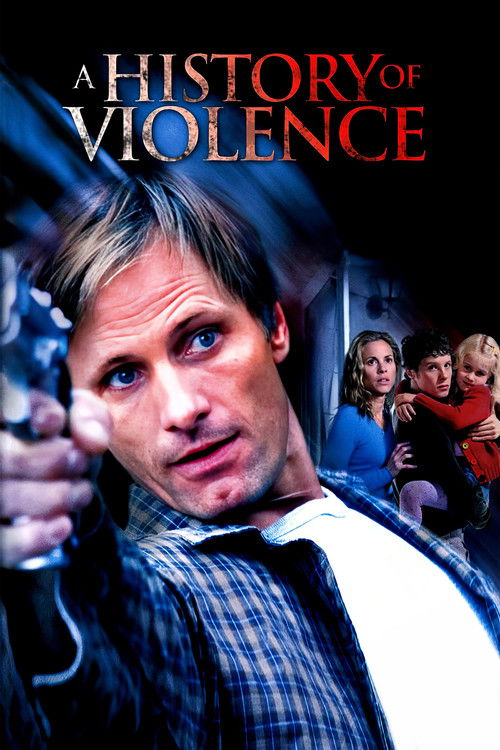
A History of Violence
2005 · David Cronenberg
When you want a film to chew on for days — a tense, adult thriller for a serious movie night, not a comfort watch. Best with someone to argue with afterward.
What it's about
Tom Stall runs a diner in a small Indiana town and lives a placid life with his wife and kids — until two robbers walk in and he kills them both with startling, instinctive efficiency. Local hero status follows, and so do scarred strangers from Philadelphia who insist Tom is someone else entirely. What starts as a thriller about mistaken identity becomes a hard look at a marriage, a family, and what violence does to the people who witness it.
The experience
Lean, coiled, and deeply unsettling — the violence is sudden, brief, and shown with consequences, so each burst leaves a mark on you as well as the characters. It plays like a classic thriller that keeps asking why you're enjoying it.
Performances
Viggo Mortensen does remarkable double-exposure work, letting something unreadable flicker under Tom's gentleness, and Maria Bello matches him as a wife watching her husband become a stranger. Ed Harris and William Hurt make brief roles unforgettable — Hurt earned an Oscar nomination for only a few minutes of screen time.
The craft
David Cronenberg directs with ruthless economy — not a wasted scene in a film well under two hours — and stages the action so cleanly that its ugliness registers fully. Every element, from the too-perfect small-town warmth to the abruptness of the cutting, is calibrated to make you complicit before you notice.
Why it matters
The film that carried Cronenberg from body horror into the mainstream art-thriller conversation, widely cited among the great American films of its decade and a touchstone for how movies interrogate their own violence.
Snapshot
A History of Violence is the film with which David Cronenberg, the Canadian master of "body horror," moved decisively into a mode of taut, classical American storytelling — and, in doing so, produced one of the defining interrogations of violence in twenty-first-century cinema. On its surface it is a lean thriller: Tom Stall (Viggo Mortensen), the mild-mannered owner of a small-town Indiana diner, kills two would-be robbers in an act of startling, instinctive efficiency, becomes a local hero, and is consequently visited by scarred Philadelphia mobsters who insist that the man they are looking at is not Tom Stall at all but Joey Cusack, a killer they have long sought. From this premise Cronenberg builds a film about the violence concealed inside ordinary American life — inside the family, the genre, and the national imagination — and about the impossibility of cleanly separating the good husband and father from the man who can break a throat without hesitation. Adapted from a 1997 graphic novel, premiered in competition at Cannes, and embraced by critics as one of the finest films of its year, it married genre legibility to an austere moral seriousness, and it announced a new, outwardly realist phase in Cronenberg's authorship while remaining, beneath the skin, entirely his.
Industry & production
A History of Violence was a studio production released by New Line Cinema, then at the height of its prestige following the Lord of the Rings trilogy. The project originated not as a Cronenberg passion piece but as an adaptation that came to him through the studio system: the screenplay, by Josh Olson, was based on the graphic novel written by John Wagner and illustrated by Vince Locke, published in 1997 under DC Comics' Paradox Press imprint. Producers included Chris Bender and J.C. Spink, whose company had developed the material. Cronenberg, a director long associated with smaller Canadian-financed and independent productions, here worked within a comparatively conventional Hollywood framework, and the film is often described — including by the director himself — as the closest he had then come to a mainstream American picture.
Despite the American setting and studio backing, the production remained rooted in Cronenberg's home base. The film was shot in Ontario, Canada, with the fictional town of Millbrook, Indiana, and the city of Philadelphia recreated largely in and around Toronto and surrounding locations — a continuation of the director's lifelong practice of working close to home with a tight, familiar crew. The casting was central to the film's gravity: Viggo Mortensen, fresh from the international visibility of the Lord of the Rings films, took the dual role of Tom/Joey in his first collaboration with Cronenberg, beginning one of the most fruitful director-actor partnerships of the period. Maria Bello played his wife Edie; Ed Harris took the role of the disfigured mobster Carl Fogarty; and William Hurt appeared, in a single extended sequence late in the film, as Joey's mob-boss brother Richie. The film carried a modest budget by studio standards, and while precise financial figures are best left to the documented record rather than asserted here, it was understood as a relatively economical production that returned a respectable critical and commercial result, buoyed considerably by its Cannes launch and awards-season profile.
Technology
A History of Violence is a photochemically shot, conventionally produced mid-2000s feature, and it makes a deliberate virtue of technical restraint. Its means are those of classical narrative cinema — 35mm photography, location and constructed sets, practical staging — rather than digital spectacle, and the film's startling violence is achieved through carefully built physical and prosthetic effects rather than digital augmentation. This is significant given Cronenberg's reputation: the director who had once been synonymous with elaborate creature and transformation effects here turns his command of prosthetic gore toward sudden, anatomically explicit wounds — a shattered face, a ruined nose, a throat torn open — rendered with clinical, unglamorized realism. The shock comes not from technological novelty but from the precise, tactile rendering of bodily damage and from editorial control over how briefly and bluntly that damage is shown. Where the record is concerned, there is no indication that the film pursued any unusual technical apparatus, and it would be invention to suggest otherwise; its power is a matter of craft and restraint, not innovation.
Technique
Cinematography
The cinematography is by Peter Suschitzky, Cronenberg's regular director of photography since Dead Ringers (1988), and it is a model of disciplined classicism. Suschitzky shoots Millbrook in a warm, lucid, almost idealized light — the diner, the porch, the schoolyard, the marital bedroom rendered as a Norman Rockwell vision of American small-town wholesomeness — precisely so that the eruptions of violence land as violations of a carefully established pictorial calm. The camera is patient and largely unshowy, favoring stable, well-composed framing and a measured distance that withholds melodramatic emphasis; when violence arrives it is filmed plainly, without stylized slow motion or kinetic flourish, the better to register its abruptness and its cost. The visual register shifts subtly as the film moves from the sunlit Midwest toward the colder, more shadowed spaces of Richie's Philadelphia mansion in the final act, the palette darkening as Tom travels back toward the buried world of Joey. Throughout, Suschitzky's restraint is the point: the film looks reassuringly ordinary, which is exactly what makes its disclosures so disturbing.
Editing
The editing, by Ronald Sanders — like Suschitzky, a decades-long Cronenberg collaborator — is built on economy and control. The film's violence is cut short and hard: the acts are brief, the aftermaths sometimes held longer than the violence itself, so that the audience is made to dwell on consequence rather than thrill. Sanders and Cronenberg are exacting about duration, allowing a struck body or a dead face to remain onscreen a beat past comfort. The film's overall rhythm is deliberate and even austere, building tension through stillness and pause rather than acceleration, and its structure tracks a steady tightening as Tom's denials become less tenable. The cutting also governs the film's two notorious sex scenes — discussed below — staging an arc from playful tenderness to something far more violent and ambivalent, the contrast carried in large part by editorial pacing and juxtaposition.
Mise-en-scène / staging
Cronenberg's staging draws a sustained, deliberate contrast between the iconography of the wholesome American home and the brutality that the film argues is latent within it. Carol Spier's production design — she, too, a long-standing member of Cronenberg's team — gives Millbrook the clean, comfortable surfaces of an idealized heartland: the family diner, the white-frame house, the high-school corridors. Against this, the staging of violence is blunt and bodily, and the film repeatedly places acts of killing within or adjacent to these domestic and communal spaces, collapsing the distance between the safe and the savage. The marital bedroom becomes a site of both eroticism and aggression; the family staircase becomes the stage for the film's most disturbing sexual encounter. The famous wordless final scene — Tom returning to the dinner table, his family deciding without speaking whether to make room for him — is a masterpiece of staging in which everything is carried by blocking, glance, and the passing of food, the camera simply observing as a family silently negotiates whether it can absorb what it now knows.
Sound
The score is by Howard Shore, Cronenberg's composer on nearly all his films and, by 2005, freshly garlanded for the Lord of the Rings trilogy. Shore's music for A History of Violence is restrained and tonally ambiguous, eschewing thriller bombast in favor of a somber, brooding orchestral underscore that lends the film a tragic rather than sensational weight. The music tends to withhold rather than goad, refusing to cue the audience toward easy excitement and instead deepening the sense of moral disquiet. The sound design favors a naturalistic register punctuated by the sudden, percussive ugliness of violence — the wet, concussive impacts deliberately mixed to shock — and the film's frequent silences, especially in its closing sequence, are as expressive as any music could be.
Performance
Performance is the film's bedrock, and Viggo Mortensen's dual-natured turn as Tom Stall is among the most quietly virtuosic of the decade. Mortensen must persuade us simultaneously of Tom's genuine gentleness and of the dormant Joey within, and the film's suspense depends on our inability to read which man we are watching; the actor accomplishes the transformation almost imperceptibly, through shifts in posture, gaze, and the cadence of speech, so that the killer surfaces as a change in the body rather than a change of costume. Maria Bello's Edie carries the film's emotional reckoning — her horror, desire, and grief as she confronts the stranger she married give the domestic drama its charge. Ed Harris invests Carl Fogarty with a patient, scarred menace, and William Hurt, in a brief but indelible appearance as Richie, earned an Academy Award nomination for a performance of oily, fraternal malice compressed into a single sequence. The ensemble, including the children, sustains the film's central proposition that violence is a family inheritance.
Narrative & dramatic mode
The film's dramatic mode is that of the thriller raised to the level of moral and even mythic inquiry. Its narrative engine is concealment and exposure: an ordinary man commits an extraordinary act, is recognized as someone he claims not to be, and is forced — against his will and his family's understanding — to confront a buried identity. Structurally it follows a classic suspense arc, but Cronenberg is uninterested in the thriller's usual pleasures; the question is never really will Tom survive? but who is Tom, and can a person ever truly bury the violence he is capable of? The film operates through a steadily widening crack in a placid surface, and its great structural turn is the confirmation that Tom is indeed Joey Cusack — a revelation handled not as a twist to be savored but as a catastrophe to be lived through, dismantling the family's understanding of itself. The dramatic stakes are domestic and existential rather than merely physical: what is threatened is not only Tom's life but the possibility of an honest marriage, an innocent fatherhood, a redeemable self. The famously silent ending refuses resolution, leaving the audience to sit, like the family, with the unanswerable question of whether the man at the table can be loved knowing what he is.
Genre & cycle
A History of Violence is a thriller that knowingly engages two foundational American genres — the Western and the gangster film — and exposes the violence at their cores. Tom Stall is a homesteader defending his land and family, a figure straight out of the frontier mythology in which righteous violence redeems the community; the film both invokes and interrogates this archetype, asking whether the "good man with violence in him" is a hero or a monster. When the narrative travels to Philadelphia and the world of organized crime, it engages the gangster genre and its mythology of family, loyalty, and the inescapable past. The film thus belongs to a lineage of revisionist genre pictures that use the conventions of American crime and frontier storytelling to examine the nation's romance with redemptive violence. It also participates in the 2000s wave of "serious" graphic-novel adaptations that sought to prove the form capable of adult, literary cinema, standing apart from the superhero cycle by drawing on a crime comic with no fantastical element. Within Cronenberg's filmography, it inaugurates a cycle of outwardly realist crime-and-identity dramas continued most directly by Eastern Promises (2007).
Authorship & method
A History of Violence is unmistakably a David Cronenberg film, despite its departure from the overt body horror of his earlier work. The Cronenbergian signature persists at a deeper level: the film is fundamentally about the body — its capacity for violence, its betrayals, the way identity is housed in and expressed through flesh — and about the instability of the self, the horror of a person who is literally two people. The director's clinical, unsentimental gaze, his refusal of moralizing commentary, and his interest in the eruption of the suppressed all carry directly over from his horror period; the "body horror" has simply migrated from mutation and disease into the realm of physical violence and psychological doubling. Cronenberg's method here is one of austere control and trust in a long-established creative family: cinematographer Peter Suschitzky, composer Howard Shore, editor Ronald Sanders, and production designer Carol Spier had all worked with him for years, and that continuity underwrites the film's disciplined consistency of tone. The screenplay by Josh Olson — Oscar-nominated for Best Adapted Screenplay — supplied a tight, classical structure that Cronenberg directed with deliberate plainness, suppressing flamboyance in favor of moral weight. The result is a film whose authorship lies in restraint: the great horror director making his most controlled, least overtly "horrific" film, and finding the uncanny inside the everyday.
Movement / national cinema
Though set in the American heartland and financed by an American studio, A History of Violence is, in its production reality, a work of Canadian cinema, made in Ontario by Canada's most internationally celebrated director with a predominantly Canadian crew. This outsider's vantage on American myth is arguably essential to the film's perspective: it scrutinizes the United States' foundational love affair with violence with a degree of cool, anthropological distance, neither celebrating nor simply condemning, but observing. Cronenberg belongs to no school but is the towering figure of English-Canadian narrative cinema, and the film extends his career-long preoccupations onto a larger, more international stage. It is best understood as a transnational production — American story and money, Canadian making and sensibility — that uses the gap between the two to interrogate American self-mythology from just outside its borders.
Era / period
The film is set in a deliberately timeless, almost archetypal American present — a small Indiana town that feels lifted out of any specific decade, its diner-and-front-porch iconography evoking an idealized, enduring image of the heartland rather than a datable moment. This abstraction is purposeful: by refusing to anchor Millbrook too firmly in 2005, Cronenberg lets the town stand for an American idea rather than an American year. Yet the film unmistakably belongs to its mid-2000s moment of release. Arriving in a period marked by national debate over violence, security, and the moral justifications for force, it spoke — without ever naming a contemporary referent — to an American culture reckoning with its own relationship to redemptive aggression. Critics at the time readily read the film's interrogation of the "good" killing and the seductiveness of righteous violence against the broader climate of the post-9/11 decade, and while the film makes no explicit political claim, its preoccupation with violence as American inheritance gave it an unmistakable contemporary charge.
Themes
The film's governing theme is the nature of violence itself — its seductiveness, its efficiency, and its inseparability from the people and institutions that disavow it. Cronenberg refuses the comfortable separation of the good man and the violent man, insisting through Tom/Joey that they are one body, and that the capacity for brutal violence does not vanish when a person reforms but only goes dormant. From this flows the film's central concern with identity as performance and concealment: the question of whether a self can be remade, whether the past can be escaped, and whether a name and a new life can truly overwrite who one is. A second major theme is the family as both the thing violence protects and the thing it poisons — the film repeatedly ties violence to sex and to lineage, suggesting that aggression is transmitted within the home and inherited by children, a dread literalized when Tom's son discovers his own capacity for it. The two celebrated sex scenes — the tender, playful encounter early on and the violent, ambivalent struggle on the staircase after Edie learns the truth — chart the entanglement of desire and aggression at the heart of the marriage. Above all, the film advances a critique of the American myth of redemptive violence: the cherished story that good people are licensed to terrible force in defense of home and family, and that such force can be clean. Cronenberg's film argues that it never is, and the wordless final scene leaves the family — and the nation it stands for — to live with the cost.
Reception, canon & influence
A History of Violence premiered in competition at the 2005 Cannes Film Festival and was met with strong critical acclaim, both there and on its subsequent release. Reviewers singled out Cronenberg's controlled direction, Mortensen's dual performance, and the film's refusal of easy moral comfort, and it appeared on a great many critics' year-end best-of lists, frequently near the top; it is widely regarded as one of the finest films of 2005 and a high point of Cronenberg's career. The film received two Academy Award nominations — William Hurt for Best Supporting Actor and Josh Olson for Best Adapted Screenplay — and gathered numerous other critical honors. Its reputation has only grown, and it is now firmly established in the canon of major 2000s American (and Canadian) cinema.
Influences on the film run backward to its immediate source — the John Wagner and Vince Locke graphic novel, from which the film retains the core premise while substantially reworking the comic's more elaborate backstory — and, more deeply, to the American genre traditions it interrogates: the Western's mythology of the violent defender of home, the gangster film's preoccupation with family and the inescapable past, and the long noir lineage of buried identities catching up with reformed men. Cronenberg's own body of work supplies the film's abiding fascination with the body, doubling, and the instability of the self.
Its influence forward is felt first within Cronenberg's own career: the film inaugurated the partnership with Viggo Mortensen that continued through Eastern Promises (2007), in which the pairing again explored violence, identity, and organized crime to even greater acclaim, and A Dangerous Method (2011). More broadly, the film became a benchmark for the serious, adult treatment of violence in popular cinema and a frequently cited model for genre filmmaking that uses thriller mechanics to pursue moral and philosophical inquiry. It helped legitimize the graphic novel as a source for literate, non-fantastical drama, standing apart from the superhero adaptations that would soon dominate. Its closing scene, in particular, has become a touchstone of restrained, unresolved ending-craft. A History of Violence endures as a rare instance of a studio thriller that is also a profound meditation on its subject — and as the film that revealed the great horror director to be, all along, a great moralist of the American imagination.
A Deleuzian reading
The hand moves first.
The full Deleuzian reading of A History of Violence →
Reception
A Cannes competition hit in 2005 that critics adored on arrival — it topped year-end polls and landed two surprise Oscar nominations — and its stature has only grown, now routinely ranked among the best films of the 2000s.
How A History of Violence was received, from release to now →
Influences: the films it descends from and the films it influenced
- Shane (1953) — Supplies the foundational Western template the film revises: the reluctant gunfighter who must reawaken lethal skill to defend a homestead, with the same mythologizing of the violent man as domestic protector that Cronenberg interrogates.
- The Far Country (1954) — Anthony Mann's pacifist-turned-killer Westerns model the concealed-violent-past structure, where a man's refusal to fight is exposed as suppression of a brutal competence that the plot forces back into the open.
- A Fistful of Dollars (1964) — Establishes the laconic stranger whose violence erupts in sudden, clinically efficient bursts after long stillness — the rhythm of restraint-then-explosion that governs Mortensen's diner shootout.
- The Godfather (1972) — Provides the gangster-film grammar of family-table domesticity intercut with brutality and the inescapable pull of a criminal past, the juxtaposition Cronenberg compresses into Tom Stall's two lives.
- Straw Dogs (1971) — Pioneers the home-invasion siege in which a mild man discovers his own capacity for savagery, staging domestic space as the arena where suppressed violence is unleashed and the protective and the monstrous become indistinguishable.
- The Searchers (1956) — Models the doubled hero whose competence at violence makes him unfit for the home he protects, and the closing image of a man framed apart from the family he has saved — the visual logic of the wordless dinner-table finale.
- Blue Velvet (1986) — Establishes the small-town American surface concealing predatory violence beneath, the uncanny-in-the-everyday that Cronenberg adopts for Millbrook's diner-and-porch idyll.
- The History of Violence comic (1997) — The source graphic novel by Wagner and Vince Locke supplies the core premise of a small-town diner owner whose heroic act exposes a buried gangland identity, which Olson's screenplay strips of its elaborate backstory.
- Road to Perdition (2002) — Proves the same counter-model: a graphic novel rendered as somber, restrained adult drama about a father's hidden damnation rather than comic-book spectacle.
- Bad Day at Black Rock (1955) — Modern-dress reworking in which a buried past surfaces to shatter a quiet community, built on a banked-stillness lead performance masking latent violence exactly as Tracy masks his mission.
- Eastern Promises (2007) — Directly extends the Cronenberg–Mortensen partnership and method: the clinically staged, anatomically explicit violence (the bathhouse knife fight) and the man living under a concealed identity inside organized crime.
- Drive (2011) — Extends the laconic protagonist whose stillness erupts into sudden graphic brutality, pairing a near-wordless lead with percussive, shocking violence framed as the eruption of a concealed self.
- A Most Violent Year (2014) — Inherits the model of a man straining to suppress a violent past beneath a respectable domestic-and-business surface, using thriller mechanics for moral inquiry rather than spectacle.
- You Were Never Really Here (2017) — Carries forward the use of percussive, fragmentary violence-mixing and a near-silent damaged protagonist whose body is the instrument and archive of past brutality.
- Logan (2017) — Extends the graphic-novel-to-serious-drama lineage and the aging violent man as reluctant domestic protector, explicitly invoking Shane to frame brutal action as Western moral reckoning.
- Nobody (2021) — The prestige template for a suburban family man whose hidden violent past erupts into domestic space; Cronenberg established the casting logic of using an unlikely physical type to make competence revelation function as character transformation rather than genre convention.
- The Equalizer (2014) — Built the calm-versus-rupture rhythm of a placid domestic surface shattered by sudden expert lethality — the mild man revealed as a master of violence.
- Videodrome (1983) — Cronenberg's own template for the body as the site where identity destabilizes and violence is literally embodied — the body-horror obsession here migrated from mutating flesh into the violent reflexes housed in Tom Stall's hands.
- Dead Ringers (1988) — Cronenberg's defining study of doubled identity and a single actor splitting into two selves, the psychological doubling that resurfaces as Tom Stall / Joey Cusack.
- No Country for Old Men (2007) — Shares the revisionist-Western treatment of violence as sudden, matter-of-fact and morally unredeemed, with restrained sound design and a refusal of cathartic resolution that mirrors the film's withheld ending.
- The Proposition (2005) — A contemporaneous revisionist Western that, like Cronenberg's film, stages violence with unsentimental clinical weight to interrogate the myth of the redemptive killer rather than celebrate it.
- Unbreakable (2000) — Cronenberg sustains the syntax of a small-town domestic drama past any conventional genre announcement, then reveals that the ordinary male protagonist's identity is built on concealed extraordinary violent capacity — the same withheld genre declaration and moral-reframing structure that Unbreakable executes across its superhero premise.
- Mystic River (2003) — Contemporary interrogation of vigilante violence and buried past identity, using restrained naturalistic staging and sudden eruptions of grief/violence as moral reckoning, paralleling Eastwood's revisionist project.
- V for Vendetta (2006) — A same-era serious-cinema graphic-novel adaptation that legitimized adult comic sources as a vehicle for grown-up dramatic argument, V's exact project in a genre register.
- Asuran (2019) — Built on the dramatic irony of a mild family man whose concealed capacity for violence surfaces through delayed disclosure, mirroring Asuran's meek-father / buried-past reveal structure.
Similar films
- Eastern Promises (2007) — influence & lineage
- Dead Ringers (1988) — influence & lineage
- No Country for Old Men (2007) — influence & lineage
- Blue Velvet (1986) — influence & lineage
- The Godfather (1972) — influence & lineage
- Videodrome (1983) — influence & lineage · often watched together
- The Searchers (1956) — influence & lineage · often watched together
- Shutter Island (2010) — often watched together
All the films related to A History of Violence →