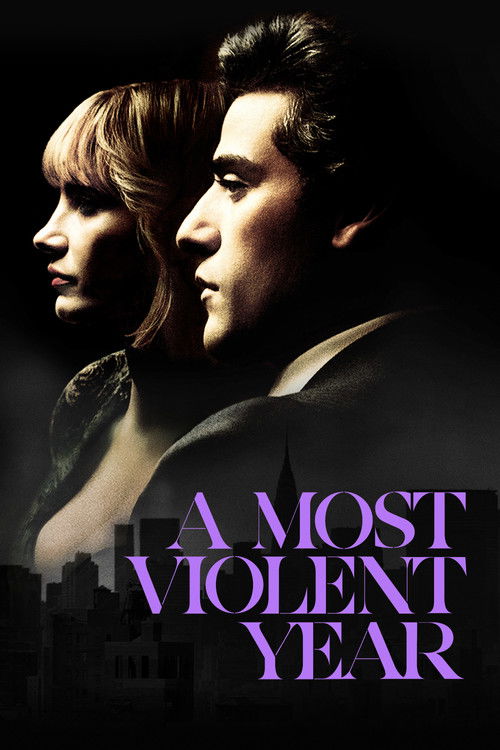
A Most Violent Year
2014 · J.C. Chandor
For a serious, grown-up evening when you want a crime story that's about character and pressure, not body count — something to sink into and mull over. A challenge in the best sense, not a comfort watch.
What it's about
New York, winter 1981 — statistically one of the most violent years in the city's history. Abel Morales, an immigrant who built a heating-oil business from nothing, is thirty days from closing the real-estate deal that would transform his company. But his trucks keep getting hijacked, a district attorney is combing his books, and his wife Anna — his bookkeeper, and a gangster's daughter — keeps telling him there are faster ways to handle this.
The experience
A slow-tightening vise rather than a shoot-out — the tension comes from watching a disciplined man hold his principles while everything around him invites him to let go. Cold, controlled, and quietly gripping, with a couple of bursts of action that land harder for being so rare.
Performances
Oscar Isaac gives Abel a coiled, almost courtly restraint — a man performing respectability so hard it becomes his armor — while Jessica Chastain's Anna cuts through every scene she's in with ice-blooded pragmatism. Their marriage is the film's real battleground.
The craft
Chandor shoots the winter city in muted golds and grays, all camel coats and freezing dawn light, and paces the film like a chess game where every move costs something. The craft is in the withholding: it looks and moves like a classic New York crime epic while refusing to deliver the genre's usual gratifications.
Why it matters
It cemented Chandor's reputation as a filmmaker of moral pressure-cookers and gave Isaac and Chastain two of their defining roles — a modern crime drama people cite when they talk about ambition and compromise in the American dream.
Snapshot
A Most Violent Year is J.C. Chandor's third feature, a crime drama that withholds almost all of the violence its title promises. Set in New York City over the winter of 1981 — flagged in an opening title as statistically among the most violent years in the city's recorded history — the film follows Abel Morales (Oscar Isaac), an ambitious immigrant who runs a heating-oil distribution company and is trying to close a transformative real-estate deal even as his trucks are hijacked, a district attorney circles his books, and his wife Anna (Jessica Chastain), the bookkeeper and a gangster's daughter, urges him toward harder measures. The picture's distinctive gambit is moral and tonal rather than sensational: it is a gangster film about a man straining not to become a gangster, a study of how legitimate enterprise and criminal enterprise rhyme. Praised for its controlled craft, its dusk-toned cinematography, and its lead performances, it was named Best Film of 2014 by the National Board of Review, even as it drew a narrower audience than its critical standing suggested.
Industry & production
The film was produced through Chandor's working orbit of independent financiers and partners, with Before the Door Pictures — the company founded by Zachary Quinto, Neal Dodson, and Corey Moosa, who had backed Chandor's Margin Call — central to its making. It was released in the United States by A24, the young distributor then rapidly building a reputation for director-driven films, with a year-end awards-qualifying release on December 31, 2014, before a wider 2015 expansion. The budget is generally reported in the low-eight-figure range, modest for a period production requiring extensive 1981 New York dressing; I would not assert a precise figure or box-office total, as the publicly cited numbers vary and the film's commercial performance was middling rather than headline-making.
The casting history is worth noting with care. Chandor wrote and developed the project over several years, and the record indicates Javier Bardem was attached to the lead at an earlier stage before the role went to Oscar Isaac; readers should treat the details of that transition as the kind of development-stage history that is reported but not exhaustively documented. What is firmer is that Chandor built the finished film tightly around Isaac, whom he had not previously directed, and around Chastain, with whom the production assembled a deep supporting bench — Albert Brooks as Abel's lawyer Andrew Walsh, David Oyelowo as the investigating district attorney, Alessandro Nivola as a rival operator, and Elyes Gabel as Julian, the immigrant driver whose hijacking ordeal becomes the film's moral fulcrum.
Technology
A Most Violent Year is not a technologically experimental film; its interest lies in restraint rather than novelty. The defining choice is photographic: a commitment to low light levels, practical and motivated sources, and a muted, period-correct palette that pushes the image toward the threshold of legibility in night and interior scenes. I will not state the capture format with false confidence — accounts of whether key sequences were shot on film stock or on a digital cinema camera should be verified against a technical source rather than asserted here — but the on-screen result is a deliberately grain-inflected, desaturated look that evokes 1970s photochemical cinema regardless of the underlying tools. Production design and costume did the heavier "period technology" work: the era's heating-oil trucks, rotary phones, the textures of outer-borough industrial New York, and the tailored camel-hair silhouette that became the film's signature image.
Technique
Cinematography
The cinematography, by Bradford Young, is the film's most celebrated formal element and arrived in the same year as his work on Ava DuVernay's Selma, a pairing that marked his emergence as a major American cinematographer. Young's approach here is built on underexposure and a brown-gray-amber palette: skies the color of dirty snow, interiors lit as if by a single failing bulb, faces frequently turned into shadow or silhouette. The camera favors patient, composed framing and slow moves over coverage, and the city is rendered as a landscape of waste ground, tunnels, and frozen waterfront. The look is both expressive and thematic — it visualizes a world in decay and a protagonist trying to keep his footing on terrain that will not hold light. Several set pieces (a foot chase, a tense confrontation on a bridge) draw their force from how little the image gives the viewer.
Editing
Ron Patane edited the film, and the cutting matches Chandor's preference for sustained tension over kinetic montage. Scenes are allowed to run, dialogue exchanges play in measured rhythms, and the few action sequences are constructed for dread and disorientation rather than adrenaline. The editing's discipline is in restraint: it trusts performance and duration, and it withholds release, so that the audience shares Abel's sense of a noose tightening slowly. The structure tracks a ticking-clock business deadline against a thriller's mounting external pressures, and the editorial pacing keeps both lines taut without resorting to conventional thriller acceleration.
Mise-en-scène / staging
The staging is among the film's quiet achievements. Spaces are blocked to express power and vulnerability — Abel's unfinished waterfront property, the modernist suburban home that signals his arrival, the wood-paneled rooms where deals and threats are exchanged. Chandor stages confrontation through proximity and stillness rather than movement; characters hold ground, and the geometry of who stands where carries the drama. The period dressing is detailed but not fetishized, integrated into the action rather than displayed. The recurring motif of the camel coat functions as costume-as-staging: Abel's deliberate, controlled self-presentation made material.
Sound
Alex Ebert's score is spare and atmospheric, favoring low, ambient textures over melodic statement — a continuation of the mood-driven scoring he brought to Chandor's All Is Lost. The sound design leans on the cold acoustics of the city: traffic, machinery, the report of a gunshot made shocking by its rarity. Because the film so rigorously suppresses overt violence, the sonic punctuation of the few violent moments lands hard, and silence is used as an instrument of suspense.
Performance
Performance is where the film concentrates its energy. Oscar Isaac plays Abel as a study in willed composure — a man performing legitimacy so completely that we cannot always tell where the performance ends, his voice and bearing frequently noted as evoking a young Al Pacino without tipping into imitation. Jessica Chastain's Anna supplies the film's volatility and its moral counter-argument; she is the daughter who never forgot where the money comes from, and Chastain plays her as both glamorous and dangerous, the spouse who would do what Abel will not. Albert Brooks, nearly unrecognizable, brings weary pragmatism as the lawyer; David Oyelowo lends institutional pressure as the DA; and Elyes Gabel grounds the film's conscience as the traumatized driver. The ensemble's restraint is consistent with the direction: these are people managing themselves under pressure.
Narrative & dramatic mode
The film's dramatic mode is the deal-under-threat — a business thriller crossed with a moral fable. Its engine is a thirty-day window in which Abel must complete payment on a property purchase or lose his deposit and his future, while hijackings bleed his company, a competitor maneuvers against him, and a criminal investigation threatens to seize his assets. The mode is realist and procedural: meetings, ledgers, loans, and negotiations carry as much weight as the chases. Crucially, the narrative repeatedly stages the choice between legal and illegal solutions and lets Abel's insistence on the "right" path read as both principle and self-interest, since legitimacy is itself a competitive advantage. The drama is internalized — the central conflict is whether a man can hold a line he has drawn for himself when everyone around him, including his wife, has stopped believing in it.
Genre & cycle
A Most Violent Year belongs to the American crime-and-corruption tradition while pointedly inverting its conventions. It is a gangster film organized around the refusal of gangsterism — closer to the genre's moral undertow than to its violence. It sits within a recurrent cycle of immigrant-capitalism narratives in which the pursuit of the American dream and the mechanics of organized crime become indistinguishable, and within the New York period-crime film as a recognizable subgenre. Its closest generic kin are the morally serious crime dramas of 1970s New York rather than the action-forward crime films of its own decade; it reads as a deliberate revival and revision of that earlier model.
Authorship & method
J.C. Chandor wrote and directed, and the film completes an unusually varied early trilogy: Margin Call (2011), an ensemble talk-piece about the financial crisis; All Is Lost (2013), a near-wordless survival film with Robert Redford; and A Most Violent Year, a dialogue-driven period crime drama. Across these, Chandor's signature is an interest in competent people making consequential decisions under pressure — the procedural texture of work, money, and risk. His method here is writerly and actor-centered: dense, naturalistic dialogue; an emphasis on behavior over exposition; and a refusal of genre payoff.
His key collaborators shape the result decisively. Cinematographer Bradford Young supplies the film's visual identity, his underexposed, painterly style as authorial as the script. Composer Alex Ebert — the musician known from Edward Sharpe and the Magnetic Zeros, and a returning collaborator from All Is Lost — provides an ambient sonic mood that resists conventional thriller scoring. Editor Ron Patane sustains the film's slow-burn rhythm. The production and costume teams render 1981 New York with a tactile, lived-in specificity, and the camel coat became a much-discussed emblem of the design's expressive precision.
Movement / national cinema
This is American independent filmmaking of the early-2010s art-house ascendancy, made and distributed within the ecosystem — A24, director-driven financing, festival-and-awards positioning — that defined prestige indie cinema of the period. It is not affiliated with a formal movement, but it is legibly in conversation with the New Hollywood of the 1970s, treating that era's New York crime cinema as both subject and stylistic model. It is a thoroughly New York film, rooted in the city's geography and its mythology of striving and corruption.
Era / period
The film is doubly situated in time. Its diegetic period is the winter of 1981, and it is unusually serious about that setting: the urban decay, fiscal exhaustion, and crime statistics of early-1980s New York are not backdrop but pressure, the environment that makes Abel's predicament plausible. Its production era — the mid-2010s — shapes its sensibility too: a moment when American independent cinema was returning, with revisionist intent, to the textures and moral seriousness of 1970s filmmaking. The film reads as a 2014 work consciously dressed as a lost film of 1981, and the gap between those two moments is part of its meaning.
Themes
The governing theme is the porous boundary between legitimate business and crime — the proposition that capitalism and racketeering share a grammar of leverage, protection, and the will to win. Abel's repeated insistence that he takes "the path that is most right" is the film's central irony, since rightness and advantage keep converging. Related themes braid through: the immigrant's bargain with American self-invention; the performance of respectability as both armor and ambition; masculinity defined by composure and control; marriage as a partnership of differing moral nerve, with Anna willing to cross lines Abel guards; and the corrosive ambient violence of a place and time, felt less as spectacle than as a constant pressure on every choice. The film's quiet thesis is that survival at this level requires a kind of complicity one can never fully disavow.
Reception, canon & influence
Critically, A Most Violent Year was well received, admired in particular for Bradford Young's cinematography, for Chandor's controlled direction, and for the Isaac–Chastain performances; the National Board of Review named it the Best Film of 2014 and honored its leads, a notable endorsement for a relatively small picture. Its awards-season profile nonetheless remained modest relative to that early acclaim, and it did not become a major box-office success — the precise figures should be checked against a reliable source rather than taken on assertion.
Its influences run backward to the New York crime cinema of the 1970s — the morally complex, institutionally minded films associated with Sidney Lumet, and the immigrant-capitalism arc of the Godfather films — as well as to the broader tradition of the American gangster picture whose conventions it inverts. The frequent comparison of Isaac's Abel to Pacino is itself an index of that lineage. Looking forward, the film's most durable legacy is arguably its consolidation of Oscar Isaac as a leading actor and, especially, its showcase for Bradford Young, whose low-light aesthetic here and in Selma helped define a strain of contemporary American cinematography and led to his work on Arrival and beyond. As an authored object it also cemented Chandor's reputation for genre-serious, craft-forward filmmaking. Its influence is felt less in direct imitation than in the continued vitality of the slow-burn, morally ambiguous crime drama and in the broader 2010s reclamation of 1970s style. Its standing today is that of a respected, somewhat underseen film — a critic's and cinephile's picture more than a popular touchstone.
A Deleuzian reading
The camel-hair coat is the first thing the film teaches you to read.
The full Deleuzian reading of A Most Violent Year →
Reception
Named Best Film of 2014 by the National Board of Review, then infamously shut out of the Oscars entirely — and it's been climbing ever since, now a fixture of 'most underrated of the 2010s' lists.
How A Most Violent Year was received, from release to now →
Influences: the films it descends from and the films it influenced
- The Godfather Part II (1974) — Supplies the immigrant-capitalism-as-tragedy arc and the dim, amber-lit interior compositions where consequential family-business decisions are made in near-shadow — the underexposed restraint Young and Chandor inherit wholesale.
- The Godfather (1972) — Establishes the legitimate-businessman-front gangster grammar and Pacino's willed-composure-under-threat performance mode that Isaac's Abel directly echoes and inverts by refusing the slide into violence.
- Prince of the City (1981) — Models the institutionally-minded, morally-compromised New York procedural — long scenes of negotiation, lawyers, and deals under threat rendered as the real drama rather than the crime itself.
- Dog Day Afternoon (1975) — Lumet's behavior-over-exposition, sweaty-realist New York staging where ordinary transactions curdle into menace, the naturalistic-dialogue procedural texture Chandor adopts.
- Serpico (1973) — The lone principled man holding his composure against systemic corruption, shot in grimy period New York exteriors — the moral-isolation framing and location realism Chandor revives for 1981.
- The Conversation (1974) — Pioneers the suppressed-violence, ambient-dread sound design and watchful stillness — quiet that signals threat — that Chandor and Alex Ebert's non-thriller score extend.
- American Gangster (2007) — Reframes the gangster as a meticulous capitalist entrepreneur in 1970s New York, the businessman-criminal-as-American-striver template that A Most Violent Year inverts toward legitimacy.
- Margin Call (2011) — Chandor's own template: competent people making consequential financial decisions under time pressure, dense naturalistic dialogue and procedural texture standing in for conventional thriller mechanics.
- There Will Be Blood (2007) — The portrait of American enterprise as moral combat, where a striver's controlled exterior masks ruthless ambition — the capitalism-as-character study that underwrites Abel's quiet menace.
- Donnie Brasco (1997) — Demythologized crime-adjacent world, desaturated winter palette, durational accumulation, behavioral restraint across performance, slow erosion of ethical identity without voiceover editorializing — extends Donnie Brasco's formal grammar into a corporate crime register.
- A History of Violence (2005) — Inherits the model of a man straining to suppress a violent past beneath a respectable domestic-and-business surface, using thriller mechanics for moral inquiry rather than spectacle.
- Little Odessa (1994) — Bradford Young's desaturated, source-lit outer-borough New York and Chandor's insistence on classical tragic gravity over genre pleasure continue Gray's argument that the American crime film can behave as though Visconti were still available.
- Arrival (2016) — Carries Young's low-light, muted-palette painterliness — proven on A Most Violent Year — into prestige studio work, the underexposed aesthetic migrating from period crime to science fiction.
- The Yards (2000) — Gray's hushed, brown-palette New York crime-family drama built on proximity, stillness, and institutional rot — the same restrained, desaturated period-crime register without genre payoff.
- We Own the Night (2007) — Shares the underexposed period New York nightscapes and a protagonist torn between legitimate ambition and a criminal milieu, staged through quiet familial confrontation rather than spectacle.
- Killing Them Softly (2012) — An inverted-gangster picture that reads organized crime as recession-era capitalism, deflating genre violence into procedural transaction — the same anti-payoff, money-as-subject crime drama.
- All Is Lost (2013) — Reunites Chandor with composer Alex Ebert, whose ambient, non-diegetic sonic mood — refusing cue-driven thriller scoring — carries directly into A Most Violent Year's suppressed tension.
- Ain't Them Bodies Saints (2013) — Bradford Young's other 2013 showcase: the same painterly underexposure, golden-hour and lamp-lit low-key imagery that defines his authorial low-light aesthetic seen here.
- Pariah (2011) — Young's earlier work establishing his signature of rendering dark skin in deep underexposure with saturated, shadow-rich color — the cinematographic method he brings to Abel's world.
- Selma (2014) — Young's concurrent 2014 cinematography that, alongside this film, consolidated his desaturated, naturally-lit-toward-darkness period look as a defining strain of contemporary American imagery.
- A Prophet (2009) — A slow-burn, procedural rise-through-crime study built on willed composure and behavioral observation rather than set-piece violence, sharing the institutional-realist crime grammar.
- The Funeral (1996) — Period crime drama that suppresses action-spectacle in favor of moral inevitability and restrained low-key interiors, extending the anti-gangster, theology-of-compromise approach.
Similar films
- Margin Call (2011) — influence & lineage
- Killing Them Softly (2012) — influence & lineage
- No Country for Old Men (2007) — shared sensibility
- The Brutalist (2024) — shared sensibility
- Revanche (2008) — shared sensibility
- Molly's Game (2017) — shared sensibility
- The American (2010) — shared sensibility
- The Order (2024) — shared sensibility