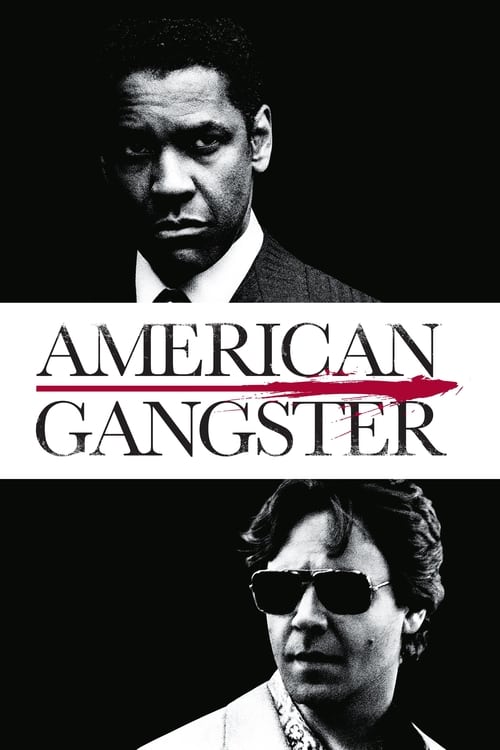
American Gangster
2007 · Ridley Scott
As famous now for press-tour belligerence ("go f— yourself" to historical accuracy critics of Napoleon) as for the films; Gladiator II's "are you not entertained" marketing and shark-in-the-Colosseum discourse kept him meme-central in his late 80s. The industry's most quotable octogenarian.
For a long, meaty Sunday-evening watch when you want a serious crime saga with weight and period texture — something to sink into, not snack on.
What it's about
In Vietnam-era Harlem, Frank Lucas builds a heroin empire by cutting out the Mafia middlemen and smuggling product home on American military planes — running crime like a Fortune 500 company. Across the river, rumpled Newark detective Richie Roberts, whose honesty has made him a pariah in his own department, slowly assembles the task force that will collide with him.
The experience
A patient, densely textured epic that trades gangster-movie fireworks for the steady pull of watching two methodical men work toward each other. It's absorbing rather than thrilling — you settle in, and two and a half hours evaporate.
Performances
Denzel Washington plays Lucas with terrifying calm, a businessman whose violence arrives without warning, and Russell Crowe matches him as a cop whose integrity costs him everything else. Two of the era's biggest stars, mostly kept apart, each carrying half the film.
The craft
Ridley Scott recreates 1970s Harlem and Newark with immersive, unglamorous detail, treating the drug trade as supply-chain logistics rather than opera. The dual-track structure — empire on one side, investigation on the other — is handled with unusual discipline.
Why it matters
It stands as one of the last big-canvas studio crime epics, cementing the Washington–Scott partnership and adding Frank Lucas to the pantheon of American screen gangsters.
Snapshot
Ridley Scott's American Gangster is a crime epic structured as a diptych: on one side, the methodical rise of Frank Lucas (Denzel Washington), a Harlem drug lord who bypassed the Mafia supply chain by sourcing heroin directly from Southeast Asia and smuggling it home inside the coffins of American servicemen; on the other, the plodding, unglamorous persistence of Richie Roberts (Russell Crowe), a Newark detective building a federal narcotics task force while his personal life disintegrates. The film refuses the cathartic operatics of the genre it inhabits, presenting crime not as tragedy but as enterprise — and law enforcement not as heroism but as institutional housekeeping. At 157 minutes in its theatrical cut (an extended cut runs to 176), it is an imposing, densely textured work, the product of a British director's cold-eyed survey of American mythology.
Industry & production
The project originated in Mark Jacobson's 2000 New York Magazine article "The Return of Superfly," a long-form profile of Frank Lucas that reintroduced the gangster to the public after decades of semi-obscurity. Brian Grazer acquired the rights and developed the material at Universal Pictures with director Antoine Fuqua attached and Denzel Washington committed to the lead role. Fuqua eventually departed over creative disagreements, and Scott was brought in — an unusual choice given that his résumé ran toward Roman epics, science fiction, and military procedurals rather than American crime drama. His interest appeared to lie precisely in the outsider's remove: the story of Lucas as a business story, a case study in vertical integration and brand management.
Steven Zaillian (whose screenplay credits include Schindler's List, Searching for Bobby Fischer, and Gangs of New York) wrote the final shooting script, constructing the parallel narrative structure that alternates between Lucas and Roberts across roughly a decade (1968–1975). Zaillian's draft reportedly went through significant revision, and both Frank Lucas and Richie Roberts served as consultants on the production, which introduced its own complications: both men had strong, and occasionally contradictory, views on how events unfolded. After release, Lucas in particular publicly disputed certain details of the script and was vocal about aspects he considered unflattering or inaccurate to his memory.
Principal photography took place in New York and New Jersey, with Harlem locations central to the production's visual authenticity. The period recreation of 1970s Harlem required extensive collaboration between Scott and longtime production designer Arthur Max, who had worked with him on Gladiator, Black Hawk Down, and Kingdom of Heaven. Costume designer Janty Yates — another Scott regular — dressed Washington in a wardrobe that walked the line between understated wealth and calculated visibility, a tension the script makes thematically explicit.
Technology
American Gangster was shot on 35mm film by cinematographer Harris Savides, working in Super 35 format. Savides, whose career had been built largely in independent cinema and music video work (his collaborations with Gus Van Sant on Elephant and Last Days, and with David Fincher on The Game and Zodiac, had established him as one of the more distinctive cameramen of his generation), brought a naturalistic, available-light orientation to a studio production of considerable scale. He resisted the conventions of period pastiche — the sepia warmth and soft gauze that typically signal "the Seventies" — in favor of a cooler, more surveillance-like register. The visual grammar thus carries an ideological charge: this is the decade not as nostalgia but as document.
For the extended cut released on home video, the film's running time expanded by approximately nineteen minutes, restoring scenes that deepened the Roberts subplot and clarified certain narrative transitions. Scott's regular work in extended and director's-cut formats — a practice begun with Blade Runner and continued through Kingdom of Heaven — makes the theatrical/extended distinction a standard feature of his releases rather than an exceptional revision.
Technique
Cinematography
Savides constructed the film's visual world around a fundamental chromatic opposition: the chic warmth of Lucas's penthouse existence — fur coats, amber light, the ordered luxury of self-made wealth — set against the institutional gray and street-level ambient cold of Roberts's world. His preference for practical sources meant that interiors feel genuinely inhabited rather than art-directed, and his handling of Harlem street scenes invokes the observational quality of the early-Seventies films the script consciously references without slavishly imitating their visual grammar. The effect is a period film that looks at its era rather than through a loving recreation of it. Savides died in 2012 at 55, and American Gangster stands among the defining achievements of his later career.
Editing
Pietro Scalia, who had edited Black Hawk Down and Gladiator for Scott, cut American Gangster, and the film's discipline belongs substantially to him. The parallel structure Zaillian built into the script requires the editor to calibrate a long-form rhythm: neither strand can dominate long enough to allow the other to feel like an interruption. Scalia maintains this balance largely through tonal contrast — cutting to Roberts when the Lucas sequences reach a moment of satisfaction, and away from Roberts when his procedural grind risks monotony. The film's extended cut reveals how much material was held back to keep this equilibrium, and some critics found the restored scenes enriched the Roberts strand in ways the theatrical version had underprioritized.
Mise-en-scène / staging
Scott is a director whose reputation rests on the organization of visual information in space, and American Gangster is full of carefully blocked scenes that function as moral tableaux. The most discussed is the Thanksgiving dinner sequence, in which Lucas presides over a long table of family and associates — the gangster as patriarch, crime rendered domestic and ordinary. Counterpointed against this is the fur coat scene: Lucas, who preaches invisibility as operational discipline and dresses in conservative suits to avoid Mafia surveillance, appears at a prize fight in a conspicuous mink coat purchased by his wife, and in that single violation of his own rule, destroys the anonymity he has spent years constructing. Scott stages the moment not as melodrama but as almost comic irony — the camera finding the agents who register what they are seeing before Lucas himself seems to realize what he has done. These scenes reflect a directorial interest less in kinetic violence (the film contains it but never fetishizes it) than in the theater of power.
Sound
Marc Streitenfeld, who had worked as a music editor on several Scott productions before American Gangster served as his breakthrough as a lead composer, produced a score that sits at some distance from both blaxploitation funk and conventional crime-film tension-building. The music is restrained, often minimal, underlining emotional beats rather than announcing them. The film's use of period source music — soul, funk, and early hip-hop antecedents from the late Sixties and early Seventies — does more atmospheric work than the score in many sequences, locating the story in a Harlem world the narrative sometimes risks aestheticizing and the music periodically corrects.
Performance
Washington's performance operates almost entirely in the register of withholding. Frank Lucas in his rendering is not the volcanic, expressive capo of the genre tradition but something colder: a manager, a logistician, a man who has calculated that emotion is a liability. The violence he commits (and there are eruptions, sudden and decisive) reads as policy rather than passion. It is a controlled, technically precise performance that depends on Washington's physical authority and the audience's awareness of his image to carry moral weight that the screenplay distributes carefully. Russell Crowe's Roberts is more conventionally disheveled — the good cop with a bad divorce — but Crowe finds specificity in the character's almost cussed integrity. Ruby Dee, in the small role of Lucas's mother, received an Academy Award nomination for Best Supporting Actress; her scenes are brief but tonally crucial, lending the Lucas family sections a human texture that counterpoints the violence surrounding them. Josh Brolin's corrupt detective Trupo, though a supporting role, anchors the film's argument about institutional rot — the drug trade could not have operated without protection, and his performance makes that systemic point visceral.
Narrative & dramatic mode
The film operates in the mode of the procedural epic, a form that subordinates incident to accumulation — the slow assembly of evidence, of capital, of reputation. Unlike the rise-and-fall tragedy of the Scarface lineage, American Gangster distributes its tragedy laterally: the falls are not spectacular but deflating, the consequence of small errors and the limits of cunning. Neither Lucas nor Roberts is given to self-reflection or soliloquy; the film's interiority is rendered through action and juxtaposition rather than disclosure. Zaillian's screenplay structures the two narratives as an asymptotic approach — the men do not appear on screen together until very late in the film, their eventual meeting carrying the formal satisfaction of a convergence that has been formally prepared throughout.
Genre & cycle
American Gangster sits within the crime biopic cycle that surged in American cinema from the mid-1990s through the 2000s — a cycle that included Donnie Brasco (1997), Blow (2001), Catch Me If You Can (2002), and Zodiac (2007) — each attempting to import literary-journalistic ambition into genre cinema. More specifically, it participates in a strand concerned with Black organized crime, linking it historically to New Jack City (1991) and Paid in Full (2002), and engaging, with some complexity, with the blaxploitation films of the early Seventies that had mythologized figures like "Superfly" and Shaft. The film's visual and dramatic register conspicuously declines the glamour those films offered, presenting the drug trade in Harlem as an occupying force on a community, not a fantasy of liberation from it.
Authorship & method
Ridley Scott's authorship in the classical sense is a contested proposition. His output is eclectic to the point of apparent incoherence — Alien (1979), Blade Runner (1982), Thelma & Louise (1991), Gladiator (2000), American Gangster (2007) — yet certain preoccupations recur: the individual against institutional or systemic power; masculine identity under extreme pressure; the aesthetics of a particular environment as moral argument. His method is that of the producer-director: high production value, dense visual information, strong reliance on trusted collaborators. Savides's naturalism is in some tension with Scott's usual appetite for stylistic abundance, and this tension produces the film's particular texture — period richness held in check by observational restraint. Zaillian's screenplay gave him unusually dense structural architecture to work with; Scott's contribution is less the story than the organization of attention within scenes.
Movement / national cinema
American Gangster is an American crime film made by a British director, a fact that is not incidental. Scott's relationship to American mythology is that of the informed outsider — appreciative, fluent in its grammar, but not native to it. The film's treatment of the American Dream through Frank Lucas's career has the quality of analysis rather than celebration or elegy: Lucas is presented as an entrepreneur who understood his market, managed his supply chain, and enforced quality control, with the drug trade as the only sector open to a Black man of his abilities in the America of 1968. This is not Scott's argument alone — it is built into Jacobson's original article and Zaillian's script — but Scott's visual language, precise and unsentimental, is well-suited to its delivery.
Era / period
The film was released in November 2007, at the peak of a moment in American studio cinema when the crime drama was being repositioned as the prestige genre — absorbing talent and ambition previously directed toward literary adaptations. The 2006–2008 period produced The Departed (2006), No Country for Old Men (2007), There Will Be Blood (2007), and Michael Clayton (2007) within roughly eighteen months, a concentration of morally complex genre filmmaking that in retrospect marks a specific cultural mood in post-Iraq, pre-financial-crisis America: a preoccupation with systems, corruption, and the cost of American enterprise. American Gangster belongs to this constellation, though its commercial orientation and genre legibility placed it at the more accessible end of the spectrum.
Themes
The film's organizing metaphor is the brand. Frank Lucas names his heroin "Blue Magic," cuts it less than his competitors, sells it for a lower price, and builds market share through product quality — the language of the screenplay is consistently entrepreneurial. This is not satirical but analytical: the film argues that capitalism and the drug trade share not just vocabulary but structure, and that Lucas's success exposed the pretense of a system that promised Black Americans access to the American Dream while systematically excluding them from legitimate enterprise. Corruption runs through both sides of the law: the Italian-American mob Lucas disrupts, the police department that protects the trade, and the Vietnam War that provides both the supply route and the customer base — soldiers returning addicted. Roberts's incorruptibility is presented as almost a pathology, aberrant in a system designed around accommodation.
Reception, canon & influence
The film received strong reviews on release, with particular praise directed at Washington's performance and the dual-structure screenplay. Critical reservations centered on its length and a perceived conventionality in the Roberts strand, which some reviewers found less vividly imagined than the Lucas material. The film was commercially successful, one of the stronger-performing prestige crime films of its year, though specific box-office figures should be verified against authoritative sources rather than cited from memory. At the Academy Awards, Ruby Dee received a Best Supporting Actress nomination, and the film was recognized in the Costume Design category.
Backward — the film consciously inherits from The Godfather (1972), whose parallel editing structure and treatment of crime as family business it adapts for a Harlem context; from the blaxploitation films of the early Seventies, particularly Superfly (1972), which it both cites and critiques; from William Friedkin's The French Connection (1971) in its procedural texture; and from Michael Mann's Heat (1995), the most direct formal precedent for the criminal-and-detective-as-mirror structure. Goodfellas (1990) is present in the rise-and-fall architecture, though American Gangster conspicuously withholds the voiceover interiority Scorsese used.
Forward — the film's influence is harder to trace with precision, as is typical of mainstream genre productions. It contributed to the rehabilitation of the crime biopic as a studio form and may have influenced the subsequent wave of drug-trade narratives in prestige television. The "drug lord as brand manager" framing — already present in The Wire, which predates the film — has become a near-ubiquitous analytical vocabulary in subsequent crime narratives. The film renewed public and journalistic interest in Frank Lucas and Richie Roberts, both of whom remained publicly engaged with questions about its accuracy for years after release, making the gap between the film and the historical record a subject of some ongoing discussion. As an artifact in Ridley Scott's filmography, it stands as one of his more formally disciplined and politically legible works — a film in which the genre serves an argument rather than the argument serving the genre.
A Deleuzian reading
The gray suit comes first.
The full Deleuzian reading of American Gangster →
Reception
Landed in 2007 as a respectable hit with two Oscar nominations, but critics kept grading it against The Godfather and The French Connection and finding it a notch below. It's since settled into something warmer: a rewatchable, endlessly-cabled crime epic that fans increasingly file under 'underrated Ridley Scott.'
How American Gangster was received, from release to now →
Influences: the films it descends from and the films it influenced
- The French Connection (1971) — Owen Roizman's handheld, available-light street cinematography — underexposed, surveillance-coded, indifferent to period glamour — established the unglamorous procedural detective as genre protagonist and the visual grammar Savides consciously reactivates: both films refuse to aestheticize the city they document.
- Superfly (1972) — Parks's blaxploitation drug-entrepreneur is the founding myth AG explicitly revises: Lucas's fur-coat opulence and vertical-integration business model quote Priest's wardrobe and self-sufficiency while Zaillian's script strips the fantasy of clean exit, converting the genre's escapist mythology into a capitalism critique.
- Serpico (1973) — Lumet's unglamorous, institution-ground detective — isolated, procedurally correct, professionally punished — establishes the Roberts strand's entire emotional register: the honest cop as organizational inconvenience rather than hero, a figure whose procedural persistence is the film's only moral anchor.
- Once Upon a Time in America (1984) — Leone's multi-decade crime epic constructs its criminal world through deliberate withholding — ellipsis over exposition, the gap between scenes carrying more weight than the scenes themselves — and distributes the moral reckoning across time rather than a single climactic confrontation; Scalia's long-form rhythm in AG is a direct compression of this structural inheritance.
- GoodFellas (1990) — Scorsese codified period-specific popular music as cultural annotation in the crime biopic — songs placed not for atmosphere but as ironic commentary on the scene's moral content; AG inherits the technique but restrains it, using period source music more sparingly to mark historical texture without the editorial finger-pointing.
- Heat (1995) — Mann's diptych parallel-cutting architecture bifurcates detective and criminal into symmetrical narrative strands — equal screen time, matching procedural logic on each side — converging asymptotically until a single confrontation; this is the structural template Scalia and Scott directly inherit, their parallel cutting calibrated against Mann's precedent.
- Paid in Full (2002) — Extends the based-on-true-events Harlem drug-baron portrait with the same period fidelity and performance restraint, treating the empire as a ledger of controlled, businesslike calculation.
- Dead Presidents (1995) — A large-canvas period Black-crime historical epic anchored to the Vietnam-era heroin pipeline, pursuing the same ambition to write Black criminal enterprise into a national historical narrative.
- Public Enemies (2009) — Mann extends the crime-biopic diptych into available-light digital naturalism — Dante Spinotti shooting on HD video to achieve the surveillance-document aesthetic Savides reached through Super 35 — with the FBI procedural as counter-strand and the asymptotic-convergence structure inherited directly from Heat and applied to Dillinger with the same formal rigor.
- Sicario (2015) — Villeneuve imports the drug-war procedural's moral-tableaux staging — scenes organized as ethical confrontations between characters whose institutional positions are explicitly marked — and Roger Deakins's available-light naturalism into a border context, extending AG's refusal to glamorize the drug trade into a critique of the enforcement apparatus itself.
- Straight Outta Compton (2015) — Gray applies the blaxploitation-revision biopic structure to Black enterprise in the music industry, using period-authentic source music as the primary vehicle for cultural-historical annotation — the technique AG inherited from GoodFellas and restrained — while maintaining the capitalism-as-drug-trade thesis in a context where the analogy is explicit.
- The Irishman (2019) — Scorsese's crime-biopic procedural epic extends the supporting-anchor ensemble principle — distributing moral weight across Joe Pesci, Al Pacino, and Harvey Keitel rather than concentrating it in De Niro — and sustains a three-and-a-half-hour withholding register that treats criminal enterprise as institutional housekeeping rather than tragedy, the diagnosis AG established in 2007.
- A Most Violent Year (2014) — Reframes the gangster as a meticulous capitalist entrepreneur in 1970s New York, the businessman-criminal-as-American-striver template that A Most Violent Year inverts toward legitimacy.
- Training Day (2001) — Washington's withholding register of moral authority made corrupt — the performance grammar of controlled menace and restrained affect beneath which violence organizes itself — is the direct predecessor to Lucas; crucially, Fuqua was originally attached to direct AG before departing, making this the film in which the Washington-crime-protagonist template was first forged.
- Black Hawk Down (2001) — Scott and editor Pietro Scalia developed the ensemble procedural editing architecture here — intercutting multiple simultaneous operational threads without a single protagonist anchor — and imported it directly into AG's diptych; Scalia's technique of using tonal contrast rather than temporal logic to justify cuts is identical across both films.
- Blow (2001) — Demme's drug-lord-as-American-entrepreneur biopic — rise through business acumen, fall through overreach, the American dream as the organizing myth — establishes the prestige-crime-biopic template AG then revises with racial and historical specificity, replacing Blow's elegiac nostalgia with a colder, more diagnostic register.
- Zodiac (2007) — Harris Savides shot both films in the same period, applying the identical surveillance-inflected, available-light aesthetic philosophy to asymptotic-convergence procedural narratives; the two films are the definitive paired statement of Savides's late-career cinematographic method — cool, institutional, suspicious of beauty — applied to true-crime material.
- No Country for Old Men (2007) — The Coens and Scott, working simultaneously, both stripped the crime film of its cathartic score — Carter Burwell's near-silence mirrors AG's restrained soundtrack — and committed to withholding-register performances that refuse genre resolution; both films are 2007 prestige-crime refusals of the operatic tradition Scarface had established.
- There Will Be Blood (2007) — Anderson's American capitalist myth uses enterprise itself — oil extraction — as the vehicle for an American dream critique, replacing violence with commercial logic as the protagonist's operative grammar; AG's capitalism-as-drug-trade thesis is a parallel structure, with Day-Lewis's withholding register and Washington's occupying the same formal register of suppressed monstrousness.
- Body of Lies (2008) — The adjacent Scott–Crowe collaboration with Scalia editing, demonstrating the same realist-procedural cross-cutting between a pursuer and a target across two worlds that structures Body of Lies.
Similar films
- GoodFellas (1990) — influence & lineage · often watched together
- Heat (1995) — influence & lineage · often watched together
- The French Connection (1971) — influence & lineage
- The Irishman (2019) — influence & lineage
- Serpico (1973) — influence & lineage
- Training Day (2001) — influence & lineage
- Blow (2001) — influence & lineage
- Scarface (1983) — often watched together