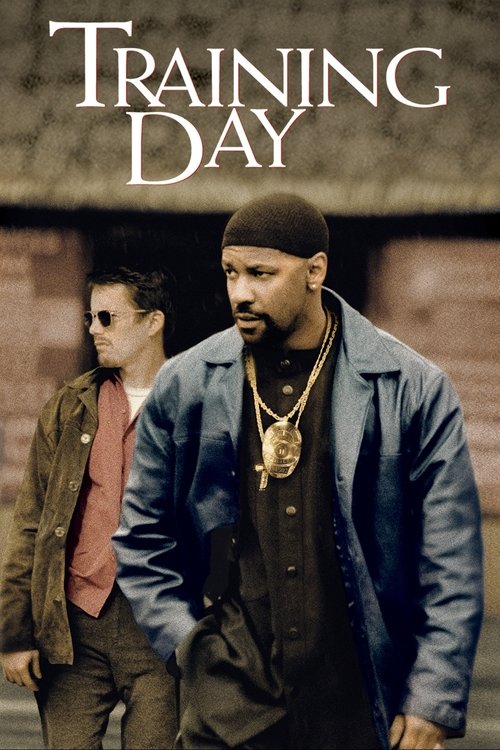
Training Day
2001 · Antoine Fuqua
For when you want a gripping, morally messy thriller with a villain you can't look away from — an intense Friday-night watch, not a comfort one. Reach for it when you're in the mood to be worked over.
What it's about
A rookie cop's first day in an elite LAPD narcotics unit becomes a guided tour of hell. His trainer is Alonzo Harris, a decorated veteran detective whose methods blur the line between policing the streets and running them, and over one long day driving through Los Angeles the new guy has to figure out how much of what he's seeing is a test, how much is a trap, and how far he'll bend before he breaks. Gangs, dealers, dirty money, and a badge that protects the wrong people — all packed into a single sunrise-to-midnight ride-along.
The experience
A pressure cooker that tightens scene by scene — it starts as swaggering, darkly funny street theater and slides into genuine dread as you realize the rookie can't get out of the car. You spend two hours off balance, never sure whether the man in the driver's seat is a mentor, a monster, or both.
Performances
Denzel Washington's Alonzo Harris is one of the great screen villains — seductive, funny, terrifying, often in the same sentence — and it won him the Best Actor Oscar. Ethan Hawke matches him as the rookie, playing mounting panic with real credibility, and earned an Oscar nomination for it.
The craft
Antoine Fuqua shoots Los Angeles from the inside — real neighborhoods, real heat, a city that feels like a character with its own rules. The single-day structure is the engine: the light literally changes as the moral ground erodes, and the script keeps handing Washington monologues that have been quoted ever since. It plays best loud, with the dialogue crackling.
Why it matters
It landed while Los Angeles was still reckoning with a real police corruption scandal and became the modern touchstone for the dirty-cop story, while Washington's Oscar — for playing a villain — made it a landmark in his career and in Fuqua's.
Snapshot
A rookie narcotics officer and a veteran detective ride together through a single, pressure-cooked day in Los Angeles. By nightfall, the rookie has been framed for murder, robbed, nearly killed, and is fighting to survive the man who was supposed to train him. Training Day is a character study dressed as a procedural thriller: its true subject is the machinery of systemic corruption and the question of how far moral compromise extends before it becomes permanent. Anchored by one of American screen acting's most celebrated villainous turns, the film arrived at an acute historical moment — Los Angeles still processing the Rampart Division scandal — and became both a popular success and a durable reference point for the corrupt-cop subgenre.
Industry & production
Training Day was produced by Warner Bros. Pictures in association with Village Roadshow Pictures, with Fuqua and Jeffrey Silver among the producers. The screenplay was written by David Ayer, who had grown up in Hawthorne and spent formative years in South Central Los Angeles — experience he drew on directly to give the script its procedural texture and insider knowledge of LAPD culture and the geography of the Crenshaw and Rampart neighborhoods. Ayer completed The Fast and the Furious in the same year, but Training Day demonstrated his range: where that film was kinetic and escapist, this was claustrophobic and morally corrosive.
The project attracted Denzel Washington, who had spent much of the preceding decade playing figures of principled authority — lawyers, soldiers, doctors — and was actively seeking a role that would invert that persona. His willingness to play Alonzo Harris without mitigation or redemptive arc was a calculated career move and an artistic risk that defined the production's identity. Ethan Hawke, cast as Jake Hoyt, provided the film with its moral center and the audience's point of identification: an actor associated with introspective, Gen-X sincerity opposite Washington's operatic menace.
The film shot substantially on location throughout Los Angeles — in Crenshaw, the Rampart Division territory, and residential neighborhoods that the production used with an unusual degree of access, in part because of Ayer's community connections and Fuqua's willingness to cast local figures (including musicians Dr. Dre and Snoop Dogg in supporting roles) who lent the film social legitimacy in the areas being depicted.
The LAPD's Rampart Division scandal, which broke publicly in 1999 following officer Rafael Pérez's testimony about systematic corruption and evidence planting in the CRASH anti-gang unit, gave the film's premise immediate cultural legibility. Ayer has cited the scandal as a direct influence on the screenplay; the film does not depict Rampart explicitly, but Alonzo Harris — a detective who steals from drug dealers, plants evidence, and operates through informal hierarchies of fear — is recognizably a product of that disclosed reality.
Technology
Training Day was shot on 35mm film, the dominant format of the moment, with location photography emphasizing natural and available light where practical. The format's grain and latitude suited the film's aesthetic aspirations: texture over polish, the impression of a world caught rather than constructed. The production's use of actual Los Angeles neighborhoods, low-rider culture, and lived-in domestic interiors was integral to the visual strategy — there is little that looks like a studio approximation of South Central. The film predates the widespread adoption of digital intermediate color grading as a stylistic tool, so its palette reflects photochemical choices rather than post-production manipulation.
Technique
Cinematography
Mauro Fiore served as director of photography — a collaboration with Fuqua that produced one of the more distinctively textured crime films of the early 2000s. Fiore shot with a documentary-adjacent handheld vocabulary in the action sequences and intimate confrontations, creating physical unease during scenes that might otherwise have read as generic procedural drama. The film's visual grammar is alert to surveillance — to being watched from stoops, from passing cars, from apartment windows — in ways that reinforce the narrative's paranoid logic. The Los Angeles light, particularly in the film's long diurnal arc, shifts from morning optimism through harsh afternoon exposure to the sodium-vapor ominousness of the project courtyard at dusk.
Editing
The editing sustains the single-day compression without mechanical urgency. The film does not rush; it allows scenes to breathe past the point of comfort, particularly in the early stretches when Hawke's Jake still believes in the institution Alonzo represents. The pacing is calibrated to the slow-building recognition of a trap — the audience is permitted to share in Jake's gradual, terrible understanding that he has been maneuvered.
Mise-en-scène / staging
Fuqua's staging relies heavily on the contained space of Alonzo's Monte Carlo — a rolling throne room in which the power differential is architecturally encoded. Jake cannot leave the car; he cannot leave the frame. The vehicle becomes a space of ideological instruction, seduction, and ultimately coercion. Against this mobility, the film deploys static interiors (Roger's house, the crack den, the project apartment) as sites of revelation and confrontation. The final sequence in the projects — where Alonzo discovers that his legend does not extend to the Sinaloa cartel — inverts the spatial logic: he is suddenly contained and exposed in a public square, stripped of the mobile authority the car represented.
Sound
Mark Mancina composed the score, which layers propulsive orchestral elements against a hip-hop-inflected sonic landscape. The film is as much defined by its diegetic sound — the music bleeding from passing cars, the ambient life of neighborhoods at different hours — as by Mancina's underscoring. Alonzo's world has its own soundtrack, and the film uses these sonic markers to establish whose territory the characters are passing through at any given moment.
Performance
Washington's Alonzo Harris is a comprehensive performance, ranging from seductive mentorship through rationalizing cruelty to something approaching operatic villainy in the final act. The performance's intelligence lies in what Washington withholds: Alonzo's self-justifications are delivered with the ease of long practice, and the performance suggests a man who has been lying to himself for so long that the lie is indistinguishable from conviction. The famous rhetorical set-pieces — including the "king" speech delivered over a forced drug consumption — are theatrical in the best sense, projecting power while encoding menace. Washington received the Academy Award for Best Actor, becoming only the second Black man to win in that category (following Sidney Poitier in 1964), and doing so while playing a character almost entirely without redeeming qualities.
Hawke's counter-performance is necessarily more restrained and arguably more technically demanding: he must register shock, fear, moral revision, and emergent resolve while being outgunned in every shared scene. His nomination for Best Supporting Actor acknowledged a performance that holds the film's moral architecture together without commanding its surface. The supporting cast — Scott Glenn as a dealer with a complex past, Eva Mendes in an early significant role, Cliff Curtis as a gang leader — are integrated into the film's sociological texture with unusual care, largely because Ayer's screenplay gives them legible agency within the system Alonzo has built.
Narrative & dramatic mode
The film adheres to classical unity of time: one calendar day, beginning with Jake's arrival and ending with the accounting that day demands. This compression is not merely a thriller device; it creates a moral pressure cooker in which the full scope of Alonzo's corruption is disclosed incrementally, and in which Jake's options narrow with each revelation. The structure echoes the "one day in hell" model visible in films from High Noon (1952) through Do the Right Thing (1989): the single day as a crucible for values that have been building toward crisis.
The film's central mechanism is the inversion of the mentor-apprentice plot. Alonzo offers Jake real knowledge — procedural, sociological, philosophical — while instrumentalizing him as a co-conspirator. The question of whether Jake will be educated or corrupted by what he learns is the dramatic engine. Ayer's screenplay resolves this through the discovery that Jake's survival instinct and his ethics are finally the same thing: to survive, he must be the thing Alonzo cannot imagine him being.
Genre & cycle
Training Day is a late entry in the corrupt-cop cycle that runs through American cinema from Sidney Lumet's Serpico (1973) and Prince of the City (1981) through Abel Ferrara's Bad Lieutenant (1992). It engages the noir tradition — a protagonist drawn into criminal complicity, a landscape that punishes innocence — while displacing the genre's typical protagonist from an investigator into a subject being investigated. The film shares DNA with Colors (1988) in its Los Angeles setting and attention to gang geography, and with the neo-noir mode that characterized much 1990s American crime cinema.
It also belongs to a distinct early-2000s Los Angeles cycle, alongside Dark Blue (2002, also written by Ayer) and the television series The Shield (2002–2008), which collectively constitute a cultural processing of the Rampart scandal and the accumulated psychic weight of the Rodney King verdict and subsequent uprising. This cycle is distinct from the glossier LA crime mode of the late 1990s; it is more interested in institutional rot than individual transgression.
Authorship & method
Antoine Fuqua came to Training Day from music video and commercial work — he directed the video for Coolio's "Gangsta's Paradise" — and brought to the film both a visual confidence in urban Black American settings and a willingness to let performance lead. His directorial strategy was to stay out of Washington's way in the big scenes while shaping the topography of the city around him as a character in its own right. Fuqua's subsequent career — The Equalizer films, Southpaw, Prisoners of the Ghostland — has demonstrated a persistent interest in genre frameworks that explore masculine codes of justice and obligation, themes Training Day established at the center of his authorial concerns.
David Ayer's screenplay is the film's primary structural achievement. Ayer's method — drawing on direct experience of the communities and institutions he depicts — produces dialogue and situation that feel ethnographically grounded rather than genre-conventional. The film's insight that corruption is a system, not an individual aberration, is Ayer's and is sustained throughout.
Mauro Fiore's cinematography shaped a visual language that would define Fuqua's subsequent work. Mark Mancina's score is functional rather than distinctive; the film's more memorable sonic choices are in the diegetic music and ambient location sound.
Movement / national cinema
Training Day is American cinema at a moment of specific urban reckoning. It belongs to a strand of Los Angeles filmmaking that takes the city's racial geography seriously — the Crenshaw corridor, the Rampart Division's boundaries, the informal territorial organization of neighborhoods — rather than using LA as a neutral backdrop for generic crime narrative. In this it connects to a lineage including the Hughes Brothers' Menace II Society (1993) and John Singleton's Boyz n the Hood (1991), films that established South Central as a legible cinematic territory with its own codes and logic.
The film is also a post-Rodney King text: it presupposes an audience with some knowledge of what the LAPD has been and what its official culture has concealed, and it asks that audience to watch a Black detective be the primary agent of corruption in a film whose protagonist is a young white man. The racial dynamics are worked through with unusual complexity by the screenplay; Alonzo uses race instrumentally, as both shield and weapon, in ways that the film does not flatten into a simpler moral scheme.
Era / period
Training Day premiered in October 2001, weeks after the September 11 attacks, in a cultural moment when questions of institutional authority, trust in public officials, and the ethics of extralegal action carried heightened charge. The film did not address these questions directly, but its portrait of an officer who believed himself above accountability resonated in ways the production could not have anticipated. It was, additionally, the breakthrough Los Angeles crime film of a cycle that would include Dark Blue, Crash (2004), and Ayer's own subsequent work through the decade.
Themes
The film's central thematic question is the relationship between knowledge and complicity: to learn from Alonzo is to become implicated in what he knows. Fuqua and Ayer are interested in how institutional corruption perpetuates itself through apprenticeship — how the senior figure legitimizes the junior figure's initial compromises until the junior figure has too much to lose by speaking. The film stages this as a thriller, but its mechanics are those of a moral argument about the conditions under which ordinary people become agents of harm.
Power, race, and geography are inseparable in the film's world. Alonzo operates across multiple racial and neighborhood communities by maintaining reciprocal fear relationships with each; his ability to move through Los Angeles depends on a fragile web of mutual interest that the final act reveals as held together only by his capacity for violence. When that violence is turned against his debtors rather than his enemies, the web dissolves.
The film is also about mythology: Alonzo has constructed a legend of himself, and the legend has real social effects — until it doesn't. The project courtyard scene, in which his authority simply evaporates, is the film's most precisely observed moment: power that is entirely relational cannot survive the withdrawal of the relationships that sustain it.
Reception, canon & influence
Training Day was a significant commercial success, performing well beyond expectations for a grim, adult crime drama in the post-September 11 theatrical environment. Critical reception was strongly bifurcated: reviewers who saw Washington's performance as sufficient justification for the film were broadly positive; those who found the screenplay's machinery too schematic were more reserved. The consensus that emerged was that the film succeeded as a performance showcase and as a genre piece while stopping somewhat short of the institutional analysis it gestured toward.
The film's backward influences are visible: Serpico and Prince of the City established the corrupt-LAPD procedural as a viable prestige mode; Bad Lieutenant demonstrated that a cop-without-redemption narrative could be commercially viable; Colors and Boyz n the Hood established the geographic and social vocabulary the film deploys. The Rampart scandal is the immediate real-world substrate.
Its forward influence has been substantial. Ayer's subsequent career as writer-director — End of Watch (2012), Fury (2014) — builds directly on the methods and preoccupations Training Day established. The Shield, which premiered in 2002, owes the film a structural debt in its portrayal of Vic Mackey as a figure whose corruption is inseparable from his effectiveness; the series deepened what the film could only sketch. More diffusely, Training Day normalized the morally complex law enforcement protagonist in mainstream American genre entertainment — a normalization whose consequences are still being traced.
Washington's performance remains a canonical reference point for "actor against type" career pivots, and for the specific mode of charismatic villainy that requires an audience to understand the seduction before it can register the horror. Hawke's nomination marked a moment in his career's maturation. The film holds its place in the conversation about Los Angeles, race, and policing not because it resolved that conversation but because it entered it with more specificity, and more respect for the complexity of what it was depicting, than the genre had typically managed.
A Deleuzian reading
Start with the car.
The full Deleuzian reading of Training Day →
Reception
A solid hit in 2001 with reviews that praised the acting more than the movie, it's since been fully canonized — now routinely called one of the great cop films, with Denzel's Alonzo ranked among the all-time screen villains.
How Training Day was received, from release to now →
Influences: the films it descends from and the films it influenced
- The French Connection (1971) — Friedkin's handheld, surveillance-adjacent camera grammar — chasing subjects through urban space, implicating the audience in morally compromised police action — is the direct cinematographic ancestor of Mauro Fiore's documentary-inflected work for Fuqua.
- Serpico (1973) — Lumet established the corrupt-institution police procedural in which an honest cop is surrounded by systemic rot; Ayer's script is a structural inversion of this template, transforming the Serpico figure into the villain who has fully capitulated.
- Chinatown (1974) — The neo-noir architecture in which investigation progressively reveals that the antagonist is the institution itself — and that the geography of Los Angeles encodes moral rot — is the formal inheritance Fuqua and Ayer draw on for Alonzo's slowly disclosed criminal web.
- Q&A (1990) — Lumet's corrupt NYPD detective (Nick Nolte played without mitigation) investigated by a younger prosecutor established the 'monster in plain sight' procedural structure — the veteran's institutional power weaponized against the person meant to hold him accountable.
- Colors (1988) — The first significant film to use the LAPD veteran/rookie partner structure within LA gang territory as its primary dramatic engine, with the veteran's methods becoming the moral question — the direct structural ancestor to the Alonzo/Jake dynamic.
- Do the Right Thing (1989) — Lee's single-day unity-of-time compression building systemic pressure to an explosive endpoint, and his use of diegetic music bleeding from storefronts and passing cars as a device for marking territorial and racial geography, both directly inform Training Day's formal architecture.
- Boyz n the Hood (1991) — Singleton established South Central LA's specific visual grammar — actual Crenshaw geography, low-rider culture, police helicopters as ambient surveillance — as cinematic language; Fuqua shoots many of the same blocks and inherits the same spatial logic of a surveilled community.
- Bad Lieutenant (1992) — Ferrara's commitment to staging a corrupt cop protagonist without redemptive arc or moral scaffolding, sustained entirely through Harvey Keitel's operatic performance, is the performance template Washington explicitly studied and surpassed with Alonzo Harris.
- Menace II Society (1993) — The Hughes Brothers' handheld 35mm documentary grammar in South Central — grain, surveillance-adjacent framing of figures through car windows and across stoops, available-light exposure — is the direct visual precedent for Fiore's approach in the film's Los Angeles location work.
- The Negotiator (1998) — A two-hander star duel built around police corruption and institutional rot, two leads circling each other across a compressed timeline of escalating mistrust.
- Where the Sidewalk Ends (1950) — A contemporary terminus of the corrupt-cop lineage — the officer whose violence and evidence-tampering make him functionally a criminal — the moral machinery Sidewalk built turned on its own protagonist.
- Narc (2002) — Carnahan shot on a mix of 16mm and 35mm with extreme handheld instability and available-light underexposure, applying documentary grain to a corrupt-veteran-detective procedural; Ray Liotta's unmitigated performance as the morally destroyed veteran is directly indebted to Washington's Alonzo.
- Street Kings (2008) — Ayer returns to the same LAPD systemic corruption milieu, using the unmarked police vehicle as a mobile power space and handheld surveillance framing to structure a corrupt-mentor revelation narrative that is nearly a scene-for-scene structural echo of Training Day.
- End of Watch (2012) — Ayer's most explicit evolution of the patrol-vehicle-as-theatrical-space device and the surveillance-framing grammar, extending Training Day's documentary aesthetic to its logical conclusion through body-cam and found-footage vocabularies within the same South Central geographic territory.
- Sicario (2015) — Villeneuve and Roger Deakins transpose Training Day's mentor-apprentice-inversion structure to the border drug war — an FBI agent realizing her handler operates outside the law — while the surveillance framing, SUV-as-power-space staging, and available-light cinematography directly extend Training Day's formal grammar into a new geography.
- Shooter (2007) — Fuqua's own prior grammar: the digital intermediate palette as moral-descent tool, Mauro Fiore's desaturated urban color scheme, and the character-actor-as-systemic-menace mode (Washington's Alonzo) that Ned Beatty's Senate patriarch in Shooter directly extends into a different institutional register.
- Safe House (2012) — Built the deglamorized-procedural mentor-protégé friction with Denzel as the magnetic, morally compromised veteran corrupting an idealistic junior — the exact performance register and pairing Washington reprises as Tobin Frost.
- The Equalizer (2014) — The original Fuqua–Washington collaboration that calibrated Washington's menace through a controlled, watchful gaze — the exact persona The Equalizer inverts from corrupt predator to righteous protector.
- Elite Squad (2007) — Supplies the corrupting-mentor cop procedural — a hardened veteran initiating a rookie into extralegal policing over a compressed span — the exact mentor/initiate axis Nascimento occupies with Neto and Matias.
- The Rip (2026) — Fuqua constructs narcotics-unit corruption from documented Rampart-era practice and hinges the entire moral collapse on a discovered cash stash, with a star's warmth weaponized against the viewer — the police-corruption-cycle template The Rip inherits.
- Southpaw (2015) — First pairing of Fuqua and Mauro Fiore, establishing the practical-source, real-location lighting scheme in which wealth is keyed clean and daylit while poverty is sodium-lit and underexposed — the class index Fiore reuses to separate Hope's mansion from Wills's gym.
- Dark Blue (2002) — Written by Ayer from a James Ellroy story and released the same year, it deploys an identical autobiographical LAPD corruption structure — a violent veteran detective whose criminality is the institution's criminality — making it Ayer's parallel draft of the same material transposed to the Watts Riots setting.
- Collateral (2004) — Mann extends Training Day's vehicle-as-power-space device into a full film — a taxi cab as the night-long theatrical container for a lethal power asymmetry between driver and passenger — while his available-light digital cinematography of nocturnal Los Angeles geography answers Fiore's 35mm day-arc with its own visual argument.
- American Gangster (2007) — Washington's withholding register of moral authority made corrupt — the performance grammar of controlled menace and restrained affect beneath which violence organizes itself — is the direct predecessor to Lucas; crucially, Fuqua was originally attached to direct AG before departing, making this the film in which the Washington-crime-protagonist template was first forged.
- Deep Cover (1992) — Directly extends the undercover/rogue-narc descent in which a mentor figure seduces a protégé across the moral line, transplanting Deep Cover's corruption-of-the-good-cop engine to LA.
Similar films
- Serpico (1973) — influence & lineage
- The French Connection (1971) — influence & lineage
- Boyz n the Hood (1991) — influence & lineage
- Bad Lieutenant (1992) — influence & lineage
- Sicario (2015) — influence & lineage
- Collateral (2004) — influence & lineage · often watched together
- BlacKkKlansman (2018) — often watched together
- Heat (1995) — often watched together