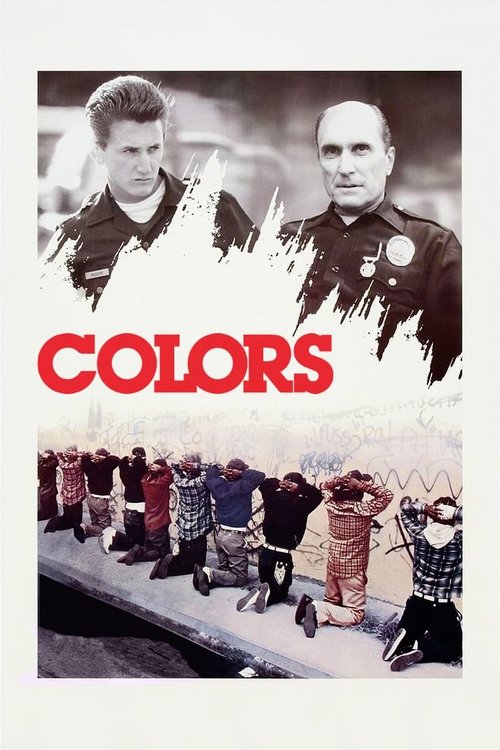
Colors
1988 · Dennis Hopper
For when you want a gritty, time-capsule crime drama — something raw and confrontational rather than slick. It's a challenge watch with a cautionary streak, best when you're in the mood for the real texture of an era.
What it's about
A patient veteran cop a year from retirement is saddled with a hotheaded young partner, and together they patrol the gang-controlled neighborhoods of late-1980s Los Angeles. The rookie wants arrests; the veteran knows the streets run on relationships and restraint. Around their clashing methods, the film maps a city at war with itself — Bloods, Crips, and barrios where the color you wear can get you killed.
The experience
Tense and abrasive, with a grubby, on-the-street realism that keeps the violence feeling sudden rather than choreographed. It plays less like a cop thriller than a ride-along through a city coming apart.
Performances
Robert Duvall and Sean Penn make the mismatched-partners setup genuinely combustible — Duvall all lived-in patience and craft, Penn practically vibrating with aggression the film keeps questioning rather than celebrating.
The craft
Dennis Hopper directs with a semi-documentary eye, shooting in real neighborhoods and giving the film an anxious, reportorial texture unusual for a studio cop picture. The attention to graffiti, hand signs, and street geography makes the setting feel observed rather than invented.
Why it matters
It landed in the middle of a national panic over gang violence and stirred real controversy on release; it became a key document of the era and helped fix Los Angeles gang culture in the popular imagination, for better and worse.
Snapshot
Colors is a Los Angeles police procedural built around the partnership of a patient, methodical veteran nearing the end of his career and a brash, aggressive rookie eager to make arrests, set against the city's escalating gang conflict of the late 1980s. Released by Orion Pictures, directed by Dennis Hopper and starring Robert Duvall and Sean Penn, the film arrived at a charged cultural moment: the crack epidemic, the consolidation of the Bloods and Crips as national media shorthand for urban disorder, and a press cycle increasingly fixated on "gang violence" as a category. The film's lasting significance lies less in its conventional buddy-cop architecture than in what surrounds and pressures that architecture — its semi-documentary attention to neighborhood texture, its anxious contemporaneity, and the controversy that attended its release, when fears that the film would incite the very violence it depicted shaped its public reception. It is also remembered as the vehicle for Ice-T's title track, a landmark in West Coast hip-hop that arguably outlived the film itself. As an authored object it represents Hopper's consolidation as a working studio director after a decade of professional marginalization.
Industry & production
Colors was produced for Orion Pictures, the independent-minded major that through the 1980s cultivated director-driven projects and prestige genre fare. The screenplay is credited to Michael Schiffer, working from a story developed with Richard DiLello; the project had reportedly circulated in development before Hopper attached himself, and the final film's Los Angeles gang setting represents a substantial reworking of earlier conceptions of the material. Robert H. Solo produced.
The picture sits within a specific late-1980s studio appetite for hard-edged urban crime stories that promised topicality and a veneer of social realism while delivering the pleasures of the cop genre. For Orion, Colors offered a relatively economical, location-driven production fronted by two bankable, critically respected leads — Duvall, an established character lead of the highest standing, and Penn, then both a rising star and a tabloid figure. The budget was modest by studio-tentpole standards, the production leaning on real Los Angeles locations rather than constructed sets.
The film's production and release were inseparable from public controversy. Law-enforcement figures and community advocates voiced concern that the film glamorized or would provoke gang activity, and reports of violence at or near some screenings amplified the anxiety. The Los Angeles police union and the city's then-police chief were among the public skeptics. Whether the film "caused" violence is unverifiable and was likely overstated by a sensation-prone press, but the discourse materially shaped how Colors was marketed, exhibited, and reviewed — a case study in how a film's reception can be authored by its surrounding moral panic as much as by its text.
Technology
Colors was shot on 35mm photochemical film, the standard professional format of its moment, finished and exhibited as a photochemical release print. There is no indication that the production was a site of significant technological innovation; its tools were the conventional ones of late-1980s studio filmmaking. What distinguishes the film technologically is its commitment to available-light and location-driven shooting practice rather than any novel apparatus — an aesthetic choice executed through the established craft of its cinematographer rather than through new equipment. In the absence of detailed, verifiable production-technical documentation, claims about specific camera packages or lens choices should be treated cautiously; the salient point is that the film's "realist" texture is a product of method and location more than of technology.
Technique
Cinematography
The film was photographed by Haskell Wexler, one of American cinema's most distinguished and politically engaged cinematographers, whose own Medium Cool (1969) had fused documentary immediacy with fiction. Wexler's contribution is central to whatever the film achieves beyond genre formula. The photography favors a grounded, observational naturalism: sun-flattened daylight in the barrios and South Central streets, handheld mobility in the patrol and pursuit sequences, and a willingness to let real locations dictate light and composition rather than imposing a glossy studio sheen. This visual approach situates the cops' point of view inside lived neighborhoods rather than above them, and it lends the gang milieu a specificity that the script's procedural beats do not always match. The pairing of Wexler's documentary-inflected eye with Hopper's interest in authenticity is the film's strongest technical signature.
Editing
The cutting serves a dual rhythm characteristic of the cop genre: extended, conversational two-handers between the partners alternating with compressed bursts of action and arrest. The film moves episodically, accreting incidents — busts, surveillance, domestic and street encounters — rather than building a single tight mechanism of plot, which gives it a patrol-shift, slice-of-the-job quality. Detailed verified attribution of specific editorial strategies is thin in the readily available record, and individual cutting decisions should not be over-claimed; the general shape, however, is that of an observational drift punctuated by genre set-pieces.
Mise-en-scène / staging
Hopper's staging leans on real Los Angeles neighborhoods, graffiti, and the semiotics of gang affiliation — most pointedly the color-coded clothing that gives the film its title and organizing metaphor. The film treats the colors worn by gang members as a literal and figurative sign system: identity, territory, and mortal risk encoded in fabric. Background is foregrounded — the production populates frames with neighborhood texture and, by widely circulated report, drew on real gang-world knowledge and local participants to lend authenticity, a practice that itself fed the surrounding controversy. The staging of authority is pointed: the two cops as differing styles of intervention (containment and relationship-building versus confrontation and aggression) physically embodied in how each man moves through and occupies these spaces.
Sound
The soundscape mixes the procedural realism of radio chatter, street ambience, and Spanish-language texture with a foregrounded contemporary-music presence. The decision to anchor the film's sonic identity in hip-hop — above all Ice-T's title track — gave Colors a contemporaneity rare for a studio cop picture of its day and tied the film's sound to the very subculture it depicted. The interplay between Herbie Hancock's score and the source/needle-drop music is part of how the film negotiates between genre convention and street authenticity.
Performance
Performance is the film's most reliable asset. Robert Duvall's veteran officer is built from restraint, fatigue, and hard-won pragmatism — a man who understands the neighborhood as an ecology to be managed rather than a war to be won. Sean Penn's rookie is all forward pressure and ego, the aggression that reads as competence to him and as liability to his partner. The friction between the two performances — Duvall's economy against Penn's volatility — supplies the film's dramatic engine and elevates a familiar template. The supporting cast included Maria Conchita Alonso as Penn's character's love interest, the late Trinidad Silva, and early-career appearances by performers including Don Cheadle and Damon Wayans, several of whom register vividly within limited screen time.
Narrative & dramatic mode
The film operates in the realist-procedural register of the partner cop drama, organized around the contrast of two temperaments and the implicit question of which approach to policing is wiser or more humane. The veteran's de-escalating, relationship-based method is set against the rookie's confrontational zeal, and the narrative repeatedly tests both against a street reality that resists either. Rather than a single propulsive mystery, the structure is cumulative and episodic — a sequence of encounters that together sketch a worldview about the limits of policing a self-perpetuating cycle of poverty, territory, and retaliation. The dramatic mode is finally elegiac and cautionary: the veteran's experience frames the rookie's arc as a warning, and the film's tragic turns insist that individual heroics make little dent in structural conditions. This tension between genre catharsis and a bleaker social fatalism is where the film's seriousness and its compromises both reside.
Genre & cycle
Colors belongs to the buddy-cop and urban-crime cycle, but it is best understood at the hinge between two traditions. Backward, it descends from the gritty 1970s American police film and its ambivalence about law enforcement. Forward and laterally, it stands at the threshold of a late-1980s and early-1990s wave of films and music centered on Los Angeles gang life and the "hood" as subject. While the canonical "hood film" cycle — typically associated with Black filmmakers telling stories from within the community at the start of the 1990s — differs fundamentally in authorship and point of view (police outsiders here versus community insiders there), Colors is frequently positioned as a commercial precursor that helped make the South Central gang milieu legible to a mass film audience, for better and worse. It is the cop-genre framing, and the outside-looking-in vantage, that most distinguishes it from what followed.
Authorship & method
Dennis Hopper directed Colors at a pivotal juncture in a famously turbulent career. After the counterculture landmark Easy Rider (1969) and the commercially catastrophic, long-suppressed The Last Movie (1971), Hopper spent much of the 1970s professionally and personally adrift; his return to directing with Out of the Blue (1980) preceded a broader comeback that, by the mid-to-late 1980s, included a striking acting resurgence (notably Blue Velvet in 1986). Colors functioned as proof that Hopper could deliver a disciplined, releasable studio picture on time and on budget — re-establishing him as an employable director rather than a cautionary tale. His method here channels his long-standing attraction to authenticity and improvisatory texture into a more controlled genre vehicle, the radicalism of his earlier work sublimated into location realism and performance.
Key collaborators define the film as much as its director. Cinematographer Haskell Wexler supplied the documentary-grained visual identity. Composer Herbie Hancock, a titan of jazz and electric fusion, contributed the score, his involvement signaling the film's musical ambitions. The screenplay by Michael Schiffer (story with Richard DiLello) provided the partner-contrast architecture. Above all, the title song by Ice-T became a cultural artifact in its own right — an early, defining statement of West Coast gangsta rap whose reach exceeded the film's. The collaboration of an Old Hollywood-adjacent craft team (Wexler, Hancock, Duvall) with an emergent hip-hop voice encapsulates the film's position athwart two eras.
Movement / national cinema
The film is firmly within mainstream American studio cinema, produced by a Hollywood major and operating within established genre economics. But it carries traces of an alternative American lineage: the politically conscious, documentary-influenced strand running through Wexler's career and through Hopper's own New Hollywood origins. It is not an avant-garde or movement film; rather, it represents the partial absorption of 1960s–70s realist and countercultural sensibilities into the commercial mainstream of the Reagan-era late 1980s. Its "national cinema" identity is inseparable from its Los Angeles specificity — the city's geography, demographics, and gang cartography are not backdrop but subject.
Era / period
Colors is a quintessential late-1980s artifact. It registers the crack-era intensification of urban violence, the media construction of the "gang problem," and a national politics of crime and policing that would harden into the punitive consensus of the 1990s. The film's anxieties — about whether aggressive enforcement helps or inflames, about the spectacle of gang identity — are the anxieties of its moment. Its sonic embrace of emergent hip-hop likewise dates and defines it: 1988 sits at the dawn of gangsta rap's national breakthrough, and the film's alignment with that music marks it as a transitional cultural document. Watched today, it is legible both as period drama and as period symptom.
Themes
The film's governing metaphor is the color itself — affiliation as a sign system in which clothing encodes belonging, territory, and lethal risk, and in which identity is something worn and read at a glance. From this flow its central concerns: the futility and ambiguity of policing a self-reproducing cycle of poverty and retaliation; the contrast of mentorship and hubris, age and youth, patience and aggression as competing models of engagement with violence; and cycles of retribution that absorb individuals regardless of intention. The film is preoccupied with boundaries — between cop and community, insider and outsider, observation and intervention — and with the limits of any individual's capacity to alter structural conditions. Its veteran-and-rookie frame ultimately stages a debate about whether wisdom is even efficacious, lending the genre exercise a fatalistic moral weight.
Reception, canon & influence
Critical reception was substantial and divided, and the film was reviewed within, and partly distorted by, the controversy over its potential to incite real-world violence. Many critics praised the lead performances — Duvall and Penn drew particular respect — and Wexler's location realism, while others faulted the script's reliance on cop-genre convention, questioned the outsider, policing-centric vantage on communities of color, and debated whether the film's authenticity was earned or exploitative. The result was a serious, contested critical conversation rather than a consensus verdict. Specific box-office figures and award outcomes should be checked against primary sources rather than asserted here; the safe characterization is that the film performed respectably and lodged itself firmly in the cultural memory of its period.
Influences on the film (backward): Colors draws on the gritty 1970s American police drama and its moral ambivalence about law enforcement; on the documentary-realist tradition embodied by Wexler; and on Hopper's own New Hollywood formation, with its appetite for authenticity and outsider perspective.
Legacy (forward): The film's most durable legacy is arguably musical — Ice-T's title track is a foundational West Coast hip-hop record whose influence vastly outstripped the film's. Cinematically, Colors is frequently cited as a mainstream commercial precursor to the Los Angeles gang and "hood" cinema that flourished at the turn of the 1990s, even as that subsequent wave answered it from the inside, replacing the police vantage with community authorship. As a career document it secured Dennis Hopper's rehabilitation as a working director. And as a media event, it endures as a paradigmatic example of how moral panic around a film's supposed real-world effects can become inseparable from its critical and cultural afterlife.
A Deleuzian reading
Start with the fabric.
The full Deleuzian reading of Colors →
Reception
In 1988 it was a lightning rod — protests, fears it would spark gang violence, and accusations of exploiting the Crips-and-Bloods crisis it depicted, even as it became a solid box-office hit. Now it plays as a fascinating, flawed time capsule of late-80s LA, arguably more important to hip-hop history than to cop-movie history.
How Colors was received, from release to now →
Influences: the films it descends from and the films it influenced
- Medium Cool (1969) — Wexler's own director-cinematographer manifesto — fiction shot vérité-style with handheld available light inside real civic unrest — is the documentary-grained method he carried directly onto Colors.
- In the Heat of the Night (1967) — Wexler's racially-charged crime-drama lensing here established the location-realist, partner-contrast visual template he reprised twenty years later.
- Bound for Glory (1976) — Wexler's Oscar-winning available-light naturalism and roving handheld coverage refined the textural realism that defines Colors' street photography.
- Matewan (1987) — Shot by Wexler immediately before Colors, its muted available-light location work is the same period-correct realist grammar applied to a different milieu.
- The New Centurions (1972) — From Wambaugh's LAPD novel, it supplies the veteran/rookie partner-contrast architecture and the elegiac fatalism of the dying senior cop that Colors structurally rebuilds.
- The French Connection (1971) — Friedkin's documentary-grained handheld procedure, radio-chatter realism, and morally ambivalent cops are the gritty-70s-policier DNA Colors inherits.
- Serpico (1973) — Lumet's location-bound, available-light cop realism and institutional moral ambivalence model the unglamorous procedural texture Colors pursues.
- Easy Rider (1969) — Hopper's own New Hollywood debut establishes his improvisatory, outsider-authenticity method and the use of source-music needle-drops as de facto score, both sublimated into Colors.
- Death Wish (1974) — Herbie Hancock's jazz-funk score for an urban-crime film prefigures the Hancock scoring sensibility he brings to Colors, bridging studio crime drama and Black popular idiom.
- Boyz n the Hood (1991) — Answers Colors from the inside, reversing the police vantage into community authorship while mapping the same South-Central gang geography and color-coded signifiers.
- Menace II Society (1993) — Extends the real-location, early-career-ensemble hood film with hip-hop source scoring, replacing Colors' outsider cop gaze with first-person fatalism.
- New Jack City (1991) — Carries forward the crack-era crime canvas and hip-hop-as-score, fusing the gang-territory realism Colors popularized with rap-soundtrack synergy.
- American Me (1992) — Takes the Chicano-gang milieu and real-location authenticity Colors foregrounded and recenters it as insider ethnography rather than police procedural.
- Mi Vida Loca (1993) — Reworks the East-LA gang world with a non-professional, early-career ensemble and observational real-location staging, shifting Colors' male cop frame to the women left behind.
- Training Day (2001) — Revives Colors' veteran/rookie partner-contrast and elegiac arc verbatim, touring the same color-coded LA gang territory with hip-hop source music and real-location shooting.
- End of Watch (2012) — Pushes Colors' LAPD partner-contrast and radio-chatter realism into found-footage handheld, extending the available-light street-cop vérité into the digital era.
- Straight Outta Compton (2015) — Directly inherits the film's most durable legacy — Ice-T's title track seeding West Coast gangsta rap — by dramatizing the same Compton hip-hop emergence Colors first put on a mainstream screen.
- American Graffiti (1973) — Its wall-to-wall diegetic pop soundtrack pioneered source music as cultural-texture structuring device — the strategy Colors transposes onto late-80s hip-hop.
Similar films
- Boyz n the Hood (1991) — influence & lineage
- Easy Rider (1969) — influence & lineage
- Medium Cool (1969) — influence & lineage
- Serpico (1973) — influence & lineage
- The French Connection (1971) — influence & lineage
- Training Day (2001) — influence & lineage
- In the Heat of the Night (1967) — influence & lineage
- Menace II Society (1993) — influence & lineage