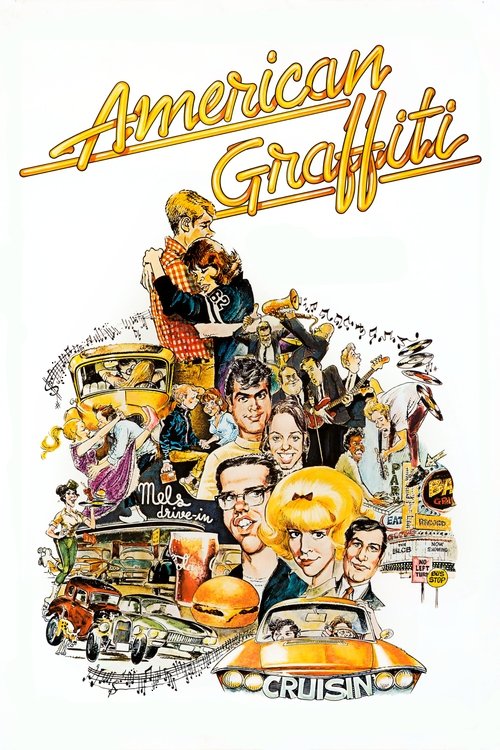
American Graffiti
1973 · George Lucas
For a nostalgic hang of a movie night — when you want to laugh, hum along, and feel eighteen again, with a little melancholy as the credits near. Pure comfort with a heart.
What it's about
One last summer night in a small California town, 1962: a handful of recent high-school graduates cruise the strip, chase romance, dodge trouble, and circle the question of whether to leave for college in the morning. Four storylines weave through drive-ins, drag races, and a radio station where the mythical Wolfman Jack spins records all night. Nothing bigger than growing up is at stake — which turns out to be everything.
The experience
Warm, funny, and shot through with an ache you don't notice until it lands — it feels like the best night of your youth replayed with the knowledge that it's ending. The energy is loose and joyful, the aftertaste bittersweet.
Performances
The young ensemble is a time capsule of talent — Richard Dreyfuss's restless charm, Ron Howard's clean-cut doubt, Paul Le Mat's cool-guy weariness, and a pre-stardom Harrison Ford rolling through as a rival racer.
The craft
George Lucas braids four storylines across a single night with no lead character and makes it feel effortless, while the neon-and-chrome night photography turns cruising into ritual. The real engine is the wall-to-wall rock-and-roll soundtrack — dozens of period records pouring from car radios — which practically invented the jukebox-scored movie. Great with the volume up.
Why it matters
A tiny-budget picture that became one of the most profitable films of its era, it launched the Hollywood nostalgia boom, seeded a generation of hangout movies and teen ensembles, and gave Lucas the clout to make Star Wars.
Snapshot
American Graffiti is George Lucas's second feature, a low-budget ensemble comedy-drama that compresses the anxieties of late adolescence into a single late-summer night in a California valley town circa 1962. Following four young men and the women in their orbit across roughly eight hours of cruising, flirtation, drag racing, and reckoning, the film converted a deeply personal memory — Lucas's own youth in Modesto — into a national myth of pre-Vietnam American innocence. It is structurally radical for a mainstream picture, braiding four loosely connected storylines without a conventional protagonist, and it is sonically saturated: dozens of period rock-and-roll records play almost continuously, bound together by the disc-jockey presence of Wolfman Jack. Critically embraced and improbably profitable relative to its tiny budget, the film launched several careers, helped finance Star Wars, and effectively codified the modern nostalgia film. It remains the cornerstone of the 1950s/early-1960s revival that swept American popular culture for the rest of the decade.
Industry & production
The film emerged from the orbit of American Zoetrope, the San Francisco studio Francis Ford Coppola and Lucas had founded as an alternative to Hollywood. After Lucas's debut, the bleak science-fiction film THX 1138 (1971), failed commercially, Coppola reportedly urged his protégé to prove he could make something warm and human. American Graffiti was developed with that mandate. United Artists initially backed development but passed; the project ultimately landed at Universal Pictures, with Coppola — by then ascendant on the strength of The Godfather — attached as producer, lending the untested concept industrial credibility.
The production was made on a famously small budget, with figures commonly reported in the neighborhood of three-quarters of a million dollars; exact accounting varies across sources, so the precise number should be treated cautiously. Shooting took place largely at night over a compressed schedule in Northern California. Modesto itself had changed too much to serve as its own past, so the company filmed in Petaluma, San Rafael, and surrounding locales, recreating the cruising strip on real streets. The night schedule, weather, and logistical strain made the shoot grueling.
The post-production history is part of the film's legend. Universal executives were reportedly unenthusiastic at an early screening, with studio figures wanting cuts and questioning the film's commercial prospects; Coppola is widely reported to have defended it forcefully, even offering to buy it back. The studio trimmed a few minutes before release. Whatever the internal friction, the film became one of the most profitable investments in studio history on a return-on-cost basis, and it earned five Academy Award nominations, including Best Picture, Best Director, and Best Original Screenplay, without winning. The financial success materially strengthened Lucas's hand in mounting Star Wars.
Technology
American Graffiti was shot in Techniscope, the economical two-perforation 35mm widescreen format that exposed half the normal amount of film per frame and used spherical lenses to capture a wide aspect ratio, with the anamorphic "squeeze" added optically in printing. The format suited a budget-conscious production while delivering a widescreen scope image. The choice carried trade-offs — a grainier negative — that dovetailed with the film's deliberately rough, documentary-flavored look rather than working against it.
The decisive technical problem was photographing an entire feature at night on location with minimal resources. The production leaned on practical and available light sources — neon storefronts, streetlamps, the glow of dashboards and diner windows, headlights — rather than elaborate built lighting setups. The result reads as found rather than designed, an aesthetic of captured ambience that depended on fast film stock and an embrace of imperfection. The other essential "technology" of the film is its soundtrack apparatus: an almost wall-to-wall bed of licensed pop records, treated as if emanating from car radios all tuned to the same station, which required extensive music licensing and a sophisticated mix to maintain the illusion of diegetic continuity across scenes.
Technique
Cinematography
The film's visual signature is a neon-lit naturalism. The credited camera work was supplemented by Haskell Wexler, the acclaimed cinematographer who served as "visual consultant" and is widely credited with shaping the film's nocturnal palette of saturated reds, ambers, and chrome reflections. The look prizes texture over polish: faces caught in passing light, the strip rendered as a river of headlights and signage. The widescreen Techniscope frame is used horizontally, emphasizing the lateral motion of cars gliding through the night and the social geography of a town strung along a single boulevard. Rather than calling attention to itself with bravura camera movement, the photography behaves like an attentive observer, which reinforces the sense that we are eavesdropping on a real time and place.
Editing
Editorially, American Graffiti is a genuine achievement of parallel construction, cut by Verna Fields and Marcia Lucas. With four storylines unfolding simultaneously across one night, the film's coherence depends entirely on the rhythm of cross-cutting — moving among Curt's wanderings, Steve and Laurie's faltering romance, Terry's misadventures, and John's reluctant night with a younger girl. The editing keeps these threads legible and emotionally synchronized, building toward the dawn drag race and the airport departure. The soundtrack functions as connective tissue: a record carrying over a cut binds disparate locations into one continuous evening. The editing was recognized with an Academy Award nomination.
Mise-en-scène / staging
The production design reconstructs the iconography of 1962 with affectionate specificity: the drive-in diner, the hot rods and customized Fords, the sock hop, the cruising strip itself. The automobile is the film's central staging device — much of the drama is blocked in and around cars, with characters framed through windshields and side windows, conversations conducted between vehicles rolling side by side. This makes the car at once a stage, a social medium, and a symbol of mobility and escape. The world is dense with period detail but rarely museum-like; the objects feel lived-in because the staging treats them as ordinary.
Sound
Sound is arguably the film's most influential formal element. There is no original orchestral score; instead, some forty-odd period rock-and-roll and doo-wop recordings play nearly continuously, motivated as radio broadcasts presided over by the real-life DJ Wolfman Jack, who appears as a near-mythic figure. The conceit that every car radio is tuned to the same station lets the music flow seamlessly across scenes, unifying the ensemble and lending the night a collective heartbeat. Walter Murch, a key Zoetrope collaborator, handled the sound montage and "re-recording," treating the music not as accompaniment but as an environment with its own spatial logic — songs swelling and receding as if heard from a passing car. This approach to a needle-drop soundtrack as continuous diegetic world was widely imitated afterward.
Performance
The performances favor naturalism and ensemble chemistry over star turns, fitting the documentary impulse. The young cast — several of them near-unknowns — delivers loose, behaviorally credible work. Richard Dreyfuss gives Curt a searching restlessness; Ron Howard plays Steve as the conventional golden boy at a crossroads; Paul Le Mat's John Milner carries the melancholy of the aging local hero clinging to his fading dominance of the strip; and Charles Martin Smith makes Terry "the Toad" a comic figure of yearning ineptitude. Candy Clark earned an Oscar nomination as Debbie. The casting now reads as a remarkable assembly of future talent, with Cindy Williams, Mackenzie Phillips, and a young Harrison Ford among them.
Narrative & dramatic mode
The film's dramatic mode is the ensemble "one crucial night" structure, in which a tightly bounded span of time substitutes for conventional plot momentum. There is no single protagonist and no central conflict in the classical sense; instead, four parallel narratives each pose a variation on the same question — whether to leave or to stay, to grow up or to hold on. The looming external event is departure: Curt and Steve are due to fly east to college the next morning, and the night becomes a final reckoning with the place and the people they are about to lose. The mode is elegiac comedy: episodic, digressive, and warm on the surface, but shadowed throughout by the awareness that this world is ending. The film withholds melodrama, letting consequence accumulate through small choices, and reserves its emotional payload for the closing departure and the abrupt, sobering title cards that follow.
Genre & cycle
American Graffiti sits at the intersection of teen comedy, the coming-of-age film, and the nostalgia picture, and it largely defined the last of these as a commercial category. It belongs to a lineage of youth-and-cars Americana but elevates it through formal ambition and emotional gravity. The film also helped inaugurate the 1950s/early-60s revival cycle of the 1970s — a broad cultural turn toward pre-counterculture innocence that the television series Happy Days (which drew directly on this milieu and cast) carried into living rooms. Within Lucas's own filmography it forms a hinge between the austere modernism of THX 1138 and the mythic populism of Star Wars, sharing with the latter a fascination with worlds rendered through dense, lived-in detail.
Authorship & method
American Graffiti is the most autobiographical of Lucas's films, drawn from his teenage years cruising in Modesto and his own early love of cars — a passion curtailed by a near-fatal car accident shortly before his high school graduation, an experience often read into the film's undertow of mortality. Lucas's method here was anthropological: to reconstruct a remembered social world with documentary fidelity and let structure emerge from simultaneity rather than plot.
The authorship is genuinely collaborative. The screenplay was written by Lucas with Gloria Katz and Willard Huyck, the husband-and-wife team who sharpened the dialogue and characters. Francis Ford Coppola's role as producer and protector was decisive to the film existing at all. Haskell Wexler's contribution as visual consultant shaped the photographic identity. Verna Fields and Marcia Lucas (then Lucas's wife) cut the film, with Marcia a significant creative presence in his work of this period. Walter Murch's sound design realized the radio-as-world concept. The film is thus best understood as a Zoetrope-generation collective effort organized around Lucas's memory.
Movement / national cinema
The film is a product of the "New Hollywood" of the late 1960s and 1970s — the period in which a generation of film-school-trained directors gained creative control within the studio system. More specifically, it issues from the San Francisco Bay Area axis of that movement, the Zoetrope circle that positioned itself geographically and temperamentally apart from Los Angeles. American Graffiti exemplifies New Hollywood traits: personal subject matter, formal experimentation (the plotless ensemble, the diegetic-music soundtrack), naturalistic performance, and location shooting. At the same time, its embrace of accessible emotion and popular nostalgia distinguishes it from the era's bleaker auteur statements and anticipates the more populist, blockbuster-oriented turn that Lucas and his contemporaries would soon drive.
Era / period
There is a double temporality at the film's heart: it was made in 1973 but set in 1962, and the gap between those dates is the source of its meaning. 1962 is positioned as the last moment before a series of national ruptures — the deepening of the Vietnam War, the assassinations, the upheavals of the later 1960s. The closing title cards, which report the later fates of the central young men, retroactively recast the whole carefree night as a vanished idyll; their abruptness lands as a quiet elegy for a generation. Viewers in 1973, on the far side of those ruptures, were invited to mourn an innocence the film knows cannot survive. That structural irony — joy framed by foreknowledge of loss — is what lifts the film above simple nostalgia. (The end cards account only for the male characters, an omission frequently noted by later critics as reflecting the period's and the film's gendered limits.)
Themes
The film's governing theme is the threshold between youth and adulthood, dramatized as the choice to leave or to stay. Each storyline tests a different relationship to this passage: Curt's intellectual restlessness and fear of the unknown; Steve's complacent assumption of a settled life he is forced to question; John's inability to imagine himself beyond the strip he rules; Terry's hunger to belong. Mobility — the car, the open road, the cruise that circles endlessly without arriving — becomes the central metaphor, expressing both freedom and entrapment. Community and place are weighed against ambition and escape. Underneath runs an awareness of time's irreversibility, embodied in the single-night structure, the dawn that ends it, and the sense that the social world being depicted is already historically doomed. The film is finally about memory itself — the act of preserving a lost place in loving, granular detail.
Reception, canon & influence
Critically, American Graffiti was widely praised on release for its vitality, its ensemble performances, and its evocative reconstruction of period, and it became a major popular success wholly out of proportion to its modest cost. Its five Academy Award nominations confirmed its standing as a serious work, not merely a teen comedy, and it has since been recognized as a landmark of 1970s American cinema, including selection to the United States National Film Registry for its cultural significance.
Looking backward, the film's most-cited influence is Federico Fellini's I Vitelloni (1953), the Italian study of aimless young men in a provincial town, which Lucas has acknowledged as a model for the portrait of youths lingering on the edge of adulthood. The broader traditions of Americana, hot-rod culture, and rock-and-roll radio supplied its raw material.
Looking forward, its legacy is large. It crystallized the nostalgia film as a durable commercial form and ignited a wider 1950s/early-60s revival in 1970s popular culture, most directly through the television series Happy Days, which grew out of the same milieu and shared Ron Howard. Its continuous diegetic pop-music soundtrack became a template that countless subsequent films and filmmakers adopted, reshaping how popular music is used in cinema. Its ensemble "one night" structure influenced later coming-of-age and "hangout" films. It launched or accelerated a striking number of careers, and its profits and prestige gave Lucas the leverage to make Star Wars, indirectly reshaping the entire industry. A sequel, More American Graffiti (1979), followed without matching the original's resonance. The first film endures as both a beloved entertainment and a sophisticated meditation on memory, and as one of the foundational texts of New Hollywood.
A Deleuzian reading
A blonde in a white Thunderbird pulls up beside Curt, mouths *I love you* through the glass, and slides back into traffic.
The full Deleuzian reading of American Graffiti →
Reception
Universal execs famously thought it was unreleasable — then it turned a ~$775K budget into one of the most profitable films ever made, landed five Oscar nominations including Best Picture, and bankrolled Lucas's leap to Star Wars. Now it's canonized as the film that invented the modern nostalgia movie.
How American Graffiti was received, from release to now →
Influences: the films it descends from and the films it influenced
- I Vitelloni (1953) — Supplied the plotless multi-strand ensemble of aimless young men loitering at the threshold of adulthood, the structural model Lucas explicitly acknowledged for letting shape emerge from simultaneity rather than plot.
- Rebel Without a Cause (1955) — Codified the automobile as dramatic stage and the drag-race set-piece (the 'chickie run') as the arena where teen mortality and bravado are staged, the cars-as-stage grammar Graffiti inherits.
- Blackboard Jungle (1955) — Pioneered the rock-and-roll needle-drop, using 'Rock Around the Clock' over its titles to charge a scene with a pop record, the diegetic-pop technique Lucas extends to a wall-to-wall radio score.
- A Hard Day's Night (1964) — Fused kinetic cutting to a continuous pop-music spine, proving editing could be choreographed to records rather than orchestral underscore — the rhythmic pop-radio energy Graffiti builds its montage on.
- Shadows (1959) — Established the loose, improvisatory naturalistic-ensemble performance style — overlapping, unforced, documentary-feeling — that Lucas sought from his young unknown cast.
- Medium Cool (1969) — Wexler's available-light, documentary-grade cinematography (later carried into Graffiti as its visual consultant) modeled shooting real environments with naturalistic, source-driven light.
- A Fistful of Dollars (1964) — Demonstrated the two-perf Techniscope format as a way to achieve anamorphic-scale widescreen on a tight budget, the same economical wide gauge Lucas used to shoot night exteriors cheaply.
- The Last Picture Show (1971) — Scores an entire period small-town youth elegy using only diegetic radio and jukebox source music as its soundtrack, the same radio-as-world conceit and nostalgic reconstruction, made two years prior.
- Cooley High (1975) — Transposes the one-crucial-night ensemble coming-of-age structure and Motown needle-drop soundtrack to a Black Chicago milieu, an explicit answer-record to Graffiti's template.
- Diner (1982) — Extends the plotless 'hangout' ensemble of young men stalling before adulthood, structured around talk and a shared social space, lifting Graffiti's simultaneity-over-plot architecture.
- Fast Times at Ridgemont High (1982) — Carries forward the multi-strand teen ensemble cut to a continuous contemporary-pop needle-drop soundtrack as period documentation rather than score.
- The Outsiders (1983) — Coppola, Graffiti's protector-producer, returns to the same 1950s-teen Americana with cars-as-stage iconography and an ensemble of soon-famous unknowns, directly downstream of Graffiti's casting and milieu.
- Dazed and Confused (1993) — The purest heir: a single-night plotless ensemble of cruising teens, period needle-drop soundtrack, and cars-as-stage cruising, explicitly modeled on Graffiti's last-night-of-an-era structure.
- Almost Famous (2000) — Builds a nostalgic coming-of-age memory piece whose emotional architecture is carried by curated diegetic pop records, inheriting Graffiti's use of needle-drops as the engine of remembered time.
- Baby Driver (2017) — Wolfman Jack's unbroken AM radio broadcast provides a continuous pre-existing musical program that organizes episodic structure and crosscutting — the first major American film to use a curated licensed-music soundtrack as the film's structural spine rather than a composed score.
- Once Upon a Time... in Hollywood (2019) — Lucas invented the diegetic period-radio-as-temporal-anchor device—Wolfman Jack broadcasting continuously over the action—that OUaTiH literalizes through Cliff's truck radio, using AM radio as the primary period-immersion mechanism rather than a period detail.
- Licorice Pizza (2021) — The episodic multi-strand structure—where California teenage social life accumulates through loosely connected encounters across a single night without resolving into a conventional arc—is the direct structural template LP inherits for its Valley picaresque.
- American Hustle (2013) — Originates the wall-to-wall licensed-pop soundtrack as continuous period-evocation rather than score, the jukebox-as-narration device the film leans on.
- Stand by Me (1986) — Established the template Stand by Me runs on: a wall-to-wall diegetic period-pop jukebox scoring an episodic, plotless ensemble night, capped by 'where are they now' epilogue text that converts the whole film into a memory-play.
- The Breakfast Club (1985) — Pioneers wall-to-wall pop needle-drops functioning as both score and era-marker across a multi-protagonist youth ensemble compressed into one continuous span—the soundtrack-as-emotional-scaffold method Forsey reprises.
- Mean Streets (1973) — Released the same year, it deploys wall-to-wall diegetic pop records as character interiority and milieu rather than mood-painting, the parallel codification of the needle-drop soundtrack.
- The Conversation (1974) — Walter Murch's sound montage — layering, degrading and foregrounding sound as narrative information — is the same authored sound-design method Murch used to build Graffiti's radio universe.
- Nashville (1975) — Lucas uses a continuous rock-radio broadcast as the acoustic spine linking simultaneous storylines among a dispersed ensemble in a single night, structurally parallel to Nashville's use of country performance as the political-social organizing thread — in both films the music simultaneously broadcasts and interrogates the culture the characters are embedded in.
- Colors (1988) — Its wall-to-wall diegetic pop soundtrack pioneered source music as cultural-texture structuring device — the strategy Colors transposes onto late-80s hip-hop.
- Paper Moon (1973) — Replaces orchestral score with wall-to-wall diegetic period source music drawn from the radio of its era — the same source-scoring strategy Paper Moon uses with 1930s broadcasts and records.
- National Class Category Up to 785ccm (1979) — Contemporary parallel: an ensemble of young men whose identities are defined through their cars across a single ticking span, carried on period-pop-scored nostalgic realism.
Similar films
- Dazed and Confused (1993) — influence & lineage · same viewing thread
- Rebel Without a Cause (1955) — influence & lineage · same viewing thread
- Almost Famous (2000) — influence & lineage · same viewing thread
- Fast Times at Ridgemont High (1982) — influence & lineage · same viewing thread
- A Hard Day's Night (1964) — influence & lineage
- The Last Picture Show (1971) — influence & lineage
- The Outsiders (1983) — influence & lineage
- Mean Streets (1973) — influence & lineage
All the films related to American Graffiti →
Watch it with: curated runs of related films
- Restless Youth, Rigid Walls — Watch these as one long walk through the school years — the teachers who crack you open, the friends who pull you off the sidelines, the first loves and the institutions you push against — where a beloved tearjerker and a surreal boarding-school revolt turn out to be cousins.