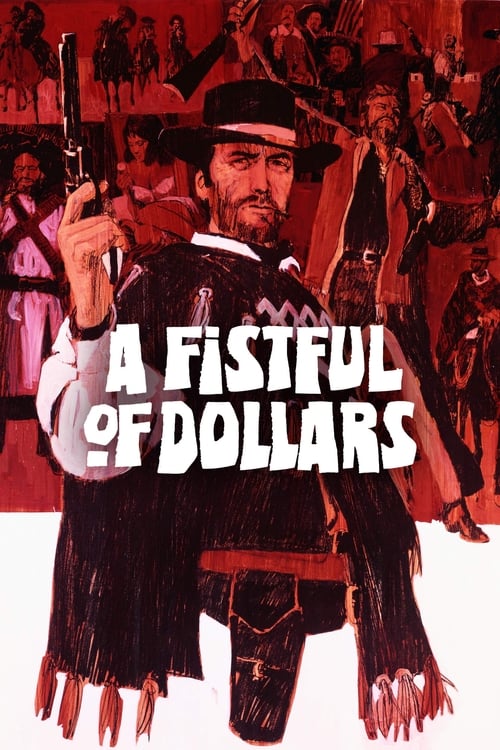
A Fistful of Dollars
1964 · Sergio Leone
For when you want cool — a poncho, a cigarillo, a plan — rather than white hats and noble speeches. Perfect entry point if you've never watched a Western and suspect they're not for you.
What it's about
A nameless American drifter rides into a dusty Mexican border town carved up between two criminal clans — the Rojo brothers on one side, the sheriff's family on the other. Sizing up the stalemate, he sells his gun and his information to both sides at once, playing them against each other for profit in a town where the coffin-maker is the only honest businessman.
The experience
Lean, sardonic and stylish — long silent stare-downs that suddenly snap into violence, all scored to Ennio Morricone's whistles and whip-cracks. It's a Western that feels dangerous and faintly amused at the same time, and it moves fast.
Performances
This is the film that invented Clint Eastwood as an icon: the squint, the poncho, the economy of a man who says maybe ten lines an hour and makes each one land. It's a performance built almost entirely from stillness, and it changed what a screen hero could be.
The craft
Leone shoots faces like landscapes and landscapes like faces — extreme close-ups against scorched wide frames — while Morricone's score replaces orchestral sweep with whistling, chanting and gunshot percussion. Made cheaply in Spain, it turns every limitation into style.
Why it matters
It launched the spaghetti Western, made Eastwood a star, and rewrote the genre's moral code: after this, the Western hero could be a mercenary and audiences would cheer. Its fingerprints are on decades of antiheroes and stylized standoffs.
Snapshot
A laconic American drifter rides into the dusty Mexican border town of San Miguel, sizes up two warring criminal clans, and proceeds to sell his gun—and his loyalty—to both sides simultaneously. Released in Italy as Per un pugno di dollari in September 1964, Sergio Leone's debut genre feature did not merely revitalize a flagging Western cycle; it rewrote the moral grammar of the form. The Man With No Name is not a frontier defender or an agent of civilization. He is a freelance opportunist, motivated by cash and governed by a cold personal code that resembles honor only from certain angles. That reinvention—of the hero, of the landscape, of the genre's very relationship to American mythology—sent tremors through world cinema that are still felt today.
Industry & production
By the early 1960s the American Western was ceding television to Gunsmoke and Bonanza while prestige productions were growing increasingly solemn. Meanwhile Italian producers had been making low-budget genre pictures—pepla, sword-and-sandal epics—that exploited cheap Spanish locations and international co-production financing. A Fistful of Dollars was financed as a West German–Italian–Spanish co-production, primarily through the Roman production company Jolly Film, with location work centered on the arid landscapes around Almería in southern Spain, which stood in economically and visually for the American Southwest.
The production was shaped by commercial camouflage. Leone directed under the pseudonym "Bob Robertson," an Anglicization that gestured toward his father Vincenzo Leone (a silent-era director who had worked under the name Roberto Roberti). Ennio Morricone, composing his first major Western score, was credited as "Dan Savio." The entire enterprise was designed to pass, at least superficially, as an American or quasi-American product, because European distributors and exhibitors were known to discount the commercial prospects of Italian genre films sold as Italian.
The casting of Clint Eastwood was itself a product of the film's limited budget and its marginal status within the American industry. Eastwood was a television actor known primarily from Rawhide and considered a secondary prospect. Several accounts suggest that more established American names were approached first—the exact list varies across secondary sources and should be treated with some caution—but Eastwood's willingness to travel to Spain for a modest fee, combined with Leone's instinct about his laconic screen presence, proved decisive. Eastwood is also reported to have contributed substantially to the character's definition: trimming dialogue, adopting the cheroot, elaborating the costume. The creative negotiation between star and director on that set established patterns that would recur through the Dollars Trilogy.
Technology
The film was shot in Techniscope, a two-perforation pulldown process developed by Technicolor Italia that achieved a 2.35:1 widescreen image while using half the film stock of standard 35mm anamorphic production. The cost savings were significant for a low-budget production, though the process produced a slightly coarser grain structure and reduced light sensitivity compared to anamorphic alternatives. Leone and cinematographer Massimo Dallamano (credited, like the director, under an Anglicized pseudonym: "Jack Dalmas") worked within these constraints to compose images that exploited the extreme horizontal field: long vistas of emptiness on either side of a single figure, deep-focus plains interrupted by architectural frames, faces occupying the extreme edges of a wide frame.
Morricone's score was recorded in advance of the shoot—an unusual practice that allowed Leone to edit to the music rather than scoring to the cut—and was produced using studio technologies that foregrounded unconventional timbres: electric guitar distortion, the crack of a bullwhip deployed as a rhythmic element, wordless vocal performances by Alessandro Alessandroni and the chorus I Cantori Moderni. The studio recording techniques of early-1960s Rome, combined with Morricone's conservatory training and his instinct for rupturing genre convention, produced a sonic language that had no real precedent in the Western.
Technique
Cinematography
Dallamano's work under Leone's direction established several visual signatures that would define the Spaghetti Western as a visual mode. The extreme close-up—a tight frame on an eye, a hand hovering over a holster, a sweat-beaded forehead—is used not for psychological revelation in the classical Hollywood sense but as a formal intensification, a kind of visual percussion that builds toward the eruption of the gunfight. These ECUs alternate with very wide shots of the landscape, creating a rhythmic oscillation between the intimate and the panoramic that is entirely unlike the middle-distance staging of classical Hollywood Westerns. The Almería terrain—sun-bleached, barren, striated with horizontal color bands—photographs as a place outside ordinary geography, a mythic rather than historical space.
Editing
Roberto Cinquini's editing amplifies Leone's tendency to stretch and compress temporal experience. The approach to the climactic duel is proto-operatic: Leone extends the pre-gunfight ritual—the stares, the hand movements, the micro-hesitations—well past any realistic duration, treating the moment of maximum tension as something to be savored rather than resolved. This is editing that refuses the utilitarian economy of classical continuity style in favor of duration as affect.
Mise-en-scène / staging
Leone stages action with a theatricality that owes something to the Italian operatic tradition and to the peplum epics from which his producers migrated. Characters are frequently positioned in symmetrical or compositionally weighted arrangements that emphasize the visual event over behavioral naturalism. The town of San Miguel, built or adapted from existing Spanish architecture, is conceived as a stage set: a main street defined by sightlines, architectural frames, and the spatial geometry of the standoff. Leone's blocking tends to position the Man With No Name at oblique angles to his interlocutors, a staging choice that physically embodies the character's lateral, non-committal relationship to every confrontation.
Sound
The decision to post-synchronize all dialogue—standard practice in Italian genre production of the period—liberated the sound design from the acoustic compromises of location recording and allowed Morricone's score to be woven into the fabric of the film with unusual precision. The score does not accompany action so much as comment upon it, sometimes ironically, often with a structural independence that treats the music as a dramatic argument running parallel to the image. The whistle melody associated with the Man With No Name functions as a leitmotif with considerable flexibility: ominous, sardonic, elegiac by turns.
Performance
Eastwood's performance is defined by withholding. Where American Western heroes of the classical period—Gary Cooper, John Wayne, James Stewart—projected moral legibility even in taciturn form, Eastwood's Man With No Name offers opacity. The half-smile, the squinted calculation, the minimal verbal response: these constitute a performance mode that refuses the conventions of sympathy-building. Gian Maria Volonté, who would reprise a similar antagonist role in For a Few Dollars More, plays Ramon Rojo with a studied volatility that contrasts with Eastwood's stillness; the pairing establishes a structural opposition—cold intelligence versus hot temperament—that would organize much of Leone's subsequent work.
Narrative & dramatic mode
The film's narrative architecture derives directly from Akira Kurosawa's Yojimbo (1961), which Kurosawa himself had partly derived from Dashiell Hammett's hardboiled fiction, particularly Red Harvest (1929). The premise—a lone, morally untethered operative who plays two criminal powers against each other for personal gain—is transposed from feudal Japan to the mythologized American Southwest with minimal alteration. Leone and co-writer Duccio Tessari made no effort to conceal this derivation; the plagiarism became a legal matter when Kurosawa and Toho brought suit against the Italian producers. The case was settled out of court, with Toho receiving distribution rights in several Asian territories and a percentage of worldwide receipts, among other considerations.
The narrative mode is less classical than operatic: it proceeds through confrontations and set pieces that build cumulative tension, with subplot mechanics—the gold shipment, the captive family, the treacheries between the Rojos and the Baxters—functioning primarily as structural pretexts for stylized encounters. Psychological interiority is minimal and mostly implied rather than dramatized. The Man With No Name's decision to protect the Baxter family at personal cost is the film's one concession to conventional heroic motivation, and Leone handles it with characteristic understatement.
Genre & cycle
A Fistful of Dollars did not invent the Italian Western—there had been earlier examples, some starring American actors—but it established the model that would define the cycle internationally. The Spaghetti Western, as the international press would call it, was defined in large part by what Leone's film made canonical: the anti-heroic protagonist, the European location photography passed off as American West, the operatic scoring, the aestheticized and highly stylized violence, the mordant irony toward frontier mythology. Between 1964 and the early 1970s, hundreds of Italian Westerns were produced, most of them drawing directly on Leone's template; a few—notably the films of Sergio Corbucci, including Django (1966) and The Great Silence (1968)—extended or complicated the form in significant ways.
Authorship & method
Leone is the film's dominant authorial intelligence, though the collaborative relationships he established on this production would prove enduring and constitutive. His partnership with Ennio Morricone, which would extend through Once Upon a Time in America (1984), is among the most consequential director-composer relationships in cinema history. Leone's reported habit of playing recordings of earlier Morricone music on set—and of occasionally editing to music composed before photography—made the sonic and visual tracks unusually interdependent; the films do not feel scored so much as composed across two media simultaneously.
Massimo Dallamano was replaced on subsequent Leone Westerns by Tonino Delli Colli, who would become the director's primary visual collaborator. The production design relationship with Carlo Simi, who built and dressed the Spanish locations into a consistent aesthetic world, was equally significant. Leone himself worked from a deep reservoir of reference—American Westerns, Japanese jidaigeki, Italian opera—and operated less as a realist than as a synthesist of genre materials, transforming borrowed forms through stylistic intensification.
Movement / national cinema
The film belongs to a specific formation in postwar Italian cinema: the genre cinema produced for domestic and international commercial consumption alongside (and largely beneath the critical notice of) the art cinema of Antonioni, Visconti, and Fellini. Italian genre production of the 1960s was industrially prolific and culturally hybrid, drawing on American models, European co-production financing, and the specific material conditions of Spanish location work. Leone's relationship to this formation is complicated by his eventual canonization as an auteur—a designation that the genre machinery he worked within neither anticipated nor comfortably accommodates. The Spaghetti Western cycle is simultaneously a national cinema phenomenon, an international co-production system, and a genre cycle with transnational coordinates.
Era / period
The film belongs to the mid-1960s moment when the certainties of the classical studio period were eroding and international cinema was disrupting American industry assumptions. It preceded the MPAA rating system's replacement of the Production Code, and its casual amorality—the hero is not merely flawed but frankly mercenary—would have been significantly more difficult to distribute in the United States even five years earlier. Its American release, delayed until 1967, coincided with a domestic climate already prepared by the mid-decade loosening of censorship norms and by the Dollars Trilogy's accumulated European reputation.
Themes
The film's most radical thematic proposition is the detachment of competence from virtue. The Man With No Name is supremely capable and entirely uninterested in the moral frameworks—civilization, law, community—that classical Western heroes exist to defend or embody. Leone views the American frontier mythology from outside, as a European, and finds in it not a story of nation-building or moral order but a Darwinian arena in which the most ruthlessly intelligent operator survives. Money is a more honest motivator than ideology, the film implicitly argues; the pretense of moral purpose only complicates what is essentially a transaction.
Violence is aestheticized to the point of abstraction. Leone's gunfights are not the quick, clean resolutions of the classical Western but ritualized performances, prolonged and stylized until they carry a formal weight that is closer to dance or ceremony than to anything naturalistic. The landscape—vast, indifferent, strikingly beautiful—frames human conflict as spectacle against a scale that renders all ideological claims trivial.
Reception, canon & influence
The film was an immediate commercial success in Italy and across much of Europe, generating the investment that financed Leone's subsequent Westerns. Critical establishment in Italy and elsewhere was slower: the genre context, the acknowledged derivation from Kurosawa, and the film's refusal of the prestige markers associated with auteur cinema delayed serious critical engagement. American critical reception on the 1967 US release was mixed to negative, with several prominent reviewers dismissing the film as a shoddy imitation of both the American Western and the Kurosawa original.
The backward influences are multiple and documented. Kurosawa's Yojimbo is the direct source. Classical Hollywood Westerns—particularly those of Budd Boetticher and Anthony Mann, with their concentration on the lone protagonist navigating a morally compromised landscape—provide the formal substrate. Japanese chambara and jidaigeki cinema informed Leone's approach to the stylized duel and the stoic protagonist. Hammett's hardboiled ethos, reaching Leone filtered through Kurosawa, supplies the amoral operative's intellectual framework.
The film's forward influence is difficult to overstate. It launched Eastwood's international stardom and established the persona that would define his subsequent career through the mid-1970s and beyond. It catalyzed an Italian genre boom of enormous scale and variable quality. More broadly, it demonstrated that genre conventions were available for ironic reprocessing—that a filmmaker could deploy the materials of a popular form while systematically refusing that form's ideological commitments. That demonstration reverberated through the revisionist Westerns of the late 1960s and 1970s (The Wild Bunch, McCabe & Mrs. Miller, Pat Garrett and Billy the Kid), through the action cinema of subsequent decades, and through any popular genre work that treats its hero's moral status as a problem rather than a premise. Leone's trilogy—completed with For a Few Dollars More (1965) and The Good, the Bad and the Ugly (1966)—represents the fullest development of the formal and thematic propositions first sketched here, but the essential argument was made in San Miguel, in the dust, at the end of a cheroot.
A Deleuzian reading
A hand hovers an inch above a gun butt.
The full Deleuzian reading of A Fistful of Dollars →
Reception
Dismissed on its 1967 US release as a cheap, violent knock-off — 'spaghetti western' was coined as an insult — it's now credited with single-handedly reviving and reinventing the western. The genre's most famous resurrection job.
How A Fistful of Dollars was received, from release to now →
Influences: the films it descends from and the films it influenced
- Yojimbo (1961) — Leone transplanted Kurosawa's structural conceit of a mercenary navigating a precisely mapped two-faction town through lateral wide masters that render geography as tactical field, translating Mifune's physical economy of stillness interrupted by explosive violence directly into Eastwood's withheld performance register.
- The Searchers (1956) — Ford's deployment of VistaVision's extreme horizontal field to position solitary figures as specks within inhuman rock formations established the visual grammar of widescreen-as-mythic-geography that Leone literalized in Almería's terrain, making landscape itself an active dramatic agent rather than backdrop.
- Shane (1953) — Stevens codified the laconic stranger archetype—a figure who communicates through physical stillness and deliberate withholding of personal history, whose costume and guncraft signal competence before any dialogue does—which Leone inherited and stripped of its redemptive moral coding.
- High Noon (1952) — Zinnemann's construction of pre-duel tension through interlocking crosscut reaction shots, environmental inserts, and real-time clock ticking—treating the anticipation phase as extended filmic duration rather than narrative compression—gave Leone the structural template he then expanded to operatic extremity.
- Johnny Guitar (1954) — Ray staged Western confrontation as theatrical tableau—figures arranged in compositionally weighted symmetry, delivering dialogue as stylized proclamation rather than behavioral conversation—establishing a non-naturalistic mise-en-scène divorced from realism that Leone amplified through Italian operatic staging conventions.
- Vera Cruz (1954) — Aldrich established the commercially viable amoral American mercenary in Mexico as Western protagonist—two competing anti-heroes who switch allegiances for profit with no civic redemption arc—making the Man With No Name's freelance opportunism legible as genre entertainment rather than moral rupture.
- Psycho (1960) — Herrmann's score, employing only string orchestra to produce abrasive timbral shock in place of conventional orchestral warmth, demonstrated that genre scoring could operate through unexpected sonic texture rather than melodic illustration—the principle Morricone radicalized by substituting electric guitar distortion, whip cracks, and Alessandroni's wordless vocals for the Western's brass-and-strings idiom.
- Seven Samurai (1954) — Leone's unlicensed remake of Yojimbo — itself a distillation of Seven Samurai's lone-warrior performance grammar — transplanted Mifune's stillness-vs-physicality method into the Western body; the legal settlement Toho won over the theft made the craft debt juridically explicit.
- Sanjuro (1962) — Leone's direct remake of Yojimbo transplanted Sanjuro's meta-genre ironist-hero grammar into the Spaghetti Western; his extreme close-up/extreme long-shot cutting pattern for staging confrontations is the Scope elaboration of the horizontal blocking Kurosawa developed for the same dramatic problem.
- El Cid (1961) — Inherits the production economy El Cid consolidated — Spanish crews, standing sets, and cheap cavalry extras that pushed European genre shooting into Almería — and with it Mann's habit of resolving conflict through precisely surveyed lateral distance across a single street.
- One-Eyed Jacks (1961) — Industrializes the beating-and-convalescence structure — the hero systematically pulped by the family he provoked, hidden away to heal, then returning with the wounded hand concealed — the same deferred-retribution shape and taste for prolonged humiliation Brando built the second half around.
- For a Few Dollars More (1965) — Leone extended his own ECU-to-landscape oscillation by coupling it to an on-screen object: Mortimer's pocket watch as both visual prop and leitmotif trigger, synchronizing Morricone's pre-recorded cue precisely to a physical artifact in the frame and deepening the score-image montage logic of the original film.
- Django (1966) — Corbucci adopted Leone's Techniscope widescreen compositions and ECU-to-wide rhythmic oscillation as the visual template for his own Spaghetti Western while pushing graphic violence further, retaining post-synchronization sound design and Morricone-influenced non-diegetic scoring as the primary emotional register.
- The Great Silence (1968) — Corbucci extended the withholding performance concept to its structural extreme through a mute protagonist—physical gesture and eye movement as the sole expressive register—while inverting Leone's arid Almería palette with snow-buried landscapes that replicate the visual isolation of the Spaghetti Western in an opposite chromatic register.
- Once Upon a Time in the West (1968) — Leone's self-conscious extension of his own formal grammar: the opening twelve-minute sequence of ambient sound, near-silence, and accumulated environmental details before a shot is fired applies the temporal extension principle without music, testing the limits of anticipatory duration as pure film form.
- The Wild Bunch (1969) — Peckinpah adopted Leone's temporal extension principle and radicalized it through multi-camera slow-motion: the opening ambush and final massacre use between four and six cameras at varying frame rates to fragment and dilate the duration of violence, pushing the stretch-the-moment editing logic to its physiological limit.
- High Plains Drifter (1973) — Eastwood transferred Leone's visual grammar directly to his own directorial practice—extreme close-up on eyes and hands as pre-violence punctuation, widescreen framing that positions the stranger as a figure without geographic origin—while recalibrating the moral register from mercenary opportunism toward supernatural retribution.
- Unforgiven (1992) — Eastwood used the withholding performance mode developed under Leone—character communicated through stillness and physical economy—to systematically interrogate the heroic mythology attached to that same performance register, making visible the psychological cost that Leone's formal aestheticism had suspended.
- Kill Bill Vol. 2 (2004) — Tarantino inserted Morricone's pre-recorded cues directly into his own diegesis as scored punctuation—treating the Spaghetti Western score as auditory quotation rather than pastiche—and constructed the final showdown through Leone's ECU-to-wide oscillation, making the formal inheritance explicit as both homage and compositional argument.
- American Graffiti (1973) — Demonstrated the two-perf Techniscope format as a way to achieve anamorphic-scale widescreen on a tight budget, the same economical wide gauge Lucas used to shoot night exteriors cheaply.
- A History of Violence (2005) — Establishes the laconic stranger whose violence erupts in sudden, clinically efficient bursts after long stillness — the rhythm of restraint-then-explosion that governs Mortensen's diner shootout.
- Hot Fuzz (2007) — Leone's extreme-close-up crash zooms and town-square showdown staging drive the finale, where Angel strides into the village green like a spaghetti-western gunslinger for a high-noon confrontation.
- Jigarthanda DoubleX (2023) — Supplies the Eastwood 'Man with No Name' iconography that the gangster Caesar literally worships as a screen ideal, motivating the poncho-and-squint imagery grafted onto a Madurai crime lord.
- The Good, the Bad and the Ugly (1966) — Leone pushed temporal extension to its structural limit in the triadic Mexican standoff—nearly ten minutes of extreme close-ups on eyes, hands, and holsters intercut with wide arena establishing shots, locked throughout to Morricone's climactic cue—making the pre-gunfight duration itself the film's formal and emotional climax.
- The Magnificent Seven (1960) — Parallel transnational adaptation of Kurosawa (Yojimbo) into the Western, completing the Ford–Kurosawa–Leone exchange the Seven also occupies as a node.
- Three Outlaw Samurai (1964) — Transplants the cynical Yojimbo ronin into the Western via lateral widescreen duel staging and sudden-violence economy, extending the same class-cynical free-agent craft into another genre.
Similar films
- For a Few Dollars More (1965) — influence & lineage · same viewing thread
- The Good, the Bad and the Ugly (1966) — influence & lineage · same viewing thread
- Once Upon a Time in the West (1968) — influence & lineage · same viewing thread
- Django (1966) — influence & lineage · same viewing thread
- The Great Silence (1968) — influence & lineage · same viewing thread
- High Plains Drifter (1973) — influence & lineage
- Yojimbo (1961) — influence & lineage
- Unforgiven (1992) — influence & lineage
All the films related to A Fistful of Dollars →
Watch it with: curated runs of related films
- The Operatic West — A run of operatic gunfighter cinema — Leone's mythic widescreen scale, Corbucci's colder cruelty, and the Tarantino homages that quote both — best watched close together to hear the same Morricone-scaled myth mutate.