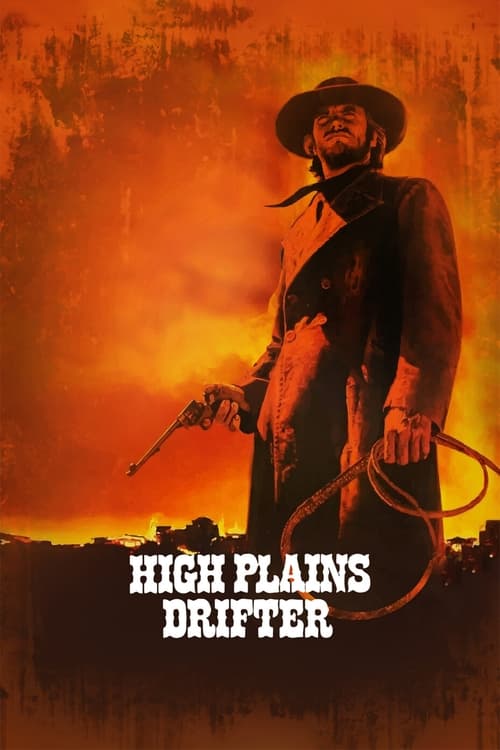
High Plains Drifter
1973 · Clint Eastwood
For when you want your Western with a nasty streak and a whiff of the supernatural — a slow-burn revenge mood, not a white-hat comfort watch. Best late at night, when ambiguity goes down easiest.
What it's about
A nameless stranger rides out of the desert haze into Lago, a small lakeside mining town with something rotten under its floorboards. Within minutes he's killed three men who pushed him too far, and the nervous townsfolk — expecting worse trouble on the way in the form of three returning outlaws — hire him for protection. He accepts, on his own terms, and his terms get stranger and more unsparing as the town's buried guilt comes into the light.
The experience
Mean, eerie, and darkly funny — a Western that keeps sliding toward ghost story, with a mounting sense that the stranger knows more about this town than he should. It's tense and unsettling rather than rousing; the heat shimmer never quite lifts.
Performances
Clint Eastwood weaponizes his own screen persona — the squint, the silence, the menace — and lets you wonder for the whole film whether this stranger is a man, a ghost, or a judgment.
The craft
Directing his first Western, Eastwood fuses the amoral gunslinger he built with Sergio Leone to American revenge-movie machinery, then pushes it past realism into allegory. The lakeside town was built full-scale for the film, and the widescreen desert light gives the whole thing a mirage-like unreality.
Why it matters
It announced Eastwood as a director with his own vision of the Western — darker and more morally ambiguous than his star image suggested — and it set the course for the revisionist Westerns he'd keep making for decades.
Snapshot
High Plains Drifter is the film in which Clint Eastwood, directing his second feature and his first Western behind the camera, fused the amoral gunslinger he had built with Sergio Leone to the moral machinery of the American revenge Western — and then pushed it past realism into allegory. A nameless Stranger rides out of a heat shimmer into the lakeside mining town of Lago, kills three men within minutes, and is hired by the guilt-ridden townsfolk to defend them against outlaws they themselves betrayed. What he delivers instead is judgment: he has the town literally painted red and rechristened "Hell," then presides over its destruction. The picture works simultaneously as a lean genre thriller and as a supernatural morality play whose central question — is the Stranger a ghost, an avenging brother, or the returned dead marshal himself? — the film deliberately never resolves. It is Eastwood's most stylized and most openly mythic Western, a hinge between the Leone persona and the darker revisionism that would culminate two decades later in Unforgiven.
Industry & production
The film was a product of Eastwood's Malpaso Company, the lean production outfit through which he controlled his own projects, released via Universal Pictures. Robert Daley, Malpaso's habitual line producer, produced. By 1973 Eastwood was among the most bankable stars in the world on the strength of the Leone "Dollars" trilogy and the recent Dirty Harry (1971, dir. Don Siegel); High Plains Drifter was made inside that leverage, on a modest budget and a famously efficient schedule that reflected Malpaso's ethos of shooting fast, printing few takes, and keeping crews small and loyal.
The production's signature decision was to build the town of Lago from scratch on the shore of Mono Lake in California, its pale volcanic tufa and alkaline flats supplying an otherworldly, purgatorial backdrop that no standing Western set could offer. The full town was constructed as a practical location so that it could be painted red and, in the climax, burned — an approach that gave the film its concrete sense of place and made its apocalyptic ending physically real rather than a matter of process shots. Reliable, non-inflated figures on the exact building count and budget vary in the secondary literature, so I won't assign specific numbers here; the salient and well-attested fact is that the town was purpose-built to be defaced and destroyed on camera.
Technology
High Plains Drifter was shot on 35mm in anamorphic widescreen (Panavision) and released in color, the standard high-end format for a studio Western of the era. Its technical character is defined less by novel equipment than by an aesthetic of available and heavily controlled light. Cinematographer Bruce Surtees — nicknamed the "Prince of Darkness" for his willingness to let faces and interiors fall into deep shadow — used the format's width for isolating figures against the lake's emptiness and its latitude for underexposure to render the flashback and night material in bruised, low-key tones. The Mono Lake location itself functioned as a kind of technology of atmosphere: the natural haze, dust, and reflected glare off the water are woven into the film's supernatural register rather than corrected away.
Technique
Cinematography
Surtees's photography is the film's most celebrated craft element. The opening — the Stranger materializing out of the horizon's heat distortion and dissolving back into it at the close — treats the widescreen frame as a threshold between the natural and the uncanny. Interiors are lit with a restraint that keeps the town's guilty faces half in darkness, while the whipping flashbacks are pushed toward harsh, desaturated, near-nightmare contrast. Surtees repeatedly uses the flat, reflective expanse of Mono Lake to strand the Stranger and the town in a landscape that reads as neither quite real nor quite hell, and his framing favors the low, mythologizing angle on Eastwood that the Leone films had codified.
Editing
Ferris Webster, a veteran cutter who worked frequently with Eastwood, edits with the economy Malpaso prized. The gunfights are dispatched with sudden, unsentimental speed — violence arrives and is over — while the recurring flashback to Marshal Jim Duncan's murder is doled out incrementally, withheld and then completed, so that the town's secret and the Stranger's motive are revealed to the audience on a curve rather than in a single expository block. That structural patience is the film's chief narrative engine.
Mise-en-scène / staging
The film's boldest gesture is environmental: the Stranger orders Lago painted red and its welcome sign changed to "HELL," transforming the mise-en-scène itself into a statement of theme. The town becomes a literalized moral condition. Staging elsewhere leans on ritual and humiliation — the Stranger installs the marginalized dwarf Mordecai (Billy Curtis) as both sheriff and mayor, an inversion that exposes the townspeople's hypocrisy through the arrangement of bodies and power in the frame. The climactic conflagration, staged against the lake at night with the red town in flames, is the culmination of a design logic that has been building since the first act.
Sound
Dee Barton, who had scored Eastwood's Play Misty for Me, composed the music. His score eschews the sweeping romanticism of the classical Hollywood Western for something sparer and more dissonant — closer to unease than to heroism — with instrumental colors that reinforce the film's spectral tone. The soundscape more broadly foregrounds wind, whip-cracks, and gunfire against the town's silences; the recurring sound of the lash is a motif in its own right, binding the present-day action to the buried crime.
Performance
Eastwood's Stranger is a refinement of the Man with No Name — laconic to the point of near-silence, physically economical, his authority conveyed through stillness and the withholding of reaction. But the performance is deliberately colder and more punitive than the Leone iterations; charm is largely stripped out, replaced by an implacability that suits a figure who may not be alive. Around him, the ensemble plays the townspeople as a study in collective cowardice and complicity — Verna Bloom's Sarah Belding registers the film's lone moral consciousness, while Billy Curtis's Mordecai supplies its most humane and its most pointed note. Marianna Hill and Mitchell Ryan anchor the town's more overt corruption. The supporting playing is pitched, appropriately, toward types rather than psychological realism, in keeping with the film's parable structure.
Narrative & dramatic mode
The dramatic mode is allegory wearing the clothes of the revenge Western. On the surface it follows a familiar hired-gun plot: outsider protects a town from returning outlaws. Beneath it runs a supernatural retribution fable in which the "protection" is a pretext for punishing the protected. The screenplay's key device is the withheld flashback of Marshal Jim Duncan being bullwhipped to death in the street while the townsfolk watch and do nothing — a crime the town has buried, literally and figuratively, having failed even to mark his grave. The Stranger's project is to make the town enact its own damnation. The film sustains a productive ambiguity about his nature: dialogue and the final graveside exchange with Mordecai strongly imply a supernatural identity — the murdered marshal's ghost or avenging kin — but the picture refuses to confirm it, and Eastwood has spoken of leaving that reading open. This irresolution is not a flaw but the film's governing dramatic principle.
Genre & cycle
High Plains Drifter belongs to the demythologizing Western cycle of the late 1960s and 1970s, the moment after Peckinpah's The Wild Bunch (1969) and the Leone films had corroded the classical genre's faith in the frontier's moral clarity. It sits at the intersection of several strands: the revenge Western, the "stranger rides into a corrupt town" template descended from Shane and, more pointedly, from Leone's own reworkings, and — most distinctively — the horror-inflected or supernatural Western, a comparatively rare hybrid that the film helped legitimize. Its town-as-hell conceit and its ambiguously undead avenger make it an anti-Western that turns the genre's redemptive arc inside out: here the community is not worth saving, and the gunfighter is an instrument of damnation rather than deliverance.
Authorship & method
As director-star, Eastwood was here consolidating the working method that would define his career: Malpaso's speed and thrift, a trusted repertory of collaborators, and an unfussy, decision-forward approach on set learned in large part from Don Siegel and observed under Leone. The screenplay is credited to Ernest Tidyman, the Oscar-winning writer of The French Connection and creator of Shaft, whose script supplied the town's guilty secret and the avenger structure; accounts of the era also credit uncredited script work by Eastwood's frequent collaborator Dean Riesner, though the precise division of authorship is not something I can document with certainty. Behind the camera, the film is very much the product of Eastwood's core craftsmen: Bruce Surtees (cinematography), whose shadow-drenched style shaped the look; Ferris Webster (editing); and Dee Barton (music). The through-line of these collaborations across Eastwood's early directing work is central to why the film feels of a piece with his emerging authorial voice, even as it is his most stylistically extreme Western.
Movement / national cinema
This is an American studio film, but its DNA is transatlantic. It is unthinkable without the Italian Western — the Leone pictures that made Eastwood a star — and it carries the European genre's stylization, moral coldness, and mythic abstraction back into a Hollywood production. As such it exemplifies the two-way traffic between American and Italian genre cinema in this period: Hollywood absorbing the "Spaghetti" Western's revisionist attitude and returning it, reprocessed, to domestic screens. Within American cinema it belongs to the New Hollywood's genre revisionism, though Eastwood's populist instincts kept him somewhat apart from that movement's auteurist mainstream.
Era / period
Released in 1973, the film is squarely a product of Vietnam- and Watergate-era American disillusionment, when institutional authority and civic virtue were under broad cultural suspicion. Its portrait of a town that watched a lawful man murdered and then lied about it — a community whose respectability rests on buried guilt — reads naturally as an allegory of complicity and moral evasion attuned to its moment, without the film ever making a topical reference. It arrived at the tail end of the American Western's commercial dominance, as the genre that had defined Hollywood for decades was contracting, which lends its scorched-earth vision an additional, almost self-immolating charge.
Themes
The film's controlling themes are guilt and complicity — the collective sin of bystanders who permit an atrocity — and retribution as damnation rather than justice. Its most literal image, the town painted red and renamed Hell, makes vengeance indistinguishable from judgment: the Stranger does not restore order but exposes and consumes a community that had none worth restoring. Related motifs include the return of the repressed (the unmarked grave, the recurring whip flashback, the dead who will not stay buried); the hollowness of frontier respectability; and the ambiguity of the avenger's own nature, which keeps the moral status of his violence permanently unsettled. Unlike the classical Western, the film offers no reconciled community at the end — only smoke, a marked grave, and a departure back into the mirage.
Reception, canon & influence
Critical reception in 1973 was mixed but substantially engaged, with the film's stylization and supernatural ambiguity drawing both admiration and unease; it performed well commercially, confirming Eastwood's viability as a director and not merely a star. I won't cite specific grosses or review quotations, as reliable figures and exact wording vary across sources — but the film's commercial success and its polarizing critical profile are well established. A frequently recounted anecdote — that John Wayne wrote to Eastwood objecting that the film misrepresented the pioneering spirit of the West — has been repeated by Eastwood himself and neatly encapsulates the generational and ideological gulf the picture opened between the classical Western and its revisionist successor; I flag it as an oft-told account rather than a documented exchange I can quote.
Influences on the film (backward): the Leone Westerns and the No Name persona; the corrupt-town and lone-avenger structures of the genre from Shane through the Italian Western; Peckinpah-era violence and disillusionment; and the horror tradition's revenant figure, grafted onto Western iconography.
Legacy (forward): High Plains Drifter is the clear ancestor of Eastwood's own Pale Rider (1985), which revisits the ghostly-avenger-in-a-mining-community premise more explicitly, and it stands as an important station on the road to Unforgiven (1992), where Eastwood's interrogation of Western violence reaches its mature, elegiac form. More broadly the film helped establish the supernatural or "weird" Western as a viable mode and has been repeatedly cited by later filmmakers working the horror-Western seam. Within Eastwood's filmography it endures as the boldest early proof that he could direct as distinctively as he could perform — a Western that burns down the genre's town and rides off into the same haze it came from.
A Deleuzian reading
He comes out of the heat.
The full Deleuzian reading of High Plains Drifter →
Reception
A solid hit in 1973 but unnerving to critics who expected a straight Eastwood oater — some called it nasty and nihilistic. It's since been canonized as the key that unlocks late Eastwood: the revisionist, near-supernatural Western that points straight at Pale Rider and Unforgiven.
How High Plains Drifter was received, from release to now →
Influences: the films it descends from and the films it influenced
- A Fistful of Dollars (1964) — Establishes the near-silent 'Man With No Name' Eastwood inhabits again here — the laconic stranger who withholds intention, communicated through squint, poncho and economy of movement rather than dialogue.
- The Good, the Bad and the Ugly (1966) — Source of the anamorphic-widescreen mythologizing grammar Drifter borrows: figures isolated low against vast sky, plus Morricone's dissonant, non-orchestral scoring that Dee Barton echoes with his atonal cues.
- Once Upon a Time in the West (1968) — Direct model for the incremental, withheld flashback — Harmonica's motive dripped out in fragments until the final reveal — which Drifter reworks as the Stranger's gradually disclosed flogging in the street.
- Shane (1953) — Supplies the lone-rider-into-a-besieged-community structure and the stranger framed against landscape as near-mythic arrival, the template Tidyman's avenger-in-a-guilty-town script inverts.
- High Noon (1952) — Origin of the townsfolk-who-betray-their-protector engine; Drifter weaponizes that communal cowardice by making the town's collective guilt the literal subject of its supernatural reckoning.
- Yojimbo (1961) — Kurosawa's stranger who plays a corrupt town's factions against each other is the staging blueprint (via Leone) for how the Stranger seizes and manipulates Lago's power structure.
- The Wild Bunch (1969) — Sets the revisionist register of disillusioned, stylized frontier violence that Drifter assumes as a given, treating brutality as moral indictment rather than heroic action.
- The Beguiled (1971) — Eastwood's directing apprenticeship with Bruce Surtees behind the camera — the shadow-drenched, underlit low-key style Surtees carries directly into Drifter's murk and hard chiaroscuro.
- Dirty Harry (1971) — The Siegel school of fast, thrift-driven, decision-forward shooting that Eastwood systematized as the Malpaso method deployed on Drifter's economical production.
- The Night of the Hunter (1955) — Precedent for grafting expressionist horror lighting and a revenant-like menace onto Americana — the visual logic Drifter uses to make a Western town feel like a haunted stage.
- Bad Day at Black Rock (1955) — Direct descendant of the guilty-town template: a stranger rides into an isolated settlement harboring a collective secret of complicity in a murder, forcing the community to face what it hid.
- The Outlaw Josey Wales (1976) — Eastwood and Surtees carry forward the mythologizing low-angle framing of the laconic avenger, refining the same shadow palette and terse-stranger performance built on Drifter.
- Pale Rider (1985) — Explicitly re-stages Drifter's premise — an ambiguous ghostly avenger arriving to a wronged mining community — making the revenant subtext textual via the Preacher's unhealed bullet scars.
- Unforgiven (1992) — Matures Drifter's interrogation of Western violence into elegy: Munny as a near-spectral figure returning to kill, the deliberate moral ambiguity now the film's entire argument.
- Dead Man (1995) — Extends the supernatural/'weird Western' mode Drifter legitimized — a protagonist who may already be dead moving through a stylized, dread-soaked frontier as purgatorial landscape.
- Django Unchained (2012) — Openly inherits the spaghetti-Western framing and dissonant needle-drop scoring lineage, and revives the whip-crack as a sonic-thematic motif of frontier vengeance echoing Drifter's whip-driven flashback.
- The Proposition (2005) — Shares the revisionist-Western project of a morally scorched frontier and an avenger structure, using dissonant scoring and heat-hazed staging in the same anti-mythic vein.
Similar films
- The Outlaw Josey Wales (1976) — influence & lineage · same viewing thread
- Shane (1953) — influence & lineage · same viewing thread
- The Wild Bunch (1969) — influence & lineage · same viewing thread
- High Noon (1952) — influence & lineage · same viewing thread
- A Fistful of Dollars (1964) — influence & lineage
- Unforgiven (1992) — influence & lineage
- Once Upon a Time in the West (1968) — influence & lineage
- The Good, the Bad and the Ugly (1966) — influence & lineage
All the films related to High Plains Drifter →
Watch it with: curated runs of related films
- Print the Legend — A run of frontier myths and their unmaking — town-taming marshals, aging gunfighters, and the stories the newspapers chose to print instead of the truth.