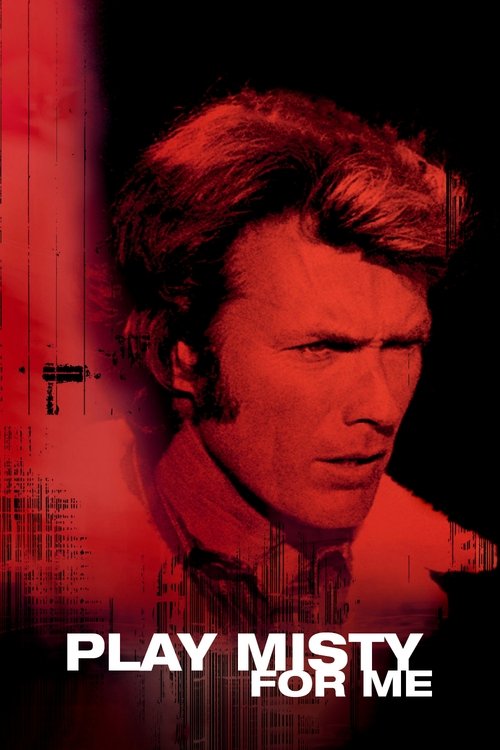
Play Misty for Me
1971 · Clint Eastwood
For when you want a tight, old-school stalker thriller with a lounge-era cool — the kind of film you put on when 'obsession gone wrong' sounds like exactly the right flavor of tense. Unnerving but very watchable.
What it's about
A late-night jazz DJ in Carmel, California keeps getting the same breathy request on the request line: play 'Misty.' The caller turns out to be a fan, and after a casual one-night stand she begins treating their fling as a claim on his life — showing up uninvited, escalating from devotion to menace — just as he's trying to rebuild things with the woman he actually loves.
The experience
A slow coil of dread inside a breezy coastal idyll — jazz, ocean light, and an easy bachelor life that curdles scene by scene into something frightening. It's suspense built on social awkwardness turning dangerous, and the final stretch really bares its teeth.
Performances
Jessica Walter is the reason to watch: her Evelyn pivots from flirtatious to wounded to volcanic within single scenes, making the obsession feel alive and unpredictable rather than cartoonish. Eastwood smartly plays the target as charming but complacent, a man slow to see the danger he's invited in.
The craft
Eastwood's directing debut is confident and economical — shot on location in his own hometown, using Carmel's fog, cliffs, and jazz-club intimacy as both seduction and trap. The use of Erroll Garner's 'Misty' and a famous Roberta Flack interlude give it a musical texture most thrillers don't have.
Why it matters
It launched Eastwood's half-century directing career and effectively invented the obsessed-lover thriller, a template Hollywood would return to for decades.
Snapshot
Play Misty for Me is Clint Eastwood's first film as director, and one of the first American films to center a woman's obsessive pursuit of a man as a source of terror. Dave Garver (Eastwood) is a late-night jazz disc jockey on a small station in Carmel-by-the-Sea, California. Every night a caller asks him to play Erroll Garner's standard "Misty." The caller turns out to be Evelyn Draper (Jessica Walter). After a casual one-night stand she begins to make claims on him, which grow into stalking, self-harm, and finally murderous violence. Meanwhile Dave tries to win back his former girlfriend, Tobie Williams (Donna Mills). The film was a modest production, shot mostly on location in the director's own home town. It showed that Eastwood, then becoming one of the biggest box-office stars in the world, could direct a tight, commercially sound thriller. It also anticipated, by about fifteen years, the "fatal attraction" cycle of the late 1980s and 1990s. In Eastwood's career it is the first piece of a long authorial project: a star using his own image to question the masculine personas he embodied.
Industry & production
By 1970 Eastwood had come back from Sergio Leone's Italian westerns as a major star. He had set up his own company, Malpaso, to keep control over his projects. The story came from Jo Heims, a writer Eastwood had known for some years, who had written a treatment about a woman fixated on a man. Eastwood optioned it. The screenplay is credited to Heims and Dean Riesner, who also worked on Dirty Harry (1971). Robert Daley, a longtime Eastwood associate, produced for Malpaso, and Universal financed and distributed.
Universal's terms reflected a studio hedging on a first-time director. It is widely reported that Eastwood took no directing fee and accepted a share of profits in its place, and that the budget was kept under a million dollars. Exact figures vary between accounts. The shoot is remembered for its speed and economy. It came in ahead of schedule and under budget, which became the signature of Eastwood's production style. The story's setting was moved to Carmel and the Monterey Peninsula, where Eastwood lived. That let him shoot in places he knew well, including a real local radio station, KRML, and coastal houses and bars. It also kept costs and logistics simple.
Don Siegel, who had just directed Eastwood in Coogan's Bluff (1968), Two Mules for Sister Sara (1970), and The Beguiled (1971), and was about to direct Dirty Harry, plays Murphy, the bartender. Accounts say Eastwood cast his mentor partly as a good-luck gesture, and Siegel's presence on set gave the debutant support. The production also filmed at the 1970 Monterey Jazz Festival. That footage appears in a documentary-style interlude featuring performers including the Cannonball Adderley Quintet and the Johnny Otis Show.
The film was released in autumn 1971, only weeks before Dirty Harry. That timing made Eastwood's year remarkable: his directorial debut, a Siegel-directed Southern gothic, and the police thriller that would define his image all reached audiences within a few months. Play Misty for Me did solid business for its cost and was profitable. It was not a blockbuster, but it established Eastwood as a reliable director in Universal's eyes and in the industry's.
Technology
The film uses the ordinary tools of early-1970s studio filmmaking: 35mm color, a flat widescreen (1.85:1) frame, and lightweight equipment of the kind that made location shooting easier during the New Hollywood period. Its technical interest lies less in innovation than in how it uses that portable, location-ready toolkit. Real interiors, natural coastal light, and a working radio booth give it a grounded texture. In 1971 that set it apart from the backlot polish of older studio thrillers. The concert footage, shot at a live event with the handheld, multi-angle methods of contemporary music documentaries, brings a vérité element into a fictional film. The record does not suggest any unusual camera, stock, or sound system was developed for the production.
Technique
Cinematography
Bruce Surtees shot the film. It was the start of a long partnership with Eastwood that included Dirty Harry, High Plains Drifter (1973), The Outlaw Josey Wales (1976), and Tightrope (1984). Surtees became known for low-key lighting and a willingness to let faces and spaces sink into shadow, which earned him the nickname "Prince of Darkness." In Misty that taste is still developing but already visible. The radio-booth scenes and night interiors are lit sparsely, so Dave's voice seems to carry out of darkness. Daylight sequences on the Carmel coast have a bright, almost tourist-brochure openness. That contrast matters dramatically: Evelyn's threat grows inside a world that looks idyllic. The opening aerial shots over the Monterey coastline set up this setting as a place of beauty and isolation.
Editing
Carl Pingitore edited the film. He had worked on Dirty Harry and was associated with Siegel's lean, propulsive cutting. For a thriller the overall rhythm is unhurried, and some critics then and since have found the middle section slack. The jazz-festival sequence and the long romantic montage set to Roberta Flack's "The First Time Ever I Saw Your Face" stop the suspense for several minutes. Read generously, these passages are a deliberate breather and a portrait of the life Dave stands to lose. The attack scenes, by contrast, are cut sharply and abruptly in the manner of Psycho (1960), with fragmented shots of the knife, the victim, and Evelyn's face. Evelyn's repeated, unexpected appearances are also edited for shock. She keeps turning up where she should not be, and the cutting withholds her approach until she is already present.
Mise-en-scène / staging
The staging relies on the contrast between public and private space in a small community. Dave's house is open and full of glass, set beside the sea, and it can be entered too easily. Evelyn exploits that openness, and the climax at a cliffside house turns the landscape's beauty into danger. The radio booth is the film's main image. Dave is alone, speaking intimately to listeners he cannot see, and the phone line becomes a channel for intrusion. The bar where Dave and Murphy talk offers a familiar, masculine refuge that Evelyn first enters as a pickup and later disrupts. Eastwood's direction is plain and practical. He favors clear spatial geography over flourish, which makes the sudden violence more jarring.
Sound
Sound is central both to the plot and to how the film works. The title is a radio request, and the "Misty" motif ties sound to obsession: the song Dave plays for a stranger becomes the sign of a relationship he cannot end. Dee Barton composed the original score. Its suspense cues are fairly conventional, but the film's musical identity comes from its source music. Garner's "Misty," the Monterey festival performances, and above all Roberta Flack's recording of Ewan MacColl's "The First Time Ever I Saw Your Face" carry much of the feeling. Flack's track had been released a couple of years earlier without great success. After its use here it became a major hit in 1972, an often-cited example of a film reviving a song's fortunes. Eastwood, a lifelong jazz enthusiast who later composed scores for his own films, chose music that announces his personal taste. That is an early sign of an authorial signature that continued through Bird (1988) and beyond.
The voice is also a sound object. Dave's late-night delivery, low and relaxed, is what draws Evelyn. When her voice comes over the phone, purring the request, the medium that makes him desirable becomes a vector for menace.
Performance
Jessica Walter's Evelyn is the film's lasting achievement. She switches between charm, neediness, wounded pride, and violent rage, often within one scene. That volatility is what makes the character frightening, and it kept the role from collapsing into a cardboard villain. Walter received a Golden Globe nomination for Best Actress in a Drama. Her performance is the main reason the film is still discussed. Eastwood underplays Dave with a laconic, self-satisfied ease that the film gradually undercuts. Dave is a likeable womanizer who cannot imagine that his casual approach to sex might have consequences. Donna Mills's Tobie is gentle by design, a stable contrast to Evelyn. John Larch as Sergeant McCallum, Clarice Taylor as the housekeeper Birdie, and Siegel's cameo fill out a supporting cast of working professionals.
Narrative & dramatic mode
The narrative is a linear escalation, built in stages: request, pickup, the first intrusions, public humiliation, a suicide attempt, violent assault, an apparent resolution, and a final return. The middle section steps away from the threat to show Dave and Tobie's relationship, and that slowdown makes the final act's escalation hit harder. The film's mode is suspense rather than mystery. The audience knows almost immediately who Evelyn is and what she is capable of, so the tension lies in when and how she will strike. A late twist reveals that Evelyn, apparently gone, has been living as Tobie's new roommate under a false name, "Annabel." The name recalls Edgar Allan Poe's "Annabel Lee," which Evelyn quotes, with its "kingdom by the sea." The climax is a physical confrontation in which Dave fights Evelyn and knocks her over a cliff edge into the ocean, while her request, "Misty," plays on the radio. The ending offers release without much reassurance. Dave survives, but the film never examines his share in the disaster in depth.
Genre & cycle
The film combines the psychological thriller with the romantic drama and turns the conventions of the woman-in-peril story around: here the man is the target. Its lineage runs back to Hitchcock, especially Psycho's sudden knife violence and its interest in disturbed psychology. It also echoes earlier films about women made monstrous by unreturned love, such as Leave Her to Heaven (1945). In its own moment it belongs with a group of early-1970s films about sexual anxiety in the post-1960s landscape of permissiveness, and with Eastwood's other 1971 films. The Beguiled in particular also shows a man punished for treating women as interchangeable.
In retrospect the film is often seen as a forerunner of the "fatal attraction" or "psycho-femme" thriller. That cycle was fully formed with Fatal Attraction (1987) and continued through The Hand That Rocks the Cradle (1992), Single White Female (1992), Basic Instinct (1992), and Swimfan (2002), among others. It also sits alongside the stalker-fan thriller (The Fan, 1981 and 1996; Misery, 1990), which shares its interest in the intimacy between a public figure and an obsessive admirer.
Authorship & method
Clint Eastwood (director, star). The film introduces the working method Eastwood kept for decades: a small, loyal crew, minimal takes, efficient schedules, location shooting, and a dislike of overcoverage. Both Siegel and Leone have been cited as formative influences. From Siegel he took economy and directness. From Leone he took a sense of the star's physical presence and of the value of silence and stillness. The project's authorial interest is that Eastwood, as both star and director, chose to cast himself as a vain, emotionally careless man who causes his own torment. That anticipates the self-critical treatment of masculine figures in later films such as Tightrope, Unforgiven (1992), and Gran Torino (2008).
Jo Heims (story, co-writer) and Dean Riesner (co-writer). Heims's original premise supplies the film's central idea. Riesner, an experienced screenwriter who worked with Siegel and Eastwood, is generally credited with tightening its structure. How they divided the work is not documented in detail.
Bruce Surtees (cinematography). This began one of Eastwood's most important collaborations. Surtees's shadow-heavy lighting helped define the look of 1970s Eastwood films.
Carl Pingitore (editor). He brought Siegel-school economy to the suspense set pieces.
Dee Barton (composer). Barton was a jazz musician and arranger, previously a member of Stan Kenton's band. That fits a film built around jazz. His original score is functional and supports the source music that gives the film its identity.
Robert Daley (producer). Daley ran Malpaso's productions through the 1970s and was a key figure in Eastwood's model of a fiscally disciplined, star-controlled production.
Movement / national cinema
This is American studio filmmaking made in the conditions of the New Hollywood era. A star-run independent company worked under a major studio's distribution umbrella, which gave the director more control in exchange for financial modesty. It is not part of New Hollywood in the auteurist, countercultural sense of Easy Rider (1969) or Five Easy Pieces (1970). But it shares that era's taste for location realism, frank sexuality, and moral ambivalence. The Malpaso model, with its low budgets, tight schedules, and star-director control, became an alternative path through the American industry that Eastwood followed for more than half a century.
Era / period
Released in 1971, the film reflects a culture in the aftermath of the sexual revolution. Casual sex was more openly portrayed, yet anxiety persisted about what it might cost. Dave's carefree bachelor lifestyle, with its jazz, sea views, and nights out, is presented as appealing and then shown to be fragile. The rising women's movement adds a layer of complication. Critics have read Evelyn both as a misogynist projection of male fears about female sexual assertiveness and as a figure whose demands reveal how disposable the casual sexual economy makes women. The film's late-night FM radio culture is also a period detail: an intimate, voice-based medium in which a DJ could build a personal relationship with listeners he never met.
Themes
- Intimacy and intrusion. The radio voice reaches into listeners' private lives, and Evelyn reverses that flow by intruding into Dave's.
- Male narcissism and its consequences. Dave assumes his casual sex carries no obligations. The film punishes that assumption, though how far it endorses Evelyn's suffering as a moral lesson is open to debate.
- Female madness as threat. Evelyn shows the film's reliance on, and in Walter's performance its partial complication of, the figure of the dangerous, unstable woman. Feminist criticism has repeatedly returned to this point.
- Paradise threatened. The Carmel coast is an idyll that the film turns into a site of violence. That pattern became something of a template for domestic thrillers.
- Music and memory. "Misty" and Flack's ballad carry emotional and obsessive meaning, connecting desire, memory, and repetition.
Reception, canon & influence
Critical reception. Reviews in 1971 were generally favorable, though not ecstatic. Critics singled out Walter's performance and expressed surprise at how assured Eastwood's debut was. Many noted his skill with suspense and atmosphere, while some thought the romantic and jazz-festival interludes weakened the momentum. Its standing has risen over time with Eastwood's reputation as a director. It is now regarded as a strong genre debut and as a key early text for anyone studying his work.
Influences on the film. Hitchcock is the clearest model, especially Psycho's knife attacks and its interest in psychological disturbance. Siegel's lean action style and Leone's handling of the star body shaped Eastwood's approach. The film also draws on the long tradition of the obsessive-lover melodrama and on Poe's romantic morbidity, which it cites directly.
Legacy. Play Misty for Me is widely acknowledged as an ancestor of Fatal Attraction and the stalker thriller that followed. Many commentators note the narrative parallels: a casual affair, escalating obsession, self-harm, threats to a rival partner, and a final violent return. It helped revive Roberta Flack's ballad as a hit. For Eastwood it established a directing career that went on to win two Academy Awards for Best Director. It also introduced his habit of examining and complicating his own screen persona. The line "Play 'Misty' for me" entered popular culture as shorthand for an obsessive admirer. In criticism the film is still a reference point for discussions of gender, sexual politics, and the figure of the predatory woman in American cinema.
Influences: the films it descends from and the films it influenced
- Psycho (1960) — Evelyn's knife attacks on the housekeeper and on Dave copy the Psycho shower murder's grammar: very short shots of a raised blade and a shrieking face, cut together so the violence seems to happen between the frames.
- Laura (1944) — Laura made a repeated theme song (Raksin's melody) the audible form of a man's fixation on a woman, and Misty turns that idea around by making a requested ballad on the radio the caller's signal of obsession.
- Leave Her to Heaven (1945) — Gene Tierney's possessive wife, who destroys every rival for her husband's attention and is shot in idyllic daylight landscapes, is the template for Walter's sunlit, smiling menace in Carmel.
- Coogan's Bluff (1968) — Siegel cast Eastwood as a womanizer whose casual seductions turn back on him, including a jealous hippie girl who sets him up. Misty takes over that self-deflating sexual persona along with the lean, low-coverage Riesner-scripted pacing.
- The Beguiled (1971) — It was shot the same year with the same star. Eastwood plays a manipulative charmer brought down by women he underestimated, and the film's gothic sexual punishment of Eastwood's body is the dark twin of Misty's stalker plot.
- High Plains Drifter (1973) — Eastwood's second film as director kept Surtees's low-key lighting, the small Malpaso crew and the few-takes method, and again made his own star persona an object of moral scrutiny instead of simple heroism.
- Breezy (1973) — It extends Misty's Carmel-area romance interludes into a full film: unhurried location shooting and a jazz-inflected score that observe a middle-aged man's emotional evasions.
- Tightrope (1984) — In this Malpaso production Eastwood's own sexual compulsions are the source of danger, and Misty's question of what the star's desire costs becomes the explicit theme, in Surtees-style noir night lighting.
- Bird (1988) — The Monterey Jazz Festival footage in Misty is the first sign of Eastwood's jazz-as-authorial-signature, which Bird expands into a full biopic built around source recordings.
- Fatal Attraction (1987) — It copies Misty's beat structure nearly point for point: a one-night stand, wrist-slashing self-harm, intrusion on the lover's real partner, and a final presumed-dead return attack. That makes it the key film of the cycle Misty began.
- The Hand That Rocks the Cradle (1992) — It reuses the inverted woman-in-peril structure in which a smiling female intruder works her way into the domestic space and turns the household's own routines into instruments of suspense.
- Single White Female (1992) — Like Evelyn's 'Annabel' alias, which hides her identity until the reveal, Hedy's identity theft and mimicry use false identity as the obsessive's weapon and the plot's turning point.
- Unforgiven (1992) — It finishes the persona interrogation Misty started, with Eastwood again directing himself as a man whose past self-indulgence comes back as violent consequence.
- The Fan (1996) — The stalker is now a male fan fixated on a sports star, but the film keeps Misty's device of a broadcast celebrity whose public medium, here a sports-radio call-in, becomes the stalker's channel of contact.
- Swimfan (2002) — A teen remake of the Misty/Fatal Attraction template: a casual fling with a jealous girl escalates through phone and message intrusions, and the rival girlfriend is attacked in a staged final return.
- Obsessed (2009) — It is a late entry in the cycle that keeps Misty's endgame intact, with the spurned obsessive invading the home and fighting the legitimate partner in a climactic struggle.
- Misery (1990) — Founds the fixated-fan premise the dossier names directly — an obsessive admirer who claims violent possession of the artist she idolizes, the parasocial-fixation engine Annie Wilkes inherits.
- Dirty Harry (1971) — Bruce Surtees's crushed-black night photography and Dean Riesner's tight escalation structure were refined on Dirty Harry at the same moment, so the two films share a shadow-heavy look and set-piece rhythm.
- Talk Radio (1988) — It turns Misty's radio-booth staging into a whole film, with the DJ sealed in his glass booth as the anonymous voice of a caller crosses from the airwaves into real threat.
Similar films
- The Beguiled (1971) — influence & lineage
- Fatal Attraction (1987) — influence & lineage
- Dirty Harry (1971) — influence & lineage
- High Plains Drifter (1973) — influence & lineage
- Duel (1971) — shared sensibility
- Sudden Fear (1952) — shared sensibility
- The Prowler (1951) — shared sensibility
- Midnight in the Garden of Good and Evil (1997) — shared sensibility