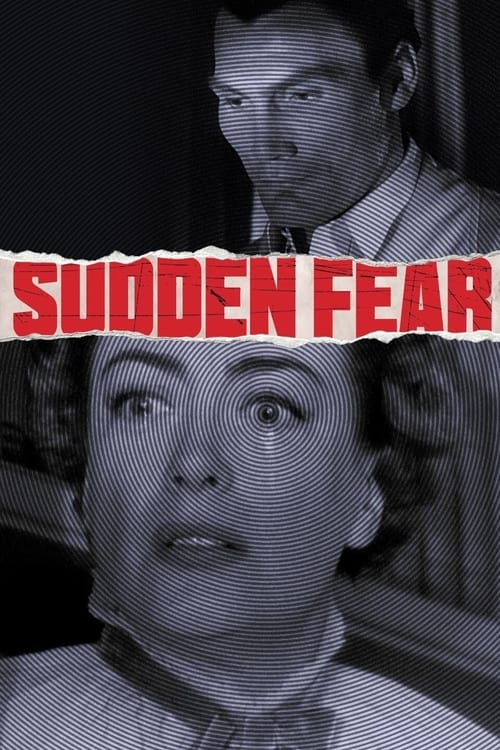
Sudden Fear
1952 · David Miller
For a night when you want classic edge-of-your-seat suspense with adult stakes — pour a drink, turn the lights down, and let it tighten around you. A comfort watch for noir lovers, a nail-biter for everyone else.
What it's about
A wealthy San Francisco playwright rejects an actor from her new play for not looking the romantic-lead part — then finds herself being romanced by him on the long train home, and marries him. Whether his devotion is real is the question the film winds tight: a chance discovery involving a recording machine turns her whirlwind marriage into something far more dangerous, and she has to decide what to do with what she knows.
The experience
Coiled and increasingly airless — it starts as a romance, curdles into paranoia, and spends its last act in nearly unbearable suspense. Much of the tension plays out silently on faces, in shadows, in waiting.
Performances
Joan Crawford, producing her own reinvention outside the studio system, gives one of her great performances — terror, calculation, and heartbreak playing across her face in long wordless stretches. Jack Palance is unnervingly plausible as the charmer, and Gloria Grahame smolders in support.
The craft
The suspense construction is textbook-worthy — the film's central set piece, built around an accidental audio recording, is a small masterclass in letting the audience's dread do the work. Shot in moody black and white, it fuses the woman-in-peril melodrama with full noir shadow and chill, and it earned four Academy Award nominations.
Why it matters
A landmark of the independent star-vehicle — Crawford steering her own late-career comeback — and one of the most admired suspense thrillers of the noir era. Its recorded-conversation device has echoed through the genre ever since.
Snapshot
Sudden Fear is a taut psychological thriller in which a wealthy San Francisco playwright discovers, by accident, that the charming husband she has just married is plotting to murder her — and sets about engineering a counter-plot of her own. Produced independently for release through RKO, it pairs Joan Crawford, then reinventing her career outside the studio system, with the young, hatchet-faced Jack Palance and a coiled Gloria Grahame. The film is best understood as a hybrid: a "woman-in-peril" suspense vehicle in the Gothic-domestic tradition, executed with the visual grammar and moral chill of late film noir. Its central set piece — a heroine learning of her own intended killing from a recording machine that has captured the conspirators by chance — is a small classic of suspense construction, and the picture earned four Academy Award nominations, including Best Actress for Crawford and Best Supporting Actor for Palance. It remains one of the most respected entries in the early-1950s cycle of glossy, anxiety-driven thrillers built around an imperiled woman of means.
Industry & production
Sudden Fear belongs to the wave of independent production that reshaped Hollywood after the 1948 Paramount consent decree loosened the studios' grip on distribution and exhibition. It was made by Joseph Kaufman Productions and released through RKO Radio Pictures, a major then in the turbulent Howard Hughes era. The source was Edna Sherry's 1948 novel of the same name; the screenplay is credited to Lenore Coffee and Robert Smith.
The production is inseparable from Joan Crawford's career strategy. Having left Warner Bros. after the run that began with her Oscar-winning Mildred Pierce (1945), Crawford was operating as a free agent and is widely reported to have taken a financial stake in Sudden Fear, effectively functioning as a star-producer who shaped casting and presentation to her own ends. The casting of Jack Palance — then a relative newcomer with a strikingly unconventional face — is the subject of much-repeated anecdote suggesting Crawford had reservations about his looks for a romantic lead, an irony given that the plot turns precisely on whether a man "looks like" a leading man or a killer. These accounts circulate widely in star biographies but should be treated as Hollywood lore rather than firmly documented fact. What is documented is the result: the film functioned as a prestige showcase, and the Academy responded with nominations for Crawford, Palance, cinematographer Charles Lang, and costume designer Sheila O'Brien.
Technology
Sudden Fear was produced on black-and-white 35mm stock in the standard Academy ratio, before the widescreen revolution that CinemaScope would trigger in 1953. Its technological signature, however, is diegetic rather than photographic: the plot pivots on a sound-recording device — a dictation/transcription machine of the period — that automatically captures the murder conspiracy. The film thus dramatizes mid-century anxieties about recording technology as both threat and salvation, a motif shared with other noir and suspense pictures of the era in which wire and disc recorders expose or incriminate. The mechanical specifics (the machine switching on, the disc as physical evidence, the timing of playback) are exploited for pure suspense, making the apparatus itself a character in the third act. Beyond this, the film relies on conventional studio-era resources — sound stages combined with location work in San Francisco — and makes no claim to technical novelty in its capture or exhibition.
Technique
Cinematography
Charles Lang's Oscar-nominated black-and-white photography is the film's most celebrated craft element. Lang, one of Hollywood's most honored cinematographers, shapes the picture's two-part structure visually: the early San Francisco courtship is comparatively warm and open, while the back half darkens into noir proper, with low-key lighting, deep shadow, oppressive interiors, and high-contrast modeling that isolates Crawford's face in fields of black. The climactic stretch, staged largely at night, exploits stark pools of light and steep contrasts to externalize dread. Lang's camera is attentive to the heroine's point of view — framing her in doorways, mirrors, and confined spaces — so that the architecture of her own luxurious home becomes a trap. The visual logic consistently subordinates spectacle to subjectivity: we are made to see, and fear, with Myra.
Editing
The film's editing (cut by Leon Barsha) is the engine of its reputation. The signature sequence — Myra's discovery of the plot via the recording — is a master class in suspense assembly, intercutting her dawning comprehension with the recorded voices and, later, with her feverish mental rehearsal of a counter-scheme. The picture deploys montage to render anxiety and planning as a rapid cascade of images and superimpositions, compressing internal calculation into visual rhythm. The long climactic pursuit through San Francisco tightens the cutting progressively, accelerating toward a reversal-laden finish. Throughout, the editing modulates between the languor of seduction and the staccato of terror, mapping the film's bifurcated structure onto its very pace.
Mise-en-scène / staging
The staging contrasts wealth and entrapment. Myra's world — the well-appointed home, the trappings of an heiress-playwright — is rendered as both privilege and prison, its grand rooms turned claustrophobic once she knows the truth. The San Francisco setting, with its hills and night streets, supplies a vertiginous geography for the finale. Costume, by the nominated Sheila O'Brien, participates in characterization: Crawford's wardrobe signals status and armor, while Grahame's Irene is styled for a harder, more available sensuality. Staging repeatedly exploits eavesdropping, thresholds, and the gap between what characters perform for one another and what the audience knows.
Sound
Sound is thematically central in a film where a recording exposes a murder plot. The recorded voices of the conspirators — heard by the heroine and by us — convert sound into evidence and weaponize the act of listening. Elmer Bernstein's score (discussed below) carries much of the emotional architecture, swelling through the seduction and clenching through the suspense passages. The interplay of recorded speech, silence, and orchestral underscoring in the discovery scene is among the film's finest effects: the mechanical neutrality of the playback set against Myra's mounting horror.
Performance
Performance is the film's beating heart, and it works through faces. Crawford anchors the picture with a near-silent register of reaction: the celebrated discovery scene asks her to play the entire arc from contentment to devastation to calculation largely without dialogue, in close-up, and it earned her an Academy Award nomination for Best Actress. Jack Palance, in the role that helped establish him, weaponizes his unconventional features — the performance trades on ambiguity, the question of whether his ardor is real, and was rewarded with a Best Supporting Actor nomination. Gloria Grahame, a definitive noir presence, brings a knowing, dangerous edge as the other woman. The triangle generates the film's tension less through what is said than through what is withheld and read.
Narrative & dramatic mode
The film's dramatic mode is suspense in the Hitchcockian sense: the audience is granted knowledge the heroine initially lacks, and later shares her knowledge as she conceals it from her would-be killers. Structurally it falls into two movements — a romance that curdles into a murder plot, and a counter-plot in which the intended victim turns architect of her own survival. The screenplay restricts its perspective largely to Myra, aligning us with her subjectivity, so that discovery, dread, and improvisation are felt from inside. The third act becomes a kind of perverse plotting-within-plotting, the playwright heroine literally scripting a scenario to turn the trap on her betrayer — a self-reflexive flourish given her profession. Irony and reversal drive the climax, where intentions misfire and chance reasserts itself.
Genre & cycle
Sudden Fear sits at the intersection of two overlapping 1940s–50s cycles. The first is the "woman-in-peril" or domestic-Gothic thriller — descended from Rebecca (1940), Suspicion (1941), and Gaslight (1944) — in which a wife comes to suspect that the man she married means to harm her. The second is film noir, whose low-key visual style, fatalism, sexual treachery, and femme/homme fatale figures the film fully inherits; Gloria Grahame's presence alone situates it squarely within noir's iconography. It also belongs to a narrower early-1950s vogue for glossy suspense vehicles built around a glamorous, endangered female star — a niche Crawford would continue to mine, and which connects forward to the later "psychobiddy" or Grand Guignol thrillers of her career. The film's particular contribution to the cycle is its inversion: the imperiled woman is not passive but becomes the active counter-plotter.
Authorship & method
Director David Miller was a capable studio craftsman rather than a celebrated auteur; Sudden Fear is generally regarded as his strongest and most fully realized film. He would return to the glossy-suspense register with Midnight Lace (1960) and direct the well-liked existential Western Lonely Are the Brave (1962), but his reputation rests substantially on the controlled tension he achieves here. The film is best read as a collaboration in which a strong star-producer (Crawford) and elite craftspeople elevate the material.
Among those collaborators, cinematographer Charles Lang brings the prestige of one of Hollywood's most nominated camera artists, supplying the noir lighting that gives the film its menace. Composer Elmer Bernstein, here near the very start of a career that would become one of the most important in American film music, contributes an early dramatic score — Sudden Fear predates his breakthrough work later in the decade and stands as evidence of his early facility. Editor Leon Barsha executes the suspense construction that critics most admire. The writing team of Lenore Coffee (a seasoned, prolific screenwriter associated with women-centered melodrama) and Robert Smith, adapting Edna Sherry's novel, supplies the bifurcated plot and the heroine's subjectivity. The authorship of Sudden Fear, in short, is genuinely distributed — its excellence emerges from the meeting of a star at a strategic career moment with first-rank technicians.
Movement / national cinema
The film is a product of classical Hollywood, specifically its post-war, post-decree phase of rising independent production and the mature film noir style. It is wholly American in idiom — its anxieties (marriage, money, trust, the treachery beneath glamour) and its San Francisco setting are domestic — yet noir's visual debts to German Expressionism are legible in Lang's chiaroscuro. It does not belong to any self-conscious movement; rather, it exemplifies the high craft of the studio system's late phase as practiced by independents working with major-studio resources and talent.
Era / period
Released in 1952, Sudden Fear arrives at a hinge moment. The studio system was contracting under the consent decree and the early pressure of television; widescreen and color were about to be deployed as box-office countermeasures, making this one of the last cohort of major black-and-white, Academy-ratio suspense films before that shift. The picture also reflects period gender currents: a heroine of independent means and professional accomplishment, but one whose vulnerability is framed through marriage and the threat of a predatory husband. Its preoccupation with recorded sound as evidence speaks to a culture increasingly aware of surveillance and mechanical reproduction. And it marks a specific career era for Crawford — the post-Warners, freelance, star-as-entrepreneur phase that kept her viable into the 1950s.
Themes
The film's governing theme is the unknowability of the intimate other — the terror that the person one loves and trusts may be a performer concealing lethal intent. This connects to a sustained meditation on performance and authenticity: Lester is an actor, Myra a playwright, and the plot is literally about whether romantic feeling is genuine or staged, culminating in the heroine writing a counter-"script." Money and class run throughout — the heroine's wealth is both the motive for her betrayal and the gilded cage of her peril. Sound, recording, and evidence form a technological-epistemological thread: truth arrives mechanically, by accident, through a machine. Finally, the film explores female agency under threat, transforming the passive imperiled wife of the Gothic tradition into an active strategist, while remaining ambivalent about how far that agency can carry her against chance and fate.
Reception, canon & influence
Critically, Sudden Fear was well received on release as a superior suspense vehicle and a strong showcase for its stars, and the industry's regard is registered in its four Academy Award nominations — Best Actress (Crawford), Best Supporting Actor (Palance), Best Cinematography, Black-and-White (Lang), and Best Costume Design, Black-and-White (O'Brien) — though it won none. Over time it has retained a solid reputation among noir and Crawford specialists as one of her best post-Warners pictures and as a model of efficient suspense construction, particularly for its recording-discovery sequence.
Looking backward, the film draws on the domestic-Gothic lineage of Rebecca, Suspicion, and Gaslight, and on the broader Hitchcockian suspense method of audience foreknowledge and the imperiled innocent; its visual style descends from the established conventions of 1940s film noir. Looking forward, its most consequential legacy lies with its performers: the role helped launch Jack Palance toward stardom, and the film is frequently cited as a key station in Crawford's reinvention as a star of suspense and, eventually, of the older-woman thrillers that culminated in What Ever Happened to Baby Jane? (1962). David Miller's own Midnight Lace extends the same glossy "wife in danger" formula. Beyond these direct lines, Sudden Fear stands as a durable template for the imperiled-woman-turned-counter-plotter, a structure that recurs across later suspense cinema. Its specific influence on individual subsequent films is not heavily documented in the critical record, and is best described as exemplary rather than singular — a polished, much-admired instance of a cycle rather than a film whose direct imitators are easily named.
A Deleuzian reading
A machine clicks on by accident.
The full Deleuzian reading of Sudden Fear →
Reception
A sleeper hit in 1952 that scored four Oscar nominations, then drifted into semi-obscurity for decades — until a 2016 restoration and streaming rediscovery turned it into the noir circuit's favorite 'why isn't this more famous?' title.
How Sudden Fear was received, from release to now →
Influences: the films it descends from and the films it influenced
- Rebecca (1940) — Establishes the domestic-Gothic template Sudden Fear inherits: the narrative locked to a wife's restricted subjectivity as she reinterprets a marriage from idyll to threat, dread accruing through her gaze rather than overt action.
- Suspicion (1941) — Direct model for the central mechanism — a wife assembling circumstantial evidence that her husband means to murder her — suspense generated from her interpretive paranoia within glossy domestic space.
- Gaslight (1944) — Supplies the husband-as-secret-predator structure and the performance/authenticity theme: a man's loving facade is a sustained act, which Sudden Fear inverts by giving the wife her own counter-performance.
- Shadow of a Doubt (1943) — Pioneers the audience-foreknowledge device Sudden Fear runs on — letting the viewer know a charming intimate is a killer long before the heroine, so tension comes from waiting for her to learn what we know.
- Sorry, Wrong Number (1948) — Closest precedent for recording/transmission-as-evidence: a confined woman overhears a plot to kill her via a sound device, the plot's machinery delivered to her (and us) acoustically, fixing her to a restricted perspective.
- Double Indemnity (1944) — Source for the dictaphone-confession conceit — a crime narrated into a recording machine that becomes physical evidence — plus the high-contrast venetian-blind chiaroscuro noir grammar Lang deploys.
- The Spiral Staircase (1945) — Model for subjective-POV terror and wordless-close-up performance: a heroine unable to speak her danger, menace conveyed through her eyeline shots and low-key staircase chiaroscuro.
- Mildred Pierce (1945) — The picture that reinvented Crawford as a noir-melodrama lead built around female subjectivity and flashback structure — the star-persona engine Sudden Fear restages as suspense.
- Possessed (1947) — Crawford vehicle that anchors the camera inside a woman's unraveling psychology through subjective POV and hallucinatory framing, rehearsing the interior-dread acting Sudden Fear demands of her.
- Dial M for Murder (1954) — Extends the perfect-murder counter-plot with full audience foreknowledge of the mechanics, plus recorded/telephonic evidence — the spouse-plots-spouse architecture Sudden Fear had just refined.
- Les Diaboliques (1955) — Carries forward the imperiled-woman-turned-conspirator structure and the meticulously timed suspense set-piece built around physical evidence, escalating Sudden Fear's accelerating-cut climax method.
- Midnight Lace (1960) — Miller's own return to the formula — a glossy, well-dressed wife-in-danger thriller with a hidden persecutor, directly extending his Sudden Fear suspense register.
- What Ever Happened to Baby Jane? (1962) — Culmination of the Crawford-reinvention line Sudden Fear started: the aging-star imperiled-woman gothic, trading on her face in extended near-wordless duress.
- Wait Until Dark (1967) — Purest heir to the imperiled-woman-becomes-counter-plotter design — a vulnerable heroine engineering her own trap inside a single apartment, suspense keyed to what she alone perceives.
- The Conversation (1974) — Builds an entire film from Sudden Fear's recording-discovery sequence: a playback obsessively replayed and re-cut as the protagonist realizes a recording documents a murder plot, sound editing as the engine of dread.
- Blow Out (1981) — De Palma's apotheosis of recording-as-evidence — a sound technician reconstructs a killing from his audio track — extending the Sudden Fear premise that a captured recording exposes a hidden crime.
- Caught (1949) — Parallel post-war 'wife trapped with a dangerous wealthy husband' noir-melodrama, using gliding camera and lavish domestic interiors as a gilded cage — the same marriage-as-menace milieu.
Similar films
- Double Indemnity (1944) — influence & lineage · same viewing thread
- Rebecca (1940) — influence & lineage · same viewing thread
- Mildred Pierce (1945) — influence & lineage
- The Conversation (1974) — influence & lineage
- Gaslight (1944) — influence & lineage
- Diabolique (1955) — influence & lineage · same viewing thread
- Strangers on a Train (1951) — same viewing thread
- Elevator to the Gallows (1958) — same viewing thread
All the films related to Sudden Fear →
Watch it with: curated runs of related films
- The Golden Age of Suspense — A run of immaculate mid-century crime pictures — Hitchcock plus his sharpest rivals — where guilt, obsession, and dangerous romance are staged in gorgeous black-and-white; watch them close together and the shared DNA of the perfect-murder plot lights up.