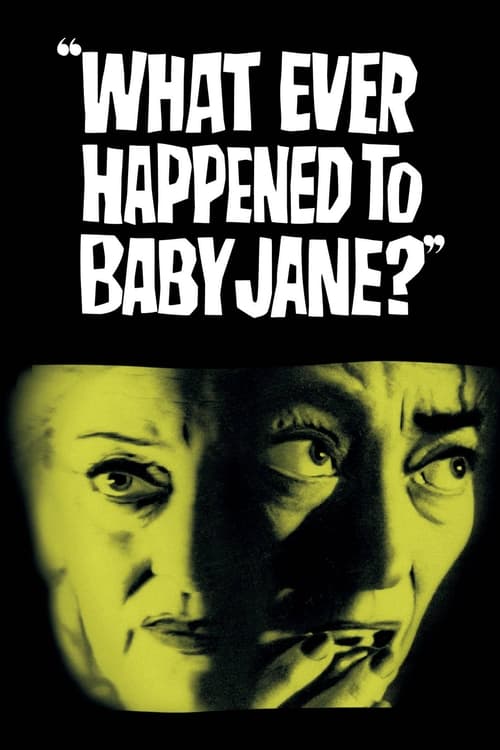
What Ever Happened to Baby Jane?
1962 · Robert Aldrich
For a wicked night in — perfect with a friend and a drink when you're craving high drama, gothic dread, and two legends going for each other's throats. A classic that's genuinely fun, not homework.
What it's about
Two sisters, both faded stars, rot together in a crumbling Hollywood mansion: Blanche, a beloved screen actress left paraplegic by a car accident, and Jane, the former vaudeville child sensation 'Baby Jane,' now a gin-soaked grotesque still performing for an audience that left fifty years ago. As Jane's grip on reality slips, her care of her helpless sister curdles into torment, and the house becomes a trap.
The experience
Deliciously nasty and genuinely frightening — a slow tightening of the screws laced with pitch-black camp, so you're grinning at one scene and holding your breath in the next. The cruelty has real pathos under it, which is what makes it linger.
Performances
Bette Davis is astonishing as Jane, caked in ghoulish makeup she designed to be as grotesque as possible, swinging between menace, baby-talk delusion, and sudden flashes of the lost child underneath. Joan Crawford plays terror from a wheelchair with almost nothing but her face — and the real-life rivalry between the two women hums through every frame.
The craft
Robert Aldrich shoots the decaying mansion in stark black and white, turning staircases, locked doors, and a dumbwaiter into instruments of dread; the famous 'Baby Jane' song is used to skin-crawling effect. Made cheap and fast, it wrings maximum menace from a single house.
Why it matters
A shock hit that revived both stars' careers and spawned an entire subgenre of gothic thrillers built around aging Hollywood actresses — and its behind-the-scenes feud became legend in its own right, later dramatized for television.
Snapshot
What Ever Happened to Baby Jane? is the film that gave horror a new face: not a monster or a haunted house, but two aging women trapped together in a decaying Los Angeles villa, the boundary between domestic melodrama and gothic terror collapsed into a single room. Adapted from Henry Farrell's 1960 novel and directed by Robert Aldrich on a modest independent budget, it stars Bette Davis as Jane Hudson — a one-time vaudeville child star, "Baby Jane," curdled into a grotesque, gin-soaked caricature of her younger self — and Joan Crawford as her sister Blanche, a former screen star now paraplegic after a car accident and held captive in the upstairs of their shared home. The film's notoriety rests on three intertwined achievements: it weaponized the off-screen and on-screen mythology of two of Hollywood's greatest studio-era stars; it inaugurated a durable subgenre, later dubbed the "psycho-biddy" or "hagsploitation" film (also "Grande Dame Guignol"); and it demonstrated, alongside Psycho two years earlier, that mature American horror could be built from psychology, performance, and the desecration of glamour rather than the supernatural. It earned Davis an Academy Award nomination and remains a touchstone for discussions of stardom, aging, and the cruelty of the image.
Industry & production
The film was produced and directed by Robert Aldrich through his own production setup and released by Warner Bros., the studio with which both Davis and Crawford had deep, fraught histories — Davis especially, whose 1930s–40s reign at Warners had been defined by combat with the front office. By 1962 both actresses were past the age at which mainstream Hollywood reliably employed leading women, and the project is frequently cited as a calculated act of professional survival for both. The production is one of the most documented examples of star-driven independent packaging in the transitional early-1960s industry, when the collapse of the studio contract system pushed established names toward one-off, producer-led ventures.
The legend of the Davis–Crawford feud is inseparable from the film's commercial identity, and the publicity around the rivalry — partly real, partly amplified — became part of the marketing. Here the scholarly record warrants caution: many of the most lurid anecdotes about on-set sabotage circulate as Hollywood folklore, and while the antagonism between the two women was genuine and long-standing, specific incidents are difficult to verify and should be treated as contested. What is well established is that the film was made quickly and economically, that its modest budget paid off substantially at the box office, and that its success spawned an immediate cycle of imitators — including Aldrich's own follow-up Hush…Hush, Sweet Charlotte (1964), originally intended to reunite Davis and Crawford before Crawford departed and was replaced by Olivia de Havilland.
Technology
Baby Jane was shot in black-and-white at a moment when color had become the commercial default for prestige features, and the choice is central to its meaning rather than merely a budgetary economy. Monochrome ties the film visually to the 1930s–40s era the sisters belong to, and renders the high-contrast extremes of Jane's caked white pancake makeup and smeared lipstick as something closer to a death mask. The production used standard 35mm Academy-ratio black-and-white stock and conventional studio and location shooting of the period; there is no notable technical innovation in apparatus. The significance lies in the deliberate refusal of contemporary color and widescreen spectacle — a backward-looking format for a story explicitly about people stranded in the past. The film's textures — flat overhead lighting, grain, the gray palette of a sunless interior — are bound up with this decision.
Technique
Cinematography
Ernest Haller, who had shot Gone with the Wind and photographed Davis in her Warners heyday (including Jezebel), served as cinematographer — a casting of crew that doubles the film's theme of stars confronting their own pasts. Haller's work here inverts the glamour lighting he once supplied. Davis as Jane is photographed pitilessly, in flat, frontal light that exaggerates rather than flatters: the makeup reads as fissured, the eyes pouched, the whole face a ruin of the child-star image. Crawford's Blanche, by contrast, is often lit more softly, sustaining a residual dignity that the narrative both honors and finally complicates. The camera favors confining compositions — staircases, doorways, the barred geometry of the house — that trap the sisters in the architecture. The visual grammar is largely classical: motivated lighting, coverage built around the performers, an emphasis on the human face as the primary site of horror.
Editing
Michael Luciano, a frequent Aldrich collaborator, edited the film, and the cutting reflects Aldrich's preference for letting performance and tension accumulate within scenes rather than fragmenting them. The film runs long for its essentially chamber-piece premise, and the pacing is deliberately claustrophobic, withholding relief. Suspense is constructed through duration — Blanche's failed attempts to summon help, the agonizing delivery of a meal whose covered tray conceals a cruel "surprise" — where the editing holds on anticipation and dread. The final beach sequence opens the spatial and rhythmic register abruptly, the cutting loosening as the action escapes the house, a structural release that lands the film's last reversal.
Mise-en-scène / staging
The decaying Hollywood mansion is the film's governing image and effectively its third character: a once-grand house gone to seed, its interiors cluttered with the relics of two abandoned careers. The staging exploits vertical space — Blanche imprisoned above, Jane prowling below — so that the staircase becomes a recurring axis of threat and futile escape. Props carry enormous weight: Baby Jane dolls, sheet music, fan letters, the wheelchair, the call buzzer, the covered serving trays. The production design insists on the gap between the glamorized past (framed photographs, memorabilia) and the squalid present. Aldrich stages the cruelty domestically, in kitchens and bedrooms, locating horror in the ordinary furniture of dependent care.
Sound
The film's most disturbing sonic element is the human voice — specifically Davis's repertoire of Jane's whining, cooing baby-talk and sudden eruptions into screaming rage, a vocal performance that makes regression audible. The song "I've Written a Letter to Daddy," the centerpiece of Baby Jane's vaudeville act, recurs as a motif: first as period nostalgia in the prologue, then horrifically when the adult Jane attempts to revive her act before a mirror, the gap between the song's saccharine sentiment and her grotesque rendition supplying one of cinema's indelible images of delusion. Frank De Vol's score supports rather than dominates, modulating between melodramatic underscoring and tension-building cues.
Performance
Performance is the film's reason for being. Bette Davis's Jane is a fearless act of self-grotesquerie — she reportedly designed the deliberately hideous, never-washed-off makeup herself — built on the courage to be ugly, ridiculous, and pitiable at once. It is a performance of large theatrical gestures held in tension with flickers of genuine pathos, especially in the late realization of what she has done and who she might have been. Joan Crawford's Blanche is the quieter, more interior counterweight: confined to the wheelchair, she acts largely with the face and eyes, building sympathy that the screenplay's final twist retrospectively destabilizes. Victor Buono, in his film debut, is memorable as Edwin Flagg, the obese mama's-boy pianist Jane hires to accompany her comeback; he received an Academy Award nomination. The film is, above all, a duet — and a meta-performance, in which the audience's awareness of Davis and Crawford as real screen legends is part of what is being dramatized.
Narrative & dramatic mode
The narrative mode is psychological gothic melodrama tightened into a chamber thriller. A prologue establishes the sisters' origins — child-star Jane adored, sister Blanche neglected — followed by a 1930s segment in which the dynamic has reversed: Blanche is now the celebrated movie star and Jane the failed has-been, until a car accident leaves Blanche paralyzed, the blame implicitly falling on a drunken Jane. The main action, decades later, confines us to the house and the slow escalation of Jane's torments. The film operates on suspense and dread rather than mystery, building toward a late, destabilizing revelation about what truly happened on the night of the accident — a reversal that recodes the entire preceding drama and the audience's allocation of sympathy. The dramatic engine is the agony of captivity and the spectacle of a mind disintegrating.
Genre & cycle
Baby Jane is the founding text of what came to be called the "psycho-biddy," "hag horror," or, more elegantly, "Grande Dame Guignol" cycle — horror-thrillers built around aging female stars cast as deranged, menacing, or persecuted women in decaying domestic settings. Its commercial success made the formula bankable, and a wave followed through the 1960s: Aldrich's own Hush…Hush, Sweet Charlotte (1964), Strait-Jacket (1964) with Crawford, Die! Die! My Darling! (1965), What Ever Happened to Aunt Alice? (1969), and numerous others, with stars including Davis, Crawford, Olivia de Havilland, Geraldine Page, and Tallulah Bankhead. The cycle has been read both as a grim commentary on Hollywood's disposal of older actresses and as exploitation that profited from their humiliation — a tension the films themselves rarely resolve. It also sits within the broader early-1960s shift, marked by Psycho (1960), toward domestic, psychological American horror.
Authorship & method
Robert Aldrich was a muscular, unsentimental director associated with aggressive, often cynical genre filmmaking — westerns, war pictures, noir (Kiss Me Deadly, 1955), and later The Dirty Dozen (1967). His method favored strong performers, robust dramatic conflict, and a willingness to push material toward the brutal and grotesque, and Baby Jane channels those instincts into a confined two-hander. The screenplay was written by Lukas Heller, adapting Henry Farrell's novel; Heller would continue working with Aldrich, including on Hush…Hush, Sweet Charlotte. The key collaborators reinforce the film's preoccupation with the Hollywood past: cinematographer Ernest Haller, a veteran of the classical studio era who had previously glamorized Davis; editor Michael Luciano, a regular Aldrich hand; and composer Frank De Vol, another frequent collaborator. Aldrich's authorship here is inseparable from his management of two formidable, mutually antagonistic stars — the direction is in significant part the orchestration of their rival energies into a coherent, savage whole.
Movement / national cinema
The film belongs to American commercial cinema in the transitional period between the collapse of the studio system and the emergence of the New Hollywood. It is not affiliated with any art-cinema movement, though its psychological intensity and willingness to confront ugliness align it loosely with the era's broader loosening of Production Code constraints and the rising influence of more frank, adult subject matter. Its sensibility — the gothic grotesque, the theatrical performance of monstrous femininity — has clear affinities with stage traditions (Grand Guignol, Tennessee Williams's Southern gothic) rather than with any national film school. It is a thoroughly Hollywood object, both in its production and in its self-conscious subject: Hollywood itself, and what it does to the people it makes and discards.
Era / period
1962 sits at a hinge in American film history. The studio contract system had effectively dissolved; television had captured the mass audience; and the Production Code's authority was eroding ahead of its replacement by the ratings system later in the decade. Films increasingly relied on subject matter — violence, sexual frankness, psychological extremity — that television could not show. Baby Jane is a product of exactly this moment: an independently packaged, star-driven, economically made picture that found a large audience by offering something stark and adult. It also belongs to a strain of early-1960s films explicitly haunted by old Hollywood — Sunset Boulevard (1950) is the obvious antecedent — in which the industry began, anxiously, to dramatize its own history of stardom and obsolescence.
Themes
The film's central theme is the cruelty of the image: the way stardom freezes a person at a moment of adoration and then leaves them stranded when the adoration withdraws. Jane is destroyed by an identity manufactured in childhood and never outgrown; her baby-talk and her makeup are the literalized refusal to age. Aging, obsolescence, and the female body under the gaze run throughout — the film is acutely about what becomes of women whom an image-economy no longer values. Sibling rivalry, dependence, guilt, and the long machinery of resentment supply its domestic engine, while the final revelation reframes the whole as a study in misplaced blame and the corrosiveness of a lie carried across decades. Underlying it all is delusion: the human capacity to keep performing for an audience that has long since left.
Reception, canon & influence
Baby Jane was a substantial commercial success on a modest outlay and a critical talking point, with much of the discussion fixated on the spectacle of two legends in mutually grotesque combat. Davis received an Academy Award nomination for Best Actress and Victor Buono for Best Supporting Actor; the film also drew nominations in other craft categories, and its costume designer Norma Koch won the Oscar for black-and-white costume design. (Precise tallies of the night should be checked against the record, but the film's awards presence centered on Davis, Buono, and costuming.) Over time the film's reputation has only deepened, sustained by camp reappraisal, by feminist and queer scholarship attentive to its treatment of aging stardom and its drag-adjacent excess, and by its enduring status as a touchstone of Hollywood mythology — renewed for a new generation by Ryan Murphy's 2017 television series Feud: Bette and Joan, which dramatized the rivalry and the film's making.
Looking backward, the film draws on Sunset Boulevard's portrait of the deluded faded star, on the Southern and domestic gothic of stage melodrama, and on the gathering force of Psycho-era psychological horror. Looking forward, its influence is large and specific: it founded the psycho-biddy cycle outright; it helped legitimize horror built from performance and psychology rather than monsters; and it established a template — the grand actress in a decaying house, terrorizing or terrorized — echoed across subsequent decades. Its deeper legacy is conceptual: the recognition that the discarded star is itself a horror subject, that glamour and grotesquerie are the same image seen at different ages. Few films have so thoroughly turned stardom against itself, and fewer still have done so while making that act of self-destruction one of the screen's most riveting performances.
A Deleuzian reading
There's a moment when Jane Hudson stops in front of a mirror in the murk of the old house and tries to become Baby Jane again.
The full Deleuzian reading of What Ever Happened to Baby Jane? →
Reception
A gamble nobody in Hollywood wanted to fund — two 'washed-up' stars in a cheap Grand Guignol — it became a surprise 1962 smash and Oscar nominee, and has since climbed from lurid curiosity to certified camp-horror canon, the founding text of the whole 'psycho-biddy' genre.
How What Ever Happened to Baby Jane? was received, from release to now →
Influences: the films it descends from and the films it influenced
- Sunset Boulevard (1950) — Supplies the template of casting a real faded star to play a deluded faded star marooned in a decaying mansion, mining the gap between past glamour and present grotesquerie as horror.
- Psycho (1960) — Legitimized horror built from black-and-white psychological derangement rather than monsters, and modeled the late-reversal reveal of a hidden body/derangement that Baby Jane structures its ending around.
- Gaslight (1944) — Establishes the domestic-gothic mechanism of a woman psychologically tormented and confined within her own house, the captor-captive two-hander Aldrich compresses into the Hudson sisters.
- The Spiral Staircase (1945) — Models terror generated by confining staircase composition and vertical domestic space — the predator-above/victim-below geometry Baby Jane stages on its mansion stairs.
- Rebecca (1940) — The decaying-mansion gothic melodrama where the dead/absent glamorous self haunts the living house, supplying the 'past stardom as oppressive presence' atmosphere.
- Kiss Me Deadly (1955) — Aldrich's own brutal, unsentimental noir method — pushing genre material toward the grotesque and cruel — is the directorial muscle he channels into the confined two-hander.
- The Bad Seed (1956) — Brings stage-melodrama horror of a monstrous innocent into the home, the theatrical domestic-cruelty register Lukas Heller adapts toward Jane's arrested-child sadism.
- Les Diaboliques (1955) — Black-and-white domestic suspense built from two women, an invalid victim, and a duration-stretched cruelty plot culminating in a body-and-reversal shock.
- All About Eve (1950) — Casts Davis herself as an aging performer imprisoned by past fame in a system that has discarded her, extending All About Eve's female-aging-and-fame theme into Gothic horror with inverted predatory power dynamics — the younger woman now the captor, the spatial grammar of theatrical ruin preserved.
- Sudden Fear (1952) — Culmination of the Crawford-reinvention line Sudden Fear started: the aging-star imperiled-woman gothic, trading on her face in extended near-wordless duress.
- Hush…Hush, Sweet Charlotte (1964) — Aldrich and screenwriter Lukas Heller's direct reprise — Davis again as a grand actress unraveling in a decaying mansion, extending the psycho-biddy two-hander with the same craft team.
- Strait-Jacket (1964) — Recasts Joan Crawford in self-grotesquerie horror, turning the aging female star's body and instability into the central spectacle Baby Jane founded.
- The Nanny (1965) — Re-deploys Bette Davis as a meticulously unglamorous domestic caretaker whose regressive psychology becomes the threat, extending performance-driven, monster-free horror.
- What's the Matter with Helen? (1971) — Pairs two aging actresses (Reynolds, Winters) in a Hollywood-haunted melodrama of decay and regression, an explicit late entry in the psycho-biddy cycle Baby Jane started.
- Misery (1990) — Reduces the form to its essence — an immobilized captive and a deranged caretaker in an isolated house — sustaining horror through psychological two-hander confinement rather than a creature.
- Mommie Dearest (1981) — Turns stardom itself into grotesque horror via Crawford, weaponizing camp excess and the cruelty of the maternal/aging image that Baby Jane first made a subject.
- Feud: Bette and Joan (2017) — Makes Baby Jane's meta-stardom premise its explicit text, dramatizing the Davis–Crawford rivalry and the cruelty-of-image industry that the film turned against itself.
- X (2022) — The foundational hagsploitation text X draws Pearl from: the aged woman rendered grotesque, performance built on decay, frustrated stardom, and murderous envy of youth.
- Death Becomes Her (1992) — The grotesque aging-diva two-hander of mutual sabotage, whose gothic 'hagsploitation' staging of decaying glamour DBH openly revives.
- Hush... Hush, Sweet Charlotte (1964) — Direct progenitor: same Farrell/Heller screenwriting team and same Davis-in-a-decaying-house formula of two aging women locked in a cruelty duel that resolves into a buried-guilt reveal, which Charlotte deliberately reworks.
- Pink Flamingos (1972) — Builds a two-woman escalating-humiliation duel around faces caked into grotesque masks — the makeup-as-character logic Van Smith weaponizes for Divine's shaved-back hairline and arched brows, and the contest structure Waters transposes to Divine vs. Connie Marble.
- Female Trouble (1976) — Aldrich's grotesque-makeup star vehicle — caked white pancake, drawn-on features and penciled brows photographed in deliberately unflattering close-up on a fallen showbiz figure — is the design premise Van Smith pushes to its terminal point in Dawn's post-acid face.
- Whatever Happened to Aunt Alice? (1969) — Even borrows the interrogative title formula to stage an aging-woman thriller of domestic menace, marketing itself as a Baby Jane–lineage psycho-biddy entry (Aldrich produced).
- Grey Gardens (1975) — Documentary counterpart to the same gothic image — faded gentility and former glamour decaying inside a crumbling mansion, mother-and-daughter trapped in regressive performance.
- The Bitter Tears of Petra von Kant (1972) — Hothouse female cruelty confined to one house, two women locked in a dependency-and-domination spiral — grand-guignol women's-picture grotesque pushed to chamber-drama claustrophobia.
Similar films
- Hush... Hush, Sweet Charlotte (1964) — influence & lineage
- Psycho (1960) — influence & lineage
- Sunset Boulevard (1950) — influence & lineage
- Mildred Pierce (1945) — shared sensibility
- Rosemary's Baby (1968) — shared sensibility
- Bride of Frankenstein (1935) — shared sensibility
- House (1977) — shared sensibility
- Beetlejuice (1988) — shared sensibility
All the films related to What Ever Happened to Baby Jane? →