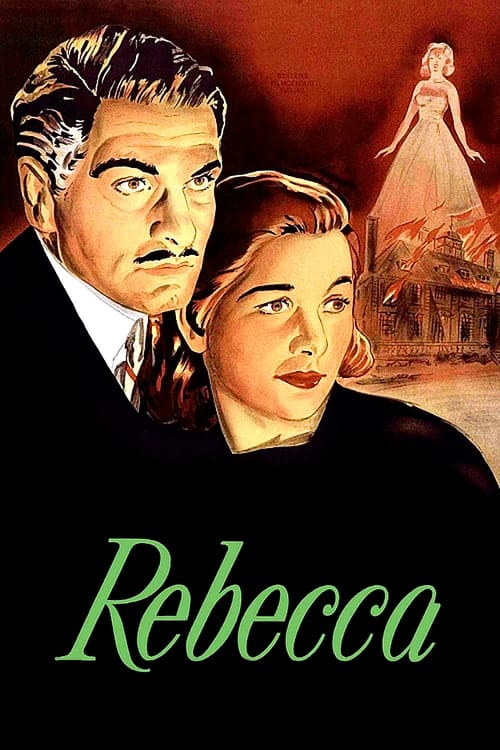
Rebecca
1940 · Alfred Hitchcock
For a stormy night when you want gothic atmosphere — a big shadowy house, a doomed romance, a secret — without gore or jump scares. Comfort viewing for anyone who likes their thrillers elegant and slightly haunted.
What it's about
A shy young woman, working as a paid companion in Monte Carlo, is swept into a whirlwind marriage with Maxim de Winter, a rich and grieving widower. He brings her home to Manderley, his vast estate on the Cornish coast, where every room still belongs to his dead first wife, Rebecca. The servants compare her to Rebecca, the housekeeper Mrs. Danvers openly worships Rebecca's memory, and the new bride starts to suspect her husband is hiding something about how the first marriage really ended.
The experience
It plays like a ghost story without a ghost — slow-building dread inside a love story, where the menace comes from a raised eyebrow or an open bedroom door rather than anything supernatural. You spend the film off-balance alongside the heroine, and the unease keeps tightening until it snaps into full-blown mystery.
Performances
Joan Fontaine makes timidity riveting — you can watch her shrink an inch every time someone says the name Rebecca. Judith Anderson's Mrs. Danvers is one of the screen's great quiet villains, all stillness and devotion curdled into threat, and Laurence Olivier gives Maxim a charm with something cold underneath it.
The craft
Hitchcock's first Hollywood film, and the black-and-white photography does astonishing things with Manderley: corridors that dwarf the heroine, Rebecca's preserved bedroom shot like a shrine. The trick at the film's heart is making a woman who never appears feel like the most powerful character in it — done entirely through objects, monograms, and other people's faces. It rewards a dark room and your full attention.
Why it matters
It won Best Picture — the only Hitchcock film ever to do so — and set the template for a decade of gothic romances about brides in houses full of secrets. It's also the bridge between Hitchcock's British thrillers and the American masterpieces that followed.
Snapshot
Rebecca is Alfred Hitchcock's first American film and the only one of his pictures ever to win the Academy Award for Best Picture — a distinction that has always carried an irony, since the statuette went to its producer, David O. Selznick, not its director. Adapted from Daphne du Maurier's 1938 best-seller, it is a gothic romance built on absence: the second Mrs. de Winter, who narrates and is never given a first name, marries the brooding widower Maxim de Winter and arrives at his Cornish estate, Manderley, to find the place saturated by the memory of his dead first wife, Rebecca, whose presence is curated and weaponized by the housekeeper, Mrs. Danvers. The film fuses Selznick's prestige-literary house style with Hitchcock's instinct for suspense and psychological menace, producing a work that is at once a faithful adaptation and a study in dread. It stands as a hinge in Hitchcock's career — the moment his British craftsmanship met Hollywood's resources and constraints — and as a foundational entry in the 1940s cycle of "paranoid woman's" gothic melodramas.
Industry & production
The film was the product of a deal that brought Hitchcock to Hollywood: Selznick signed the director to a contract in 1939, and after considering a Titanic project, the two settled on du Maurier's novel, whose rights Selznick had acquired. Selznick was at the zenith of his power and reputation, releasing Rebecca on the heels of Gone with the Wind (1939), and he approached the adaptation with the same proprietary intensity. He was a famously interventionist producer, governing his productions through voluminous memoranda, and he insisted that Rebecca remain faithful to a beloved book rather than become, in his view, a vehicle for Hitchcock's invention. An early Hitchcock treatment that took liberties with the material was rejected outright; Selznick wanted the novel essentially intact.
The most consequential industrial pressure, however, came from the Production Code. In du Maurier's novel, Maxim murders Rebecca. The Code forbade allowing a murderer to escape punishment, and a sympathetic protagonist who kills his wife and goes free was unacceptable. The screenplay therefore recast Rebecca's death as an accident: during a confrontation in which she taunts Maxim — claiming to be pregnant with another man's child — she falls and strikes her head. Maxim concealed the death and sank her body in her boat, but he is no longer her killer. This single alteration reverberates through the film's moral architecture, softening Maxim and shifting the drama from guilt to concealment.
Selznick conducted a widely publicized search for the actress to play the nameless heroine, and the role ultimately went to the relatively unknown Joan Fontaine. Laurence Olivier, then a rising stage and screen star, played Maxim; he had reportedly hoped his partner Vivien Leigh would be cast opposite him, which is sometimes cited as a source of on-set tension. The supporting cast included Judith Anderson as Mrs. Danvers, George Sanders as the cad Jack Favell, and Nigel Bruce, Reginald Denny, and Gladys Cooper in smaller parts — a roster drawing heavily on the British acting colony in Hollywood. The picture was a critical and commercial success and went on to receive eleven Academy Award nominations, winning two: Best Picture and Best Cinematography (Black-and-White).
Technology
Rebecca was made with the standard apparatus of late-1930s Hollywood: 35mm black-and-white photography in the Academy ratio, studio sound recording, and large purpose-built sets. Manderley itself was realized through a combination of full-scale interiors and miniature and matte work; the great house is glimpsed in establishing shots and, most memorably, consumed by fire in the finale, effects that depended on model photography and optical compositing rather than location shooting. The decision to shoot in black and white — at a moment when Selznick had just demonstrated the power of three-strip Technicolor in Gone with the Wind — was an aesthetic one, suited to the film's gothic register of shadow, fog, and chiaroscuro. The film's technical achievement lies less in novel equipment than in the disciplined deployment of existing studio craft toward atmosphere.
Technique
Cinematography
George Barnes's photography, which won the film's second Oscar, is central to its effect. Barnes lights Manderley as a place of cavernous, oppressive space, full of deep shadow and looming verticals, while reserving a softer, more diffused glamour for certain framings of the heroine. The camera repeatedly dwarfs the new Mrs. de Winter within the architecture — the vast staircase, the immense fireplace, the over-scaled doorways — so that the house reads as an antagonist. Rebecca's lingering presence is conveyed photographically: her monogram, her possessions, her bedroom preserved as a shrine, all rendered with a fetishistic clarity. The mobile, gliding camera and careful eyeline construction sustain a sense that the dead woman is always just out of frame.
Editing
Cut by Hal C. Kern, with James E. Newcom, the film moves at the measured, classical pace of Selznick prestige production rather than the brisk tempo of Hitchcock's British thrillers. Editing serves suspense through the withholding and timing of reveals — the sudden, near-magical appearances of Mrs. Danvers, the gradual disclosure of the boathouse secret, the inquest's accumulating tension. Hitchcock's montage instincts are present but subordinated to a more stately continuity style that keeps the literary narrative legible.
Mise-en-scène / staging
Manderley is the film's defining design achievement, supervised in its art direction by Lyle Wheeler under Selznick's organization. The house is a character: its scale, its preserved west wing, its morning-room desk still arranged to Rebecca's taste, all stage the heroine's dispossession. Hitchcock stages Mrs. Danvers as an almost supernatural figure — she is rarely shown walking, instead materializing within the frame, standing preternaturally still, so that the cutting and blocking make her seem to haunt the corridors. The famous bedroom sequence, in which Danvers displays Rebecca's furs and lingerie to the trembling new wife, is staged with an intimacy that has been widely read as carrying an erotic charge toward the dead woman.
Sound
Franz Waxman's score is one of the film's principal instruments of mood, built around a recurring, yearning "Rebecca" theme that lends the absent woman a musical body even as she is denied a visual one. The score swells through the romance and curdles into unease around Manderley and Mrs. Danvers, binding the film's lush melodrama to its gothic dread. Dialogue and voice are themselves thematic: the heroine's first-person narration frames the story as memory and dream ("Last night I dreamt I went to Manderley again"), and Rebecca's name, spoken constantly, becomes a sonic haunting.
Performance
Joan Fontaine's performance turns timidity into a sustained dramatic register — flinching, apologetic, perpetually unsure — which the film leverages to make the audience feel her displacement. It is reported that Hitchcock deliberately unsettled Fontaine on set, fostering her isolation to draw out the character's insecurity, though such anecdotes should be treated as part of the film's lore rather than documented method. Olivier gives Maxim a clipped, volatile hauteur that masks grief and guilt. The film's most indelible performance is Judith Anderson's Mrs. Danvers: controlled, glacial, and obsessive, she earned a Best Supporting Actress nomination and created one of cinema's archetypal sinister housekeepers. George Sanders supplies oily menace as Favell.
Narrative & dramatic mode
The film operates in the mode of the first-person gothic romance, narrated retrospectively by a heroine looking back from a place of loss. Its dramatic engine is restricted knowledge: the audience, like the heroine, is kept ignorant of what truly happened to Rebecca until the late confession, and much of the suspense derives from misreading — the heroine assumes Maxim still loves his dead wife, when in fact he loathed her. The structure moves from courtship and arrival into a long middle of psychological siege at Manderley, then pivots into mystery and quasi-procedural investigation (the discovery of the boat, the inquest, the blackmail, the medical revelation of Rebecca's terminal illness) before the apocalyptic burning of the house. It is a story in which the central object of obsession is dead before the film begins and never appears — a structural absence that the whole film is organized to fill.
Genre & cycle
Rebecca helped inaugurate and define the 1940s cycle of gothic melodramas sometimes called the "paranoid woman's film" or "female gothic" — narratives in which a young wife comes to fear that her husband may be a murderer, and the domestic home becomes a space of menace. The cycle includes Suspicion (1941, also Hitchcock and Fontaine), Gaslight (1944), Jane Eyre (1943), Dragonwyck (1946), Secret Beyond the Door (1947), and Notorious (1946) in part. Rebecca draws on older gothic literary conventions — the great isolated house, the secret, the first wife — and crystallizes them into a durable screen formula. It also belongs to the prestige literary adaptation, the Selznick specialty, sitting at the intersection of horror-adjacent atmosphere and respectable women's melodrama.
Authorship & method
Rebecca is the textbook case of divided authorship. Hitchcock directs, bringing his command of suspense, his expressive staging of Mrs. Danvers, and his fascination with guilt, surveillance, and the psychology of the dominated; yet the film is unmistakably a Selznick production, governed by the producer's insistence on fidelity and prestige. Hitchcock himself, in his later conversations with François Truffaut, was somewhat dismissive of the film as not fully "a Hitchcock picture," lacking the humor and the freer construction he preferred — a self-assessment worth registering even as critics have come to value the film highly.
The key collaborators shaped it decisively. The screenplay is credited to Robert E. Sherwood and Joan Harrison, with adaptation by Philip MacDonald and Michael Hogan; Harrison was a long-standing Hitchcock collaborator who helped carry his sensibility into the script. Cinematographer George Barnes provided the film's visual texture. Franz Waxman's score supplied its emotional and gothic coloration. Editor Hal C. Kern imposed the measured Selznick rhythm. The result is a genuinely hybrid object whose strengths come from the friction between a controlling producer and a director of great visual intelligence.
Movement / national cinema
The film is a product of classical Hollywood, made within the independent-prestige model Selznick had perfected — an autonomous producer marshaling studio-level resources. But it is also a transatlantic artifact: a British director, a largely British cast, and a quintessentially English source novel, all transplanted to California. Its visual language draws on the gothic and on the chiaroscuro inheritance of German Expressionism, channels that fed broadly into Hollywood horror and, soon after, film noir. Rebecca thus sits at a confluence — English literary gothic, Hitchcock's British thriller training, and the resources and constraints of the American studio system.
Era / period
Released in 1940, the film arrived as Hollywood was at the height of its studio-era confidence and as war engulfed Europe — a context that gave the migration of British talent to Hollywood, including Hitchcock's, a particular charge. It operates under the full force of the Production Code, whose requirements directly reshaped its plot, making it a clear case study in how censorship structured American narrative film at midcentury. It also marks the threshold of the 1940s, the decade in which the woman's gothic and, shortly, film noir would flourish, both trading in domestic suspicion and shadow.
Themes
At its center is the tyranny of memory and the difficulty of inhabiting a life shaped by someone else's. The nameless heroine's anonymity is itself the theme: she has no identity of her own against the overwhelming, curated legend of Rebecca. The film explores jealousy, class anxiety (the gauche young wife among the rituals of the manor), and the psychology of domination, embodied in Mrs. Danvers's near-worshipful fixation on her dead mistress — a devotion long read as carrying a suppressed homoerotic charge. Manderley figures the weight of the past as a physical structure that must literally burn before the couple can be free, and even then the freedom is ambiguous, purchased through concealment and loss. Guilt, secrecy, and the gap between public reputation and private truth — Rebecca admired by all, despised in private — run throughout.
Reception, canon & influence
The film was both a popular success and a critical one, capped by its Best Picture win and its cinematography award among eleven nominations; Hitchcock received the first of his several Best Director nominations, none of which he would convert into a competitive win. Among its backward influences, the foundation is du Maurier's novel, itself in dialogue with Charlotte Brontë's Jane Eyre — the orphaned heroine, the secret-laden husband, the burning house — so that Rebecca extends a literary gothic lineage running from the Brontës into the twentieth century. Its atmosphere also inherits the Expressionist tradition of shadow and the conventions of stage and screen melodrama.
Forward, its influence is broad. Rebecca established a template for the 1940s gothic woman's film and gave Hollywood one of its enduring archetypes in Mrs. Danvers, the malevolent housekeeper devoted to a dead mistress, a figure echoed across later thrillers and horror. For Hitchcock personally, it launched the American phase that would produce Notorious, Vertigo, Psycho, and the rest, and several of its preoccupations — obsessive love for an absent or dead woman, the past colonizing the present, identity dissolved into another's image — would return, most powerfully, in Vertigo (1958). The novel and film have generated continued adaptation and homage, and the opening line and the image of Manderley in flames have entered the common stock of film memory. If Hitchcock undervalued Rebecca as insufficiently his own, criticism has reached a more generous verdict: a film whose very hybridity — producer's fidelity and director's dread — makes it both a landmark of studio-era prestige and an essential early statement of the themes that would define one of cinema's central authorships.
A Deleuzian reading
A hand opens a leather address book, and there it is: a tall, slanting *R*, embroidered, gold-stamped, somehow more present than any living person in the room.
The full Deleuzian reading of Rebecca →
Reception
A smash on release — it won Best Picture, the only Hitchcock film ever to do so — but for decades cinephiles half-disowned it as 'really a Selznick picture' (Hitchcock himself shrugged it off as not truly his). It's since been fully reclaimed as a gothic masterwork, helped along by the coolly received 2020 Netflix remake reminding everyone how good the original is.
How Rebecca was received, from release to now →
Influences: the films it descends from and the films it influenced
- Gone with the Wind (1939) — Selznick's very next memo-governed, producer-driven literary adaptation, carrying forward the model of producer-as-decisive-author over a hired director.
- Gaslight (1944) — Extends Rebecca's restricted-knowledge structure in which a vulnerable wife's reality is destabilized inside a memory-haunted house, weaponizing domestic psychological terror and the dead-predecessor's lingering presence as plot engine.
- Notorious (1946) — Develops the sinister-housekeeper/devouring-matriarch figure (Madame Sebastian) and the imposing staircase mansion as a surveillance trap, refining Rebecca's staging of a dominated heroine inside an oppressive household.
- The Innocents (1961) — Refines the female-gothic of a fragile woman alone in a great house menaced by a dead predecessor's influence, with Freddie Francis's deep-focus black-and-white chiaroscuro descending directly from Rebecca's visual grammar.
- Crimson Peak (2015) — Self-conscious revival of the female-gothic bride entering a decaying mansion with a husband, a dead first wife, and a sinister controlling housekeeper-figure — an explicit homage to Rebecca's archetypes and Manderley-as-character design.
- Marnie (1964) — The opening-withholding device — Joan Fontaine's character denied a name while her past is systematically obscured — and shadow-bar enclosure staging within Manderley's interiors directly establish the formal grammar Hitchcock systematizes in Marnie.
- The Birds (1963) — Hitchcock's first du Maurier adaptation establishes the Gothic method of staging domestic architecture as a psychically overdetermined space — every room, window, and threshold carrying latent menace — that The Birds inherits wholesale for the Brenner house, including the fireplace as breach-point and the staircase as a contested vertical axis.
- Sunset Boulevard (1950) — Hitchcock codified the Hollywood Gothic-mansion formula for the studio era: decor as psychological weapon, the dominant woman controlling domestic space through overwhelming presence, and a male newcomer drawn into a house he cannot exit.
- The Piano (1993) — George Barnes's cinematography encodes female interiority through oppressive domestic interiors and Joan Fontaine's first-person retrospective voiceover — the Brontë gothic-on-film grammar of constrained female narration and subjective dread that The Piano inherits as its primary narrative architecture.
- Rosemary's Baby (1968) — Hitchcock codified the formula of a young woman navigating a domestic space where every institutional figure — husband, household staff, doctor — is complicit in a conspiracy she cannot name; Polanski transplants this exact architecture from Gothic manor to Manhattan apartment.
- Brief Encounter (1945) — Hitchcock's retrospective female voiceover spoken from a position of irrevocable loss — reconstructing an overwhelming experience through memory that cannot be fully escaped — is the exact narrative architecture Brief Encounter places inside Laura's interior monologue, including the return to a lost space that opens the recollection.
- Laura (1944) — Hitchcock's investigation-as-archaeology of a dead woman through her possessions, portrait, and the distorted testimony of those who loved her directly models Laura's narrative architecture: the detective-protagonist whose psyche is colonized by a woman he never met, with every room and object a relay of her constructed image.
- Mildred Pierce (1945) — The analeptic structure built around a female protagonist reconstructing her past under psychological pressure, combined with domestic staging where the architecture of each room is legible as a register of class aspiration or transgression, gives Curtiz a formal template for organizing Mildred's rise through space.
- Jane Eyre (1943) — Another Selznick-derived gothic that copies Rebecca's playbook of a timid governess-bride, a brooding secret-keeping master, and a fire-gutted manor, lit in the same Expressionist chiaroscuro that became the woman's-gothic house style.
- Suspicion (1941) — Hitchcock's immediate follow-up reuses Joan Fontaine as the naive bride trapped in dread over a possibly-murderous husband, carrying forward Rebecca's subjective-fear point-of-view and the leitmotif-scored marriage-as-threat.
- Vertigo (1958) — The most direct descendant: obsessive love for an absent/dead woman, identity dissolved into another's image, and the past colonizing the present — Rebecca's 'tyranny of memory' theme realized as full subjective psychodrama.
- The Spiral Staircase (1946) — Carries Rebecca's gothic-mansion chiaroscuro and scale-dwarfing of an imperiled woman within a shadowed house into noir-horror, with the same materializing-menace staging out of darkness.
- Dragonwyck (1946) — A direct woman's-gothic clone — innocent bride enters a vast brooding estate ruled by a charismatic husband with a dead first wife — extending Rebecca's 'house as malevolent character' formula.
- Secret Beyond the Door (1947) — Pushes Rebecca's voiceover-narration of female dread and the bride-investigating-her-husband's-locked-past into overt Expressionist, near-Freudian gothic, inheriting both the device and the haunted-architecture motif.
- Rebecca (1938) — Daphne du Maurier's source novel is the foundational text whose first-person nameless-narrator voice, structural absence of the title character, and Jane Eyre debts the film transposes wholesale into restricted-knowledge cinema.
- Jane Eyre (1934) — Earlier screen rendering of the Brontë template — orphaned heroine, secret-laden master, burning house — that established the literary-gothic adaptation lineage Rebecca consciously extends.
- The Old Dark House (1932) — Whale's Expressionist treatment of a sinister, near-supernatural household servant and a labyrinthine menacing mansion prefigures Mrs. Danvers and Manderley-as-character staging.
- Wuthering Heights (1939) — The prior Goldwyn prestige-literary romance of doomed love on a brooding estate, shot by Gregg Toland in moody chiaroscuro, set the studio template of fidelity-driven gothic adaptation Selznick chased with Rebecca.
- The Haunting (1963) — Inherits Rebecca's 'house as living antagonist' and suppressed-homoerotic charge (Theo/Eleanor) plus the materializing-menace-from-shadow staging, transposed into psychological horror.
- Rebecca (2020) — Direct remake re-staging the nameless-narrator voiceover, the structural absence of Rebecca, and Mrs. Danvers's malevolent devotion, confirming the durability of the 1940 film's craft template.
Similar films
- Vertigo (1958) — influence & lineage · same viewing thread
- Notorious (1946) — influence & lineage · same viewing thread
- Gaslight (1944) — influence & lineage
- Sunset Boulevard (1950) — same viewing thread · often watched together
- Diabolique (1955) — same viewing thread · often watched together
- Psycho (1960) — same viewing thread
- Rear Window (1954) — same viewing thread
- Double Indemnity (1944) — same viewing thread
All the films related to Rebecca →
Watch it with: curated runs of related films
- The Golden Age of Suspense — A run of immaculate mid-century crime pictures — Hitchcock plus his sharpest rivals — where guilt, obsession, and dangerous romance are staged in gorgeous black-and-white; watch them close together and the shared DNA of the perfect-murder plot lights up.