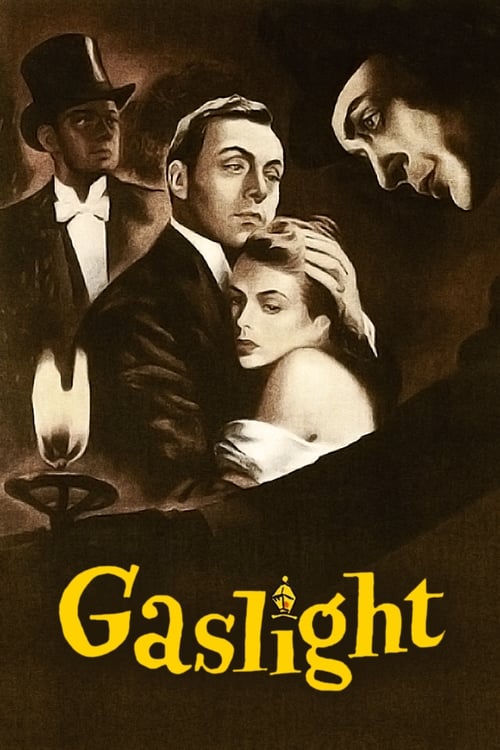
Gaslight
1944 · George Cukor
When you're craving an elegant, old-fashioned psychological thriller for a dark evening — tension built from candlelight and conversation rather than shocks.
What it's about
In Victorian London, young Paula Alquist marries the charming Gregory Anton after a whirlwind romance and moves with him into the townhouse where her aunt, a famous opera singer, was murdered years before. Then small things start going wrong: objects vanish, footsteps sound in the sealed attic, the gaslights dim with no one touching them — and her husband gently insists she's imagining all of it. Isolated and doubting her own eyes, Paula begins to wonder if she's losing her mind, while a Scotland Yard man starts taking an interest in the house.
The experience
A slow, suffocating tightening — the horror isn't ghosts but the drip-by-drip demolition of a woman's confidence in her own perceptions. It's claustrophobic and infuriating in the best way, and the release, when it comes, is deeply satisfying.
Performances
Ingrid Bergman won the Oscar for this, charting Paula's slide from radiant bride to trembling wreck with heartbreaking precision; Charles Boyer weaponizes his own charm chillingly, and a teenage Angela Lansbury makes a startlingly assured screen debut as an insolent housemaid.
The craft
Cukor and MGM turn one overstuffed townhouse into a trap — shadows, gaslight, and Victorian clutter closing in a little more each scene. The manipulation is staged with surgical patience: you see every move being made on Paula, which makes watching her doubt herself almost unbearable. It's studio-era craftsmanship at its most controlled.
Why it matters
This is the film that put the verb 'to gaslight' into the language — its name became the standard term for psychological manipulation that makes a victim doubt reality, a rare case of a movie coining a concept the culture still needs.
Snapshot
Gaslight is the most famous screen adaptation of Patrick Hamilton's 1938 stage thriller Gas Light (known in America as Angel Street), produced by MGM and directed by George Cukor. It tells of Paula Alquist (Ingrid Bergman), a young woman who marries the charming Gregory Anton (Charles Boyer) and returns to live in the London townhouse where her aunt, a celebrated opera singer, was murdered years earlier. Anton is in fact the unpunished killer, returned to search for hidden jewels, and he sets about convincing Paula that she is losing her mind — hiding objects, staging small thefts, and, most memorably, dimming the house's gas lamps while insisting she imagines the change. The film is the principal reason the verb "to gaslight" entered the language as a term for sustained psychological manipulation that makes a victim doubt her own perceptions. It won Bergman her first Academy Award and an Oscar for its art direction, and it remains a touchstone of the 1940s woman-in-peril thriller. Its cultural afterlife — the word it bequeathed — now arguably exceeds the film's own fame.
Industry & production
Gaslight was a prestige production for Metro-Goldwyn-Mayer, the most lavish of the major studios, and it bears the marks of MGM's house style: high-gloss period craftsmanship, star-centered storytelling, and heavy investment in sets and costumes. The property arrived with a strong pedigree, having succeeded on the London and Broadway stage, which gave the studio confidence in a "quality" literary thriller.
The production carries a well-documented and unusual piece of industrial history. A British film of Hamilton's play had already been made in 1940, directed by Thorold Dickinson and starring Anton Walbrook and Diana Wynyard. When MGM acquired the remake rights, it also sought to suppress the earlier version; accounts in film histories hold that the studio wanted prints and the negative of the British film destroyed to clear the field for its own. The British film survived — a print was preserved, and it has since been restored and reassessed — but the episode is frequently cited as an example of Hollywood's protective handling of valuable properties. Beyond that broad outline, exact contractual details should be treated cautiously, as popular retellings vary.
Casting reflected MGM's star economy. Bergman, on loan and at a rising point in her career, was paired with Charles Boyer, a major romantic lead whose Continental charm made him ideal for a husband whose warmth curdles into cruelty. Joseph Cotten, associated with Orson Welles's Mercury circle, took the comparatively functional role of the Scotland Yard man who rescues Paula. The film is also celebrated as the screen debut of Angela Lansbury, cast as the insolent housemaid Nancy while still a teenager; her assured performance earned an Academy Award nomination and launched a long career.
Technology
The film was shot on black-and-white 35mm stock and exhibited with a standard Academy-ratio frame and an optical mono soundtrack — the conventional technical package for a Hollywood A-picture of 1944. Its more interesting technological dimension is thematic rather than apparatus-based: the plot turns on Victorian gas lighting, a domestic technology whose flickering, variable glow becomes the literal instrument of psychological abuse. Because gas lamps drew on a shared household supply, lighting one fixture could dim others — the period-accurate mechanism that lets Anton's secret nighttime searches register as an inexplicable darkening that only Paula seems to notice. The production thus dramatizes an obsolescing technology at the very moment electric light was displacing it, lending the film a faint air of historical threshold. The filmmaking craft is devoted to rendering that gaslit world convincingly on modern studio equipment, rather than to any novel camera or sound innovation.
Technique
Cinematography
Joseph Ruttenberg, one of MGM's senior cameramen, shot Gaslight and received an Academy Award nomination for it. His photography is the film's atmospheric engine. Working in deep blacks and pooled, unstable light, Ruttenberg builds an interior world of looming shadow and cramped, overfurnished rooms, so that the house itself feels like an instrument of confinement. The recurring image of the gas flame guttering up or sinking down is staged as a visual event — the audience sees the change Paula reports, which aligns us with her perception against her husband's denials and makes his cruelty unbearable. The lighting design partakes of the low-key, high-contrast register often associated with film noir, though Gaslight applies it to a Victorian melodrama rather than a contemporary crime story.
Editing
The picture was cut by Ralph E. Winters, later one of MGM's most honored editors. The editing serves classical continuity and the slow tightening of dread: scenes are built to let Boyer's insinuations land and to hold on Bergman's mounting confusion. The film's tempo is deliberately patient, accumulating small domestic incidents until they compound into a sense of siege. The detective subplot, intercut with the household scenes, supplies the countervailing movement toward rescue. The most discussed structural choice is the late confrontation scene, in which the rhythm shifts decisively from suffocation to release.
Mise-en-scène / staging
Gaslight won the Academy Award for Black-and-White Art Direction, and its physical world is central to its meaning. The Victorian townhouse — its clutter of bric-a-brac, its sealed-off upper floor, its heavy drapery and narrow stairs — externalizes Paula's psychological imprisonment. The decision to keep most of the action inside this single dense interior intensifies the claustrophobia; the house is at once a domestic refuge and a trap, haunted by the earlier murder and the hidden jewels concealed somewhere within it. Cukor, a director famed for his handling of actors and for richly appointed period settings, choreographs the staging around proximity and surveillance: Anton is forever watching Paula, and the blocking repeatedly isolates her within the frame. Objects — a brooch, a letter, the dimming lamp — are staged as recurring motifs that carry the manipulation.
Sound
The sound design supports the central conceit through what Paula hears as much as what she sees: footsteps overhead from the supposedly empty upper floor, the small noises of the house at night. These auditory cues, like the dimming light, are presented as real to the audience, so that we share her certainty and feel the injustice of being told she imagines them. Bronisław Kaper's score underscores the Gothic atmosphere and the swings between tenderness and menace. The film's dialogue, inherited from a stage play, is verbally dense, and the soundtrack foregrounds the verbal duels between husband and wife in which Anton's affection is the velvet over coercion.
Performance
Performance is where Gaslight is richest. Bergman's Paula is a study in deteriorating composure — luminous and trusting at the outset, then jittery, apologetic, and finally hollowed out by self-doubt. The Academy recognized the role with the Best Actress award, and the performance is often cited as a definitive portrait of a victim made to participate in her own unmaking. Boyer is her essential counterweight: his Anton weaponizes charm, and the performance withholds overt villainy long enough to make the manipulation insidious rather than melodramatic. Lansbury, as the maid Nancy, injects a note of class friction and sexual challenge into the household, her pertness implicitly licensed by Anton to further unsettle Paula. Cotten's detective and Dame May Whitty's nosy neighbor round out an ensemble in which the principal action is psychological rather than physical.
Narrative & dramatic mode
The film operates in the mode of domestic Gothic melodrama crossed with the suspense thriller. Its dramatic engine is dramatic irony: the audience knows, or quickly infers, that Anton is the villain, so the suspense lies not in a whodunit puzzle but in watching Paula be ground down and in waiting for rescue and exposure. This is a "paranoid woman's film" in the sense critics have used for a 1940s cycle in which a wife comes to fear that the man she has married means her harm. The narrative is tightly unified around a single household and a compressed span, betraying its theatrical origins, and it builds toward a cathartic reversal in which the victim is finally granted a moment of power over her tormentor. The mode is fundamentally about epistemology — about whose account of reality will be believed — which is what gives the story its lasting resonance.
Genre & cycle
Gaslight belongs to the 1940s Hollywood cycle of female-centered Gothic suspense films, often grouped with such pictures as Rebecca (1940) and Suspicion (1941), in which a vulnerable heroine in an oppressive domestic setting comes to doubt the intentions, or the sanity-sparing love, of a husband or household. These films married the conventions of nineteenth-century Gothic fiction — the imperiled bride, the sinister mansion, the secret in the locked room — to contemporary anxieties about marriage and women's social position. Gaslight sits at the heart of this cycle and is frequently treated as its archetype. It also shares lighting and atmospheric vocabulary with the emerging film noir, and as a period crime story it overlaps with the Victorian-set thriller. Its hybridity — melodrama, mystery, crime, and proto-noir at once — is part of its richness.
Authorship & method
The film is a meeting of strong collaborators under a studio-prestige model. George Cukor, the director, was renowned as a "woman's director" — a label that flattened a real gift for eliciting nuanced performances, especially from actresses — and for cultivated literary adaptations. Gaslight plays directly to those strengths: its achievement is less in bravura camerawork than in the modulation of Bergman's and Boyer's performances and the control of tone within an enclosed world. The screenplay is credited to John Van Druten, Walter Reisch, and John L. Balderston, a team that retained the play's hothouse intensity while opening it modestly for the screen and strengthening the detective strand. Joseph Ruttenberg's cinematography and the art direction overseen within Cedric Gibbons's MGM department supplied the indispensable visual atmosphere, the latter winning an Oscar. Bronisław Kaper composed the score, and Ralph E. Winters edited. The method is classical studio filmmaking at a high level: a respected property, a marquee cast, top craft departments, and a director trusted to shape performance — authorship distributed across a system rather than concentrated in a single visionary.
Movement / national cinema
Gaslight is a product of the Hollywood studio system at its mature peak, specifically the polished, production-values-forward house style of MGM. It is not affiliated with a self-conscious film movement. That said, its visual language draws on the Gothic and Expressionist-tinged shadow-play that European émigrés helped bring to American cinema, and several of its key personnel had Continental backgrounds — Boyer was French, composer Kaper and writer Reisch were of Central European origin, and Bergman was Swedish — reflecting how thoroughly transatlantic talent shaped 1940s Hollywood. The film also exists in explicit dialogue with British cinema by way of the 1940 Dickinson version it sought to supplant, making the two Gaslight films a notable case study in how the same property was realized within different national industries.
Era / period
Released in 1944, Gaslight arrived during the Second World War, when the female-Gothic cycle was at its height and when domestic anxiety — marriages strained, women's roles in flux — had heightened cultural charge. The film does not address the war directly; instead it offers a hermetic Victorian world, a costume-drama remove that was itself a common feature of wartime escapism. Within Hollywood's own periodization it belongs to the late classical era, before the postwar surge of harder-edged noir and the slow erosion of the studio system. Its diegetic period — gaslit, late-Victorian London — is essential to its identity, situating the story in an age of domestic confinement and rigid gender expectation that the plot exploits: a wife's word counts for little against her husband's, and the machinery of "madness" can be turned against her with social impunity.
Themes
At its center Gaslight is about the manipulation of reality and the theft of a person's confidence in her own mind — the systematic substitution of an abuser's account for the victim's perception. This is bound up with themes of marriage as a site of power rather than refuge, and of patriarchal authority: Anton's control is enabled by a social order in which a husband administers his wife's money, her movements, her contacts, and her credibility. Greed and the buried past supply the plot's mechanics — the hidden jewels, the unsolved murder — but the film's enduring subject is epistemic abuse, the weaponizing of trust. Class runs through the household in the figure of the maid, whose insolence is licensed from above. And the film is preoccupied with seeing and believing: light that should reveal becomes the medium of deception, and the heroine's salvation comes when an outside witness finally confirms that what she perceived was real all along.
Reception, canon & influence
Gaslight was a critical and awards success on release. It received seven Academy Award nominations — including Best Picture, Best Actor for Boyer, Best Supporting Actress for the debuting Lansbury, the screenplay, and Ruttenberg's cinematography — and won two: Bergman's Best Actress and the award for Black-and-White Art Direction. Bergman's victory consolidated her standing as one of the era's foremost stars. (Detailed contemporary box-office figures are not something I can reliably cite here and are best left unstated rather than guessed.)
Looking backward, the film's influences are clear and acknowledged: Patrick Hamilton's stage play is the direct source, the Victorian Gothic literary tradition supplies its furniture of haunted houses and imperiled brides, and the immediate cinematic predecessors are the 1940 British film and the broader Hitchcock-adjacent cycle of Rebecca and Suspicion that made the menaced-wife story bankable.
Looking forward, Gaslight's influence is unusually concrete. Its premise gave the English language the term "gaslighting," which migrated from film criticism into popular and clinical usage to describe coercive manipulation that destabilizes a victim's sense of reality — a rare instance of a single film naming a recognized psychological phenomenon, and one whose currency has surged in recent decades. As cinema, it stands as the canonical example of the 1940s female-Gothic thriller and a recurring reference point for later films and television about domestic abuse and contested reality. Cukor's handling of Bergman is regularly invoked in accounts of his work with actresses, and the film endures in repertory and home-video circulation as both a polished studio artifact and a story whose central metaphor has only grown more resonant with time.
A Deleuzian reading
Watch the flame.
The full Deleuzian reading of Gaslight →
Reception
A prestige hit in 1944 — seven Oscar nominations and Ingrid Bergman's first win — it's had a strange second life: the 2010s turned its title into everyday psychological vocabulary, and suddenly an old MGM thriller felt urgently modern.
How Gaslight was received, from release to now →
Influences: the films it descends from and the films it influenced
- Gaslight (1940) — The direct screen predecessor from the same Hamilton play, it established the dimming gas-jet as a diegetic visual proof the wife perceives but cannot get corroborated — the exact device Cukor inherits wholesale.
- Rebecca (1940) — Codified the menaced-bride-in-a-grand-house template and the subjective framing that welds the camera to a wife's mounting dread inside an oppressive domestic interior.
- Suspicion (1941) — Boyer's charm-as-menace descends from Cary Grant's, and the glass of milk lit from within by a hidden bulb is the precedent for reading a single diegetic light source as a sign of lethal threat.
- Jane Eyre (1943) — Supplies the Victorian-gothic chiaroscuro and the brooding, secret-keeping husband whose shadowed mansion conceals a hidden crime — Welles' Rochester modeling the patriarch behind the locked room.
- Sunrise (1927) — Its expressionist low-key lighting and the spouse advancing through pooled shadow furnish the female gothic's visual grammar of marital threat.
- The Cabinet of Dr. Caligari (1920) — German Expressionist painted shadow and the staging of a destabilized, unreliable perception are the formal root of the genre's chiaroscuro and contested reality.
- Secret Beyond the Door (1947) — Pushes the epistemic abuse into expressionist subjectivity — a wife narrating her own dread of a husband who may mean to kill her behind a literal locked door.
- Sleep, My Love (1948) — Near-remake mechanics: a husband secretly drugging his wife to convince her she is going insane, transposing the gaslighting plot to a contemporary setting.
- Sorry, Wrong Number (1948) — Takes sound-as-truth to its limit, a bedridden woman assembling a murder plot through the diegetic telephone while dramatic irony tightens the noose.
- Les Diaboliques (1955) — Weaponizes the contested-reality engine, staging sensory 'proof' — the corpse that vanishes — to drive a woman toward a breakdown the audience is made to share.
- What Ever Happened to Baby Jane? (1962) — Relocates gaslighting to a sealed house where one woman psychologically tortures another, carrying the claustrophobic-interior staging into Grand Guignol.
- Rosemary's Baby (1968) — Modernizes the paranoid woman's film: a wife whose accurate perceptions are systematically denied by husband and neighbors, with surveillance blocking inside the apartment.
- The Invisible Man (2020) — An explicit gaslighting thriller built on negative-space blocking, literalizing the abuser so the heroine cannot prove a threat others refuse to see.
- Vertigo (1958) — Cukor's staging of enclosed interiors as instruments of a man's systematic manipulation of a woman's perception and self-knowledge is the Gothic architectural and dramatic grammar Vertigo inherits for Scottie's engineering of Judy's identity transformation.
- Dial M for Murder (1954) — Cukor's Victorian London domestic interior — a husband systematically manipulating objects (gas jets, letters, jewels) to trap and destabilize his wife — establishes the grammar of the confined marital space in which a husband's criminal plot operates through the domestic object itself, the template for Dial M's apartment logic.
- Sleuth (1972) — The domestic two-hander of psychological humiliation, where one party methodically degrades another inside a single house — the manipulator/victim power duel Sleuth weaponizes between Wyke and Tindle.
- Suddenly, Last Summer (1959) — The threat-of-committal melodrama in which a woman's sanity is weaponized against her by a powerful relative, the suppression-of-the-witness dynamic Mrs. Venable mounts against Catherine.
- Sudden Fear (1952) — Supplies the husband-as-secret-predator structure and the performance/authenticity theme: a man's loving facade is a sustained act, which Sudden Fear inverts by giving the wife her own counter-performance.
- Experiment Perilous (1944) — Released the same year with the identical imperiled-wife-of-a-controlling-husband plot, rendered in Tourneur's velvety low-key shadow and enclosed mansion.
- The Spiral Staircase (1946) — Extends the surveillance blocking and claustrophobic-mansion staging, trapping a vulnerable woman in deep-focus interiors watched by an unseen menace.
- Notorious (1946) — Bergman again slowly poisoned within a controlling household, the camera aligning us with her physical deterioration to extend the menaced-wife method.
- Shadow of a Doubt (1943) — The husband-as-hidden-monster within the Victorian domestic Gothic space, the wife's investigative interiority rendered through sustained closeup performance as she moves from suspicion to certainty while the household closes around her, maps precisely onto Young Charlie's arc—both films deploy the domestic Gothic as a trap that tightens with feminine knowledge.
- Manichitrathazhu (1993) — Codified the woman-unravelling-inside-a-grand-house thriller, where an isolated wife's grip on reality erodes amid period interiors — the domestic-psychological staging Fazil transplants to the tharavadu.
- Leave Her to Heaven (1945) — The domestic psychological thriller of controlled cruelty staged within opulent household mise-en-scène, sibling to the 'poisoned comfort' art direction of Wheeler and Ransford.
Similar films
- Rebecca (1940) — influence & lineage
- Rosemary's Baby (1968) — influence & lineage
- The Invisible Man (2020) — influence & lineage
- Notorious (1946) — influence & lineage
- The Lady Vanishes (1938) — shared sensibility
- The Woman in the Window (1944) — shared sensibility
- From the Life of the Marionettes (1980) — shared sensibility
- The Innocents (1961) — shared sensibility
All the films related to Gaslight →