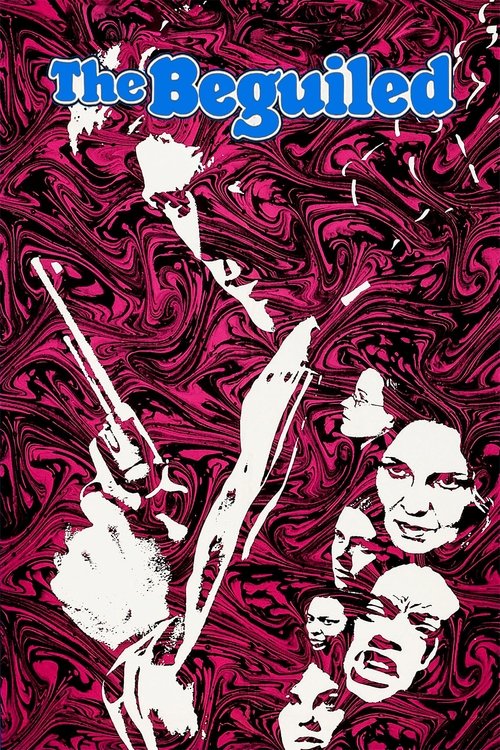
The Beguiled
1971 · Don Siegel
For a night when you want something dark, strange, and adult — a psychological hothouse to squirm through rather than comfort viewing. Reach for it when you're in the mood to be unsettled and can't resist a story about bad behavior behind closed doors.
What it's about
In the last days of the Civil War, a wounded Union soldier is taken in by an isolated Confederate girls' seminary deep in the South. Cut off from the fighting, the household of women and girls nurses him back to health while he charms, flatters, and plays them against each other to secure his survival — and his pleasure. What starts as rescue curdles into a hothouse standoff where desire, jealousy, and control are the real weapons.
The experience
Slow-burning and humid, with a creeping unease that tightens scene by scene until it's genuinely shocking. It's seductive and sinister at once — you keep changing your mind about who's the predator and who's the prey.
Performances
Clint Eastwood plays deliberately against his heroic image as the manipulative corporal, and Geraldine Page is quietly formidable as the headmistress — their battle of wills gives the film its charge.
The craft
Don Siegel trades his usual lean action style for candlelit interiors, gauzy Southern light, and a mounting sense of enclosure; the seminary becomes a beautiful trap. The film's power is in atmosphere and implication — what's said at the dinner table matters as much as anything violent — and it rewards patient, attentive viewing.
Why it matters
A commercial flop in 1971 that became a cult touchstone, it's now seen as the key film where the Eastwood persona was deliberately taken apart — released the same year it was being cemented — and it was remade decades later from the women's point of view.
Snapshot
The Beguiled is the strangest object in the Don Siegel filmography and, arguably, in Clint Eastwood's: a Southern Gothic chamber piece about a wounded Union corporal who takes shelter in a Confederate girls' seminary and is slowly dismantled by the household he thinks he is manipulating. Adapted from Thomas Cullinan's 1966 novel A Painted Devil (reissued under the film's title), it was produced by Universal at the peak of the Siegel–Eastwood collaboration, between Coogan's Bluff (1968) and Two Mules for Sister Sara (1970) on one side and Dirty Harry (1971) on the other. It arrived in the same year as Dirty Harry and Play Misty for Me, Eastwood's directorial debut — a startling three-film cluster that makes 1971 the year Eastwood's screen persona was simultaneously consolidated and taken apart.
The film's peculiarity is structural as much as tonal. Corporal John McBurney is a liar and a seducer who works his way through the seminary's inhabitants — the repressed headmistress Martha Farnsworth, the frustrated teacher Edwina, the precociously predatory student Carol, the slave Hallie, the child Amy who found him in the woods — and the film grants each of them interiority through voiceover and fantasy inserts. When his double-dealing is exposed, the household amputates his leg on the dining table and, later, poisons him with mushrooms. The male protagonist is not merely defeated; he is anatomized, dismembered, and consumed by the domestic space. In a career built on lean, muscular action pictures, Siegel made a hothouse film about castration.
It failed commercially in the United States on release — the record is consistent on this point, though precise figures are best left to the studio ledgers rather than repeated as folklore — and was better received in France, where critics recognized the Gothic and the Bressonian austerity beneath the exploitation packaging. Its reputation has climbed steadily since, and Sofia Coppola's 2017 remake returned it to critical circulation, both as a source and as a foil.
Industry & production
The film sits inside the studio-era-in-collapse logic of Universal in 1970–71. The Eastwood–Siegel partnership had already proven bankable, and Universal was in the business of financing star-driven pictures with modest budgets and quick schedules. Malpaso, Eastwood's production company, was involved; Siegel produced as well as directed. That arrangement — a star with his own shingle, a genre director with autonomy, a studio underwriting a mid-budget picture — is precisely the transitional New Hollywood configuration that made oddities like this possible for a few years.
The production shot largely in Louisiana, using antebellum plantation architecture and the moss-hung landscape around Baton Rouge; interiors were completed at Universal. The location work matters: the film's sense of a sealed, humid, decaying world is inseparable from the real Louisiana light and the real Spanish moss, and Siegel's willingness to shoot dark, underlit interiors on location gives the house a materiality that a stage set would have flattened.
The most consequential industrial fact about The Beguiled is its marketing. Universal did not know what it had. The campaign sold Eastwood, and Eastwood in 1970–71 meant the Man with No Name and Coogan — a Western star, an action star. Audiences bought tickets for a Civil War Eastwood picture and were given a psychosexual chamber drama in which their star is crippled and murdered. The mismatch is the standard explanation for the film's domestic failure, and it is a persuasive one: this is a case study in a distribution apparatus unable to position a film that violates its star's contract with the audience. Eastwood himself has spoken over the years about the picture's failure and his fondness for it; Siegel likewise regarded it as among his best work, a view he expressed in his memoir A Siegel Film.
The screenplay is credited to Albert Maltz and Irene Kamp under the pseudonyms "John B. Sherry" and "Grimes Grice." Maltz was one of the Hollywood Ten, blacklisted after 1947, and by 1971 was working again but with a complicated relationship to credit. The pseudonymous credit is a small artifact of the blacklist's long afterlife embedded in a 1971 studio release. Claude Traverse and Siegel shaped the material further during production; the exact division of authorship between drafts is not fully documented in the public record, and it would be wrong to assign specific scenes to specific writers with confidence.
Technology
Technically the film is conventional for a 1971 Universal production, and the interest lies in how conservatively its resources are deployed. It was shot on 35mm color negative — Technicolor processing, spherical rather than anamorphic — and framed for widescreen projection at the standard 1.85:1 of the period. Bruce Surtees exposed for available and practical light to a degree that was still unusual in studio filmmaking: candlelight, lamplight, and window light carry many of the interiors, pushed to the edge of legibility.
This is the technological point worth dwelling on. By 1971, faster color stocks and improved lens speeds had made low-light color cinematography feasible without the heavy fill that Technicolor-era practice required, and a small group of American cinematographers — Surtees, Gordon Willis, Conrad Hall, Vilmos Zsigmond, László Kovács — pushed into that territory almost simultaneously. Surtees's work here belongs to the same technical moment as Willis's on The Godfather the following year: color interiors in which shadow is allowed to be actually black and faces are allowed to fall away into it. Surtees would carry the approach through Dirty Harry, Play Misty for Me, High Plains Drifter, and The Outlaw Josey Wales, earning the nickname "the prince of darkness" within the industry.
The film also uses optical effects sparingly but pointedly: dissolves, superimpositions, and brief sepia or desaturated inserts to render memory and fantasy. These are old-fashioned devices, available since the silent era, and Siegel deploys them without apology in a film otherwise committed to a fairly modern realism.
Technique
Cinematography
Surtees's photography is the film's most-cited formal element and deservedly so. The opening sequence — young Amy in the woods, the image rendered in a bleached sepia over Civil War photographs, the sound of distant artillery — establishes a register of documentary pastness that the film then abandons for saturated Gothic color. Inside the seminary, the palette narrows to greens, browns, and the amber of lamplight; exteriors are green to the point of oppression.
The camera favors medium shots and slow, unemphatic reframings. Siegel and Surtees keep McBurney below eye level for long stretches — bedridden, then on crutches, then legless — so that the film's architecture of looking systematically disadvantages him. The women look down; he looks up. When the film wants to convey the household's collective assessment of him, it uses grouped compositions in which four or five faces occupy a single frame at different depths, each registering a different appetite.
The famous low-light interiors are not merely atmospheric. Darkness in this film is functional: it conceals who is moving through the house at night, and the plot turns on nocturnal traffic between bedrooms. The audience is placed in the same epistemological position as the characters — unable to see clearly, forced to infer.
Editing
Carl Pingitore cut the film, as he had Coogan's Bluff and would Dirty Harry. The editing is the film's most experimental dimension. Siegel intercuts fantasy, memory, and flashback into the present-tense narrative without conventional signposting: Martha's incestuous recollection of her brother arrives as a soft-focus ménage-à-trois superimposition; Edwina's desire and Carol's calculation surface in brief inserts; McBurney's own past — the battlefield conduct he lies about — is corrected by images that contradict his voiceover.
That last device is the structural key. The film uses editing to establish that the narration is unreliable, and it does so early enough that the audience is never allied with McBurney. Voiceover is distributed among several characters, an unusual choice for a studio film of the period, and it produces a genuinely polyphonic interiority: we are inside multiple heads at once, and the heads disagree.
The amputation sequence is edited for elision rather than gore. Siegel cuts around the surgery, using reaction, sound, and the aftermath, and the restraint makes it more disturbing than explicitness would. This is craft in the classical mode — the horror is placed in the viewer's imagination.
Mise-en-scène / staging
The seminary is a single, near-total location, and the film treats it as a system: gate, drive, garden, parlor, dining room, staircase, bedrooms, cellar, and the woods beyond. The gate is repeatedly emphasized — locked, then unlocked, then a point of terror when Confederate soldiers pass. The staircase organizes the household's hierarchy and its sexual traffic. The dining table becomes an operating table. Domestic objects and domestic spaces are converted, one by one, into instruments.
The production design (Alexander Golitzen and Ted Haworth) leans on genteel decay: good furniture, worn fabric, wartime scarcity. Costume distinguishes the women by degree of repression — Martha's high-necked severity, Edwina's softer palette, Carol's deliberate dishevelment. Hallie, the enslaved woman played by Mae Mercer, is costumed and staged apart from the white household in ways that mark her position, and the film gives her the clearest-eyed reading of McBurney of anyone in the house.
Siegel's staging of groups is precise. Scenes are frequently blocked so that one character is excluded from the frame's social center — standing at a doorway, seated at a distance — which visualizes shifting alliances without dialogue.
Sound
Lalo Schifrin's score is spare and strange: harpsichord, woodwinds, and folk-inflected material, a long way from the brass-and-percussion propulsion of his Bullitt or Dirty Harry work. Schifrin uses period-suggestive textures without pastiche, and there are long passages with no music at all.
The sound design privileges ambience: cicadas, birds, the creak of the house, distant artillery. The intermittent gunfire is a structural device, reminding the audience that the war continues outside a house that behaves as though it were the whole world. Diegetic music — the girls' singing and piano playing — is used ironically, civility performed over appetite. Roy Kellino's editing of these elements creates a soundscape in which silence is genuinely audible.
Performance
Eastwood's performance is the most against-type work of his career to that date and remains among his best. He plays McBurney as a charming, self-pitying, fundamentally weak man — an Irish immigrant mercenary who tells each woman a different version of himself. Eastwood strips out the impassivity that defined the Leone persona and replaces it with volubility and neediness. The post-amputation scenes, in which he descends into drunken rage and terror, are genuinely raw.
Geraldine Page is the film's center of gravity. Her Martha is a study in sublimated desire and moral self-authorship: she can order a leg sawed off and narrate it to herself as necessity. Page finds the woman's intelligence and her self-deception simultaneously, and she does it largely through control of voice and stillness.
Elizabeth Hartman's Edwina is fragile, credulous, and finally the film's only real romantic possibility, which makes her betrayal by McBurney the film's cruelest turn. Jo Ann Harris plays Carol with an unsettling knowingness. Mae Mercer's Hallie is the film's skeptic. Pamelyn Ferdin's Amy carries the film's opening and its closing turn — the child who saves him and the child who kills him.
Narrative & dramatic mode
The dramatic mode is chamber tragedy crossed with the Gothic. The film observes something close to unity of place, and its narrative engine is not external event but internal reconfiguration: a closed system disturbed by an intruder, moving through phases of fascination, competition, exposure, punishment, and expulsion.
Structurally the film is a reversal machine. McBurney's early advantages — mobility, charm, the ability to lie to people who cannot compare notes — are stripped one by one. The turning point is the night he is caught in Carol's room, which converts three separate private relationships into a public scandal and unifies the household against him. From there the film moves with the inevitability of tragedy: the fall, the amputation, the false reconciliation, the poisoning.
The multi-voiced narration is the film's boldest formal decision. It refuses a single subjectivity, and in doing so refuses to tell the audience whose story this is. Is the seminary a coven or a war zone? Is McBurney a predator or prey? The film sustains both readings, and its power comes from that irresolution rather than from any resolution of it.
Genre & cycle
The Beguiled stands at the intersection of several cycles without belonging comfortably to any. It is a Southern Gothic, inheriting from Tennessee Williams, Carson McCullers, and Faulkner by way of the film adaptations of the 1950s and '60s — decaying houses, sexual repression, the past as contagion. It is a Civil War film that refuses battle scenes. It is a horror-adjacent picture in the vein of the "psycho-biddy" or Grande Dame Guignol cycle initiated by What Ever Happened to Baby Jane? (1962) and continued in Hush... Hush, Sweet Charlotte (1964), though its women are not grotesques.
It belongs, too, to the early-1970s cycle of films that dismantle male protagonists — a body of work in which the American leading man is interrogated rather than celebrated. Read alongside Deliverance, Straw Dogs, and Dirty Harry itself, it participates in a moment of acute anxiety about masculine authority, though it is the only one of these to place that anxiety inside a female-governed domestic space.
Contemporary marketing tried to make it a thriller. Later criticism has often filed it as a feminist Gothic or a proto-horror film. Both are partially right; the film's genre instability is precisely why it failed in 1971 and why it endures.
Authorship & method
Siegel's reputation rests on economy — Invasion of the Body Snatchers (1956), Riot in Cell Block 11 (1954), The Killers (1964), Madigan (1968), Dirty Harry (1971) — films built on professional competence, institutional distrust, and terse violence. The Beguiled is a deliberate departure, and Siegel treated it as such. He worked in a slower, more atmospheric register than anything else in his filmography, and he took the material's sexual psychology seriously rather than sensationalizing it.
The Siegel–Eastwood relationship is the film's crucial authorial fact. Eastwood, who would direct Play Misty for Me immediately afterward — with Siegel appearing in a small role as a bartender — learned economy from Siegel and said so repeatedly over the following decades; he dedicated Unforgiven to Siegel and Sergio Leone. The Beguiled is where Eastwood permitted his persona to be interrogated, and that willingness resurfaces in Unforgiven, A Perfect World, and Million Dollar Baby.
Bruce Surtees, son of the veteran cinematographer Robert Surtees, was effectively launched by this collaboration and became Eastwood's cinematographer of choice for over a decade. Carl Pingitore's editing and Lalo Schifrin's scoring were likewise part of a recurring unit. The film is thus a product of a stable creative team working outside its usual genre — which may explain the confidence with which it executes unfamiliar material.
The writing credit, discussed above, is a genuine complication: pseudonymous, contested in emphasis, and imperfectly documented. Cullinan's novel supplies the plot and much of the structure, including the multiple points of view; the film compresses and sharpens.
Movement / national cinema
The film is a New Hollywood artifact by circumstance rather than affiliation. Siegel was a studio veteran, not a film-school insurgent, but the conditions that permitted The Beguiled — permissive content standards after the 1968 ratings system, star-driven independent production, willingness to end a film with the hero's corpse — were New Hollywood conditions.
Its warmer reception in France is significant and well attested. French critics had long championed Siegel as an auteur within the American studio system, and The Beguiled's Gothic sensibility, restraint, and psychological cruelty read more legibly to a critical culture already attuned to Buñuel and to the Gothic literary tradition. The film's transatlantic reputational split is one of the clearest cases in American cinema of a picture being understood abroad before it was understood at home.
Era / period
1971 is the film's essential context. The Vietnam War was in its late, discrediting phase; American masculinity, military authority, and the myth of the righteous soldier were under sustained public pressure. A film about a lying, self-serving soldier who is destroyed by the community he exploits is not a neutral object in that year, and the Civil War setting reads as displacement.
Second-wave feminism was also at high visibility, and the film's depiction of female solidarity converted into collective violence is legible as both a response to and an anxiety about that movement. Critics have read the film in both directions — as feminist and as misogynist — and the text supports the argument rather than settling it.
The film's treatment of slavery is its most dated element. Hallie is given more agency and intelligence than the period's conventions typically allowed, and Mae Mercer plays her with real force, but the film ultimately treats her as an instrument within the white household's drama rather than a subject with her own trajectory. Sofia Coppola's decision to remove the character entirely from her 2017 remake generated substantial criticism and, in doing so, drew attention back to what the 1971 film had at least attempted.
Themes
Castration and the body. The amputation is the film's literal and figurative center. McBurney's power is physical — his mobility, his sexual availability, his capacity to leave — and its removal is precise. The film understands castration anxiety not as metaphor but as plot.
Deception as mutual project. McBurney lies to everyone, but so does everyone else: about their desires, their histories, their motives. The household's genteel surface is itself a sustained deception. The film's title is deliberately ambiguous about who is beguiled.
Repression and the closed system. The seminary is a pressure vessel. Sexual desire, denied outlet, becomes violence. This is Gothic orthodoxy, executed with unusual rigor.
War inside and outside. The distant artillery never stops. The film argues that the domestic sphere is not a refuge from war but another theater of it, governed by the same logics of alliance, deception, and elimination.
Female collectivity. The women's solidarity is real, effective, and lethal. The film neither celebrates nor condemns it; it observes that a community of the disempowered, given an opportunity, will act.
Reception, canon & influence
Contemporary reception. The film underperformed in the United States, and American reviews were mixed — some critics recognized its ambition, others found it lurid or confused. French reception was markedly more enthusiastic, and Siegel's standing there was already high. Beyond that broad shape, individual review verdicts vary in the record; specific quotations should be checked against the original sources rather than taken from secondary circulation.
Influences on the film (backward). The Southern Gothic literary tradition — Faulkner, Williams, McCullers — supplies the idiom. The Grande Dame Guignol cycle supplies the register of domestic horror. Buñuel is a plausible reference point for the film's fantasy inserts and its treatment of repressed desire, and French critics made the comparison. Cullinan's novel is the direct source, including its multi-perspectival structure. The Gothic novel proper — the isolated house, the trapped outsider, the household with secrets — is the deeper ancestor.
Legacy (forward). The film's most visible descendant is Sofia Coppola's 2017 adaptation, which won Best Director at Cannes and which returns to Cullinan's novel while consciously reorienting the perspective toward the women, cooling the tone, and — controversially — excising Hallie. The two films together now function as a paired case study in adaptation and perspective, taught and written about far more than either would be alone.
Within Eastwood's career the film is foundational: it establishes the strain of self-critique that runs to Unforgiven. Within Siegel's, it is the film that most complicates the "efficient action director" reading and has driven serious reappraisal of his work.
More broadly, The Beguiled anticipates a durable strain of contemporary genre filmmaking in which an intruder's arrival exposes a closed community's violence, and in which female-coded domestic spaces are the site of horror rather than its refuge. Its reputation has been carried by home video, repertory programming, and critical reappraisal rather than by any single canonizing event — the classic trajectory of a commercially failed film that turns out to have been ahead of its audience.
A Deleuzian reading
For most of *The Beguiled*, Clint Eastwood is looking up.
The full Deleuzian reading of The Beguiled →
Reception
A notorious flop in 1971 — Universal marketed a gothic psychodrama as a Clint Eastwood action picture and audiences stayed away — it found early champions in France and has since been reappraised as one of the strangest, boldest films Siegel and Eastwood ever made. Sofia Coppola's 2017 remake sent a whole new generation back to the original.
How The Beguiled was received, from release to now →
How to watch The Beguiled: what to notice on a first viewing
- Watch how often the camera looks down on McBurney. Siegel and Surtees keep him below eye level for long stretches, bedridden then on crutches, so the women look down at him and he has to look up. The camera has already decided who holds power in this house long before the plot does.
- Watch the film shift from bleached sepia into deep Gothic color. The opening plays in sepia over Civil War photographs, and the moment the seminary gate closes, the film moves into saturated greens, browns, and amber lamplight. Crossing that gate feels like crossing into a completely different kind of world, and the color does it.
- Listen for distant artillery under nearly every scene. Intermittent gunfire keeps sounding from somewhere beyond the gate throughout, a constant reminder that the war has not actually stopped just because the house pretends it has. The seminary is not a refuge from the war, it is only a smaller room the same war is happening in.
- Watch who gets left out of the frame's social center. Siegel blocks scenes so that one woman stands at a doorway or sits apart at a distance from the group, visualizing shifting alliances without a line of dialogue. You can track who is in favor and who is not just by where the blocking puts them.
The whole guide to watching The Beguiled, with the keys for a rewatch →
Influences: the films it descends from and the films it influenced
- Black Narcissus (1947) — Jack Cardiff's saturated low-key color and vertiginous low-angle framing let a sealed community of women register its repression through lighting, décor and blocking rather than dialogue, so a single male intruder's arrival detonates the enclosure — the template for Surtees's exposure-as-eroticism in the seminary.
- The Night of the Hunter (1955) — Stanley Cortez lights interiors from visible practical sources and shoots from child height, turning a house into a lit-from-within trap, while a recurring hymn functions as a menace-motif across scenes — the structural model for Schifrin's harpsichord figure and the film's low-angle subordination of the intruder.
- Baby Doll (1956) — Boris Kaufman shot the ruined plantation on location in available and practical light, letting shuttered rooms, dust and sweat carry the sexual pressure — the point at which the decayed Southern house becomes a photographic condition in American film rather than a set.
- The Innocents (1961) — Freddie Francis's candle- and window-sourced deep-focus interiors are paired with subjective inserts the cutting refuses to mark as fantasy, so the governess's desire and the film's events share one grammar — precisely the edit logic of the Beguiled's dream inserts and unreliable interior narration.
- The Servant (1963) — An intruder inverts a closed household's hierarchy by degrees, staged through staircase geography, mirrors and exclusionary blocking that continuously reassign who commands the frame — Siegel's reversal machine worked out in a single townhouse.
- Hush… Hush, Sweet Charlotte (1964) — Grande Dame Guignol relocated to a decaying Southern mansion with strict unity of place, a lullaby/music-box motif carrying the dread, and a late reversal that redistributes which inhabitant was the predator all along.
- Belle de Jour (1967) — Fantasy inserts are cut flush against the diegesis with no dissolve, optical or musical cue, refusing to quarantine the erotic imagination from the plot — the Buñuel device French critics recognized in Siegel's three-way bedroom reverie.
- Reflections in a Golden Eye (1967) — Aldo Tonti's desaturated gold-tinted release print drains a closed Southern military post of naturalism as a formal statement of repression — the direct precedent for the sepia prologue and the muted low-key color of the seminary.
- Rosemary's Baby (1968) — Hospitality is the weapon: prepared drinks, dosed desserts and kitchen ritual convert domestic objects into instruments of control, and abrupt subjective inserts arrive without the edit validating them as real.
- Two Mules for Sister Sara (1970) — The immediately preceding Siegel–Eastwood–Schifrin film rehearses the dependency structure whole — a wounded Eastwood physically incapacitated and nursed by a woman in religious habit who is manipulating him under cover of the habit.
- Suddenly, Last Summer (1959) — Extends the carnivorous-garden conceit — a hothouse of repressed Southern women who literally consume/dismember the predatory man — making explicit the devouring-as-revenge metaphor this film encoded.
- Play Misty for Me (1971) — Eastwood's directing debut, shot immediately afterward by Surtees with Siegel cast as the bartender, repeats the premise verbatim: the Eastwood figure trapped and punished inside a domestic interior by a woman's obsessive desire, with the knife arriving from the kitchen.
- High Plains Drifter (1973) — Eastwood directing Surtees pushes the deliberately underexposed, practical-source look further, and transplants the structure — a stranger arrives at a sealed community and forces its collective guilt into the open — from seminary to town.
- Misery (1990) — Strict unity of place around an immobilized man crippled by the woman nursing him, with bed, meals and household implements converted into surgical instruments — the amputation logic of The Beguiled compressed into a two-hander.
- Unforgiven (1992) — The mature payoff of the self-interrogating persona begun here — dedicated to Siegel — and photographed by Jack Green, Surtees's longtime operator, sustaining the lamp-sourced, near-black interiors Surtees established on this film.
- The Virgin Suicides (1999) — A sealed household of girls rendered through polyphonic voiceover by narrators who cannot know what they describe, with hazy filtered light and the deaths themselves elided — Coppola's first working-through of the unreliable-narration and closed-female-house apparatus.
- The Beguiled (2017) — Direct re-adaptation that retains the unity of place, the dinner-table blocking and the mushroom reversal while stripping out voiceover and fantasy inserts, substituting Philippe Le Sourd's candle- and window-only exposures and relocating point of view entirely to the women.
- Escape from Alcatraz (1979) — First deployment of the Siegel–Surtees–Eastwood unit; Bruce Surtees's underexposed, single-source (candlelight) naturalism that would define the Alcatraz look originates here.
- Lenny (1974) — Bruce Surtees's low-key available-light method — rating film for practicals and candles, letting faces fall into near-black rather than adding fill — is the photographic technique he carries directly into Lenny's club spots and motel-room interviews.
- Ride with the Devil (1999) — Stages the Civil War entirely inside a house where hospitality, table manners and nursing are the instruments of violence; the direct ancestor of Ride's dinner-table and parlor scenes, where courtesy is the medium in which killing is negotiated.
- Dirty Harry (1971) — Same year, same unit — Surtees's underexposed single-source nights, Carl Pingitore's cutting, Schifrin's scoring — applied to the Eastwood authority figure that The Beguiled spends its runtime dismantling; the two films are a matched pair from one crew.
- Picnic at Hanging Rock (1975) — A cloistered girls' school photographed through gauze-diffused light that aestheticizes adolescent eroticism, with the central act of violence elided entirely — the same refusal to stage the decisive rupture that governs Siegel's cutting around the amputation.
- Tristana (1970) — Independently arrives at Tristana's structural hinge one year later — an amputation performed inside a cloistered religious household that inverts the erotic power relation permanently — and stages it in the same enclosed corridors-and-thresholds geography rather than as spectacle.
Similar films
- High Plains Drifter (1973) — influence & lineage
- Unforgiven (1992) — influence & lineage
- Dirty Harry (1971) — influence & lineage
- Belle de Jour (1967) — influence & lineage
- The Night Porter (1974) — shared sensibility
- Midnight in the Garden of Good and Evil (1997) — shared sensibility
- The Handmaiden (2016) — shared sensibility
- Straw Dogs (1971) — shared sensibility