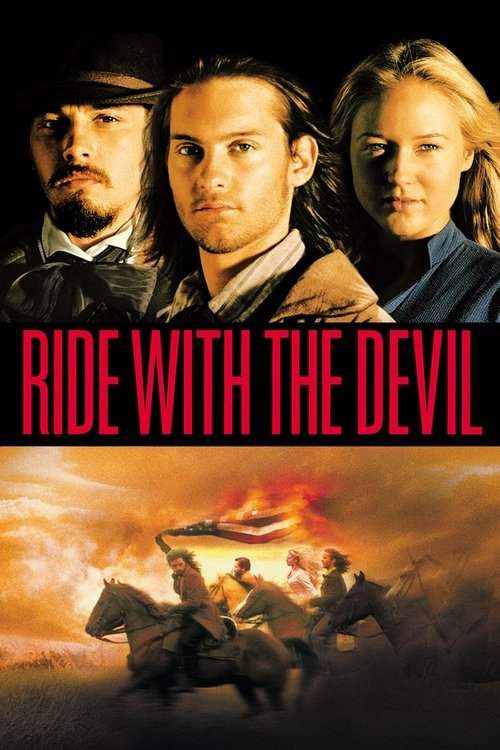
Ride with the Devil
1999 · Ang Lee
For when you want a serious, immersive period epic that asks something of you — a Sunday-afternoon western with real moral weight, not comfort viewing but deeply rewarding.
What it's about
During the Civil War, two young friends from Missouri join the bushwhackers — irregular pro-Southern raiders fighting a neighbor-against-neighbor guerrilla war along the Kansas border, all night ambushes and burned farms rather than battlefields. Jake, the son of a German immigrant, is never fully trusted by the men he rides with; alongside him is Daniel Holt, a freed Black man bound by loyalty to the friend who bought his freedom. As the raids turn crueler, both have to work out what honor and allegiance actually mean when the cause around them is rotting.
The experience
Slow-burning and mournful, with sudden eruptions of chaotic violence that feel genuinely frightening rather than exciting. It's talky and novelistic between skirmishes — long winters in hillside dugouts, formal 1860s speech — and it leaves you sitting with the waste of it all.
Performances
Jeffrey Wright is the quiet center of the film as Daniel Holt, doing enormous work with watchfulness and restraint; Tobey Maguire, cast against type, makes Jake's youth and outsider status genuinely felt.
The craft
Ang Lee shoots the border war with an outsider's clear eye — period detail down to the ornate letters and antique speech, and a big daylight raid sequence staged with terrifying sprawl. It's handsome widescreen filmmaking that rewards a large screen, and James Schamus's script from Daniel Woodrell's novel trusts you to keep up with its loyalties and dialects.
Why it matters
A commercial failure on release that has been steadily reclaimed as one of the most historically serious American films about the Civil War — the rare one about the guerrilla borderlands rather than the armies — and a key panel in Ang Lee's run of genre-hopping American films.
Snapshot
Ang Lee's Civil War film is not about the Civil War as Americans usually picture it — no massed lines, no generals, no national narrative. It is about the guerrilla war along the Missouri–Kansas border, where pro-Confederate "bushwhackers" and pro-Union Kansas "jayhawkers" fought a neighbor-against-neighbor conflict of night raids, burned farms, and reprisal killings. Adapted by James Schamus from Daniel Woodrell's 1987 novel Woe to Live On, the film follows Jake Roedel (Tobey Maguire), the son of a German immigrant and therefore permanently suspect among the Southern-identified irregulars he rides with; his friend Jack Bull Chiles (Skeet Ulrich); George Clyde (Simon Baker); and Daniel Holt (Jeffrey Wright), a freed Black man riding with the bushwhackers out of obligation to the man who purchased his freedom. The band's arc runs from adolescent adventure through a winter spent hiding in dugouts, to Quantrill's massacre at Lawrence, Kansas, in August 1863, and then to a dispersal that is less a resolution than an exhaustion.
Made between The Ice Storm (1997) and Crouching Tiger, Hidden Dragon (2000), it was released by Universal in a token number of theaters at the end of 1999 and effectively vanished. It has since become the most durable "lost film" of Lee's career — a status consolidated by the Criterion Collection's 2010 edition, which restored the director's longer cut.
Industry & production
The film was produced by Good Machine, the New York company run by Schamus, Ted Hope, and David Linde that had been Lee's home since Pushing Hands (1992). By 1999 Good Machine had graduated from micro-budget independence to brokering studio money, and Ride with the Devil represents that model at full stretch: an art-house sensibility applied to a period war epic with hundreds of extras, horses, and a mass-scale set-piece.
The commercial outcome was severe. The film received a minimal release with almost no marketing support, and returned a negligible fraction of its cost; precise figures vary across sources and are best treated with caution, but the scale of the failure is not in dispute. The theatrical version ran roughly 138 minutes. Lee's preferred cut, approximately 148 minutes, was the version Criterion issued in 2010. The internal history of that trim — how much was studio pressure and how much Lee's own second-guessing under pressure — is thinly documented, and it would be irresponsible to assign blame confidently; what is clear is that the longer version restores connective tissue in the dugout section and around Holt, and is now the standard text.
The failure had consequences. Lee's next film was a Mandarin-language wuxia picture financed outside the American studio system, and Crouching Tiger, Hidden Dragon became one of the most successful foreign-language releases in U.S. history. Good Machine itself was folded into Focus Features in 2002 when Universal consolidated its specialty operations, with Schamus and Linde running the new label — meaning Ride with the Devil sits precisely at the hinge between 1990s American independent cinema and the studio-owned specialty-division era that replaced it.
Technology
This is an emphatically analog film released in the year of The Matrix and Star Wars: Episode I — 1999 being the moment American cinema began converting to digital compositing, digital intermediates, and consumer video aesthetics. Ride with the Devil declines all of it. It was shot photochemically on 35mm with a strong bias toward practical and available light; its effects are smoke, black powder, weather, and bodies.
The period technology is itself a subject. The bushwhackers' signature weapon was the cap-and-ball revolver, carried in multiples — men riding with four, six, or more loaded pistols rather than a single slow-loading rifle — and the film's action grammar follows from that hardware: close-range, high-volume, cavalry charges pressed to point-blank distance, then flight. The tactical logic of the border war is legible on screen because the props are correct. Reloading is not a dramatic beat; it is a logistical crisis. Powder smoke is thick enough to blind, and the film lets it obscure the frame rather than clearing it for legibility.
The production drew on the Civil War reenactment community for its large-scale sequences, a common practice for American period films of the era and one that shows in the mass movement of the Lawrence raid — the crowd behaves like an organized body rather than a herd of extras.
Technique
Cinematography
Frederick Elmes shot the film, reuniting with Lee after The Ice Storm. Elmes's résumé — David Lynch's Eraserhead, Blue Velvet, and Wild at Heart; Jim Jarmusch's Night on Earth — is not obviously a Western pedigree, and that is the point. His work here is patient and unromantic, built on wide, horizontal compositions in which figures are small against Missouri scrub and treeline, and on interiors lit as though by what is actually in the room: a hearth, a lamp, a shaft through a doorway.
The palette is autumnal and then wintry, mud-brown and slate, with the bushwhackers' embroidered guerrilla shirts supplying almost the only saturated color — a deliberate irony, since those shirts were sewn by the women of sympathizing families, making the men's vanity a visible index of the civilian support network that sustains the war. Elmes shoots violence without elevation: no crane reveals, minimal slow motion, and a general refusal to make the raid on Lawrence beautiful.
Editing
Tim Squyres, Lee's editor since the beginning, cuts against propulsion. The film's structure is seasonal and episodic rather than escalating, and the long middle — the winter in the dugouts, where four men lie in a hole in the ground and wait — is the most radical editorial decision in the picture. Squyres holds on stasis, conversation, and boredom for a duration that a conventional war film would compress to a montage. Time passes in ellipses of weeks and months, marked by weather and beards rather than titles.
The Lawrence sequence is by contrast unusually legible: geography is established and maintained, so that the massacre reads as a systematic house-by-house operation rather than a blur of chaos. The horror comes from clarity, not confusion.
Mise-en-scène / staging
Lee stages the film as a study of manners under conditions of atrocity — which is continuous with Sense and Sensibility and The Ice Storm more than it appears. The bushwhackers observe elaborate courtesies: forms of address, deference to older men, ritualized hospitality at the farms that shelter them. The dugout is the film's central set and its central image: a domestic interior burrowed into the earth, where a war is conducted by men living like animals while maintaining the etiquette of gentlemen.
Costume and grooming carry argument. Long hair is the bushwhacker's identity badge; the film's closing movement includes a haircut and shave that functions as a demobilization ritual more decisive than any surrender. Jake's amputated finger — a wound that never stops being visible — keeps the cost of the war attached to the body of the man who survives it.
Sound
Mychael Danna's score, following his work on The Ice Storm and his long association with Atom Egoyan, is sparse and unpatriotic: no brass, no anthem, no swelling affirmation. Period-inflected fiddle and small folk textures appear at the wedding and dance sequences, where diegetic music does the emotional work instead.
The sound design is built on contrast between the muffled, close, breathy acoustics of the dugout and the concussive report of revolvers fired at conversational distance. Gunfire here is loud, ugly, and abrupt. Between engagements the track is dominated by wind, insects, horses, and silence — the long stretches of nothing that constitute most of an irregular war.
Performance
Maguire, two years before Spider-Man, plays Jake as watchful and internally divided, a young man whose outsider status makes him a better reader of the group than its members are of themselves. Jeffrey Wright's Daniel Holt — largely silent for the first half, then increasingly the film's moral center — is now widely regarded as the picture's finest performance: a study in withheld interiority, in which the character's reticence is itself the evidence of his condition. Jonathan Rhys Meyers's Pitt Mackeson supplies the film's account of how war produces men who simply prefer it. Skeet Ulrich, Simon Baker, Jim Caviezel, Tom Wilkinson, and a young Mark Ruffalo fill out the world. The casting of the singer Jewel as Sue Lee Shelley, in her first acting role, was the most contested decision at the time of release; the performance has been reassessed more kindly since, though it remains the film's most divisive element.
Narrative & dramatic mode
Woodrell's novel is a first-person account, and Schamus's adaptation strips the narration while preserving the crucial thing: the voice. The dialogue retains an ornate, formal, faintly archaic nineteenth-century register that many viewers in 1999 found stilted and that now reads as the film's boldest formal choice. These men speak in complete, balletic sentences, deploying courtesy as armor. The gap between how they talk and what they do is the film's central irony.
The mode is picaresque chronicle rather than plot: a sequence of episodes, arrivals, and departures, structured by seasons and by attrition. It is also a bildungsroman in which the education consists of unlearning — Jake begins by wanting to belong to a group that will never accept him and ends by walking away from the category of belonging altogether. The final movement is a series of separations: Holt going south to find his mother, Jake and Sue Lee going west, the war simply stopping rather than concluding.
Genre & cycle
Formally it is a Western wearing a war film's costume, and it belongs to the revisionist Western cycle that ran from Dances with Wolves (1990) and Unforgiven (1992) through The Ballad of Little Jo (1993), Posse (1993), and Dead Man (1995). Ride with the Devil arrives at the tail of that cycle, just before the genre's turn-of-century dormancy.
Its most direct genre ancestor is The Outlaw Josey Wales (1976), which occupies the identical historical ground — Missouri bushwhackers, Kansas redlegs — but organizes it around a revenge structure and a mythic hero. Lee's film systematically declines that structure. Earlier Hollywood treatments of Quantrill (Dark Command, 1940; Kansas Raiders, 1950) treated the border war as outlaw romance; Ride with the Devil is among the few American films to stage the Lawrence massacre as a massacre.
Within the 1990s Civil War cycle — Glory (1989), Gettysburg (1993), Andersonville (1996) — it is the anti-epic, and it prefigures the more commercially successful Cold Mountain (2003) in treating the war from its ragged edges. Structurally, its nearest kin may be Heaven's Gate (1980): a mud-and-manners American historical epic, commercially catastrophic on release, rehabilitated by later critics.
Authorship & method
By 1999 Lee had established a method: enter a closed social world, learn its rules with an anthropologist's precision, and dramatize the cost those rules exact from individual desire. Pushing Hands, The Wedding Banquet, Eat Drink Man Woman, Sense and Sensibility, and The Ice Storm all do this. Ride with the Devil applies the same instrument to the clan society of the Missouri border — a world of extended families, obligation, hospitality, and blood debt, where the war is essentially a feud conducted at scale. Lee has spoken about approaching American history as an outsider and finding in the bushwhackers' kinship structures something legible to him; the specific formulations vary across interviews and are worth reading in the source rather than paraphrasing.
Schamus is the essential collaborator — writer and producer, and the person who translated Woodrell's voice to screen. Their partnership ran from The Wedding Banquet through Lust, Caution (2007) and Taking Woodstock (2009). Elmes, Squyres, Danna, and production designer Mark Friedberg constitute a crew drawn from American independent cinema rather than from studio genre production, which accounts for the film's texture: a war movie made by people who make chamber dramas.
Movement / national cinema
The film is a product of 1990s American independent cinema at the moment it merged with the studios — Good Machine's model of festival prestige plus studio finance, which produced Focus Features and, with it, the specialty-division economics of the 2000s.
It is also a transnational object. Lee is a Taiwanese director trained at NYU, whose first features were made with Taiwanese state support and who won the Golden Bear for The Wedding Banquet in 1993. That he made one of the more historically serious American Civil War films is not incidental: the film's attention to how a society converts kinship obligation into organized violence is the observation of someone who did not inherit the American mythology.
Era / period
Two eras are in play. The depicted one is 1861–1865 Missouri: a slave state that did not secede, where the war took the form of civilian counterinsurgency. The film touches the machinery of that conflict — the network of sympathizing farm families, the Union policy of burning out and depopulating the border counties in reprisal, and the Lawrence raid of August 21, 1863, which killed roughly 150 men and boys and which the film stages at length. Holt's presence reflects a genuine, if very small, historical phenomenon: a handful of Black men rode with the bushwhackers, most famously with Quantrill's band.
The production era is 1999 — the year of Fight Club, Magnolia, Being John Malkovich, Three Kings, and The Blair Witch Project, when American cinema was loudly reinventing itself. A slow, formally conservative, verbally antique Civil War picture had no purchase on that conversation, which is a substantial part of why it disappeared.
Themes
Honor as vocabulary. The men constantly invoke honor while executing unarmed civilians. The film's method is to take their language seriously enough to expose it.
Literacy and power. The film's most-discussed scene has Jake reading aloud an intercepted letter written by a Union soldier's wife; its ordinary decency destabilizes the room. Holt's late acquisition of reading is the film's real emancipation — legal freedom without literacy having been, the film argues, a partial condition.
Freedom versus manumission. Holt is free and unfree simultaneously, bound by a debt of gratitude that functions as ownership by other means. His arc is the slow recognition that loyalty can be a form of captivity.
The outsider. Jake's German ancestry codes him as "Dutchy" — Missouri's German immigrants were overwhelmingly Unionist — so he fights for a cause that regards him as provisional. The film's subject is less the war than the machinery of belonging.
Domesticity inside atrocity. Marriage, childbirth, weddings, and cooking occur continuously alongside massacre. The dugout is a home.
Reception, canon & influence
Backward. The film draws on Woodrell's novel above all — its voice, its structure, and its refusal of heroism. Behind that stand the Missouri border-war historiography of the late twentieth century, which reframed Quantrill's men as insurgents rather than romantic raiders, and, cinematically, The Outlaw Josey Wales as the template being argued with. Lee's own manners-drama practice supplies the rest.
Reception. Reviews from the small number of critics who saw it were mixed to warm, with recurring praise for Wright and for the film's historical seriousness, and recurring complaints about pacing, the formality of the dialogue, and Jewel's casting. But the dominant fact of the film's reception is that reception barely occurred: the release was too small to generate a conversation.
Forward. Its influence has been posthumous and reputational rather than direct. The Criterion edition in 2010 restored the long cut and initiated a sustained critical reassessment; the film is now routinely cited as the most underrated work in Lee's filmography, and Wright's Holt as one of the great overlooked American screen performances of the 1990s. Its patient, de-mythologized, procedurally accurate mode of Western — history rendered as weather, boredom, and manners — anticipates the strain of American Westerns that followed the genre's revival: The Assassination of Jesse James by the Coward Robert Ford (2007), Meek's Cutoff (2010), The Homesman (2014), Slow West (2015). Its concern with the war's irregular margins runs forward into Free State of Jones (2016) and into television's long-form nineteenth-century revisionism. Woodrell's own screen reputation arrived later, with Winter's Bone (2010).
For Lee, the film's failure was decisive in a different way: it pushed him out of the American studio system and toward Crouching Tiger, Hidden Dragon, which changed his career and the international market for Chinese-language cinema. Ride with the Devil is thus doubly consequential — as an unabsorbed achievement in its own right, and as the pivot that produced the film everyone did see.
A Deleuzian reading
Four men spend a winter in a hole in the ground.
The full Deleuzian reading of Ride with the Devil →
Reception
Universal buried it in 1999 — it grossed roughly $635,000 against a budget near $38 million, one of the decade's quietest catastrophic flops — but the 2010 Criterion director's cut kicked off a real reappraisal, and 'Ang Lee's most underrated film' is now practically its official title.
How Ride with the Devil was received, from release to now →
How to watch Ride with the Devil: what to notice on a first viewing
- Watch the men maintain table manners inside a dirt hole. The dugout is a burrow roofed with logs and dirt where four men live like animals, and yet they keep addressing each other with the full formality of a parlor. The etiquette surviving inside a hole in the ground is stranger than anything in the fighting.
- Listen for gunfire fired at conversational, close range. There is no brass or swelling anthem anywhere in the score, and when revolvers go off they are loud, abrupt, and close, nothing like the clean distant shots of a typical Western. The sound design refuses to make any of this feel triumphant or thrilling.
- Watch for the only bright color: the guerrillas' embroidered shirts. Everything around the men runs to mud brown and slate, while their hand sewn shirts stay the one saturated thing in almost every frame. A small vanity is quietly carrying the whole civilian network that keeps the war fed.
- Listen for how formally these men speak to each other. The men talk in complete, balletic, old fashioned sentences even in the middle of raids and reprisals, courtesy deployed like a kind of armor. The gap between how politely they speak and what they actually do carries most of the film's argument.
- Watch how long the film holds on waiting and boredom. The long winter in the dugout is not compressed into a quick montage, months pass in weather and beards instead, and the film simply sits inside the waiting with the men. The waiting itself is treated as the substance of the war, not empty time to skip past.
The whole guide to watching Ride with the Devil, with the keys for a rewatch →
Influences: the films it descends from and the films it influenced
- The Outlaw Josey Wales (1976) — Lee restages its opening bushwhacker premise almost beat for beat — Missouri farm burned, boy rides with the irregulars — but strips out the lone-avenger framing and the revenge-arc payoff, so the template survives as the argument the film is having.
- The Long Riders (1980) — Hill cast real brother-sets to make the James–Younger gang legible as a kinship network rather than an outfit, and shot black-powder gunfights as blunt, smoke-choked concussion; Ride inherits both the clan-feud reading of the border war and the unchoreographed ballistics.
- Ulzana's Raid (1972) — Atrocity filmed as logistics — flat unmoralized medium shots, no cutaway, no score to tell you how to feel about a mutilation — which is precisely the register of Ride's roadside executions and the Lawrence sequence.
- The Beguiled (1971) — Stages the Civil War entirely inside a house where hospitality, table manners and nursing are the instruments of violence; the direct ancestor of Ride's dinner-table and parlor scenes, where courtesy is the medium in which killing is negotiated.
- Barry Lyndon (1975) — Licensed both halves of Ride's period surface: interiors lit off practical flame with the shadows left genuinely black, and archaic written-period diction delivered straight rather than smoothed into modern speech.
- Days of Heaven (1978) — Néstor Almendros' available-light, magic-hour agrarian photography and a narrative clocked by season and field labor instead of plot — the source of Elmes' autumnal exteriors and Squyres' habit of cutting a whole winter into an ellipsis.
- Blue Velvet (1986) — Frederick Elmes' Lynch-era practice of building an interior from one practical source and letting everything outside its throw fall to true black is what makes the dugout scenes read as one lamp, one fire, and four men in a hole.
- The Ice Storm (1997) — Assembled the exact crew (Elmes, Squyres, Danna, designer Mark Friedberg) and the method: weather as the film's clock, ellipsis across a freeze, and catastrophe arriving with no musical warning whatsoever.
- Sense and Sensibility (1995) — Lee's manners grammar — held two-shots in which feeling can only be stated through forms of address, and costume deployed to mark faction and rank — transposed intact onto Missouri clan society, where the same rules exact the same cost.
- Glory (1989) — Set the drill-accuracy and massed-musketry sound standard the film adopts, while Wright's Holt is built as its refusal: interiority withheld from the camera entirely where Glory's soldiers declaim theirs into a swelling chorus.
- Crouching Tiger, Hidden Dragon (2000) — Squyres carries the spatial-legibility cutting straight over — you always know who stands where relative to whom, whether it's a Lawrence street or a rooftop chase — and Lee's constrained-desire manners structure becomes the jianghu code.
- Brokeback Mountain (2005) — Squyres' seasonal ellipsis returns as the whole architecture, landscape functioning as calendar, and Ennis is Holt's successor in Lee's own filmography: a lead performance built on interiority deliberately kept off the actor's face.
- The Assassination of Jesse James by the Coward Robert Ford (2007) — Follows the identical Missouri bushwhacker cohort into its afterlife using period available light, long stretches of duration-as-dread, and gunfire staged as sudden concussive rupture rather than as choreography.
- Meek's Cutoff (2010) — Extends the de-mythologized mode to its limit: chores, water rationing and waiting constitute the plot, violence stays off-screen or is refused outright, and there is no non-diegetic swell anywhere to elevate it.
- Winter's Bone (2010) — The other Woodrell adaptation, and the one that made his screen voice legible: Ozark kin-obligation and hospitality as menace, carried by a performance that declines to explain itself to the audience.
- Slow West (2015) — Builds its Western from chore-level detail and abrupt de-glamorized gunfire, with an outsider protagonist reading a violent society whose rules he does not possess — Maguire's Jake Roedel function transplanted.
- Free State of Jones (2016) — Takes up the war's irregular margins directly: swamp-dugout hideout as the film's central interior, oath and kinship as the unit of political organization, and an interracial alliance forged inside insurgency, extending the Jake–Holt bond.
- Cold Mountain (2003) — Home Guard irregular warfare and the deserter's odyssey, scored from inside the world — Sacred Harp and fiddle as diegetic sound rather than orchestral commentary, the same choice Danna makes around Ride's dugout music.
Similar films
- The Outlaw Josey Wales (1976) — influence & lineage
- Brokeback Mountain (2005) — influence & lineage
- Glory (1989) — influence & lineage
- The Assassination of Jesse James by the Coward Robert Ford (2007) — influence & lineage
- The Beguiled (1971) — influence & lineage
- I Saw the Devil (2010) — shared sensibility
- Red River (1948) — shared sensibility
- The Hateful Eight (2015) — shared sensibility