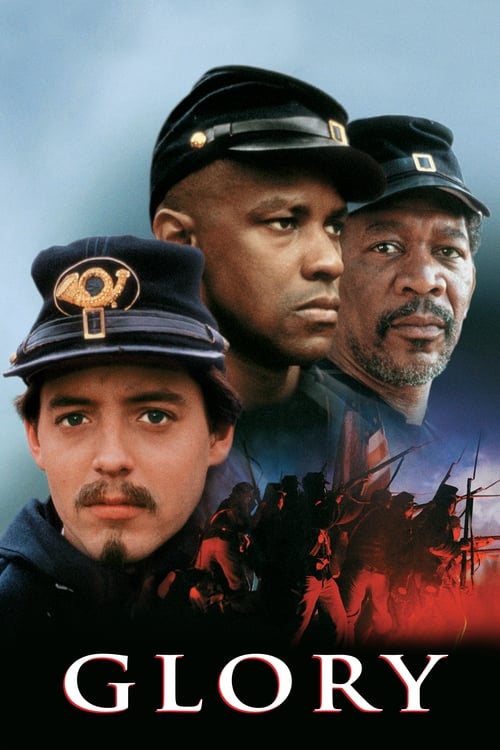
Glory
1989 · Edward Zwick
For when you want a serious, emotionally full historical drama — the kind of film you watch to feel moved and come away knowing something. Bring tissues; it earns them.
What it's about
During the American Civil War, young Boston officer Robert Gould Shaw is given command of the 54th Massachusetts, one of the Union's first all-Black volunteer regiments. The film follows the unit from raw recruitment through brutal training to the battlefield, as the men fight for the right to actually fight — facing contempt and broken promises from their own army even before they face the Confederates.
The experience
Earnest, stirring, and steadily devastating — it builds from drill-yard friction to battlefield fury, with quiet character moments that land harder than the cannon fire. Expect a lump in your throat by the end.
Performances
Denzel Washington won an Oscar as the angry, self-possessed Private Trip, and one wordless scene of his is among the most famous pieces of screen acting of its era; Morgan Freeman brings quiet moral gravity, and Matthew Broderick's boyish uncertainty suits a young colonel in over his head.
The craft
Freddie Francis's Oscar-winning cinematography gives the battles a smoky, painterly weight, and James Horner's choral score is one of the most borrowed pieces of film music ever written. The combat is staged with an emphasis on the terrifying mechanics of Civil War fighting — massed lines walking into fire — and the sound design won an Academy Award.
Why it matters
It helped reframe the Civil War in popular cinema around the agency and sacrifice of Black soldiers rather than Lost Cause romance, launched Denzel Washington to the front rank of American actors, and set the template for the modern prestige war drama.
Snapshot
Glory recounts the formation and first campaigns of the 54th Massachusetts Volunteer Infantry, one of the earliest official African American regiments raised for the Union during the American Civil War, told largely through the eyes of its young white colonel, Robert Gould Shaw (Matthew Broderick). It was Edward Zwick's second feature and the film that consolidated a durable American mode: the historically grounded, morally earnest studio drama that treats a national wound as prestige entertainment. Released by Tri-Star Pictures at the end of 1989, it earned three Academy Awards — Best Supporting Actor for Denzel Washington, Best Cinematography for Freddie Francis, and Best Sound — and it is widely credited with helping reframe the Civil War in popular cinema around the agency of Black soldiers rather than the Lost Cause romance that had dominated Hollywood since The Birth of a Nation (1915) and Gone with the Wind (1939). It remains a fixture of classroom teaching and a touchstone for the war film's treatment of race.
Industry & production
Glory was produced in the late-1980s environment in which mid-budget adult dramas could still command a studio release, though its subject made it a difficult sell; the historical record consistently describes the project as one that required considerable persistence to finance, since a Civil War picture centered on Black soldiers had no recent commercial precedent. Screenwriter Kevin Jarre is generally credited as the originating force, having drawn the material from primary and secondary sources rather than a single novel (see Authorship below). The film was produced by Freddie Fields for Tri-Star, then part of the Columbia/Tri-Star orbit.
Principal photography took place largely in Georgia, with the climactic assault on Fort Wagner staged on the Atlantic coast. The production leaned heavily on Civil War reenactors to fill out the regiment and battle lines — a practice that lent the marching, drilling, and volley-fire sequences their density and period discipline. The film opened in limited release in December 1989 to qualify for awards and expanded in early 1990. Its critical standing sharply outran its initial commercial profile; I do not have reliable box-office figures to cite here and will not invent them, but the consensus account is of a film whose reputation and earnings grew through awards attention and word of mouth rather than an opening-weekend surge.
Technology
Glory was shot photochemically on 35mm and conceived within an entirely pre-digital pipeline: optical effects, practical pyrotechnics, and in-camera staging carry the war footage. Its distinction is not technological novelty but the expressive command of conventional tools. The battle sequences depend on practical black-powder squibs, physical smoke, and large-scale coordinated movement of extras rather than any optical multiplication of armies. Freddie Francis's lighting is the film's most consciously "technological" dimension in the craft sense — his handling of low-light interiors, firelight, and the smoke-diffused daylight of the battlefield exploits the latitude of the film stock rather than any post-production manipulation. The sound work, which won the Oscar, is likewise an achievement of recording, mixing, and layering — the concussive report of massed musketry and artillery, the rattle of drums, and the human noise of a charge — built through analog craft.
Technique
Cinematography
Freddie Francis, a British cinematographer and horror director of long standing (a two-time Oscar winner, the first for Sons and Lovers), gives Glory a painterly, almost nineteenth-century pictorial sensibility. The film repeatedly evokes the visual memory of the war as it survives in period imagery — the desaturated, tonal quality of Mathew Brady's battlefield photographs and the compositional gravity of Winslow Homer. Francis favors backlit smoke, silhouetted ranks, and a controlled palette of blues, browns, and muted golds. The Fort Wagner assault is shot to emphasize the soldiers' bodies against sky, sand, and the looming earthwork, so that the advance reads as both spatial fact and elegiac tableau. Interiors and camp scenes use soft, sourced light to keep faces legible in a way that dignifies the individual soldier — a visual argument consonant with the film's thesis.
Editing
Steven Rosenblum, who would become Zwick's regular editor, cut the film (an Academy Award nomination for editing is part of its awards record). The editing balances two registers: the patient, accretive rhythm of the training and camp passages, which build the regiment as a collective character, and the compressed, kinetic cutting of combat. The film withholds full-scale battle for much of its length, using earlier skirmish and drill sequences to establish spatial grammar, so that the final charge lands with accumulated weight. Rosenblum's cutting keeps individual soldiers identifiable within the mass — a structural choice that prevents the climax from dissolving into anonymous spectacle.
Mise-en-scène / staging
The staging is organized around the transformation of a crowd into a regiment. Early scenes emphasize disorder, mismatched clothing, and improvised drill; over the film's course, the mise-en-scène tightens into ranks, uniform blue, and synchronized movement, so that the visual order of the frame tracks the men's hard-won cohesion and citizenship. Zwick and his designers pay close attention to the material textures of army life — boots, or the lack of them; the issuing of rifles; the physical business of a camp — and to the geometry of nineteenth-century linear warfare, in which massed men advance in the open against entrenched fire. The film's most quoted staging beats — the ranks under fire, the flag-bearer, the assault up the sand rampart — depend on this legibility of formation.
Sound
The Oscar-winning sound design is central to the film's effect. The battlefield is rendered as an overwhelming acoustic environment: the coordinated crash of volley fire, the individual snap of rifles, artillery concussion, and the sonic chaos of the charge. Equally important is the film's use of quieter diegetic sound — drilling cadence, drums, the singing of the men around the fire on the eve of battle, a sequence that functions as the emotional hinge before Fort Wagner. The interplay of James Horner's score with these diegetic elements structures the audience's passage from communal intimacy to lethal spectacle.
Performance
The ensemble performances are the film's enduring achievement. Denzel Washington, as the embittered runaway slave Trip, delivers the performance that won him the Academy Award for Best Supporting Actor; the scene in which he is flogged and a single tear falls is among the most cited pieces of screen acting of its era. Morgan Freeman anchors the regiment as the gravedigger-turned-sergeant-major Rawlins, a figure of moral authority; Andre Braugher, in an early film role, plays the educated, initially soft Thomas Searles; Jihmi Kennedy plays the stammering Sharts. Matthew Broderick's Shaw is deliberately restrained and uncertain — a casting and performance choice that has divided viewers, some finding it a truthful portrait of a young man growing into command, others finding it recessive. Cary Elwes plays Shaw's second, Cabot Forbes. The film's method gives its Black soldiers interior lives and disagreement among themselves, resisting the reduction to a single collective attitude.
Narrative & dramatic mode
Glory is a work of dramatized history in the classical mode: a linear, cause-and-effect narrative organized as a bildung — the making of a regiment and the moral education of its colonel. It uses the epistolary device of Shaw's letters as a framing voice, lending the film a documentary claim to authenticity while filtering events through his consciousness. This framing has drawn the film's most substantive criticism: because the point of entry is the white officer, the Black soldiers, though richly individuated, are to some degree observed rather than authoring the narrative. The dramatic mode is elegiac and inevitably tragic — the audience is positioned to know that the celebrated regiment marches toward a costly, only partially successful assault, so the film's forward motion is shadowed by foreknowledge of sacrifice. It is, structurally, a war film that culminates not in victory but in a defeat reframed as moral and historical vindication.
Genre & cycle
The film sits at the intersection of the war film, the historical epic, and the prestige literary/historical drama. Within the specific tradition of Civil War cinema, it stands as a deliberate corrective to a long lineage of Lost Cause and plantation nostalgia. It also participates in the late-1980s cycle of American films reckoning with race and history for a prestige adult audience, and it prefigures the 1990s wave of large-scale, reenactor-driven Civil War projects, including Ken Burns's television documentary The Civil War (1990) and Ronald Maxwell's Gettysburg (1993). As a battle picture, it belongs to the tradition of the "regiment film," which treats a military unit as a microcosm of society, and it anticipates the visceral, ground-level combat aesthetic that would be pushed further later in the decade.
Authorship & method
Glory is best understood as a collaboration in which several authors' contributions are legible. Edward Zwick, coming from television (thirtysomething) and the feature About Last Night…, established here the signature that would define his career — the socially conscious historical drama that places a personal story inside a large-scale conflict, a template he would return to in Legends of the Fall, The Last Samurai, Blood Diamond, and Defiance. His method foregrounds emotional accessibility and moral clarity, a tendency admirers call humane and skeptics call sentimental.
Screenwriter Kevin Jarre built the script from historical sources rather than a single adaptation — most consistently associated in the record with Lincoln Kirstein's Lay This Laurel, Peter Burchard's One Gallant Rush, and the surviving letters of Robert Gould Shaw. Cinematographer Freddie Francis brought a veteran's pictorial authority and a horror director's command of low light and atmosphere. Composer James Horner provided a score built around choral writing — the boys' choir sound is one of its defining textures — that moves between martial drive and lament; it is among the works most associated with his elegiac register. Editor Steven Rosenblum began with this film a long partnership with Zwick. The convergence of these collaborators — a television-trained director, a classically pictorial DP, a lyrical composer, and a research-driven writer — produced the film's characteristic blend of intimacy and grandeur.
Movement / national cinema
Glory is a mainstream American studio film with no affiliation to a formal movement; its aesthetic is the polished classicism of Hollywood prestige filmmaking. It is most usefully located within American national cinema's ongoing project of narrating the Civil War and slavery to itself. In that longer national conversation, the film marks a shift — supported, in its craft, by the participation of a distinguished British cinematographer — toward centering Black military service and citizenship within the popular historical imagination. It belongs to Hollywood's recurring cycle of "socially responsible" historical entertainment rather than to any avant-garde or regional tendency.
Era / period
Made and released at the close of the 1980s, Glory reflects a moment when the mid-budget adult drama still had a secure place in studio slates and when the Academy rewarded literate historical filmmaking. Its production coincided with a broader late-century reappraisal of the Civil War in American culture — an appetite the film both fed and anticipated, cresting the following year with Ken Burns's documentary. It is also a pre-digital film, and its combat aesthetic — massed reenactors, practical effects, photochemical imaging — belongs to the last period before computer-generated crowds and battles transformed the historical epic.
Themes
The film's governing theme is the claim to full citizenship through sacrifice — the paradox of men fighting for a nation that has not yet recognized their humanity, and asserting that humanity precisely by their willingness to die for it. Around this cluster several others: the tension between individual dignity and military discipline; the corrosive and various forms of racism, including the "soft" prejudice of well-meaning white allies and the institutional discrimination of unequal pay and menial assignments (the pay protest is a key sequence); the transformation of disparate, often traumatized individuals into a brotherhood; and the moral education of a young man learning what leadership costs. The film is also, self-consciously, about historical memory — the letters and the framing insist that these men be remembered, making commemoration itself part of the subject.
Reception, canon & influence
Critically, Glory was received as a major and moving achievement, with particular and near-unanimous praise for Denzel Washington's performance, for Freddie Francis's imagery, and for the battle sequences; the most persistent critical reservation, then and since, concerns the choice to center a white officer's perspective in a story about Black soldiers. Its awards record is the clearest index of its standing: Academy Awards for Supporting Actor (Washington), Cinematography, and Sound, with additional nominations including editing and art direction.
Influences on the film (backward): it draws on the documentary photography of the war (Brady) and the pictorial tradition of American war art (Homer); on the historical scholarship and primary sources behind Jarre's script (Kirstein, Burchard, and Shaw's own letters); and, in its very conception, on a reaction against the Lost Cause mythology of earlier Hollywood Civil War films.
Legacy (forward): Glory is widely regarded as a watershed in the popular representation of Black military service and of the Civil War, and it is a durable teaching text in both film and history classrooms. It helped establish Denzel Washington as a leading dramatic actor of his generation and inaugurated Edward Zwick's career-long template of the intimate story set against historical spectacle, carried by his continuing collaborations with editor Steven Rosenblum and others. Its reenactor-driven, practically staged battle aesthetic fed directly into the Civil War projects of the early 1990s. It is frequently cited in critical and popular canons of the war film and has been recognized in institutional preservation efforts as a culturally significant American film. Its influence is visible whenever later filmmakers stage the Civil War from the vantage of those the earlier tradition had erased.
A Deleuzian reading
A man is stripped and flogged in a Union camp.
The full Deleuzian reading of Glory →
Reception
A critical hit in 1989 that won three Oscars yet was snubbed for Best Picture the year Driving Miss Daisy won — a pairing that's aged into its own discourse. Decades of classroom screenings have cemented it as the definitive 54th Massachusetts film, even as modern viewers re-litigate its framing.
How Glory was received, from release to now →
How to watch Glory: what to notice on a first viewing
- Watch the men's clothing and lines tighten across the film. They arrive as a crowd: mismatched, barefoot, drilling badly. Over the training passages the frame fills with uniform blue, straight ranks, synchronized movement. Zwick lets the composition carry the change rather than a speech. You watch a claim to citizenship arrive as a change in how the frame is arranged.
- Watch the men's feet and what they get issued. Boots, or none. Rifles withheld and then handed over. Unequal pay, menial work details, a quartermaster's counter that keeps saying no. The film keeps its politics in objects. The material details say what the Union thinks of these soldiers without anyone making a speech about it.
- Look at the blues, browns and smoke in the exteriors. Freddie Francis works a desaturated period palette with backlit smoke and silhouetted ranks. The compositions sit closer to Mathew Brady's photographic plates and Winslow Homer's paintings than to a modern battle picture. The film looks like the images the war actually left behind, which lends the staged scenes documentary weight.
- Watch how still Washington keeps Trip's face. Denzel Washington plays Trip as a mask set against everyone, white officers and fellow soldiers alike. Almost nothing moves. What does move is small, and he makes you wait for it. A feeling with nowhere to go gathers in the face, which is why one moving feature hits so hard.
- Listen for the drums and drill cadence between the battles. The mix holds two worlds. One is massed volley fire and artillery concussion. The other is cadence, drums, boots, and the men singing around a fire, with Horner's choral writing running alongside. The quiet sound builds the regiment as a group of men, not only as a firing line.
The whole guide to watching Glory, with the keys for a rewatch →
Influences: the films it descends from and the films it influenced
- The Red Badge of Courage (1951) — Composes its Civil War battle tableaux directly after Mathew Brady's field photographs, the documentary-photo gray palette and posed-dead compositions Glory's Brady-inspired imagery revives.
- The Birth of a Nation (1915) — The Lost Cause Civil War spectacle whose racial mythology Glory was conceived as a deliberate rebuttal to, inverting the point of view onto the Black troops that tradition erased.
- Paths of Glory (1957) — Establishes the regiment-scale war film as elegiac tragedy staged around officers' moral choices, with lateral tracking through the ranks that Glory's dual-register cutting between officer and enlisted echoes.
- Zulu (1964) — Codifies the linear-warfare geometry of disciplined ranks firing in volley against a massed charge — the set-piece grammar of Glory's final assault on Fort Wagner.
- Barry Lyndon (1975) — Advances redcoat battle lines walking into fire and pioneers naturalist low-light interior photography, both echoed in Glory's linear warfare and Francis's firelight camp scenes.
- The Elephant Man (1980) — Freddie Francis's own prior showcase of backlit smoke, industrial haze silhouettes and low-key Victorian atmosphere — the horror-DP command of shadow he carried into Glory.
- The Innocents (1961) — Freddie Francis's celebrated deep-focus, low-light Gothic cinematography, the pictorial authority over darkness and firelight that defines Glory's night and battle imagery.
- Lawrence of Arabia (1962) — The prestige-classicism template of an intimate character study set inside vast historical spectacle, the Hollywood grandeur-plus-intimacy mode Zwick adopts wholesale.
- All Quiet on the Western Front (1930) — Follows ordinary enlisted men as an ensemble toward collective death in an anti-war register, the elegiac regiment-tragedy and diaristic intimacy Glory frames epistolarily via Shaw's letters.
- Sergeant Rutledge (1960) — Restores Black soldiers to the dignified center of an American military-history frame, extending Rutledge's recovery of the Buffalo Soldier as a subject worthy of the epic.
- Gettysburg (1993) — Scales up the reenactor-driven, practically staged Civil War battle aesthetic — real regiments in period drill rather than optical trickery — that Glory pioneered for the early-'90s Civil War cycle.
- The Last Samurai (2003) — Reprises the Zwick template exactly — a Western officer's vantage onto another culture's martial sacrifice, built around linear-warfare set pieces and elegiac scoring.
- Saving Private Ryan (1998) — Extends Glory's desaturated battlefield palette and immersive, Oscar-caliber battlefield sound mix into a full aesthetic of realist infantry carnage.
- Braveheart (1995) — Weds massed-infantry linear-battle geometry to personal martyrdom and elegiac voiceover, the intimate-hero-in-historical-slaughter formula Glory templated.
- Ride with the Devil (1999) — Stages the Civil War from erased vantages — bushwhackers and a freed Black combatant — using the reenactor-practical battle aesthetic Glory legitimized.
- Lincoln (2012) — Adopts low-key lamplight and firelight interior cinematography and tells the Civil War with Black agency foregrounded, the corrective vantage Glory introduced.
- 12 Years a Slave (2013) — Recentres the Civil-War-era narrative fully on Black experience and subjectivity, completing the point-of-view correction Glory began but hedged with its white-officer frame.
- We Were Soldiers (2002) — Zwick's staging of casualty-notification sequences as elegiac punctuation within combat chronicle — and Matthew Broderick's performance of grief held in check by command responsibility — are direct precedents for the telegram-delivery montage and Gibson's stoic-grief performance register.
- Hacksaw Ridge (2016) — Zwick pioneered the prestige war biographical hagiographic climax — slow-motion sacrifice tableau with choral score — encoding the soldier's death as spiritual transcendence within mainstream Hollywood production grammar that Gibson adopts directly for Doss's ordeal sequences.
- Remember the Titans (2000) — Establishes Denzel Washington's screen persona as the moral center of a racial-integration-through-shared-endeavor ensemble, the exact gravitas Titans casts him to reprise.
- Heneral Luna (2015) — Period-war drama that fuses candlelit chiaroscuro interiors with doomed heroism and internal factional conflict, a tonal and lighting precedent for Luna's intimate command scenes.
- Legends of the Fall (1994) — Zwick's same personal-story-inside-historical-conflict signature, cut by returning editor Steven Rosenblum in the intimate/spectacle dual register begun on Glory.
- Dances with Wolves (1990) — A contemporaneous prestige historical epic using an officer's journal/epistolary frame and a Union soldier's sympathetic vantage onto a marginalized people, sharing Glory's Hollywood-classicist mode.
- The Hurricane (1999) — Established Denzel's register of righteous endurance under institutional racism rendered through close performance-centered framing, the actor-vehicle mode Hurricane is bent toward.
- Mississippi Burning (1988) — Adjacent Reagan-era reckoning prestige drama that likewise narrates Black history with a white officer as audience surrogate, sharing the moment's earnest-liberal-spectacle approach.
Similar films
- Paths of Glory (1957) — influence & lineage · same viewing thread
- 12 Years a Slave (2013) — influence & lineage
- The Birth of a Nation (1915) — influence & lineage
- All Quiet on the Western Front (1930) — influence & lineage
- Saving Private Ryan (1998) — influence & lineage
- Ride with the Devil (1999) — influence & lineage
- Lincoln (2012) — influence & lineage
- Lawrence of Arabia (1962) — influence & lineage · same viewing thread
All the films related to Glory →
Watch it with: curated runs of related films
- The Futility of War — A run of films about ordinary men fed into war's machinery — from the trenches to the Casbah to the Warsaw sewers — where the futility and human cost rhyme across a century and a dozen conflicts.