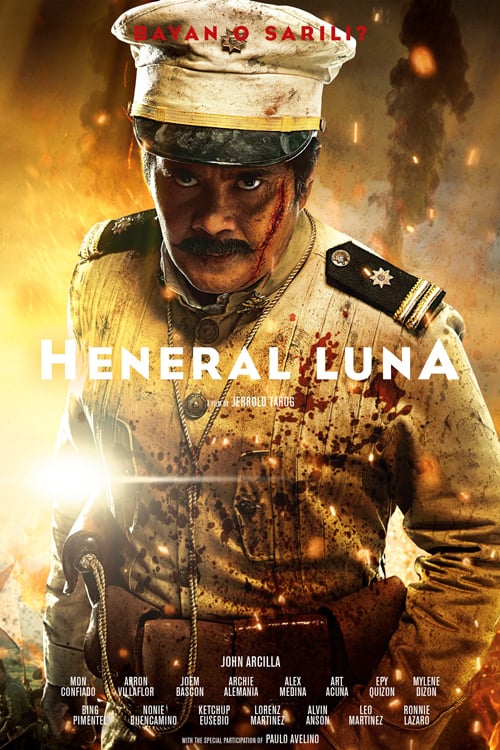
Heneral Luna
2015 · Jerrold Tarog
For when you want a big, blood-pumping historical epic that also makes you furious about politics — a film to argue about afterward, not just admire. More galvanizing than comforting.
What it's about
In 1899, as the young Philippine republic fights off an American invasion, General Antonio Luna — brilliant, hot-tempered, impossible — tries to forge a squabbling revolutionary army into a force that can actually win. His real war turns out to be on two fronts: against the Americans at the trenches, and against the politicians, regional rivalries, and self-interest eating the revolution from inside. It follows Luna through the final months of his doomed campaign, a man too fierce for his enemies and maybe for his own government.
The experience
Muscular and angry in the best way — battle scenes with real scale, but the heat comes from the shouting matches in cabinet rooms, where Luna's temper is both thrilling and terrifying. It's rousing, often surprisingly funny, and it leaves a bitter aftertaste that's entirely the point.
Performances
John Arcilla is a force of nature as Luna — volcanic, profane, weirdly lovable, the kind of performance a whole national conversation gets built around.
The craft
Jerrold Tarog directed, edited, and scored it himself, and that single vision shows: the film moves like a thriller, cuts between battlefield and boardroom with real bite, and stages its combat with genuine sweep. The period reconstruction and epic battle scenes reward a big screen.
Why it matters
A genuine cultural event in the Philippines — repeat audiences, school screenings, word-of-mouth momentum — and the country's submission to the Academy Awards, it proved a homegrown historical epic could be both popular and confrontational.
Snapshot
Heneral Luna is a Filipino historical war drama that reconstructs the final months of General Antonio Luna, the fierce, temperamental commander of the revolutionary army during the Philippine-American War of 1899. Directed, edited, and scored by Jerrold Tarog and built around a towering performance by John Arcilla, the film uses one man's doomed campaign to stage a larger argument about the young republic's self-sabotage — the regionalism, class interest, and personal jealousy that hollowed out the fight for independence from within. Released in September 2015, it became a genuine cultural event in the Philippines, drawing repeat audiences and school screenings on the strength of word of mouth, and it was selected as the country's submission for the Best Foreign Language Film category at the 88th Academy Awards. It is the first installment of Tarog and Artikulo Uno Productions' intended trilogy on Filipino historical figures, continued in Goyo: Ang Batang Heneral (2018).
Industry & production
The film was produced by Artikulo Uno Productions, the company associated with E.A. Rocha and Fernando Ortigas, as a deliberately ambitious independent effort outside the dominant studio system of major Manila outfits. Its financing model reflected a passion-project origin: a mid-scale budget (modest by international standards, though substantial for Philippine independent cinema) marshaled to stage cavalry, uniformed armies, and period reconstruction. Precise budget figures reported in the press should be treated with some caution, but the production was unambiguously stretched against the demands of a war film, and much of the craft ingenuity on screen is a response to that constraint.
The commercial story is the film's most remarkable industrial fact. Historical films had long been considered box-office poison in the Philippine market, and Heneral Luna opened without the built-in advantages of the Metro Manila Film Festival slate or a star-vehicle romance. Its theatrical run built slowly, then surged as audiences — notably students, teachers, and viewers energized by its nationalist charge — returned and evangelized. It went on to become one of the highest-grossing Filipino films of its period and, by most accounts, the most commercially successful local historical film to that date. That success materially reshaped the business case for serious historical and biographical cinema in the country and made the trilogy's continuation possible.
Technology
Heneral Luna was shot digitally, in line with the near-total digital transition of Philippine feature production by the mid-2010s, and its look leans into the flexibility digital capture offers for low-light interiors and controlled color grading. The technological interest of the film is less about cutting-edge hardware than about how a limited-budget production simulates the scale of period warfare. Battle sequences and the American forces are extended through visual effects and careful framing rather than through the vast practical armies of a Hollywood epic; smoke, controlled explosions, and digital augmentation stand in for resources the production did not have. The result is a film that mostly conceals its economies, though the seams are occasionally visible in the compositing of larger crowd and combat shots — an honest limitation rather than a failure of ambition. I do not have reliable confirmation of the specific camera system used, and so decline to name one.
Technique
Cinematography
The cinematography, by Pong Ignacio, is one of the film's clearest achievements. It favors a burnished, earthen palette — sepia-inflected browns, muddy greens, candlelit gold — that reads at once as period-appropriate and as a visual metaphor for a nation in the mud of its own conflicts. Interiors, especially the cabinet and council scenes where the film's real war is fought in words, are lit with a chiaroscuro heaviness that isolates faces against darkness. Ignacio's camera is willing to move with Luna's temper: handheld urgency in confrontation, restless energy that mirrors the general's own. The film's most celebrated single image is a virtuoso long take of Luna's assassination and its aftermath — a fluid, unbroken movement that turns the killing into a continuous, inescapable tableau, letting horror accumulate in real time rather than being cut into digestible pieces.
Editing
Tarog cut the film himself, and the editing carries the double signature of a director-editor who conceives rhythm and structure as one gesture. The film opens with a framing device — the fictional young journalist Joven Hernando interviewing and later recollecting Luna — and the editing threads this act of remembering through the chronology, occasionally puncturing the historical action with reflexive or stylized interruptions. Tarog is not a strict realist in the cutting room: he permits tonal shifts, moments of dark comedy in the bickering councils, and abrupt escalations into violence. The pacing is built to hold a two-hour argument together, alternating the static tension of political rooms with the kinetic release of the battlefield.
Mise-en-scène / staging
The staging draws a sharp and deliberate contrast between two theaters of the revolution: the field, where Luna's authority is physical and absolute, and the cabinet room, where it dissolves against the maneuvering of politicians and businessmen. Costume, set dressing, and the choreography of bodies in colonial-era interiors establish period texture, while the blocking repeatedly isolates Luna — placing him at the head of tables he cannot command, or alone in frame against groups closing ranks. The recurring motif of doors, thresholds, and the fateful staircase and plaza of the assassination gives the physical spaces a moral geography.
Sound
Tarog also composed the score, and the music is integral to the film's rhetorical force — martial, elegiac, and at moments deliberately anthemic, cueing the audience toward the film's nationalist emotion. The sound design contrasts the clamor of gunfire and cannon with the charged quiet of the council chambers, where the scrape of a chair or a held silence carries as much threat as any battle. The film's multilingual soundscape — Tagalog, Spanish, and English braided together — is itself a technique, sonically dramatizing a fractured elite in which language marks class, education, and allegiance.
Performance
John Arcilla's performance as Luna is the film's engine and its lasting legacy. He plays the general as a man of ferocious intelligence and ungovernable temper — profane, brilliant, contemptuous of cowardice, and finally undone by the very intransigence that makes him magnetic. Arcilla modulates between explosive rage and moments of wounded tenderness, and the film trusts him to carry long stretches on the force of rhetoric alone. Around him, a strong ensemble sharpens the political drama: Mon Confiado's watchful, opaque Emilio Aguinaldo; Epy Quizon as the ailing sage Apolinario Mabini; Nonie Buencamino and other players as the self-interested cabinet figures; and Arron Villaflor as the audience-surrogate journalist Joven.
Narrative & dramatic mode
The film's dramatic mode is tragedy in the classical sense — a great man destroyed by a flaw inseparable from his greatness, in a society that cannot accommodate him. Its structure is built on dramatic irony: the audience, knowing Luna's fate, watches him alienate the very allies whose loyalty he needs. Crucially, the film locates its central conflict not in the war against the Americans but behind the lines, in the internal betrayals of the revolutionary government. The framing device of Joven's recollection foregrounds the film's status as constructed memory and historical argument rather than transparent record; the narrative openly signals that it is dramatizing history, blending documented events with invented and composite figures (Joven chief among them) to render the era's forces legible. The tone oscillates deliberately — satire in the councils, horror on the battlefield, martyrology in the finale — a hybridity that is itself the film's rhetorical strategy.
Genre & cycle
Heneral Luna sits at the intersection of the war film, the political drama, and the national biopic, drawing on the iconography of the international historical epic — battles, uniforms, great-man portraiture — while subordinating spectacle to argument. Within Philippine cinema it belongs to, and helped revive, the historical-heroic cycle, a lineage that includes earlier films on Rizal, Bonifacio, and the revolution. What distinguishes it within that cycle is its refusal of reverent hagiography: it presents its hero as difficult and flawed and its subject as a story of failure. As the first film of a planned trilogy, it also inaugurates a small franchise-scale cycle of its own, extended in Goyo and intended to continue further.
Authorship & method
The film is unusually the product of a single controlling sensibility. Jerrold Tarog directed, co-wrote, edited, and composed the score — a multi-hyphenate authorship that gives the film its tonal coherence and its blend of populist accessibility with formal ambition. The screenplay is credited to Tarog with Henry Hunt Francia and E.A. Rocha, and it draws on historical scholarship on Luna (biographical accounts of his rise and fall inform the film's shape), though the filmmakers foreground dramatization over documentary fidelity. Key collaborators include cinematographer Pong Ignacio, whose imagery defines the film's look, and the producing partnership of Rocha and Fernando Ortigas at Artikulo Uno, whose backing made the scale possible. Tarog's method — controlling picture, cut, and music together — is central to understanding how a mid-budget independent film achieves the emotional sweep of a larger production.
Movement / national cinema
The film is a landmark of contemporary Philippine independent cinema and of the country's broader post-2000s "indie" resurgence, in which digital production enabled ambitious work outside the mainstream studios. But Heneral Luna is a distinctive case within that movement: where much acclaimed Philippine indie cinema is austere, slow, and festival-oriented (the international art-house lineage of Lav Diaz, Brillante Mendoza, and others), Tarog's film is unabashedly popular in address, aiming at a mass domestic audience and a civic-educational function. It thus represents a bridge between the artistic seriousness of the indie sector and the commercial reach of mainstream release — a proof that a formally accomplished national-historical film could also be a hit.
Era / period
The film depicts the Philippine-American War at the turn of 1899, in the immediate aftermath of the Philippine Revolution against Spain, when the newly declared First Philippine Republic faced American annexation. Its historical texture — the transition from Spanish colonial elite culture to American imperial pressure, the mixed Spanish-Tagalog-English speech of the ilustrado class, the fragile institutions of the Malolos government — is central to its meaning. Made in 2015, the film also speaks pointedly to its own moment: its portrait of elite self-interest, regional division, and betrayed national purpose was widely received as a commentary on contemporary Philippine politics, and much of its popular resonance came from audiences reading the past as a mirror of the present.
Themes
The film's governing theme is national disunity — the tragedy of a people who, in Luna's own furious framing, fight one another instead of the invader. Around this it organizes a cluster of concerns: the conflict between personal or regional loyalty and the abstract idea of bayan (nation), crystallized in the film's recurring provocation "Bayan o sarili?" (Nation or self?); the corrosive role of class and business interest in undermining the revolution; and the incompatibility of principled intransigence with political survival. Luna's uncontrollable temper is presented as both a moral virtue — an refusal to compromise with cowardice and treason — and the practical cause of his isolation and death. The film also meditates on historical memory itself, on how nations narrate their heroes and failures, framing its story as an act of remembering meant to instruct the living.
Reception, canon & influence
Critically and popularly, Heneral Luna was received as a watershed. Reviewers praised Arcilla's performance, Tarog's confident direction, and the film's success in making history urgent and commercially viable; Arcilla's Luna was widely honored in local award-giving circles, and the film accumulated recognition across Philippine industry bodies. Its selection as the Philippines' Oscar submission confirmed its status as the year's flagship national film. Some historians and commentators debated its dramatic license and its heroic framing of Luna, and that debate is part of its legacy — the film became a catalyst for public conversation about Philippine history rather than a settled account of it.
Looking backward, the film's influences run through the tradition of the international historical epic and the great-man biopic, and more specifically through the Philippine lineage of revolutionary and heroic cinema and the biographical scholarship on Luna that underpins its screenplay. Its multilingual realism and its willingness to portray a flawed hero mark a deliberate departure from more reverent predecessors.
Looking forward, its impact has been substantial. Commercially, it rewrote the assumption that Filipino historical films could not draw audiences, encouraging further investment in serious period and biographical work. Institutionally, it entered classrooms and public discourse as a touchstone for teaching the Philippine-American War and the theme of national unity. And within its own franchise it directly generated Goyo: Ang Batang Heneral (2018), extending Tarog and Artikulo Uno's project of a historical trilogy; a further planned installment has been discussed publicly, though I cannot confirm its completion status and so leave that open. Its most durable legacy may be cultural shorthand: lines and images from the film, above all its insistence on choosing nation over self, passed into wider Filipino public conversation — an unusually direct instance of a film shaping how a country talks about its own past.
Reception
It opened quietly and was nearly yanked from Philippine cinemas within the first week — then a #HeneralLuna social-media campaign turned it into a word-of-mouth phenomenon, theaters brought it back, and it became the highest-grossing Filipino historical film ever at the time. It's since settled into modern-classic status: school screenings, endless rewatches, the film that kicked off a whole wave of Filipino historical cinema.
How Heneral Luna was received, from release to now →
Influences: the films it descends from and the films it influenced
- Patton (1970) — The template for a biopic built around a brilliant, profane, insubordinate general undone by his own temperament rather than the enemy — Luna's volatile characterization and self-destructive command arc descend directly from George C. Scott's Patton.
- Citizen Kane (1941) — Its reflexive framing device — a journalist reconstructing a titanic public figure through mediated recollection — is echoed in the fictional reporter Joven, whose interviews and vantage frame our access to Luna.
- Amadeus (1984) — Model for sustaining dramatic irony through a narrator-witness whose recounting shapes our judgment of a doomed genius, letting the audience know the fall before the hero does.
- The Battle of Algiers (1966) — Source of the handheld, docudrama-realist crowd staging and multilingual anticolonial soundscape that give Luna's war scenes their reportorial, on-the-ground immediacy.
- Lawrence of Arabia (1962) — Establishes the epic sweep married to a tragic-hero arc — a charismatic, insubordinate military visionary whose personal grandeur curdles — achieving scale through composition rather than sheer budget.
- José Rizal (1998) — The immediate Filipino national-hero biopic precedent: scholarly, prestige period filmmaking about a founding figure, whose reverent template Luna deliberately roughens with a flawed, abrasive protagonist.
- Oro, Plata, Mata (1982) — Filipino period epic whose chiaroscuro-lit interiors and earthen wartime palette during the collapse of a social order prefigure Pong Ignacio's lighting and color scheme.
- Ganito Kami Noon, Paano Kayo Ngayon (1976) — Dramatizes national identity being painfully forged during the revolution and the American arrival, seeding the theme of Filipino disunity that Luna centers as tragic engine.
- Braveheart (1995) — Blueprint for the martyr-hero nationalist cycle — personal sacrifice mythologized as national awakening, with brutal, muddy battlefield staging and betrayal by one's own leadership.
- Glory (1989) — Period-war drama that fuses candlelit chiaroscuro interiors with doomed heroism and internal factional conflict, a tonal and lighting precedent for Luna's intimate command scenes.
- Ran (1985) — Model for isolating blocking and formal, painterly composition that strands a great leader within the wide frame as loyalty disintegrates around him.
- Goyo: Ang Batang Heneral (2018) — The direct sequel in Tarog's trilogy, extending his multi-hyphenate method of directing, editing, and composing the score himself to unify tone across the historical cycle.
- Quezon's Game (2018) — A prestige Filipino historical drama enabled by Luna proving period biography could be commercially viable, foregrounding a flawed statesman under moral pressure.
- GomBurZa (2023) — Later national-martyr biopic that inherits Luna's model of scholarly-yet-urgent historical dramatization aimed at classrooms and mass audiences alike.
- Katips: Ang Mga Bagong Katipunero (2021) — Extends Luna's project of using heroic historical framing as direct commentary on present-day national unity and political memory.
- Che (2008) — A contemporaneous revolutionary biopic that treats the leader with unsentimental, multilingual realism and procedural detail rather than hagiography — the same anti-reverent register Luna adopts.
- Bonifacio: Ang Unang Pangulo (2014) — A parallel entry in the Philippine revolutionary-biopic resurgence, staging the same era's factional betrayals with a similarly heroic-tragic framing.
Similar films
- Braveheart (1995) — influence & lineage
- The Battle of Algiers (1966) — influence & lineage
- Magellan (2025) — shared sensibility
- Rio 2096: A Story of Love and Fury (2013) — shared sensibility
- Pearl Harbor (2001) — shared sensibility
- Tora! Tora! Tora! (1970) — shared sensibility
- De Gaulle: Liberté (2026) — shared sensibility
- From What Is Before (2014) — shared sensibility