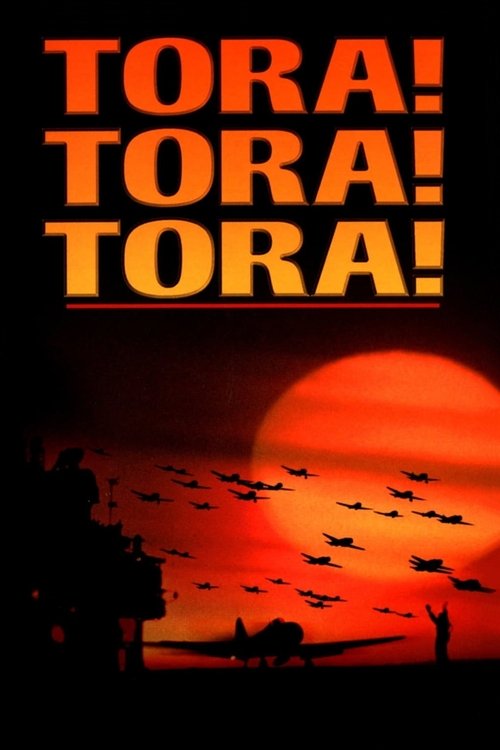
Tora! Tora! Tora!
1970 · Toshio Masuda
For when you're in the mood for serious, meat-and-potatoes history done with rigor — a long sit that rewards patience, best for an evening when you want to understand how a disaster actually happens.
What it's about
Summer 1941: embargoes and failed diplomacy have pushed the United States and Japan to the edge of war. The film reconstructs the months, days, and final hours before the attack on Pearl Harbor from both sides at once — Japanese admirals planning a meticulous strike they doubt is wise, and American officers and code-breakers watching the warnings pile up while the machinery of bureaucracy fails to connect them. There's no invented hero, no romance: just two nations sleepwalking toward December 7th.
The experience
Methodical and absorbing, like watching a slow-motion systems failure where you know the ending and still hope someone will catch it in time. The restraint of the first two hours makes the attack itself, when it finally comes, overwhelming.
The craft
A genuine bi-national production, nearly unique in studio history: Japanese filmmakers shot the Japanese scenes in Japanese, American filmmakers shot the American side in English, and each half is granted equal dignity and competence. The attack sequence is a colossal feat of practical effects — real aircraft, real explosions, full-scale ship sets — and it won an Academy Award for its effects work. This is emphatically a big-screen, big-speakers film.
Why it matters
It set the standard for the even-handed, procedural war epic and its attack footage was so authoritative that documentaries and later films borrowed from it for decades.
Snapshot
Tora! Tora! Tora! is a 20th Century-Fox roadshow epic that reconstructs the months, days, and final hours leading to the Japanese attack on Pearl Harbor on December 7, 1941, presenting the catastrophe simultaneously from American and Japanese vantage points. Conceived by producer Darryl F. Zanuck as a companion piece to his earlier all-star war documentary-drama The Longest Day (1962), the film is unusual—almost singular—in studio history: a genuine bi-national co-production in which Japanese filmmakers shot the Japanese scenes in Japanese and American filmmakers shot the American scenes in English, each half granted dignity, competence, and interiority. It deliberately refuses a central hero, a romance, or a villain, opting instead for an institutional, procedural account of how two bureaucracies—one preparing a meticulous gamble, the other paralyzed by miscommunication and complacency—arrived at disaster. The result is a film admired for its scale, technical craft, and even-handedness, and faulted by some for the coldness those same virtues produce. The credited direction of the Japanese sequences belongs to Toshio Masuda and Kinji Fukasaku; the American sequences were directed by Richard Fleischer; and the project's most famous backstage event was the removal of Akira Kurosawa, who had originally been engaged to helm the Japanese half.
Industry & production
The production was among the most ambitious and troubled studio undertakings of its era, and its difficulties are exceptionally well documented. Zanuck and Fox mounted the film as a prestige "event" picture in the dying tradition of the roadshow epic, with a budget reported in contemporary accounts to be very large for its day—comparable to the most expensive productions then in release. (Precise figures vary across sources; I will not assert a single number.) The defining production crisis was the Kurosawa episode. Akira Kurosawa, then the most internationally celebrated Japanese director, was contracted to direct the Japanese-language sequences and spent many months on preparation. Shooting began in late 1968 but collapsed within weeks; Kurosawa was removed from the project around December 1968. The reasons remain genuinely contested in the historical record—accounts cite scheduling and budget conflicts with Fox, Kurosawa's exacting and reportedly erratic working methods, his casting of non-professional businessmen in some roles, and rumors about his health and state of mind. Because the participants gave differing and sometimes self-serving accounts, the precise cause is not settled, and it is responsible to say so rather than to adjudicate it.
After Kurosawa's departure, Fox engaged two veteran directors from the Japanese studio system—Toshio Masuda and Kinji Fukasaku—to complete the Japanese sequences, while Richard Fleischer, an experienced Hollywood professional, directed the American sequences and effectively supervised the assembly of the whole. The screenplay drew on Gordon W. Prange's research (later published as the book Tora! Tora! Tora!) and Ladislas Farago's The Broken Seal, with screenwriting credited to Larry Forrester on the American side and Hideo Oguni and Ryūzō Kikushima—both longtime Kurosawa collaborators—on the Japanese side. Commercially, the film is generally described as a disappointment in the United States relative to its cost, while performing strongly in Japan; I avoid citing specific grosses, as figures differ across sources.
Technology
The film is a showcase of late-1960s large-format, pre-digital spectacle technology. It was shot in 35mm anamorphic Panavision and released in color by De Luxe, engineered for the wide, deep roadshow screen. Its centerpiece achievements are practical: full-scale and large-scale physical mock-ups of warships and aircraft, extensive aerial photography, and elaborate pyrotechnics and miniatures for the attack itself. Because no operational examples of the Japanese aircraft survived in flyable numbers, the production converted American trainers and light aircraft—North American T-6 Texans and BT-13/AT-6 derivatives among them—into convincing replicas of Zeros, Val dive-bombers, and Kate torpedo planes, creating a fleet that would be reused in films and television for decades. The visual-effects work, led by L.B. Abbott and A.D. Flowers, combined these full-scale assets with miniature ships and the partial reconstruction of Battleship Row, and it won the film the Academy Award for Best Visual Effects—the area in which its technological ambition was most decisively recognized.
Technique
Cinematography
The cinematography is credited to a bi-national team: Charles F. Wheeler on the American side, with Japanese cinematographers including Shinsaku Himeda, Masamichi Satoh, and Osami Furuya. The film earned an Academy Award nomination for cinematography, reflecting the difficulty and polish of its work. The visual approach favors clarity and documentary legibility over expressive stylization: wide, evenly lit master shots of war rooms and decks, careful staging in depth so that the apparatus of decision-making is always readable, and a restrained palette. The aerial and attack photography, by contrast, is kinetic and immersive, with low passes, tracking shots along the harbor, and high vantages that render the assault as a coordinated machine. The contrast between the static, talk-driven planning scenes and the explosive mobility of the attack is itself a structural argument.
Editing
Editing is credited to James E. Newcom and Pembroke J. Herring (American sequences) with Inoue Chikaya among the Japanese editors. The film's most distinctive editorial task was cross-cutting between two national narratives that never meet dramatically—holding the audience oriented across two governments, two militaries, and two languages without a shared protagonist. The first two-thirds proceed through accumulation and parallelism, intercutting Japanese operational planning with American intelligence failures, building suspense from the audience's foreknowledge. The attack sequence then shifts the editorial logic entirely, marshaling effects shots, full-scale action, and miniatures into a sustained set-piece. The deliberate slowness of the build-up is a defensible choice that some viewers experience as inertia.
Mise-en-scène / staging
The staging is procedural and architectural. Much of the film unfolds in conference rooms, code-breaking offices, ship's bridges, and command centers, with figures arranged around tables and maps. The mise-en-scène foregrounds documents, telegrams, decryptions, and clocks—the paper trail and the ticking timeline of bureaucratic process. This is a film about information: who knew what, when, and why the knowledge failed to move. The Japanese sequences carry a more formal, ceremonial spatial sense; the American sequences a more cluttered, contingent one. The attack staging, by contrast, opens onto vast exteriors—harbor, airfield, sky—and the shock of the sequence partly derives from this sudden release from interior confinement.
Sound
Sound is integral to the film's identity, beginning with its title: "Tora! Tora! Tora!" was the coded radio signal transmitted to confirm that surprise had been achieved. The film treats radio traffic, telegraphy, and the spoken relay of orders as dramatic material in their own right. The bilingual soundtrack—Japanese scenes in Japanese, American scenes in English—was a deliberate authenticity choice unusual for a Hollywood studio film of the period. The attack sequence is a sustained exercise in sound design, layering aircraft, ordnance, alarms, and the human voice into the chaos.
Performance
The ensemble performances are calibrated to the film's anti-star, documentary register: restrained, professional, and subordinated to function. On the American side, Martin Balsam plays Admiral Husband Kimmel and Jason Robards plays General Walter Short, the two commanders who bore official blame for the unpreparedness at Pearl Harbor; Joseph Cotten, E.G. Marshall, and other established character actors fill out the command and intelligence structure. On the Japanese side, So Yamamura's Admiral Isoroku Yamamoto anchors the film with a grave, reluctant authority—Yamamoto is portrayed as a strategist who foresaw the long-term peril of awakening American industrial power. Takahiro Tamura appears as Commander Mitsuo Fuchida, who led the air attack. The performances avoid grandstanding by design, which is both the film's integrity and, for some viewers, its emotional reticence.
Narrative & dramatic mode
The narrative mode is procedural, polyphonic, and ironic. There is no protagonist and no invented personal drama; the "characters" are largely the historical officials, and the engine of suspense is dramatic irony—the audience knows the attack is coming, and watches as warning after warning is missed, mishandled, or arrives too late. The film's structure is essentially a converging countdown: two parallel timelines, one of preparation and one of obliviousness, moving toward a fixed point. This is history-as-mechanism, closer to a reconstruction or a docudrama than to a conventional war narrative of individual heroism. The dramatic payload lies in the accumulation of institutional failure—the misrouted radar warning, the delayed decryptions, the diplomatic note not delivered in time—rendered without a scapegoat.
Genre & cycle
Tora! Tora! Tora! belongs to the cycle of large-scale, all-star, semi-documentary World War II reconstructions that Zanuck himself had helped define with The Longest Day. These films aimed at comprehensive, multi-perspective coverage of a single historic operation, emphasizing authenticity, breadth, and spectacle over personal story. Within that cycle, Tora! Tora! Tora! is distinguished by its full bilateral commitment: where The Longest Day gave its enemy perspective in subtitled fragments, Tora! Tora! Tora! devotes half its running time and creative authority to the Japanese side. It is simultaneously a war epic, a procedural, and a disaster film—indeed, its final-act spectacle of destruction visited upon an unprepared population anticipates the structure of the 1970s disaster cycle.
Authorship & method
Authorship here is genuinely distributed, which complicates any auteurist reading. Toshio Masuda and Kinji Fukasaku—both seasoned directors of Japanese studio genre cinema, Fukasaku later renowned for his yakuza films and ultimately Battle Royale—directed the Japanese sequences after Kurosawa's removal; Richard Fleischer, a craftsman of wide range (20,000 Leagues Under the Sea, The Boston Strangler), directed the American sequences and shaped the overall assembly. The screenwriting was likewise split across Larry Forrester, Hideo Oguni, and Ryūzō Kikushima, working from the historical research of Gordon Prange and Ladislas Farago. Jerry Goldsmith composed the score, deploying spare, martial, and at times distinctly Japanese-inflected material that supports the film's restraint rather than inflating it. The cinematography and editing were similarly bi-national. The "method," then, is less the imprint of a single vision than a managed collaboration designed to keep two national accounts authentic and balanced—a producer's film in the best sense, with Zanuck's conception of even-handed historical reconstruction as its through-line.
Movement / national cinema
The film sits athwart two national cinemas without belonging fully to either. It is a Hollywood studio production that genuinely incorporated Japanese studio-system filmmaking—its directors, writers, cinematographers, and editors drawn from the same industry that produced Kurosawa, with Oguni and Kikushima being core members of Kurosawa's own writing circle. This makes it a rare artifact of transnational production at a moment when Japanese cinema commanded high international prestige. It is not part of any aesthetic movement; rather, it represents an institutional experiment in co-production and in the on-screen rehabilitation of a former enemy's perspective, made a quarter-century after the war by the very nations it depicts.
Era / period
Released in 1970, the film arrives at the hinge between Old and New Hollywood. It is a late example of the big-budget, hard-ticket roadshow epic—a form already faltering commercially as the studio system that sustained it gave way to the cheaper, more personal cinema of the New Hollywood. Its measured pace, intermission-scaled length, and spectacle-driven economics belong to the early 1960s sensibility of The Longest Day and Cleopatra, even as the surrounding industry was being remade. Coming twenty-nine years after Pearl Harbor and during the Vietnam War, its sober, blame-distributing treatment of military and political failure also reads against the period's deepening skepticism toward official narratives, though the film itself maintains a deliberately apolitical, reconstructive stance.
Themes
The film's governing theme is institutional failure—the way large organizations, rich in information, fail to act on it through compartmentalization, complacency, hierarchy, and the friction of communication. Closely related is dramatic irony as moral structure: the audience's foreknowledge converts every missed signal into tragedy. A second theme is the asymmetry of perception—the Japanese side depicted as clear-eyed about the stakes (Yamamoto's foreboding) while plotting a gamble it doubts it can win long-term, the American side complacent in its assumptions of safety. The film's much-quoted closing line, in which Yamamoto reflects that the attack may have done nothing but awaken "a sleeping giant," gives this irony its capstone; it is worth noting that the historical authenticity of that exact remark is debated and not firmly documented, so it is best treated as the film's dramatized distillation of Yamamoto's recorded misgivings rather than a verified quotation. Underlying all of this is a theme of even-handedness itself—the conviction that catastrophe is best understood by granting full rationality to both sides.
Reception, canon & influence
Critically, the film met a divided reception that has largely persisted: admiration for its technical achievement, scale, and unusual fairness, set against complaints of dryness, length, and emotional detachment owing to its refusal of conventional character drama. It won the Academy Award for Best Visual Effects and received additional nominations including cinematography, art direction, sound, and editing—recognition concentrated, tellingly, in craft categories. Commercially it underperformed expectations in the United States while faring better in Japan.
Looking backward, the film descends most directly from Zanuck's own The Longest Day, sharing its multi-perspective, all-star, semi-documentary template, and from the broader tradition of authoritative historical reconstruction; its intellectual grounding in the Prange and Farago research lends it a scholarly seriousness uncommon in the genre. Looking forward, its influence is concrete and considerable. Its effects footage and converted-aircraft fleet were reused extensively—most notably its attack footage was incorporated into Midway (1976) and other productions, making it a literal source of subsequent Pearl Harbor imagery. As a model, it stands as the definitive sober, dual-perspective treatment of the attack, the implicit counter-example against which later, more melodramatic and nationalistic renderings—most prominently Michael Bay's Pearl Harbor (2001)—are measured. Among historians and military-history audiences it retains a strong reputation for fidelity to the documented sequence of events. Its lasting place in the canon is thus secure less as a beloved drama than as a benchmark: the film that demonstrated a major studio could portray a national trauma with procedural rigor and grant its former enemy equal authorial standing.
A Deleuzian reading
A message is decoded in one room and has to walk to another.
The full Deleuzian reading of Tora! Tora! Tora! →
Reception
A costly box-office disappointment in the US in 1970, widely dismissed by critics as dry docudrama; it's since been reappraised as the definitive Pearl Harbor film, praised for its even-handed dual American-Japanese perspective and its Oscar-winning practical effects.
How Tora! Tora! Tora! was received, from release to now →
Influences: the films it descends from and the films it influenced
- The Longest Day (1962) — Zanuck's own production template—assigning separate directors to separate national segments, shooting an all-star ensemble in bilingual dialogue across multiple command levels—is the exact distributed-direction, multi-perspective semi-documentary model Tora inherits and formalizes.
- A Night to Remember (1958) — Advances a documented catastrophe with procedural fidelity and no central hero, cross-cutting between bridge, engine room, and passenger decks—the disaster-as-reconstruction grammar Tora applies to a military event.
- The House on 92nd Street (1945) — Establishes the Zanuck-era Fox semi-documentary style—location legibility, authoritative procedural staging, and dossier-derived fidelity—that Tora scales up into archival historical reconstruction.
- Storm Over the Pacific (I Bombed Pearl Harbor) (1960) — Eiji Tsuburaya's Toho miniature-fleet effects staging the Pearl Harbor attack from the Japanese side supply the practical-miniature naval/aerial effects lineage and Japanese-perspective precedent Tora's effects team drew on.
- Thirty Seconds Over Tokyo (1944) — Renders the Doolittle Raid as mission mechanics over personal heroics, with Oscar-winning miniature/practical effects—the procedural, effects-driven air-operation template Tora extends.
- Battleship Potemkin (1925) — Its montage cross-cutting between perspectives to build dread toward a foreknown act of violence is the editing grammar of dramatic irony underlying Tora's countdown structure.
- Midway (1976) — Literally incorporated Tora's attack and converted-aircraft footage, and copied its all-star, multi-perspective naval-battle cross-cutting structure.
- A Bridge Too Far (1977) — Extends the Longest Day/Tora all-star, multi-perspective procedural epic—documentary legibility, no central protagonist—into a deliberately unheroic defeat narrative.
- Pearl Harbor (2001) — The melodramatic inversion: re-stages the identical attack but replaces Tora's procedural even-handedness with romance and single-protagonist spectacle—the counter-example against which Tora's sobriety is measured.
- Letters from Iwo Jima (2006) — Grants the Japanese combatant equal authorial standing and an autonomous, sympathetic account, extending Tora's bi-national even-handed reconstruction to a full Japanese-language perspective.
- United 93 (2006) — Real-time procedural reconstruction of a documented catastrophe using an anti-star ensemble and documentary legibility, advancing by cross-cutting between control rooms exactly as Tora cross-cuts decoders, commanders, and pilots.
- Dunkirk (2017) — Parallel timelines, near-absent protagonist, dramatic irony, and practical-effects staging of a foreknown defeat with real aircraft—the modern apotheosis of Tora's no-protagonist procedural form.
- Black Hawk Down (2001) — Ensemble-without-protagonist battle procedural rendered with documentary legibility and architectural clarity of a real operation's geography, inheriting Tora's procedural-architectural staging.
- The Battle of Britain (1969) — Assembled a flyable fleet of restored and converted period aircraft for real aerial-combat photography with an all-star ensemble—the immediate practical-effects sibling to Tora's converted-aircraft armada and anti-star casting.
- The Battle of Algiers (1966) — Newsreel-legible cinematography, anti-star ensemble, and even-handed dual-perspective reconstruction of documented events—a contemporaneous model of docudrama objectivity granting both sides authorial standing.
- Patton (1970) — Same-year anamorphic-scale, research-grounded WWII reconstruction that pursues sober historical legibility over melodrama, sharing Tora's restraint and craft-category ambitions.
Similar films
- A Night to Remember (1958) — influence & lineage · same viewing thread · often watched together
- Pearl Harbor (2001) — influence & lineage
- Letters from Iwo Jima (2006) — influence & lineage
- Midway (1976) — influence & lineage
- Dunkirk (2017) — influence & lineage
- Patton (1970) — influence & lineage
- Battleship Potemkin (1925) — influence & lineage · often watched together
- Silent Victory Submarine Warfare in WWII (2010) — shared sensibility
All the films related to Tora! Tora! Tora! →
Watch it with: curated runs of related films
- The Machinery of Catastrophe — A run of hour-by-hour reconstructions and unblinking documentaries that watch disaster as procedure — ice warnings, intercepted cables, evacuation drills, ward routines — and refuse to sentimentalize what the systems grind out.