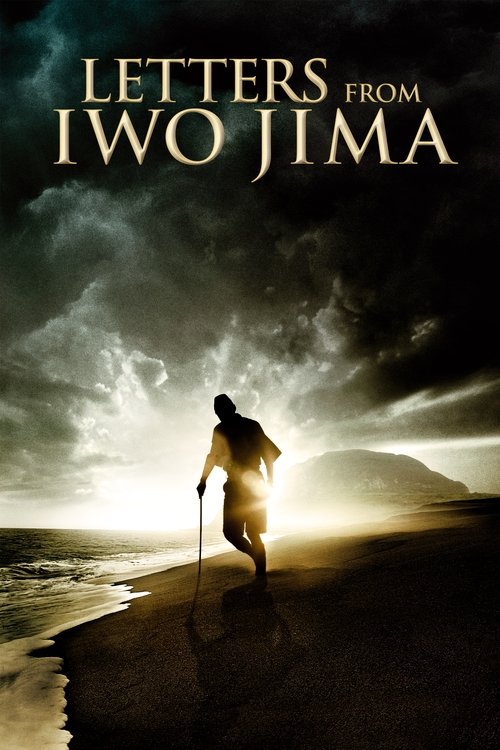
Letters from Iwo Jima
2006 · Clint Eastwood
For a night when you want a serious, sorrowful war film that honors the people inside it — a challenge, not a comfort, and one that leaves you sitting in silence when it ends. Reach for it when you want to feel the human cost rather than watch the fireworks.
What it's about
In the last winter of World War II, a Japanese garrison digs into the black volcanic rock of Iwo Jima to await an American invasion they cannot survive. The film follows the battle from inside the caves and gun emplacements — chiefly through a worldly, unconventional general who knows the war is lost, and an ordinary young conscript who just wants to get home to his wife and the bakery he left behind. It's the Japanese-language companion to Flags of Our Fathers, telling the other half of the same battle, drawn in part from the real letters of the garrison's commander.
The experience
Slow-burning, intimate, and quietly devastating — less a combat spectacle than a long vigil with men counting down their own lives. The dread is patient and the tenderness sneaks up on you; it treats every soldier, doomed or not, as someone with a letter left to write.
Performances
Ken Watanabe gives the general a warmth and dry humor that makes his clear-eyed fatalism heartbreaking, and Kazunari Ninomiya's baker-turned-soldier is the film's stubbornly ordinary, deeply sympathetic heart.
The craft
Eastwood drains the palette to near-monochrome — ash, smoke, and the sudden orange of fire — so the island feels like a place already half in the afterlife. The staging stays close and claustrophobic inside the tunnels, and the spare, mournful score never pushes. It's a Hollywood production performed almost entirely in Japanese, and the sound design of the bombardment rewards good speakers.
Why it matters
A rare thing in American studio filmmaking — a major war picture told entirely from the enemy's side of the line — and one of the most acclaimed films of Eastwood's late-career run, released as a two-film project with Flags of Our Fathers.
Snapshot
Letters from Iwo Jima is the Japanese-language companion to Clint Eastwood's Flags of Our Fathers, released the same year, together forming a diptych that depicts the 1945 battle for the volcanic island from both sides of the line. Where Flags dissected the American home front and the manufacture of the famous flag-raising photograph, Letters dwells inside the cave tunnels and gun emplacements of a garrison that knew it would not be relieved or evacuated — a film about men ordered to die slowly for a homeland that had already written them off. Adapted in part from the real letters of the garrison commander, Lieutenant General Tadamichi Kuribayashi, and structured around two protagonists separated by rank and worldview, the film is unusual in the annals of American studio filmmaking: a major Hollywood war picture, financed by Warner Bros. and produced by Steven Spielberg's DreamWorks, made almost entirely in Japanese with a Japanese cast and a fundamentally empathetic view of the wartime enemy. It became the most critically acclaimed film of Eastwood's late career and is widely regarded as one of the finest American films ever made about the Japanese experience of the Pacific War.
Industry & production
The two-film project originated when Eastwood, developing Flags of Our Fathers from James Bradley and Ron Powers's bestseller, grew preoccupied with the Japanese defenders glimpsed only as a faceless threat in the American story. Reading about Kuribayashi — a cosmopolitan officer who had traveled in the United States in the 1920s and 30s — Eastwood resolved to make a second film told entirely from the other side. The decision to shoot it in Japanese, with subtitles, was commercially counterintuitive for a star director working within the studio system; that Warner Bros. and DreamWorks backed it owed much to Eastwood's standing and to the relatively modest budget at which he was known to work. Spielberg produced alongside Eastwood and Robert Lorenz under the Malpaso and Amblin/DreamWorks banners.
Letters was the second of the pair to shoot but was completed quickly and, in a reversal of the original plan, released first in the awards corridor at the end of 2006, with a wider rollout in early 2007; Flags had opened in the autumn to softer returns. Principal photography drew on locations in Iceland and California to stand in for the island's black-sand terrain, and on the real Iwo Jima for limited material, the island being a Japanese war grave with restricted access. The screenplay was credited to Iris Yamashita, working from a story by Yamashita and Paul Haggis, the latter Eastwood's collaborator on Million Dollar Baby; Yamashita's facility with Japanese language and idiom was central to the film's authenticity. Reviewers and awards bodies overwhelmingly favored Letters over its companion, and it earned Academy Award nominations including Best Picture and Best Director, winning for Sound Editing — a notable outcome for a foreign-language film produced within Hollywood.
Technology
The film was shot photochemically on 35mm, consistent with Eastwood and cinematographer Tom Stern's practice in this period, and finished through a digital intermediate that enabled the picture's signature near-monochrome palette. Rather than desaturating in-camera or relying on a single global look, the production used the DI to crush color toward a steely, ashen gray-blue, retaining only flickers of true color — blood, fire, the warm interior light of a flashback to home. This was an aesthetic decision executed by then-current post-production technology rather than a technical novelty in itself. The combat staging used practical pyrotechnics, squibs, and physical effects in the Eastwood tradition, with restrained digital augmentation for the scale of the American invasion fleet offshore, where matte and CG extension stood in for the historically enormous armada that no production could assemble. The two-film structure also allowed certain large-scale assets and research to be shared across both productions.
Technique
Cinematography
Tom Stern's photography is the film's defining technical achievement. Working with very low light levels — Eastwood and Stern were known for shooting in conditions other crews would consider unworkable — Stern lit the cave interiors with sourcey, motivated pools of lamp and daylight spilling through tunnel mouths, leaving large areas in deep shadow. The exterior battle is rendered in the same near-grisaille, the black volcanic sand and overcast sky collapsing into a continuous ashen field that makes the few moments of saturated color shock the eye. The handheld and shoulder-mounted camerawork during the invasion is kinetic without tipping into incoherence, and the contrast between the claustrophobic, horizontally compressed tunnel spaces and the exposed openness of the beachhead organizes the film's visual argument: men buried alive in the earth versus men annihilated in the open.
Editing
Editors Joel Cox and Gary Roach, Eastwood's longtime cutting room, give the film a measured, almost contemplative rhythm unusual for the war genre. The combat is legible rather than fragmented; the film resists the strobing montage of much contemporary war cinema in favor of sustained shots and clear geography. The editing's most expressive work lies in its handling of the epistolary flashbacks — brief, warm-toned returns to prewar civilian life triggered by letters and memory — which are threaded through the present-tense siege so that interior life and military catastrophe are held in continuous tension. The cross-cutting also maintains the dual-protagonist structure, alternating between Kuribayashi's command-level perspective and the foot soldier Saigo's ground-level survival.
Mise-en-scène / staging
The production design renders the garrison's world as a network of hand-dug tunnels, gun positions, and the natural cave system of Mount Suribachi, spaces that are at once shelter and tomb. Eastwood stages much of the film in these cramped interiors, where rank, ritual, and despair play out in close quarters. The staging is attentive to the hierarchies and codes of the Imperial Japanese Army — the bowing, the slaps, the ritual of the seppuku grenade — without exoticizing them; violence among the Japanese themselves, the coercion and self-destruction demanded by the death-before-surrender ethos, is staged as plainly as the violence between the armies.
Sound
The film's Academy Award came for sound editing, and the soundscape is integral to its effect: the muffled, earthen acoustics of the tunnels, the concussive arrival of naval and aerial bombardment heard before it is seen, the disorienting reverberation of explosions through rock. Silence is used pointedly — the long waiting before the assault, the quiet of letters being written and read. The sound design consistently privileges the subjective, enclosed experience of men underground over the spectacle of the battle as a whole.
Performance
Ken Watanabe's Kuribayashi anchors the film with a performance of weary intelligence and reserved authority — a commander who understands both the futility of his orders and the impossibility of disobeying the larger logic of the war. Kazunari Ninomiya, a pop idol cast against type, plays the conscript baker Saigo with an unheroic, sardonic survivalism that grounds the film at the level of the ordinary soldier; his is the perspective through which the audience experiences the siege. Tsuyoshi Ihara as the former Olympic equestrian Baron Nishi and Ryō Kase as the disillusioned former military policeman Shimizu supply the film's other key registers — cosmopolitan grace and broken idealism. The ensemble's collective achievement is to render the garrison as a spectrum of men rather than a monolithic enemy.
Narrative & dramatic mode
The film operates in a realist, character-driven register organized around the epistolary conceit announced by its title. Its framing device — the modern-day discovery of buried letters on the island — gives way to the 1944–45 siege, and the letters function throughout as the vehicle of interiority, the means by which men condemned to anonymous death assert a private self. The dramatic mode is tragic in the strict sense: the outcome is known and inescapable from the first reel, and the drama lies not in suspense over whether the garrison will fall but in how each man meets a death already determined. The dual-protagonist structure sets the strategic, historical view (Kuribayashi) against the experiential, survivalist one (Saigo), and the film's moral seriousness comes from refusing to resolve the tension between duty and self-preservation into easy judgment.
Genre & cycle
Letters belongs to the combat film and the broader cycle of revisionist World War II cinema that followed Saving Private Ryan (1998), which reset the genre's expectations toward visceral, demythologizing realism. Within that cycle it is distinguished by its inversion of point of view: it is a Pacific War film told from the Japanese side by an American director, a near-unprecedented move in mainstream Hollywood. It also participates in the long tradition of the doomed-garrison or last-stand narrative, and in the anti-war film's lineage, where the enemy is humanized to indict the machinery of war itself. As the second panel of a diptych, it gains additional meaning from its relation to Flags of Our Fathers, the two films together constituting a single meditation on how nations narrate, exploit, and bury their war dead.
Authorship & method
The film is a culmination of the late-Eastwood method: fast, economical shooting, minimal coverage and few takes, a preference for available and low light, and an unsentimental moral gravity. Eastwood famously worked quickly and quietly on set, a discipline that here produced an intimate, unforced quality. His longtime collaborators are essential to the authorship — cinematographer Tom Stern, editors Joel Cox and Gary Roach, and production designers and crew carried over from his Malpaso unit. The screenplay by Iris Yamashita (story with Paul Haggis) supplied the linguistic and cultural specificity Eastwood could not author himself. The spare, mournful piano-led score is credited to Kyle Eastwood and Michael Stevens, working in the director's own restrained musical idiom — Eastwood, himself a musician, favored sparse thematic material over the swelling orchestration typical of the war epic. That a director then in his mid-seventies, with no Japanese, would entrust a film so fully to another language and culture speaks to a late-career confidence in his collaborators and in the universality of the material.
Movement / national cinema
Letters sits at an unusual cultural crossing. It is, by production and authorship, an American studio film, yet by language, cast, and subject it reaches toward Japanese national cinema and the Japanese collective memory of the Pacific War — a memory contested in Japan itself, where the war's commemoration remains politically fraught. The film was received in Japan with notable warmth, in part because it treated the garrison's dead with a dignity Japanese audiences did not necessarily expect from Hollywood. It does not belong to any Japanese film movement, but it engages, knowingly or not, with the postwar Japanese tradition of anti-war filmmaking — the lineage of Kobayashi's The Human Condition and Ichikawa's Fires on the Plain — that views the imperial military machine as a destroyer of its own men.
Era / period
Made and released in 2006, the film is inseparable from the climate of the Iraq War years, and many critics read its sympathetic treatment of a wartime enemy, and its diptych's concern with how war is mythologized and sold to a home audience, as a quiet commentary on the contemporary American moment. Eastwood denied any narrowly topical intent, but the films' preoccupation with propaganda, the exploitation of soldiers' images, and the gulf between official narratives and lived experience clearly resonated with mid-2000s anxieties. As a piece of period reconstruction, the film renders 1945 with restraint, eschewing nostalgia for a grim, ashen materiality.
Themes
The film's central theme is the humanity of the enemy — the insistence that the men on the other side of the gun were individuals with homes, families, fears, and doubts. From this flow its other concerns: the conflict between duty and survival; the cruelty of an honor code that demanded suicide over surrender; the gap between the patriotic abstractions for which men are told to die and the concrete lives they lose; and the letter as a fragile assertion of self against erasure. Kuribayashi and Baron Nishi, both shaped by prewar contact with America, embody the tragedy of men who admired their enemy and were ordered to die fighting them. Running beneath all of this is the diptych's shared meditation on memory and burial — what nations choose to remember, and what they leave underground.
Reception, canon & influence
Letters from Iwo Jima was received as a major achievement, widely judged superior to Flags of Our Fathers and counted among the best films of 2006 by numerous critics and critics' organizations. It earned Academy Award nominations for Best Picture, Best Director, and Original Screenplay, winning for Sound Editing, and it won the Golden Globe for Best Foreign Language Film, among other honors. In Japan its reception was notably positive, a rare instance of a Hollywood war film embraced by the nation it depicted.
The influences on the film run backward through the revisionist realism of Saving Private Ryan, through the Japanese anti-war cinema of Kobayashi and Ichikawa, and through the doomed-garrison tradition of the combat film; the historical record of Kuribayashi's own letters supplied its documentary spine. Its legacy forward lies less in spawning imitators — its commercial logic was too singular to replicate easily — than in standing as a proof of concept: that a mainstream American studio could produce a foreign-language film of empathy for a former enemy and win both critical and Academy recognition. It cemented Ken Watanabe's international standing, elevated the perception of Eastwood's late period as a sustained creative summit, and remains a touchstone in discussions of how cinema can represent the enemy's point of view. Among the war films of its decade it endures as one of the most morally serious and formally disciplined, and as the stronger half of one of the most ambitious experiments in perspective in modern American filmmaking.
A Deleuzian reading
A trowel scrapes black sand.
The full Deleuzian reading of Letters from Iwo Jima →
Reception
Landed in 2006 as the surprise of Eastwood's Iwo Jima diptych — the Japanese-language 'companion piece' that critics immediately ranked above Flags of Our Fathers, sweeping critics' prizes and a Best Picture nod. Two decades on it's settled in as the consensus peak of late-period Eastwood.
How Letters from Iwo Jima was received, from release to now →
Influences: the films it descends from and the films it influenced
- Saving Private Ryan (1998) — Established the desaturated, shutter-stripped handheld combat grammar and the subjective hearing-loss sound design that Letters reworks for its beachhead bombardment seen from inside the Japanese pillboxes.
- The Human Condition (1959) — Japanese anti-war epic that frames the soldier as a conscience trapped between duty and survival — the exact moral architecture Eastwood gives Saigo and Kuribayashi.
- Fires on the Plain (1959) — Renders a doomed, starving Japanese garrison stripped to bare physical survival, the degradation-of-the-trapped-soldier register Letters adopts in its cave and retreat sequences.
- The Burmese Harp (1956) — Models the mournful, humanist treatment of the ordinary Japanese conscript and the use of music/letters as the soldier's interior voice.
- Harakiri (1962) — Supplies the formal gravity around ritual honor and seppuku that Letters stages literally in its cave suicides, dramatizing the death-code as tragedy rather than valor.
- All Quiet on the Western Front (1930) — The template for anti-war told entirely from the 'enemy' side, humanizing soldiers through homesick letters and longing — the epistolary, humanity-of-the-enemy spine Letters inherits.
- Grand Illusion (1937) — Pioneers cross-line empathy and the shared officer's code between adversaries that underwrites Kuribayashi's Americanized worldliness and the film's refusal to demonize.
- Bataan (1943) — Classic doomed-garrison combat film whose last-stand structure — a fixed position held to annihilation — Letters inverts by placing the audience inside the losing garrison.
- Million Dollar Baby (2004) — Where Tom Stern's available-light near-monochrome chiaroscuro and Eastwood's sparse piano-led scoring crystallized into the Malpaso house style Letters runs on.
- We Were Soldiers (2002) — Eastwood's decision to film the Japanese command perspective on Iwo Jima as a full-length companion film — sustaining interior access to General Kuribayashi comparable to We Were Soldiers' NVA sequences — carries the dual-national editorial logic of Hoy's intercutting to its formal conclusion as a fully autonomous diegetic space.
- Midway (1976) — Extends the dual-perspective Pacific-war structure to its limit by devoting an entire companion film to the Japanese command POV that Midway only intercut.
- The Last Samurai (2003) — Directly leverages Ken Watanabe's international stardom launched here, extending the Japanese-soldier perspective that Last Samurai opened to Western audiences.
- Dunkirk (2017) — Extends the war-as-survival-not-heroics ethic through subjective enclosed combat and cross-cut parallel strands, treating an evacuation/defeat with the same anti-triumphal discipline.
- Hacksaw Ridge (2016) — Carries forward the visceral Pacific-theater combat realism descended from Saving Private Ryan and Letters, staging the same Okinawa-adjacent escarpment warfare with handheld immediacy.
- The Forgotten Battle (2021) — Hollywood-financed WWII film shot entirely in a non-English language with multilingual authenticity as a deliberate humanization of the enemy perspective; the prestige precedent for van Heijningen's casting of German-speaking performers without forcing English dialogue.
- Changeling (2008) — Immediate precursor in Stern's near-monochrome desaturation and photochemical period recreation, demonstrating the muted-color true-history look Changeling applies to 1928 Los Angeles.
- Flags of Our Fathers (2006) — The literal companion shot back-to-back — same battle, same Tom Stern bleached palette and cross-cut flashback structure, deliberately reversed to the American perspective.
- Das Boot (1981) — Enclosed subjective sound design of a doomed crew in claustrophobic metal interiors — the submarine-as-tomb acoustics Letters transposes to its tunnel-and-cave staging.
- Downfall (2004) — Contemporary proof that a foreign-language film could humanize the wartime enemy inside a sealed bunker, sharing Letters' empathy-without-exoneration and underground claustrophobia.
- The Thin Red Line (1998) — Privileges contemplative pacing and soldiers' interior subjectivity over action spectacle in a Pacific campaign, the meditative anti-war mode Letters favors over kinetic battle.
- Come and See (1985) — Builds combat trauma through subjective enclosed sound — muffled, ringing, interiorized — the perceptual technique Letters uses to lock us inside one frightened soldier's head.
- Mystic River (2003) — Stern's near-monochrome, desaturated low-key palette and Eastwood's minimal-coverage, few-takes shooting method extend the same visual signature established on Mystic River.
- Land of Mine (2015) — Enemy-perspective humanization set on a coastal battlefield, using a bleached, desaturated palette to bind landscape to lethal ground much as Hjelm's photography does.
Similar films
- The Burmese Harp (1956) — influence & lineage · same viewing thread
- Fires on the Plain (1959) — influence & lineage · same viewing thread
- The Thin Red Line (1998) — influence & lineage
- Hacksaw Ridge (2016) — influence & lineage
- Merry Christmas, Mr. Lawrence (1983) — same viewing thread
- Grave of the Fireflies (1988) — shared sensibility
- Twenty-Four Eyes (1954) — shared sensibility
- Tora! Tora! Tora! (1970) — shared sensibility
All the films related to Letters from Iwo Jima →
Watch it with: curated runs of related films
- Japan's Long Reckoning With War — Watch these when you want Japanese cinema turning its unflinching gaze on its own war — the conscript's conscience, the retreat, the survivor who won't let the officers forget — each film picking up the moral wreckage the last one left.