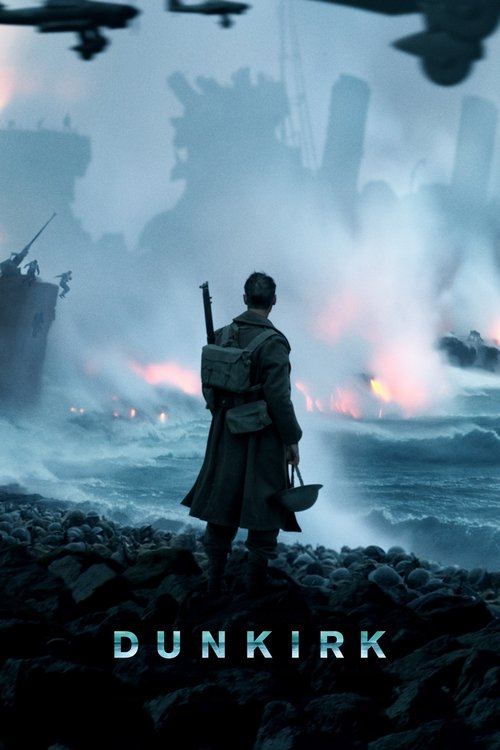
Dunkirk
2017 · Christopher Nolan
The director whose every release is treated as a referendum on theatrical cinema itself: Oppenheimer's IMAX-70mm pilgrimage culture, the Barbenheimer phenomenon, and now The Odyssey selling out screenings a full year in advance. Naming him signals you believe in the big screen; arguing about him (cold characters, muddy sound mixing) is its own cottage industry.
When you want to be gripped rather than comforted — a white-knuckle, edge-of-seat experience that demands your full attention. Not the pick for a casual background watch, but unforgettable when you commit.
What it's about
May 1940: hundreds of thousands of Allied soldiers are trapped on a French beach with the German army closing in and the sea at their backs. The film follows the evacuation from three vantage points — soldiers on the beach over a week, a civilian boat crossing the Channel in a day, and a fighter pilot with an hour of fuel — as ordinary people improvise a rescue under fire.
The experience
Pure sustained tension with almost no dialogue — it plays less like a war drama than a ticking-clock thriller you're inside of. Ninety-odd minutes of held breath, and then a release that lands harder because it was earned without speeches.
Performances
Mark Rylance is quietly devastating as a civilian sailor whose calm decency becomes the film's moral center, and Tom Hardy conveys an entire arc with little more than his eyes above an oxygen mask.
The craft
Shot largely on massive IMAX film with real Spitfires, real ships, and thousands of extras, it looks and sounds staggering — Hans Zimmer's ticking, ever-tightening score is practically a second script. The three interlocking timelines converge with a precision that turns editing itself into the source of suspense.
Why it matters
It rewired what a war film could be — experience over exposition — earned Christopher Nolan his first Best Director nomination, and became the benchmark for immersive large-format filmmaking.
Snapshot
A war film stripped to its nervous system. Dunkirk abandons the genre's traditional architecture — the briefing room, the command decision, the human backstory delivered in a quiet tent — and replaces it with sustained, near-wordless dread. Nolan frames the May–June 1940 evacuation of Allied forces from the northern French coast not as a story of triumph or even survival but as an experience of time itself under pressure. Three interlocking timelines — a week on the Mole, a day at sea, an hour in the air — converge on the same catastrophic moment from different temporal distances, generating suspense through structural irony rather than conventional plot. The result is closer in spirit to a psychological thriller than to either the classical British war picture or the modern combat epic, and it represents the most formally ambitious film of Nolan's career.
Industry & production
Dunkirk was produced by Nolan's company Syncopy in association with Warner Bros. and StudioCanal, with Emma Thomas serving as producer alongside Nolan. Nolan had been developing the project for some years before shooting began in 2016; he has spoken in interviews about visiting Dunkirk as a young man and crossing the Channel by small boat, experiences that lodged the evacuation in his imagination as something physical and immediate rather than merely historical.
Principal photography took place on location in Dunkirk itself — the beaches and the Mole jetty visible in the film are the actual sites of the 1940 evacuation — as well as on the coast at Urk in the Netherlands and in Weymouth, Dorset, England. The production used genuine Mk I Spitfires and Hurricanes, sourced from private collectors and preserved aviation groups, for the aerial sequences, supplemented by a small number of replica aircraft. The fleet of small civilian vessels recreating the "little ships" evacuation included authentic vessels that had actually sailed to Dunkirk in 1940, lending the production an archival quality that Nolan deliberately cultivated. The production's commitment to practical filmmaking — real aircraft, real water, real crowds of extras — was a distinguishing feature of its making and its marketing, positioning it against the predominant CGI-reliant model of contemporary blockbuster production.
The film's release in July 2017 was accompanied by an unusually sustained IMAX-first theatrical strategy, with Warner Bros. prioritizing premium large-format screenings. Box-office performance exceeded industry expectations for a film with minimal dialogue, no American leading man, and an oblique narrative structure, though precise global figures varied across reporting sources and the film's ultimate commercial success is beyond what its formal austerity might have predicted.
Technology
Dunkirk was shot principally in IMAX 15-perf/70mm and 65mm anamorphic film, with cinematographer Hoyte van Hoytema operating IMAX cameras in demanding practical environments — on the Mole, in the water alongside actors, mounted to the fuselage of Spitfires in flight. The ratio shifts organically through the film: IMAX sequences expand to fill the full 1.43:1 frame in theatrical presentation, while 65mm material plays in 2.20:1, the variation itself becoming a subtle formal marker of scale and intimacy. Nolan and van Hoytema rejected digital intermediate color grading in the conventional sense, working instead to preserve the photochemical character of the film image; prints struck from the original camera negative for premium IMAX release carried a grain structure and luminance range that digital projection cannot fully replicate.
The sound design exploited the Shepard tone — a psychoacoustic phenomenon in which overlapping tones create the aural illusion of a pitch that rises continuously without ever resolving — as both a compositional tool and a structural metaphor for the film's escalating, unrelieved tension. This extended from Hans Zimmer's score into the sound design itself, blurring the conventional boundary between music and ambient environment.
Technique
Cinematography
Van Hoytema's work is defined by proximity and instability. The camera is rarely at a distance from the bodies it follows: it crowds the soldiers in the crush on the Mole, bobs with the water when men go overboard, and sits inside the Spitfire cockpit with Tom Hardy's Farrier for the aerial sequences. The large-format film stock absorbs available light without losing shadow detail, and the predominantly overcast English Channel sky — its flat, diffuse light neither heroic nor picturesque — becomes an oppressive ceiling. The absence of wide establishing shots that would situate the viewer geographically in the conventional war-film manner is deliberate; van Hoytema and Nolan deny the audience the cognitive comfort of a bird's-eye orientation, keeping the experiential vantage close and partial throughout.
Editing
Lee Smith, Nolan's editor across multiple films, faced the challenge of interweaving timelines that are not merely parallel but temporally incommensurate — a week, a day, an hour rendered as continuous experience rather than labeled episodes. The editing's coup is that the crosscutting feels rhythmically urgent without violating the internal logic of each timeline; Smith holds longer within any single strand than a conventionally propulsive assembly would permit, honoring each timeline's duration, then cuts with maximum dramatic precision to its neighbors. The climactic convergence — where all three timelines arrive simultaneously at the evacuation's critical moment — is assembled with exceptional clarity given the formal complexity it represents.
Mise-en-scène / staging
The staging is organized around the suppression of the conventional war-film image. The German military is never seen: the enemy is represented only as noise, as bomb explosions, as a shadow that never materializes into human form. This is not oversight but argument. Nolan's mise-en-scène insists on the soldier's-eye view, in which the threat is ambient and faceless. The Mole sequences emphasize mass — bodies pressing forward, bodies retreating, the logic of the crowd — while the aerial sequences are spare and almost balletic. Mark Rylance's small boat is staged as domestic, intimate, an English living room improbably placed on the Channel. The film's iconic visual rhyme — Tommy (Fionn Whitehead) walking through fire toward the water at the outset, soldiers in the water surrounded by burning oil later — is arranged to recur without underlining, as if the film trusts the viewer to feel the echo.
Sound
The sound work — supervised by Richard King, who won the Academy Award for Sound Editing, alongside production sound mixer Mark Weingarten — is the film's most discussed technical achievement. The Shepard-tone structure runs through Zimmer's score and bleeds into the ambient sound design, so that the distinction between diegetic noise and musical accompaniment is frequently dissolved. The Spitfire engines, the percussion of bombs falling, the creaking of ships' hulls, the silence of the English countryside after the evacuation: each is handled with documentary precision and assembled with maximum dramatic pressure. Zimmer incorporated a ticking-clock motif — reportedly recorded from Nolan's own watch — as the score's foundational rhythmic unit, an unusually literal device that the film's sustained pressure renders unexpectedly powerful rather than mechanical.
Performance
Nolan cast against conventional war-film expectation. The central soldiers — Whitehead as Tommy, Aneurin Barnard as Gibson, Harry Styles as Alex — are young and unformed, deliberately lacking the authoritative screen presence the genre typically demands of its protagonists. Styles, making his feature debut, was criticized by some critics for his casting but is generally acknowledged to be adequate in the role; the film does not require him to carry dramatic weight so much as to represent a particular type: the exhausted ordinary soldier. Mark Rylance's Mr. Dawson is the film's moral anchor, performed with characteristic Rylancean economy — restraint and unspoken feeling where another actor might have reached for declaration. Kenneth Branagh as Commander Bolton and Cillian Murphy as the traumatized "Shivering Soldier" operate in a more traditionally expressive register. Tom Hardy's Farrier is largely wordless behind an oxygen mask, his performance conducted entirely through eyeline and posture — an extreme case of the film's general preference for presence over speech.
Narrative & dramatic mode
Dunkirk operates in the mode of what might be called the experiential or immersive narrative: a film less interested in what happens than in how it feels to be inside events. Conventional war-film dramaturgy — characters introduced with backstory, objectives named and pursued, sacrifice made legible through personal relationship — is almost entirely absent. The film's seventy-six-page script (unusually short for a feature of its scale) consists largely of action description rather than dialogue. The three-timeline structure creates dramatic irony of a particular kind: the viewer understands the temporal relationship between the strands before the characters do, generating suspense from structural knowledge rather than withheld information. This is closer to the tradition of formal suspense construction — Hitchcock's distinction between surprise and suspense, the bomb under the table — than to the emotional-identification model of most war films.
Genre & cycle
Dunkirk enters into dialogue with several competing traditions. The British war film of the 1950s and early 1960s — The Dam Busters (1955), The Battle of Britain (1969) — provided the cultural template for Dunkirk as subject matter: stoic, collective, understated. Nolan's film inherits the stoicism but strips away the celebratory architecture that characterized that cycle. The 1958 British production simply titled Dunkirk, directed by Leslie Norman and starring John Mills, is the closest predecessor in subject matter, but it observes the classical conventions Nolan systematically refuses. More pertinent as formal antecedents are the experiential war films of subsequent decades: Samuel Fuller's visceral combat sequences, Terrence Malick's The Thin Red Line (1998) in its prioritization of sensory experience over narrative transparency, and Wolfgang Petersen's Das Boot (1981) in its claustrophobic submarine sequences — all films that privilege immersion over exposition. Das Boot's sustained dread and confinement is a particularly apt comparison point.
Authorship & method
Nolan functions as writer-director, and Dunkirk consolidates preoccupations visible across his career: the manipulation of temporal sequence as a formal and thematic device (Memento, The Prestige, Inception), the large-scale practical production, the collaboration with Zimmer, and an interest in subjective experience under cognitive or emotional pressure. The departure from earlier work is the near-total suppression of dialogue and explanation; where Inception and Interstellar burden characters with the task of articulating the film's conceptual framework, Dunkirk simply enacts it.
Hoyte van Hoytema replaced Wally Pfister — Nolan's cinematographer on every film through The Dark Knight Rises — for Interstellar, and Dunkirk deepens their collaboration. Lee Smith has cut every Nolan film since Batman Begins. Hans Zimmer, having scored multiple Nolan features, here arguably produces his most formally integrated work, the Shepard-tone device functioning as compositional architecture rather than atmospheric embellishment.
Movement / national cinema
Dunkirk is a British subject and largely a British production, drawing on the national mythology of the evacuation as a foundational narrative of collective endurance and improvised civilian heroism — "the miracle of Dunkirk" in Churchill's resonant formulation. At the same time, it is an American studio production and Nolan is a British-American filmmaker working primarily within Hollywood infrastructure. The film's relationship to British national cinema is therefore selective: it mobilizes the iconography (the little ships, the Spitfires, the cliffs visible across the Channel) without the triumphalism that typically accompanied it in postwar British production. It also, notably, includes the French soldiers whose contribution to the rearguard action protected the evacuation — a corrective to the exclusively British-centric account that dominated earlier screen treatments.
Era / period
Dunkirk arrives in the mid-2010s as part of a broader return to prestige analog filmmaking practice in an era of dominant digital production: a cohort of filmmakers including Quentin Tarantino, Paul Thomas Anderson, and Christopher Nolan advocated publicly for the retention of photochemical film stocks and large-format production. The film also reflects a period of renewed anxiety about the coherence of Western democratic alliance, released into a political climate in which the historical weight of the evacuation — and Churchill's surrounding rhetoric — carried heightened contemporary resonance, though Nolan has generally resisted allegorical readings of the film.
Themes
The film's central thematic preoccupation is survival as distinct from heroism. The characters are not trying to win; they are trying not to drown, not to burn, not to be left on the beach. Nolan treats this unsentimental priority as morally serious rather than shameful: the soldier's obligation is first to persist. Time is the film's governing theme in its formal dimension — the three timelines make time itself the subject — and also in its existential dimension: the soldiers on the Mole wait as time compresses against them. The film is also concerned with the relationship between individual experience and collective historical narrative: Tommy knows nothing of the evacuation's scale or its outcome; the viewer, positioned outside his timeline, knows both. This epistemological gap — the difference between living history and comprehending it — is one of the film's genuine intellectual arguments.
Reception, canon & influence
Critical reception on release was strongly favorable, with reviewers emphasizing the film's formal ambition and its departure from conventional war-film idiom. Some critics, particularly those attentive to the evacuation's human complexity — the French soldiers left behind, the class dynamics of the little ships — noted that Nolan's experiential approach elided political and historical texture in favor of sustained sensation. The tension between formal achievement and historical accountability was a recurring axis of debate.
At the Academy Awards, Dunkirk received eight nominations, winning three: Best Film Editing, Best Sound Mixing, and Best Sound Editing. Nominations for Best Picture, Best Director, Best Cinematography, Best Original Score, and Best Production Design reflected the scope of its industry recognition without resulting in major prizes in those categories.
Looking backward, Dunkirk's influences are multiple: the British war-film tradition it refutes as much as inherits; Das Boot's submersive claustrophobia; Malick's experiential textures; the formal experiments of subjective cinema from Hitchcock forward. The Shepard-tone compositional strategy has precedents in avant-garde electronic music; its deployment at blockbuster scale and budget is without close precedent.
Looking forward, Dunkirk's influence on subsequent war filmmaking has been more atmospheric than structural: the film established a template for prestige war cinema that prioritizes sensation and formal constraint over biographical narrative, and its demonstrated commercial viability for austere, dialogue-minimal filmmaking in the blockbuster format has given subsequent filmmakers with comparable formal ambitions some cover to pursue them. It also consolidated IMAX 65mm film as a prestige production signifier, accelerating the retention of premium analog formats against the prevailing digital tide.
A Deleuzian reading
A soldier walks down a deserted French street and paper drifts down around him like snow.
The full Deleuzian reading of Dunkirk →
Reception
Rare Nolan film with no reappraisal needed — critics called it his masterpiece on arrival and it landed him his first Best Director nomination. If anything has shifted, it's that the 'too cold' complaints have softened as its stripped-down approach looks more radical with time.
How Dunkirk was received, from release to now →
Influences: the films it descends from and the films it influenced
- Das Boot (1981) — Establishes the war film as claustrophobic endurance machine; Nolan's mole sequences replicate its method of embedding the camera inside cramped steel walls and building pressure through layered diegetic sound — dripping water, grinding metal, depth-charge concussions — rather than heroic scoring.
- Lawrence of Arabia (1962) — Shot in Super Panavision 70mm specifically to make the desert exist at a scale 35mm cannot accommodate; Nolan's deployment of IMAX 65mm film for the beaches and Channel inherits Lean's doctrine that certain subjects require photochemical format scale to become physically inhabitable for the audience.
- Vertigo (1958) — Bernard Herrmann constructed the score from a single obsessively cycling harmonic interval rather than conventional melodic development; Hans Zimmer's Shepard tone — a musical illusion of perpetual ascent — is the direct formal descendant, using an acoustic paradox as compositional architecture rather than emotional underscoring.
- Hiroshima Mon Amour (1959) — Resnais cuts between two incommensurate temporal streams — Hiroshima present, wartime Nevers — with no dialogue signal, relying on the viewer to reconstruct causality and structural irony across the gap; Dunkirk's three parallel timelines running at different clock speeds apply this technique at action-cinema scale.
- Apocalypse Now (1979) — Walter Murch built war zones as layered acoustic environments in which the unseen enemy is heard as omnipresent pressure; this model of sound-as-environment — dissolving the boundary between score, ambient noise, and diegetic effect — is the direct ancestor of Zimmer and Dunkirk's sound department collapsing that same line.
- Come and See (1985) — Non-professional lead casting for physical rawness; the protagonist's wordless dissociative deterioration under sustained attack — face as sole dramatic register — establishes the performance model Nolan demands of his largely non-verbal ensemble, where no actor is asked to articulate what they feel.
- The Thin Red Line (1998) — Broke Hollywood war-film convention by fragmenting Guadalcanal combat into disoriented sensory impressions distributed across a de-centered ensemble with no tactical overview; Dunkirk's refusal to give any character — or the audience — a strategic map of the evacuation descends from Malick's phenomenological grammar.
- Saving Private Ryan (1998) — The Omaha Beach sequence codified proximity combat cinematography: desaturated handheld framing tight on bodies, no tactical establishing shot, panic produced by the exclusion of context rather than by spectacle; Nolan extends this grammar from a 24-minute set-piece into Dunkirk's entire structural mode.
- Children of Men (2006) — Lubezki's long unbroken combat takes — Bexhill, the stairwell — kept the camera moving through action without editorial escape, making the threat omnipresent and invisible simultaneously; Nolan extracts this no-refuge cinematographic grammar and applies it as structural principle rather than isolated tour-de-force.
- The Hurt Locker (2008) — Barry Ackroyd's multi-camera proximity system — several handheld units simultaneously surrounding the actors — produced grain-texture rawness and unposed physical performance that van Hoytema adapts; the film also demonstrated commercial viability for austere dialogue-minimal war cinema before Dunkirk proved the same at blockbuster scale.
- The Dark Knight (2008) — Nolan's direct extension of practical IMAX 70mm large-format photography—shooting fully in IMAX rather than oscillating formats—and Zimmer's score-as-sound-design (the Shepard-tone ticking clock as continuous ambient threat motif) is the technical and aesthetic evolution of TDK's dual-format and sonic-threat grammar.
- A Bridge Too Far (1977) — Radicalizes A Bridge Too Far's cross-cutting-parallel-catastrophe editing — multiple simultaneous timelines of a failed military operation, no protagonist who anchors meaning, collective survival as the only available consolation — while the triptych temporal structure pushes Attenborough and Gibbs's parallel montage to its formal extreme.
- 1917 (2019) — Directly inherits Dunkirk's survival-over-heroism thesis and experiential non-narrated structure; the simulated continuous-take form is a formal response to Nolan's temporal fragmentation — eliminating the cut itself as an audience escape valve — while Deakins's IMAX photography extends the no-establisher proximity grammar.
- All Quiet on the Western Front (2022) — Berger's large-format German-language war film inherits Dunkirk's structural refusal of Allied-victory teleology and anti-heroic survival thesis; the near-absence of dialogue in combat, non-star European ensemble, and lethal final structural irony — armistice announced, killing continues — directly extend Nolan's formal and thematic commitments.
- Oppenheimer (2023) — Nolan and van Hoytema deepened the IMAX 65mm photochemical commitment — including the first true large-format black-and-white sequences shot on film in blockbuster history — while Ludwig Göransson's percussion-driven score applies the Shepard-tone principle of rhythmic inevitability to existential dread at the scale of the Trinity test.
- Tenet (2020) — Van Hoytema's first full-scale deployment of 70mm IMAX for sustained practical-location action establishes the visual grammar Tenet extends to inverted combat; the multi-strand simultaneous chronology—three timelines of different duration converging at a single event—is the direct structural predecessor to Tenet's forward/inverted pincer operation at Stalsk-12.
- The Forgotten Battle (2021) — Three perspectival strands crosscutting a single underrepresented Allied engagement, each strand operating at a different temporal compression rate; the direct structural model for the film's three-protagonist convergence toward the Scheldt Estuary flooding.
- Thirteen Lives (2022) — Multi-strand rescue-operation structure that replaces conventional dramatic music with ambient sound design (Zimmer's ticking) and distributes heroism across an ensemble with no commanding protagonist, arguing formally that logistics — the process of evacuation itself — is sufficient dramatic content.
- Maharaja (2024) — Intercuts three timelines of different durations as if concurrent, converging only at the climax — the structural sleight-of-hand of presenting non-simultaneous events in braided montage that Maharaja weaponizes for its reveal.
- Son of Saul (2015) — Nemes's radically restricted proximity frame — close on the protagonist's face, horror unfolding in shallow-focus background — produces atrocity through exclusion rather than spectacle; this invisible-event strategy, in which the camera refuses to show what it cannot escape, is a formal sibling to Dunkirk's invisible enemy rendered as omnipresent acoustic and narrative pressure.
- Mad Max: Fury Road (2015) — Miller's commitment to practical in-camera photography — real vehicles, real stuntwork, minimal digital augmentation — at full blockbuster budget co-established the industrial credibility of no-CGI filmmaking that Dunkirk's production discourse explicitly claims; both films use physical action as primary expressive register rather than as spectacular decoration.
- The Revenant (2015) — Lubezki's IMAX-equivalent natural-light photography and DiCaprio's largely wordless physical performance built the prestige case that survival cinema could dispense with conventional dramatic scaffolding; co-established, in the same two-year window as Dunkirk, a market category for dialogue-minimal experiential cinema at awards scale.
- First Man (2018) — Industrial sound design — mechanical, percussive, predominantly non-melodic — deployed as primary psychological pressure rather than scored accompaniment; known-outcome dramatic irony structuring the audience's engagement with a multi-strand procedural timeline.
- Darkest Hour (2017) — Nolan ends his film with the public reading aloud of Churchill's 'We shall fight on the beaches' speech as emotional culmination — Churchill's words doing the work an unseen Churchill cannot — placing Darkest Hour and Dunkirk in deliberate dialogue as complementary accounts of the same historical moment from opposite vantage points.
- A Quiet Place Part II (2021) — Both films structure narrative through parallel crosscutting across split geography and dual temporal registers, and both use Dolby Atmos spatial sound design as a formal storytelling layer rather than atmospheric supplement — Nolan's use of Hans Zimmer's ticking-clock sound architecture to externalize dread through the audio channel runs directly parallel to AQP II's survival-grammar approach to sound-synchronized editing.
- Warfare (2025) — Nolan's structural use of real-time compression across interlocked temporal streams — the film as an experience of duration under pressure rather than a narrative of events — shares Warfare's commitment to compression as the formal device that produces experiential fidelity; both films refuse the retrospective moral clarity that conventional war-film dramaturgy uses duration to build toward.
- Top Gun: Maverick (2022) — Pioneers large-format cockpit-mounted photography of real aircraft in natural light, the same in-camera aerial-capture and immersion strategy Maverick scales up with the Venice Rialto rig.
- The Outpost (2020) — Hoyte van Hoytema's large-format immersion and sound-forward, near-scoreless tension exemplify the same prioritization of visceral spatial experience over expository dialogue.
- Master and Commander: The Far Side of the World (2003) — A process-war film of near-wordless military procedure with legible action geography and design-forward, immersive sound — M&C's craft values transposed to ships, beach and air.
- The Odyssey (2026) — Nolan's first feature shot predominantly on IMAX 65mm film, the direct proof of concept that a narrative feature can be captured almost entirely in the large format The Odyssey pushes further.
Similar films
- 1917 (2019) — influence & lineage
- All Quiet on the Western Front (2022) — influence & lineage
- Saving Private Ryan (1998) — influence & lineage
- The Thin Red Line (1998) — influence & lineage
- The Hurt Locker (2008) — influence & lineage
- Oppenheimer (2023) — influence & lineage
- Mad Max: Fury Road (2015) — influence & lineage
- The Revenant (2015) — influence & lineage
All the films related to Dunkirk →