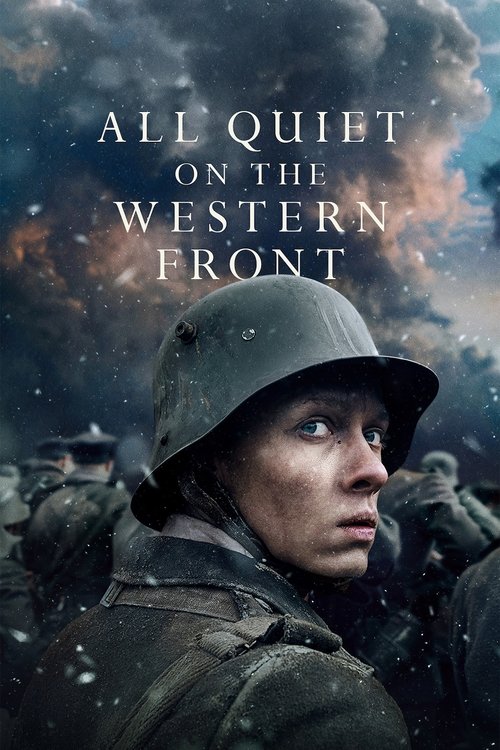
All Quiet on the Western Front
2022 · Edward Berger
For when you want a serious, gut-level film that leaves a mark — a challenge you choose deliberately, not a casual watch. Expect to sit in silence for a while afterward.
What it's about
Fired up by speeches about glory and the fatherland, teenager Paul and his schoolfriends volunteer for the German army in World War I. The romance dies the moment they reach the Western Front, where the war grinds on as an industrial machine for consuming young men — mud, gas, tanks, and generals bargaining far from the trenches.
The experience
Punishing and immersive — beautiful in a cold, terrible way, and unflinching about what shells and bayonets do to bodies. It works like a slow crush: awe at the spectacle giving way to numb heartbreak.
Performances
Felix Kammerer, in his first film role, carries it almost wordlessly — you watch a boy's face empty out over two hours, and it's shattering.
The craft
Edward Berger stages the trench assaults with punishing scale and clarity, the wintry cinematography finding an awful beauty in the mud, and a menacing three-note score drives the machinery of war forward like a heartbeat. Made to be seen big and heard loud.
Why it matters
The first German-language adaptation of Remarque's novel — a book the Nazis burned — it swept four Oscars and a record haul of BAFTAs, proving a non-English war film could dominate the global conversation.
Snapshot
Edward Berger's All Quiet on the Western Front is the first German-language adaptation of Erich Maria Remarque's 1929 anti-war novel — a book the Nazis burned, and which had previously been filmed only by American studios. Produced for Netflix and released globally in October 2022, the film won four Academy Awards including Best International Feature Film and seven BAFTAs including Best Film, making it the most-decorated non-English-language film in BAFTA history. It announced the arrival of Felix Kammerer, a stage actor with no prior feature credits, as a major screen presence, and confirmed Berger as a filmmaker capable of operating at the highest level of prestige international cinema. Formally audacious and uncompromising in its physical horror, it reinvented a canonical text for an era of streaming-platform global cinema while reopening debate about what the German war film owes to the legacy of Remarque's moral vision.
Industry & production
The project was developed by producer Malte Grunert and Amusement Park Films in association with Netflix Germany, representing the platform's push into prestige German-language originals. That Netflix bankrolled a German-language WWI film on a significant budget — reported in industry coverage to be in the range of €20 million, though exact figures were not publicly confirmed — would have been unthinkable in the previous studio ecosystem. The Netflix model, bypassing traditional theatrical windows and releasing simultaneously across markets, shaped the film's ambitions: it could be made at a scale and creative boldness that German co-production financing alone might not have sustained, while reaching audiences far beyond the festival circuit.
Berger brought in a substantially international crew. Cinematographer James Friend is British; composer Volker Bertelmann (known professionally as Hauschka) is German but internationally active in experimental music; editor Monika Willi is Austrian, best known for her long collaboration with Michael Haneke on The White Ribbon, Amour, and Happy End. The screenplay was written by Berger alongside Lesley Paterson — a Scottish screenwriter whose day career as a multiple Ironman Triathlon world champion made her one of the more unusual collaborators in prestige film history — and Ian Stokell. Production design was handled by Christian M. Goldbeck, who won the Academy Award for his work.
Principal photography took place largely in the Czech Republic, whose forests, plains, and managed landscapes could be shaped into the mudscapes of the Western Front with less logistical obstruction than filming in France or Belgium. The production built extensive practical trenches and deployed hundreds of extras, while strategic VFX extended the scale of mass-battle sequences.
Technology
James Friend shot on ARRI large-format digital cameras, using anamorphic glass that produces the characteristic lens flare and lateral compression associated with widescreen grandeur — here deployed ironically, as a kind of visual language of epic cinema conscripted into depicting industrial slaughter. The anamorphic format produces shallow depth of field in which faces float against blurred fields of mud and smoke, isolating the individual body against an undifferentiated environment. Friend and Berger developed a severe color palette through digital intermediate work: desaturated, cold, drained of the greens and golds that traditionally connote pastoral Europe. Earth tones are muted toward gray-brown; blood registers as rust. The visual grammar deliberately refuses the picturesque.
Practical effects were used extensively for trench combat sequences — physical mud rigs, real fire, explosive charges — while VFX augmented aerial views, tank movements, and the scale of open-field battles. The integration is unusually seamless; the film never visibly pivots between a physical and a digital register. Sound design (addressed below) required bespoke spatial audio work to achieve the immersive, disorienting quality of artillery bombardment from inside a trench.
Technique
Cinematography
Friend's work is the film's dominant formal statement. The opening sequence — in which a German soldier is killed in a charge, his uniform stripped, laundered, repaired, and re-issued to Paul Bäumer within minutes of the film beginning — is shot with the cold efficiency of an inventory process, a factory rhythm. There is no music; cuts are observational rather than dramatic. The sequence establishes the film's thesis before a word of dialogue: soldiers are not individuals but consumable units moving through a logistics chain. From this point, Friend's camera alternates between two registers: extreme proximity (handheld close-ups that track faces through the chaos of assault, putting the viewer inside the tunnel vision of combat stress) and sudden, terrible withdrawal (wide anamorphic frames that reveal the battlefield as geometric waste, lines of men cut down across empty space). Neither register offers the viewer a position of security. The night scenes lit by flare-light and explosion are among the most precisely controlled pieces of practical-light cinematography in recent war cinema.
Editing
Willi's editing manages three narrative threads that accumulate pressure against one another: Paul's experience in the trenches, the armistice negotiations conducted by German diplomat Matthias Erzberger (Daniel Brühl), and the increasingly futile offensives ordered by General Friedrichs in the hours before the armistice takes effect. The parallel cutting does not simply alternate for suspense; it builds a structural argument. The treaty is signed; the armistice is agreed; and yet men are being ordered to advance and die in the interval between signing and 11 a.m. The editing paces this irony with formal deliberateness. Individual scenes within the trench sequences are held long, refusing the rapid-cut grammar of most contemporary action filmmaking, allowing dread to accumulate rather than substituting kineticism for horror.
Mise-en-scène / staging
Berger draws explicitly on the visual tradition of German Expressionism and the wartime paintings of Otto Dix and Käthe Kollwitz — images that presented the mutilated male body as an aesthetic and political subject. The trenches are staged as claustrophobic, labyrinthine, with the geometry of confinement given architectural emphasis: low ceilings, narrow corridors, perpendicular angles that funnel soldiers toward apertures framing nothing but more mud. When the film opens out onto the surface — the open-field assault sequences — the staging inverts this geometry, replacing confinement with terrifying exposure. Goldbeck's production design is insistently material, constructing spaces that appear to have been occupied for years rather than constructed for a production.
The film's handling of the armistice subplot involves a deliberate tonal contrast: the negotiations take place in a railway carriage, carpeted and lamp-lit, the ambient temperature of comfort and bureaucracy. Brühl's Erzberger moves through a civilized negotiating world whose insulation from the mud is the film's most devastating rhetorical point.
Sound
Sound designer Frank Kruse developed a texture for the Western Front that locates the viewer inside the acoustic experience rather than observing it. Artillery does not sound grandiose; it sounds physically wrong — concussive, ear-clearing, followed by a ringing absence. Voices break up and disappear under bombardment. The distinction between diagetic and non-diagetic sound is frequently dissolved: Bertelmann's score bleeds in and out of the landscape noise without a clear threshold, so that the industrial percussion of the music and the percussion of actual shelling become compositionally continuous.
Performance
Felix Kammerer had no prior feature film credits when cast as Paul Bäumer; Berger found him through German-language theater. His performance is almost entirely somatic: he communicates through physical depletion — the progressive collapse of posture, the eyes' increasing inability to focus outward, the body learning the specific economy of extreme fear. He does not play the arc of disillusionment as a psychological journey so much as a biological one. Albrecht Schuch's Kat — the older, resourceful soldier who mentors Paul — is performed with a worn, sardonic warmth that gives the film its only sustained register of human connection. Daniel Brühl brings a quality of exhausted, morally lucid ineffectuality to Erzberger that is exactly calibrated to the film's ironies.
Narrative & dramatic mode
The film's most significant departure from Remarque's novel — and from Lewis Milestone's 1930 adaptation — is the insertion of the armistice negotiation as a parallel plot strand. In the novel, the war's end is peripheral to Paul's consciousness; here, it becomes structurally central. The effect is to transform the ending from personal tragedy into institutional indictment: Paul does not simply die in the war; he dies after the war has been formally ended, because a general refused to relinquish his offensive. This shift from personal to political tragedy is a deliberate update of the novel's pacifist humanism into something closer to bureaucratic horror.
The dramatic mode is immersive and behaviorist rather than introspective. There is almost no interiority shown through voiceover or reflection; Remarque's meditative first person is replaced by a camera that witnesses without explaining. The film trusts physical action and the accumulation of incident to carry the anti-war argument without editorial comment.
Genre & cycle
The film belongs to the tradition of the prestige WWI film — a cycle that includes Milestone's All Quiet (1930), Stanley Kubrick's Paths of Glory (1957), Joseph Losey's King and Country (1964), Peter Weir's Gallipoli (1981), and more recently Sam Mendes' 1917 (2019). Within German national cinema specifically, it occupies a distinct position: German WWI films are far less common than German WWII films (which have their own dense tradition from Stalingrad to Das Boot to Downfall). Berger's film effectively establishes a point of entry into WWI for German cinema's own reckoning with that war, distinct from the anglophone tradition's Somme-centred iconography.
The film also participates in the prestige Netflix original cycle of the early 2020s, in which the platform funded major international productions — Alfonso Cuarón's Roma, Paolo Sorrentino's The Hand of God, Pawel Pawlikowski's work — designed to compete at awards level while bypassing traditional theatrical release structures.
Authorship & method
Edward Berger (born 1970 in Göttingen) emerged from German television and international co-production, directing the critically acclaimed Deutschland 83 series and the limited series Patrick Melrose (starring Benedict Cumberbatch). His approach to All Quiet is marked by what he described in interviews as a deliberate refusal of romanticism — an insistence that the adaptation avoid aestheticizing its own horror. The irony is that the film is formally beautiful, and that tension between visual accomplishment and anti-aesthetic intent runs through critical debate about the film.
James Friend had worked extensively in British television and mid-budget features before this film; his Oscar win represented a significant recognition of a cinematographer whose work had not previously received awards attention. Volker Bertelmann's score — built around prepared piano, metal percussion, and industrial texture — consciously refused conventional orchestral scoring. The score won the Academy Award for Best Original Score, and its industrial quality became one of the film's signature formal elements. Monika Willi's involvement connected the film to the tradition of Haneke's rigorous, ethically precise European art cinema.
Movement / national cinema
All Quiet on the Western Front (2022) is a defining work of contemporary German cinema, and its significance is partly historical: it is the first German-language adaptation of Remarque's novel, a correction of a long absence. The novel's anti-war thesis was suppressed in Germany under National Socialism — the 1930 American film was banned and its Berlin premiere disrupted by Nazi agitators. That a German production finally filmed the story carries symbolic weight the film itself does not overly labor.
It sits alongside The Lives of Others (2006) and Toni Erdmann (2016) as a German film that succeeded simultaneously in domestic, European, and global Anglo-American reception contexts — a difficult alignment that most German films fail to achieve. It represented Germany's official submission to the Academy Awards, winning Best International Feature Film, the first German-produced film to do so since The Lives of Others.
Era / period
Released at the pivot point of streaming's consolidation as the dominant prestige distribution model, the film demonstrates what the Netflix platform could enable in international cinema by 2022: scale, global simultaneous release, awards infrastructure, and freedom from the co-production compromises that had previously constrained German-language ambitious filmmaking. It also arrived in a period of renewed attention to European political history, with the Russian invasion of Ukraine having begun in February 2022; reviewers and audiences in several markets noted that the film's depiction of territorial warfare and the expendability of conscripted soldiers resonated with immediate news contexts, a resonance the film's makers did not explicitly court but could not prevent.
Themes
The film's governing themes are the systematic dehumanization of soldiers by the institutions that deploy them; the unbridgeable distance between the experience of combat and the bureaucratic or civilian world that administers it; and the specific moral obscenity of deaths that occur after political resolution has been reached but before the logistics of cessation catch up. These themes are not new to war cinema, but the film prosecutes them with an unusual structural coherence — the armistice subplot is not a distraction but the film's engine.
A secondary thematic register concerns the gap between the ideological conscription of young men — the nationalist rhetoric that recruits them — and the physical reality they encounter. The film's early scenes, in which teachers and peers celebrate the boys' enlistment with patriotic fervor, are brief but carefully observed as scenes of civilian complicity in military carnage.
Reception, canon & influence
Critical reception was overwhelmingly positive in anglophone markets, with particular praise for Friend's cinematography and Kammerer's performance. German reception was more divided: the Remarque Peace Center, based in Osnabrück, issued a statement arguing that the film's additions — particularly the armistice strand and General Friedrichs — worked against the novel's focus on the individual soldier's experience and risked substituting a new political thesis for Remarque's pacifist humanism. Some German critics felt the film's aesthetic investment in the spectacle of horror was in tension with its stated anti-war position, a version of the Susan Sontag argument about the aestheticization of suffering. These criticisms registered without significantly denting awards-circuit reception.
The film's principal influences are traceable along two axes. The first is the 1930 Milestone adaptation, which established the iconography of Paul Bäumer and which the 2022 film consciously engages, updating Milestone's own innovations in sound-era combat filmmaking. The second axis runs through the European art-cinema war film: Kubrick's Paths of Glory provides the template for institutional indictment; László Nemes' Son of Saul (2015) — another first-language film that won Best International Feature — demonstrates the formal possibilities of a severely constrained, proximate perspective in extreme historical circumstances; Sam Mendes' 1917 (2019), released three years earlier, had already re-established audience appetite for immersive WWI filmmaking, and Berger's film both benefited from and consciously differentiated itself from that precedent.
As of this writing, the film's forward influence on war cinema and on German-language prestige production remains in its early stages. Its most immediate legacy may be institutional: it demonstrated that a German-language film produced for a streaming platform could compete at the summit of global film culture, opening a commercial and critical argument for similar ambitions in European cinema.
A Deleuzian reading
A soldier dies in the first minutes — a charge, a scream, mud.
The full Deleuzian reading of All Quiet on the Western Front →
Reception
Swept the 2023 season abroad — a record seven BAFTAs including Best Film and four Oscars — while critics in Germany itself were noticeably cooler, calling it bombastic and unfaithful to Remarque. Three years on it's settled in as the era's default 'great modern war film,' with the German ambivalence now a footnote.
How All Quiet on the Western Front was received, from release to now →
Influences: the films it descends from and the films it influenced
- All Quiet on the Western Front (1930) — Milestone's innovations in early-talkie combat sound — spatializing gunfire across multiple microphone setups to give artillery a directional acoustic field — established the WWI sound grammar that Berger's Dolby Atmos spatial-audio design directly updates; and the 1930 film's iconography of Paul Bäumer, which Berger's casting of Kammerer consciously engages and revises.
- Paths of Glory (1957) — Kubrick's cross-cutting between General Broulard's comfortable dining room and the suicidal assault establishes the structural template Berger directly adopts in the armistice strand: parallel editing that generates irony not through action-reaction but through the temporal and spatial gulf between institutional comfort and the moment of dying.
- Apocalypse Now (1979) — Walter Murch's sound design pioneered the controlled dissolution of diegetic and non-diegetic layers — helicopter rotor bleeding into a ceiling fan, battlefield ambience absorbed into the score — establishing the grammar for Volker Bertelmann's industrial score, which enters and leaves the diegetic space of artillery and mud without seam.
- Das Boot (1981) — Petersen established the German-language war film's grammar of extreme claustrophobic proximity — the camera pressed against faces inside a machine that is destroying its operators — and the institutional irony of soldiers who understand the futility of their orders but obey anyway, both of which Berger inherits as the formal lexicon of a German-perspective anti-war film.
- Gallipoli (1981) — Weir's cross-cutting between the command decision to send the men over the top and the runners trying to deliver the countermand — the famous final cut to Archie's face — provides the structural precedent for Berger's armistice parallel plot: irony generated not by the battle itself but by the temporal gap between institutional order and the moment it kills the men it governs.
- Come and See (1985) — Aleksei Kravchenko's performance of progressive physical and psychological depletion — rendered entirely through behavior, without voiceover or conventional emoting, the face aging visibly across a single shoot — is the direct formal model for Felix Kammerer's somatic deterioration; Berger's behaviorist no-voiceover approach descends directly from Klimov's decision to make the body the film's argument.
- Saving Private Ryan (1998) — Janusz Kamiński's bleach-bypass desaturation, which drained color from combat to prevent it from being visually pleasurable, and Gary Rydstrom's spatial sound design — which positioned the viewer inside the acoustic envelope of battle rather than observing it — both feed directly into James Friend's palette decisions and the film's immersive artillery sound design.
- The Thin Red Line (1998) — John Toll's anamorphic widescreen oscillates between extreme close-ups of grass, hands, and faces and vast landscape compositions that dwarf figures — the proximity-withdrawal alternation Berger adopts as his primary cinematographic mode — while Malick's editorial refusal to provide interpretive voiceover for combat behavior establishes the behaviorist grammar Friend and Berger inherit.
- The White Ribbon (2009) — Monika Willi co-edited The White Ribbon with Haneke and went on to edit Berger's film; her Haneke-trained approach — the withholding cut that refuses emotional punctuation and forces behavioral reading rather than affective response — is the direct editorial transmission linking Haneke's ethically precise European art cinema to Berger's anti-romantic editorial logic.
- Son of Saul (2015) — Mátyás Erdély's shallow-depth photography keeps Saul razor-sharp while surrounding atrocity blurs beyond recognition at the frame's edges, anchoring horror to a single proximate consciousness — the formal model Friend adapts for Paul's perspective; Son of Saul also demonstrated that a first-language historical film could win Best International Feature on awards circuits Berger's film then replicated.
- Dunkirk (2017) — Nolan's three-strand parallel timeline — temporally misaligned but cross-cut to generate irony between beach, sea, and air — is a sibling approach to Berger's armistice strand: both films use structural cross-cutting not for suspense but to irradiate individual deaths with the scale of institutional indifference; Hans Zimmer's Shepard-tone score similarly dissolves the boundary between diegetic ambient sound and non-diegetic underscore.
- 1917 (2019) — Roger Deakins' practical-light cinematography in underground passages and trench spaces — candles, signal flares, burning buildings as the only source — established the vocabulary for illuminating the Western Front without artificial fill that Friend consciously reworked; Berger's film both benefited from 1917 re-establishing audience appetite for immersive WWI filmmaking and differentiated itself through proximity rather than the continuous-take conceit.
- The Zone of Interest (2023) — Glazer's industrial sound design — the constant ambience of the camp beyond the garden wall rendered as a persistent acoustic implication rather than a visible atrocity — extends the diegetic/nondiegetic dissolution strategy Bertelmann's score employs, using off-screen industrial sound as a formal mechanism for implicating the audience; both films inherit Haneke's ethical-restraint framework and advance it through sound rather than image.
- Conclave (2024) — Berger's preceding film established the Berger–Bertelmann creative partnership: Bertelmann's post-minimalist score austerity — sustained tones, avoided resolution — and Berger's directorial method of subordinating period spectacle to psychological and moral argument carry forward unchanged into Conclave.
- The Hurt Locker (2008) — Barry Ackroyd's handheld proximity photography — alternating extreme close-ups of sweat-sheened faces and trembling hands with wide staging of the surrounding kill zone — shares the proximity-withdrawal alternation that defines Friend's approach to Paul in the trenches; both films refuse to stabilize the viewer in a master-shot geometry, keeping combat legible only through the body of the protagonist.
- The Revenant (2015) — Emmanuel Lubezki's large-format natural-light anamorphic cinematography — using only available light in extreme conditions, the wide-angle lens pressed into bodies that fill the frame — combined with DiCaprio's physicalized somatic-depletion performance establishes the contemporary model Friend's approach updates; both cinematographers use the large format not for spectacle but to make the body's suffering materially legible.
- The Forgotten Battle (2021) — Netflix-financed German-language national war film using the identical production model—domestic historical subject, non-English language, prestige streaming release—with matching desaturated palette and physical location staging, confirming the commercial form The Forgotten Battle helped establish as a viable streaming category.
- Society of the Snow (2023) — Berger's non-anglophone Netflix prestige war film uses the same desaturated cold palette and collective-over-individual anti-heroic survival framing, consolidating a shared formal language for streaming-financed European testimonial cinema competing at the international feature level.
- De Gaulle: Liberté (2026) — Volker Bertelmann's Oscar-winning score there defines the texturally restless, non-triumphal orchestral idiom he brings to Liberté in place of conventional patriotic scoring.
- Pressure (2026) — Volker Bertelmann's three-note harmonium blast treats score as an offscreen mechanical threat rather than emotional commentary — the same device he transfers to Pressure's approaching front.
Similar films
- 1917 (2019) — influence & lineage · same viewing thread
- Das Boot (1981) — influence & lineage · same viewing thread
- Paths of Glory (1957) — influence & lineage · same viewing thread
- All Quiet on the Western Front (1930) — influence & lineage
- Dunkirk (2017) — influence & lineage
- The White Ribbon (2009) — influence & lineage
- Apocalypse Now (1979) — influence & lineage
- Come and See (1985) — influence & lineage
All the films related to All Quiet on the Western Front →
Watch it with: curated runs of related films
- The Futility of War — A run of films about ordinary men fed into war's machinery — from the trenches to the Casbah to the Warsaw sewers — where the futility and human cost rhyme across a century and a dozen conflicts.