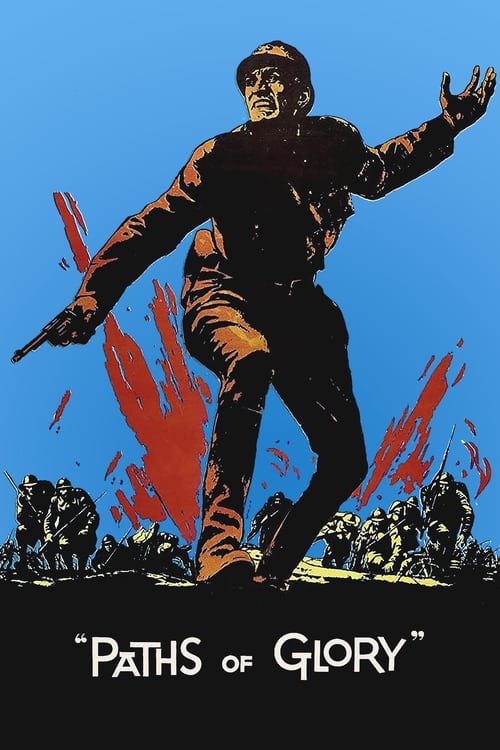
Paths of Glory
1957 · Stanley Kubrick
For when you want a film with moral weight — something short, ferocious, and clarifying rather than comforting, the kind you finish and immediately want to argue about with someone.
What it's about
In the French trenches of 1916, a colonel is ordered to lead his men in a hopeless assault on an impregnable German position. When the attack fails, the generals who ordered it pick three ordinary soldiers to stand trial for cowardice, and the colonel — a lawyer in civilian life — steps up to defend them against a court that has already made up its mind.
The experience
Lean, furious, and completely gripping — ninety minutes with no fat on them, moving from battlefield terror to courtroom outrage without letting you exhale. It leaves you angry in the way only a truly just film can, then closes on a note of unexpected tenderness.
Performances
Kirk Douglas gives the performance of his career as Colonel Dax, all clenched decency and barely contained rage — the rare movie-star turn where the star's force is put entirely in service of an argument.
The craft
Kubrick's camera prowls the trenches in long tracking shots that put you shoulder-to-shoulder with doomed men, then glides through the generals' marble chateau like a guest at a party — the contrast between the two worlds is the whole film, told visually. The black-and-white photography is stark and exact, and the battle sequence still hits hard on a big screen.
Why it matters
It announced the 28-year-old Kubrick as a major filmmaker and set the standard for the anti-war film — banned or suppressed in parts of Europe for years, which only confirmed how squarely it hit.
Snapshot
A masterwork of moral fury compressed into ninety minutes, Paths of Glory follows Colonel Dax of the French Army as he leads a suicidal assault on a fortified German position called Ant Hill in 1916, watches it fail, and then attempts to defend three arbitrarily selected soldiers court-martialed as scapegoats for their superiors' incompetence. Kubrick constructs the film around one of cinema's most unsparing contrasts: the marble-floored chateau where generals plan slaughters as though rearranging furniture, and the muddy trenches where those slaughters are carried out by men who have no language for what is being done to them. The film does not flinch. Its trial is a show trial; its execution is an atrocity wearing military dress; its final image — a young German woman singing a folk song as French soldiers weep — refuses both easy catharsis and aesthetic consolation.
Industry & production
Paths of Glory was produced by Harris-Kubrick Pictures, the independent production company Kubrick formed with producer James B. Harris, and distributed by United Artists. It was Kubrick's fourth feature and his first film of the scale — physical and moral — that would define his mature career. Kirk Douglas, who had seen Kubrick's previous film The Killing (1956) and been struck by its precision, optioned the rights to Humphrey Cobb's 1935 novel and brought the project to Kubrick. Their collaboration was by most accounts productive and intense, though it did not outlast the contentious production of Spartacus (1960), for which Douglas hired and then largely sidelined Kubrick as director.
The film was shot almost entirely in Bavaria, West Germany. The Schleissheim Palace near Munich doubled as the generals' chateau, providing authentic aristocratic grandeur at a fraction of what comparable locations would have cost in France. The trench sequences were constructed on location. The budget was modest for the scope of the project; exact figures are not reliably documented in the public record, and the film's commercial performance at the time of release was unremarkable.
The film's release was followed almost immediately by a ban in France, where it remained officially unavailable until 1975, when it was first broadcast on French television. The ban reflected official French sensitivities about the representation of the 1914–1918 mutinies and summary executions within the French Army — a history the Republic had not yet publicly processed. Switzerland and Belgium initially restricted exhibition as well. American military installations reportedly declined to screen it. These prohibitions became a significant part of the film's critical biography and ultimately reinforced its reputation as a work of dangerous honesty.
Technology
The film was shot in black and white 35mm, almost certainly in a 1.66:1 aspect ratio consistent with West German production norms of the period, though precise frame specifications are not always uniformly cited across sources. The choice to work in black and white was not constrained by budget alone; by 1957 color was available for prestige productions, and the monochrome palette was a deliberate aesthetic commitment, aligning the film's visual grammar with both wartime photojournalism and the hard-edged tradition of American film noir from which Kubrick had emerged. No special proprietary technologies were employed. The camera work in the trench sequences relied on conventional dolly rigs rather than the Steadicam (which did not exist until 1976), making the smooth tracking shots through irregular terrain a significant practical achievement requiring meticulous preparation.
Technique
Cinematography
The cinematographer was Georg Krause, a West German professional whose familiarity with the production environment proved pragmatically useful. Kubrick, himself a trained photographer and already deeply involved in the visual construction of his films, maintained tight control over the image. The film's central visual accomplishment is the lateral tracking shot through the trenches preceding the assault — the camera glides at Dax's eye level as he walks the length of the trench inspecting his men, the composition holding a steady horizontal axis against the vertical vertigo of the trench walls. The shot is both formally rigorous and viscerally communicative: it makes the viewer inhabit Dax's position without recourse to point-of-view cuts, generating identification through proximity and movement rather than optical identification. The assault on Ant Hill is handled with multiple cameras, the choreography deliberately asymmetrical — men fall at random, the smoke is real enough that spatial orientation becomes difficult, and the effect approaches the horrified documentary look that would not be refined until the landing sequence of Saving Private Ryan four decades later. Against this, the chateau sequences are filmed with deliberate elegance: high ceilings, deep focus, the camera occasionally pulling back to expose the absurd opulence in which death is administered. The generals are never quite as physically close to each other as they believe themselves to be — Kubrick frequently frames them across empty space.
Editing
The film was edited by Eva Kroll, working from Kubrick's closely pre-planned shot selections. The editing is controlled and asymmetrical in its pacing: the assault sequence is rapid and disorienting; the trial and execution sequences are drawn out, the cuts arriving just a beat too late to allow emotional relief. The crosscutting between the generals' ballroom discussions and the soldiers' trenches in the film's opening half establishes the film's core structural argument before a word of dialogue makes it explicit — these are two worlds that share a geography but not a reality. The execution sequence is notably edited for duration rather than efficiency; each procedural step is observed, the deliberate pace creating a weight that a faster cut would have dispersed.
Mise-en-scène / staging
The production design orchestrates the film's moral argument spatially. The chateau is the domain of abstraction: its stone floors, high windows, and formal symmetry figure military strategy as an intellectual exercise insulated from consequence. The trenches are the domain of the body: mud, cramped timber supports, the smell of men living in their own filth. Kubrick rarely allows these two spaces to contaminate each other visually, which makes the moments of rupture — a soldier brought from the trench into the chateau to testify, generals arriving at the execution ground — register as profound category violations. The court-martial staging is particularly precise: the three accused men are seated at a small table in a vast room, the judges elevated, Dax reduced to approaching the bench as a supplicant. The spatial argument of the room precedes any word of testimony.
The final tavern scene — in which a young German woman (Christiane Harlan, who would later marry Kubrick and become Christiane Kubrick) is brought onstage and sings "Der treue Hussar," a German folk song — is staged against the grain of what has preceded it. The room is tight and warm, the men crowded together. The camera watches faces rather than the performer. It is the film's only moment in which the biological fact of human feeling is permitted to overwhelm institutional logic, and Kubrick stages it quietly, without musical swelling or editorial flourish.
Sound
Gerald Fried, who had scored Kubrick's earlier features, composed the film's music. The score is spare and percussive, rooted in military drum patterns that carry ironic weight — the formal march idioms of military ceremony stripped of their intended meaning. The assault sequence uses sound aggressively: artillery, shouted commands, the ambient roar of a battle that no single person can comprehend or control. Conspicuous silences — in the moments before the execution, in the tavern before Harlan begins to sing — are deployed as structural punctuation rather than dramatic absence.
Performance
Kirk Douglas delivers a performance of controlled, escalating fury. Dax is not a naïve man — he knows by mid-film exactly what the court-martial is and what it will produce — and Douglas plays his advocacy as a form of witness rather than hope: he argues because to stop arguing would be to collaborate in the murder. George Macready as General Mireau offers a portrait of the self-deception required by institutional complicity; Mireau genuinely believes his own rationalizations until the moment they are no longer useful. Adolphe Menjou's General Broulard is the film's most disturbing performance precisely because Broulard suffers no self-deception at all — he is entirely lucid about what is happening and entirely unconcerned. The three condemned soldiers — Ralph Meeker as Corporal Paris, Timothy Carey as Private Ferol, Joe Turkel as Private Arnaud — are given differentiated registers: Paris angry and articulate, Ferol terrorized and inarticulate, Arnaud mentally and physically broken before the execution even begins. The range of their responses to institutional death sentence refuses the comfort of a single representative response.
Narrative & dramatic mode
The film operates through formal procedural escalation: assault, failure, accusation, trial, execution, coda. Each stage closes off the possibility of reversal established in the previous stage, so that the viewer, like Dax, understands earlier and earlier that the outcome is fixed. This is not a thriller structure — the tension does not resolve into surprise — but a tragedy structure in the strict sense: the audience watches characters of intelligence and partial virtue destroyed by forces they can identify but not overcome. Cobb's source novel was already structured this way, and Kubrick, Calder Willingham, and Jim Thompson's adaptation preserves and sharpens it. The coda — the tavern scene, set after the executions — is not a resolution but a remainder: this is what is left of these men after the institution has finished with them. They hum along to a dead enemy's folk song and weep for reasons they probably could not articulate.
Genre & cycle
Paths of Glory belongs to the anti-war film tradition, though it handles generic conventions with deliberate abrasiveness. Where the classical Hollywood war film insists on the legitimacy of sacrifice, Paths of Glory refuses legitimacy as a category available to military institutions. It is not primarily a combat film — the assault on Ant Hill occupies perhaps ten minutes of screen time — but a legal and bureaucratic film, closer in structural DNA to Twelve Angry Men (also 1957) and the courtroom drama than to Sands of Iwo Jima. In this sense it participates in the late-1950s American cinema of institutional critique — films that examine American (or, here, displaced-European) institutions and find them morally compromised — while remaining formally more austere than most of its contemporaries. It predates the New Hollywood by a decade but anticipates many of its thematic preoccupations.
Authorship & method
By Paths of Glory, Kubrick's directorial method was already characterized by its essential features: exhaustive pre-planning, collaborative but decisive control of the visual field, an interest in adapting existing literary material rather than originating screenplays, and a tendency to use genre conventions as a container for anti-generic content. The screenplay's three credited writers — Kubrick, Calder Willingham (who had adapted The Strange One in 1957), and Jim Thompson (the noir novelist whose voice is sometimes heard in the dialogue's hard, flat cadences) — represent a writing process that was Kubrick's standard practice: multiple collaborators whom he directed and often substantially rewrote. Thompson's contributions are documented but their precise extent is a matter of ongoing scholarly discussion rather than settled record. James B. Harris's production role was substantive; Harris understood Kubrick's requirements and ran interference with studios in ways that gave Kubrick unusual creative freedom for an independent director in this period.
Movement / national cinema
Paths of Glory was an American-financed, American-cast film shot in West Germany. It does not belong to any national cinema tradition in the usual sense, though its choice of a European war and a European theatrical tradition of moral drama aligns it with the contemporaneous French New Wave's interest in genre deconstruction and the postwar German cinema's processing of institutional evil. It is better understood as part of Kubrick's project of using Hollywood resources while declining Hollywood's ideological protocols — a project that would increasingly require him to work outside the American studio geography, a logic that culminated in his permanent relocation to England in the 1960s.
Era / period
The film was produced and released at a specific Cold War juncture: the Korean War had ended four years earlier, leaving a residue of skepticism about the official justifications for military sacrifice; nuclear anxiety had reframed questions of war and institutional authority; and the Production Code, while not yet broken, was showing the strains that would crack it within a decade. Paths of Glory could not have been made five years earlier under wartime conditions of patriotic consensus. That it was made and released in 1957 reflects the specific freedoms and anxieties of that moment.
Themes
The film's organizing theme is the institutional production of injustice: the systematic process by which bureaucratic self-preservation converts individual human beings into expendable abstractions. This is not an argument about individual evil — Mireau's self-deception and Broulard's cynicism are portrayed as personality types produced by a system rather than as aberrations within it. Class is structural rather than incidental: the officers and the men live in different physical worlds and speak functionally different languages; the court-martial is less a tribunal than a meeting between two castes, one of which has pre-decided the outcome. Moral courage is anatomised through Dax: the film is interested not only in the fact of his resistance but in its limits and its ultimate futility, and it does not console Dax or the viewer with the notion that bearing witness is the same as achieving justice.
Reception, canon & influence
Backward: Kubrick and his collaborators drew on Humphrey Cobb's novel, which was itself based on documented incidents of French Army summary executions, most prominently the Souain corporals affair of 1915, in which four men were shot for refusing to advance against an impossible position. The case was later reviewed and the executions condemned as unjust. Jean Renoir's La Grande Illusion (1937) stands as the essential predecessor in thinking about class, nationality, and war on the Western Front, though Kubrick's film is darker and less invested in human solidarity as a consoling force. All Quiet on the Western Front (1930) provided a cinematic template for WWI as anti-war subject matter. The Kafkaesque legal machinery of the trial reflects a broader literary and theatrical inheritance.
Critical reception at release was respectful but the film was not initially recognized as a canonical work. Its suppression in France limited its European critical reach for nearly two decades.
Forward: The film's influence operates on several levels simultaneously. Its formal vocabulary — specifically the lateral tracking shot as an instrument of moral witness — has been absorbed into the grammar of war cinema and is legible in the work of filmmakers from Francis Ford Coppola (Apocalypse Now, 1979) to Steven Spielberg. Kubrick's own Full Metal Jacket (1987) can be read as a structural descendant, applying the same institutional-critique architecture to Vietnam. More broadly, Paths of Glory helped establish the template of the serious American anti-war film that asks not only whether a particular war was just but whether military institutions are capable of justice at all — a question that MASH (1970), Breaker Morant (1980), and A Few Good Men (1992) all answer in its shadow. The film's standing in the canon is now uncontested; it regularly appears on critics' and directors' lists of the greatest films made. Its decades-long suppression in France has become part of its meaning — evidence, retrospective but undeniable, that the institutional critique it mounted was accurate enough to require silencing.
A Deleuzian reading
Start with the walk.
The full Deleuzian reading of Paths of Glory →
Reception
In 1957 it was a commercial disappointment that so angered the French establishment it went unreleased in France until 1975 — now it's routinely called one of the greatest anti-war films ever made and sits near the top of Kubrick rankings.
How Paths of Glory was received, from release to now →
Influences: the films it descends from and the films it influenced
- Battleship Potemkin (1925) — The tarpaulin execution scene on deck — rifles raised over kneeling mutineers in procedural countdown — establishes military execution as formal set piece with witnessing camera held at the distance of indictment, the structural prototype for Kubrick's execution sequence staging.
- All Quiet on the Western Front (1930) — Milestone's lateral tracking shot moving parallel to troops through trench corridors — the camera gliding horizontally along the line of men before the assault — establishes the trench-horizontal visual grammar that Kubrick executes as Dax's pre-assault inspection walk.
- La Grande Illusion (1937) — Renoir's architectural staging of military class hierarchy — the German château and officer quarters coded as spaces of aristocratic abstraction versus the POW barracks of physical consequence — is the direct formal precursor to Kubrick's chateau/trench spatial-contrast argument.
- Citizen Kane (1941) — Gregg Toland's deep focus in cavernous institutional interiors — multiple planes simultaneously sharp, figures dwarfed by architecture — is the compositional grammar Kubrick borrows wholesale for the Schleissheim Palace sequences, using room scale to externalize power relation.
- The Ox-Bow Incident (1943) — Wellman's procedural staging of an extrajudicial hanging — each preparatory step held at full duration, one man's dissenting advocacy rendered structurally futile — establishes the witnessing-as-indictment rhythm Kubrick adopts for the condemned soldiers' final sequence.
- The Court-Martial of Billy Mitchell (1955) — Preminger's deep-space trial staging isolates the defendant against the institutional apparatus through blocking and focal depth in precisely the terms Kubrick uses in the court-martial: a single advocate's eloquence made visually small against a machine that has already written the verdict.
- From Here to Eternity (1953) — Kubrick developed the war-without-combat formula into long-take corridor tracking shots (trench and chateau) that function as architectural entrapment in structural parallel to Zinnemann's barracks hallways, extending Eternity's thesis that military institutions systematically destroy the principled individuals they nominally protect.
- The Killing (1956) — Carries forward the authorial signature The Killing crystallized — the chess-player's logic of systems and procedure, exacting deep-focus staging, and a cold view of human plans crushed by contingency.
- Twelve O'Clock High (1949) — Carries forward the moral cost of command — generals spending lives from confined institutional interiors far behind the killing — as the film's structural spine.
- The Caine Mutiny (1954) — Turns the military court-martial itself into the indictment of command, extending Caine's structural discovery that the trial, not the mutiny, is where authority is judged.
- J'Accuse (1919) — Inherits the accusation-against-one's-own-society structure — the antagonist is the French command, tried and answered through a court-martial and execution — and converts Gance's advance-into-fire staging into the unbroken backward tracking shot down the trench.
- Judgment at Nuremberg (1961) — Kramer's war-crimes tribunal staging inherits Kubrick's court-martial geometry — defendants spatially isolated against the towering institutional frame, the courtroom architecture used to visualize the weight of institutional judgment bearing down on individual testimony.
- Dr. Strangelove or: How I Learned to Stop Worrying and Love the Bomb (1964) — Ken Adam's circular War Room table inverts the Paths of Glory ballroom into explicit satirical theater — replacing gilt with fluorescent austerity but preserving identical spatial logic: commanders administering death at bureaucratic remove from its execution, the chateau's power geometry made grotesque.
- The Hill (1965) — Lumet's single-location British military prison applies Kubrick's deep focus and blocking-as-power-map to a wholly enclosed institutional space, staging the institution's control over every cubic foot of occupied ground without a frame of combat — the court-martial space generalized into a total environment.
- Catch-22 (1970) — Nichols fragments Heller's circular bureaucratic trap using non-linear crosscutting between command and combat that inherits Kubrick's chateau/trench intercutting logic, pushing the structural argument from moral tragedy into surrealist nightmare where the institutional machinery becomes the visible absurdity.
- Apocalypse Now (1979) — Coppola's crosscutting between Saigon command's air-conditioned abstraction and Willard's river descent inherits Kubrick's spatial-contrast intercutting as structural argument: two geographies sharing a chain of command but operating in mutually unintelligible realities.
- Breaker Morant (1980) — Beresford's WWI court-martial — soldiers scapegoated by command for battlefield executions ordered by that same command — is the most direct structural descendant of Kubrick's procedural tragedy: a defense counsel whose eloquence cannot interrupt an institutional verdict already written before the trial begins.
- Gallipoli (1981) — Weir's climactic sequence — runners carrying orders while men are sent to die — inherits Kubrick's duration-weighted pacing strategy: each procedural step stretched to full duration so that bureaucratic routine converts, beat by beat, into moral atrocity felt rather than argued.
- Come and See (1985) — Klimov radicalizes Kubrick's lateral trench tracking shot into a sustained follow-shot accompanying a deteriorating protagonist through atrocity — the camera holding eye-level proximity without cutting away, extending a formal device into a sustained method of traumatic witness.
- Full Metal Jacket (1987) — Kubrick returns to the Paths of Glory two-space diptych: Hartman's barracks as the chateau's dark mirror — institution planning violence with total control — and Vietnam as trench — the space where that control dissolves — the same crosscutting structural argument driven to its nihilistic conclusion.
- 1917 (2019) — Roger Deakins's oner-structured tracking shot through WWI trenches and no-man's land pushes Kubrick's lateral trench inspection shot to its formal limit — real-time unbroken camera movement as the governing device, making spatial traversal of a killing field physically experienced rather than observed.
- The Green Mile (1999) — Kubrick's long tracking shots through military prison corridors framing judicial murder as spatial inevitability—soldiers marching their ordained route from cell to courtyard to execution wall—directly inform Darabont's liminal-corridor cinematography of the green mile walk and the visual grammar of condemned-man procession.
- Fail Safe (1964) — Kubrick established the B&W military-procedural tragedy in which institutional logic executes its course despite individual moral objection; Lumet inherits the formal argument but strips Kubrick's expressionist tracking shots for static close-ups, replacing kinetic dread with affectless observational pressure.
- The Bridge on the River Kwai (1957) — Released the same year and also adapting a literary source, Lean independently deploys the same structural device: architectural spatial separation between the commander's institutional space (Saito's compound) and the soldiers' physical reality, staging the same collision between military abstraction and human cost.
- Twelve Angry Men (1957) — Lumet maps institutional authority through physical blocking — who stands, who paces, who occupies the frame's center — applying to jury deliberation the same power-geometry staging Kubrick uses in the court-martial: the room's spatial logic as a register of coercive force.
- Touch of Evil (1958) — Georg Krause's deep-focus wide-angle lens work in confined institutional spaces and Kubrick's use of the tracking shot as an instrument of moral indictment rather than spatial orientation — contemporaneous formal solutions running parallel to Welles's development of the same techniques for exposing institutional rot.
- Witness for the Prosecution (1957) — Kubrick stages the military tribunal through institutional spatial hierarchy — wide ceremonial courtroom versus cramped accused space — as visible indictment of legal mechanism; the European outsider's clinical detachment from American institutional performance parallels Wilder's project, arriving at the same year from the same angle.
- The Human Condition II: Road to Eternity (1959) — Contemporary study of the individual of conscience crushed by military hierarchy, using camera movement through rigidly architectural military spaces to make institutional oppression visible as structure — Kobayashi's frontal-architectural conscience-vs-institution project in parallel.
- Stalag 17 (1953) — Dramatizes the military scapegoat mechanism — men condemned to satisfy the group — through an émigré director's anti-war irony, a darker cousin to the barracks' rush to name a traitor.
Similar films
- 1917 (2019) — influence & lineage · same viewing thread
- The Bridge on the River Kwai (1957) — influence & lineage
- Full Metal Jacket (1987) — influence & lineage
- All Quiet on the Western Front (1930) — influence & lineage
- The Hill (1965) — influence & lineage
- Judgment at Nuremberg (1961) — influence & lineage
- Grand Illusion (1937) — influence & lineage
- The Red and the White (1967) — same viewing thread
All the films related to Paths of Glory →
Watch it with: curated runs of related films
- The Futility of War — A run of films about ordinary men fed into war's machinery — from the trenches to the Casbah to the Warsaw sewers — where the futility and human cost rhyme across a century and a dozen conflicts.
Film essays and courses that include it
- The Art of the Assault: How Cinema Stages War
- Stanley Kubrick
- The Camera at War: A Century of Reinvention
- No Comfort: Cinema's Grammar of Despair
- Witness: Cinema's Century of War and Its Wound
- Men Under Orders: Cinema's Century at War
- The Face Under Trial: A Century of Justice on Film
- Revolt in the Frame: Revolutionary Cinema 1925–2006
- The Frame as a Trap
- The Genre at War With Itself